Genesis earth, p.11
Genesis Earth,
p.11


She opened her mouth as if to argue with me, but stopped just short of saying anything.
“What were you going to say?” I asked.
“Nothing,” she said. “You’re right, I guess. It’s just…”
Her voice trailed off. Neither of us spoke for a few seconds.
“Are you afraid?” I asked.
“Yes,” she whispered.
I smiled. “Didn’t you tell me once that everyone who goes into the unknown is scared at first?”
“This is different,” she said. “Mission or no mission, we don’t have to do this.”
“If we don’t, we’ll never learn what it is—where it came from, what’s inside of it. Who knows? Maybe we’re making it into more of a monster than it really is.”
I could tell, from the look on her face, that I wasn’t helping her to feel any better about the idea. Still, the firmer I was, the more she seemed to warm up to it.
“Are you sure this is a good idea?”
“It’s better than the alternative. I’m not going to run from what I have to do just because I’m frightened by it. This object, or one just like it, made that signal we detected, back at the wormhole. We have to find out what it is. I have to find out.”
“Do you?”
“Yes.”
She bit her lip and looked off to the side. Still, from the way her expression had changed, I could tell that I’d hit on something, though I didn’t know what.
“Well?” I pressed her.
“Alright,” she said. “If this is something you have to do, let’s do it. But if you change your mind, I’m all for staying as far away from that thing as we can.”
“Don’t worry,” I said. “We’ll be alright.”
I wished there was someone who could tell that to me.
* * * * *
Waiting was the worst part. Even though we could have accelerated to relativistic speeds and arrived in only a few short hours, we didn’t want to do anything that might be interpreted as a hostile move. It was probably still watching us, after all—and just as capable of shooting us from the fourth planet as anywhere. Things would happen very quickly once we arrived at Icaria, but in the meantime, we couldn’t do much more than count down the days and the hours to our arrival.
While Terra was sleeping, I took the photograph of my parents from beside my bed and set it below the main holoscreen monitor on the bridge, where I could look at it while I worked. I found it calming to have the image near me; it gave me some sense of human connection and made me feel less alone.
My parents looked so young in the picture. Their eyes were a lot brighter, their faces more vibrant. The way they smiled and held each other, they didn’t seem to have much else on their minds. They both looked so carefree and energetic, yet I knew that at the time of the picture, they had already decided to leave Earth forever. How could they be so happy, knowing that they would soon leave their families and friends behind, most of them forever? How could they focus so much on each other, knowing that they would soon leave their home, possibly never to return?
My eye wandered up to Terra’s starmap, still on the holoscreen. I stared for several moments at the dot marked ‘Sol.’ Earth, seven million years into the future, some fifty light-years away. I would not be the one to discover her mysteries; I would not be the one to go down as the explorer of the future Earth. History would honor another.
But that wasn’t the only thought that preyed on me. Sol stared down at me through the windows, and yet she was silent. All the stars were silent. No transmissions, no artificial signals. No conclusive evidence of intelligent life.
It was as if the entire human race had gone extinct.
The thought sent chills up and down my back. I had always thought that humanity’s ultimate destiny lay among the stars. Earth was like a womb, about to give birth to a glorious age of human expansion across the boundless frontiers of space. And yet, to actually be in that future, and find it cold, dark, and silent—it was chilling.
Did the alien object have anything to do with the extinction of mankind?
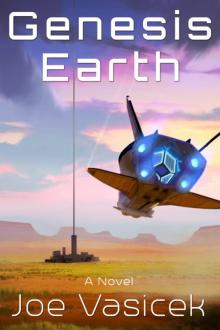
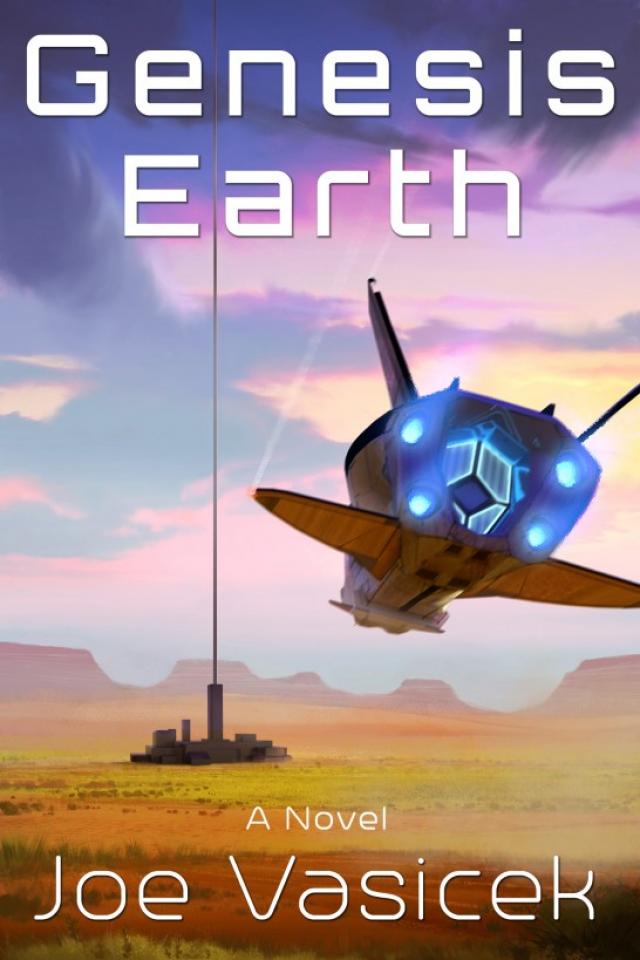
I accessed the computer and brought up images of the two known artificial structures in the 37 Geminorum system: the space elevator at Icaria, and the object in orbit around the fourth planet. The images were new, taken only hours earlier, and showed a greater depth of detail than any of the other pictures of the planet’s surface. The hairline tether of the space elevator stretched in a perfect line down to a system of gray bunkers on the surface, surrounded by splotches of green biomass set on a golden-brown background—probably grass. No cities or roads, no building or structures except for the complex at the base of the elevator. Nothing to show that humans had ever had anything to do with the structure.
I stared at the images for a long time. Were the space elevator and the ghost ship connected somehow? Who had built them? Who still operated them?
I glanced down at the image of my parents, then back up to the starmap with Sol labeled in bold letters. I narrowed my eyes. Maybe we wouldn’t be going there—maybe that mission was for somebody else—but that didn’t mean that our mission was unimportant. Your mission, Michael, is the pivot on which the future of humanity depends. Perhaps that was even truer now, if these two alien objects could give us any answers about the fate of humanity.
I returned to the images of the space elevator, only to find that something unusual near the surface caught my eye. I frowned and zoomed in. Recognition came slowly, but when it did, it sent chills up and down my spine.
“Oh wow.”
* * * * *
Our controlled deceleration began a short time later, right after Terra began her waking shift. We sat at our chairs on the bridge, strapped in tight. All of our notes, tools, papers, clothes, and personal belongings had been carefully stowed in their lockers, and the artificial gravity was turned off for the duration of the engine burn. Even though we had less than a minute to go, the weightlessness was enough to give me a jittery stomach.
“Beginning engine burn in ten, nine, eight…” Terra counted down.
The powerful engines engaged, and an invisible hand reached out from the stars in front of us, pushing me gently against my seat. Though we decelerated only a fraction of one Earth gravity, the force of it made me feel like I was lying on my back. The floor and ceiling seemed to be perfectly vertical, the rest of the ship a vast cavern underneath me. I let down my leg and arm rests to a slightly more horizontal level, and Terra did the same.
“How’s our trajectory looking?” I asked Terra.
“Perfect,” she said. “We should be locked in a capture orbit in only half an hour.”
I nodded. The triple crescents of Icaria and her moons were visible in the rear video feed. With each passing minute, they grew slowly larger. Immediately below them both shone the central sun of the system, bright and yellow, reminding me of Sol.
“How much longer before the object arrives?”
“Eight hours and fifteen minutes,” said Terra. She let out an anxious sigh. “I just wish it were over with already.”
I felt much the same way.
“Here,” I said, “while we’re here together, take a look at this.” I brought up an image of the surface of Icaria, one I’d taken just a couple of hours ago.
“What is it?” she asked.
“A high resolution image of the terrain immediately around the base of the space elevator on Icaria,” I said. “I made something of a breakthrough while you were sleeping.”
I’d been itching for a chance to show her my discovery, but maneuvers took precedence. Now that we’d begun our deceleration, I had the opportunity to break it to her.
She studied the image for a little while and frowned. “What are those things in the close up?”
“I don’t know,” I said, “but they don’t seem to be natural formations. In fact, I think they’re artificial.”
“Artificial?”
“Nothing high tech, of course. Primitive, pre-industrial structures—pre-urban, even. It was the white lines coming from them that tipped me off. Looks a lot like smoke, doesn’t it?”
“Smoke?” she said, turning her head to glance at me.
“Yeah,” I said. “But I haven’t seen any fire at all, which can mean one of two things: either there’s some kind of volcanic/geothermal activity going on, or the fire is controlled.”
“Controlled by what? Are you sure it’s not just natural?”
“It doesn’t match the geology of this area. There’s no volcanic activity for hundreds of miles, no major mountain ranges, no igneous rock structures, and so far as I can tell, the nearest edge of this continental plate is more than a thousand miles away. Nothing but desert, plains, and old, weathered mountains in every direction.”
“So what’s making the fire?”
“Intelligence,” I said, smiling. “I didn’t know what to think at first, but then I remembered some satellite images of Earth that I’d seen years ago. I was even able to find them in the database—let me show them to you.”
I brought up an image of a late 21st century satellite image taken over Kenya. Wavy lines of smoke drifted over circular tan structures clustered tightly together. The resemblance between those and the satellite images of Icaria was compelling.
“So what are the round domes?” Terra asked.
“Straw huts,” I said, reaching up to pull up an encyclopedia article on the screen. “Pre-industrial domiciles. Primitive, but definitely man-made.”
Terra frowned. “So you think those are people?”
“Some kind of intelligent life,” I said. “It may be human, it may be alien. I don’t know yet.”
“But how could people with such primitive technology construct a space elevator?”
“Good question. They probably didn’t. Since I can’t find any evidence of advanced cities or developed population centers, the builders of the elevator probably either left the planet or died off. But look at this.”
I uploaded several images I’d taken from other places around the planet. River valleys, coastal bays and inlets, rainy highland plateaus, and seasonal floodplains. In each of the images, small structures similar to the first ones stood in clusters.
“What is this?” Terra asked.
“Once I knew what I was looking for, finding more of them was easy. I checked all the places where primitive civilization was most likely to thrive—places capable of supporting large-scale agriculture. Sure enough, I found more settlements. Quite a few more, in fact.”
“Wow,” said Terra. “So there was intelligent life on this planet all along.”
“Primitive intelligence, but yes,” I said. “These cultures aren’t even advanced enough to build proper urban centers. My guess is that pottery and domestication are still relatively recent developments. I don’t even know if they’ve discovered writing yet.”
“What does this mean for us?”
“I don’t know—yet. The main question in my mind is whether these natives are indigenous to Icaria, or whether their evolutionary ancestors were transported here by the civilization that built the space elevator.”
“Maybe,” said Terra. “Or maybe they’re descended from human settlers.”
“Not likely,” I said, a little taken aback by Terra’s comment. “These natives are so primitive it took me a couple of weeks to even notice that they were there. Humanity wouldn’t fall behind that far—or if they did, they’d rebuild again within less than a thousand years. We’re too intelligent and advanced to return to the Stone Age for very long. If these natives were of human origin, I would have detected the signs of the civilization that they fell from—ruins, abandoned cities, etc. I didn’t find anything like that at all.”
“I don’t know,” said Terra. “Just thought I’d throw it out there.”
“Either way,” I continued, “we’ll have to make contact with these natives at some point. I’m no more of an anthropologist than you, but we’ll have to do our best, I suppose.”
She gave a short laugh. “Yeah,” she said. “The natives on the ground are primitive compared to us, and we’re utterly archaic compared to whatever’s piloting that alien ship out there.”
I nodded grimly. The two crescents of Icaria’s moons loomed larger in the rear video feed, as the engines continued to rumble through the walls of our ship.
* * * * *
A couple hours later, we arrived in orbit.
First we came around the night side, flying only a few hundred kilometers above the surface. With one of her moons already on the other side, the other a silvery crescent, the planet was as dark as a wormhole, a circle of darkness with light ringing the edge. The light on the circular horizon grew brighter, until the sun leaped out from the edge of the world. I covered my eyes with the back of my hand until it passed beyond our window.
When I opened my eyes again and looked down at the planet, I saw something completely unlike the black spot that had been there before. Bright blue oceans shone up at me through the crescent haze of a white-flecked atmosphere. Green lands and dark gray mountains punctuated the enclosed landscape. Through the pristine clearness of space, I saw mountains and oceans and tiny puffs of clouds drifting lazily above the ground, scattered randomly about like thousands of opaque white nebulae in a glass ball world.
This must be what Earth looks like, I realized. It looked almost exactly like the images I’d seen in my parents’ old photo album. The sight made me stare in reverence, temporarily forgetting the stress of the past few days. Staring at the Earthlike world, I felt as if I’d arrived at an ancient holy site after making a long and treacherous pilgrimage.
In some ways, perhaps I had.
“The space elevator is right ahead,” said Terra as the circle of the world below us gradually grew smaller. “We’ll be parked in geosynchronous orbit in about half an hour.” She paused. “Are you sure this is a good idea? We can still get out in time.”
“No,” I said. “We’re not going to run away.”
“I could park us on the other side of the planet—if you’re right, and the object does dock with the space elevator, we might be safer on the other side.”
Her voice was a little faster than usual, betraying the anxiety we both felt. Even though the Icarus’s computer was flying us, Terra gripped the flight stick as if we would die if she let go. With the tightness of her shirt revealing the smallness of her body, she seemed frail and vulnerable. I felt a sudden and unexpected urge to protect her, to stand between her and anything that threatened her.
Unfortunately, for the sake of our mission, I had to do just the opposite.
“Terra,” I said, “you know that it won’t make a difference where we park. If the object wants to shoot us down, it’ll do it no matter where we are. Better to park ourselves where we can observe without disturbing it.”
She didn’t say anything. Neither of us wanted to bring up the very real possibility that the object might interpret our presence itself as a sign of hostility—in which case, we were dead no matter what we did. I bit my lip and stared out the forward window, wishing I could be more reassuring.
Up ahead, I made out a large spherical structure dangling a line as delicate as a hair. It was the space elevator.
For all the awe and wonder I felt upon seeing the surface of Icaria up close with my own eyes, I felt it even more as I stared at that distant artificial structure. This was it—proof of an advanced starfaring culture more than fifty light-years from Earth. We’d studied hundreds of photos of this object before, but seeing it in person was something else entirely.
The chills running down my arms and back no longer felt invigorating. Here was something unnatural—something alien. Something dangerous. As the structure grew in our forward window with increasing speed, I felt as if I were falling towards it.
Slowly, gradually, details became visible. The dark metallic hull showed signs of protrusions that might have been windows, docking bays, storage tanks, and other basic structures. Those were mere guesses, however. Whatever they were, they were dark, silent, and completely dead.
The reverse thrusters engaged, and the acceleration made the falling sensation all that more vivid as the new gee forces pressed my body against the seat restraints.
As vertigo swirled around the edges of my vision, I felt Terra’s hand slip into mine—or had I taken hold of hers? I glanced over at Terra and saw her look up at me, through her short brown hair that had drifted across her face. She squeezed my hand and smiled. Fear and vulnerability were written in her eyes, but resoluteness as well. My heart started beating faster, and I smiled and squeezed back before turning again to the window. Neither of us let go.
The structure had taken up almost half of the forward window by now and was rapidly growing closer. Before long it filled our view, blotting out the stars. Hundreds of minute details stood out with the visual clarity that only exists in the vacuum of space.
The space elevator’s end station was shaped like a giant ring, with windows on the underside and along the massively thick spokes that ran to the center. The windows were all black, so I couldn’t see into them, but I could see a number of structures jutting laterally out of the edge of the disk that looked like docking bays. Hundreds of cylindrical containers attached to the ring, the edges rounded off, with markings that could have been alien writing. Beyond the station, a network of cables stretched several more kilometers to the counterweight, a surprisingly small black orb nearly hidden from our view.
Terra and I sat in silence, holding each others’ hands until the autopilot parked us less than a hundred meters underneath the central disk of the end station. Until that moment, we barely dared to breathe.
First Contact
“It’s started,” said Terra, just a few hours later. “The object is breaking orbit, just like you predicted.” Her voice sounded nervous and ragged around the edges.