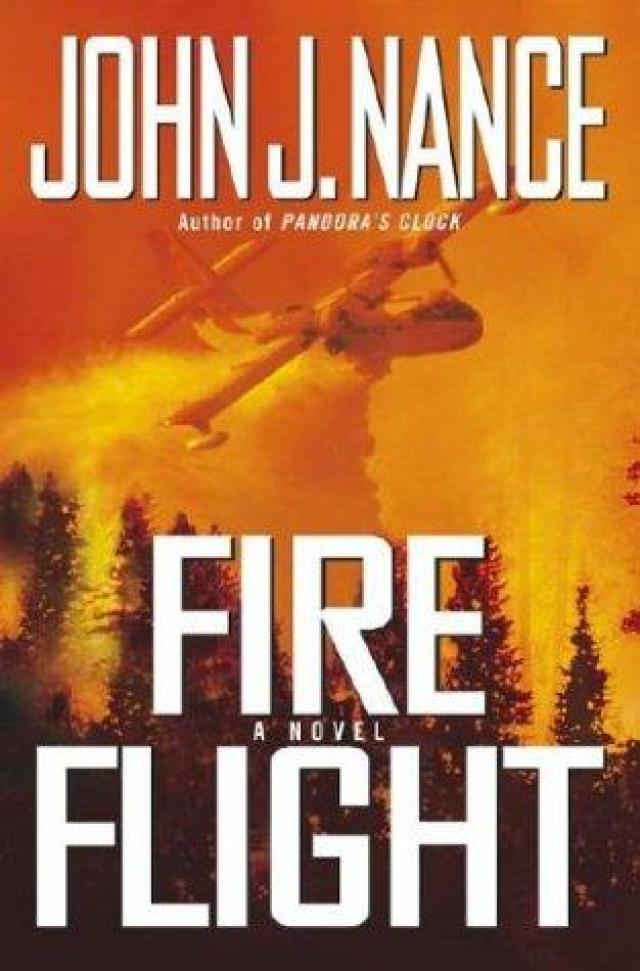
Fire flight 2003, p.5
Fire Flight (2003),
p.5


“Oh, God!” Karen gasped, rubbing her eyes. Jeff Maze. She remembered the last time she’d spent a great evening in the company of the almost legendary pilot. Jeff and Trent had always been great friends. It had been just a year ago.
She sighed heavily. “All right. I’ll be right there.”
But the line was already dead.
Chapter 3
FOREST SERVICE AVIATION OPERATIONS,
WEST YELLOWSTONE AIRPORT, MONTANA
News that Jeff Maze had gone down in Tanker 86 hadn’t reached Clark Maxwell in the air.
He left his DC-6 with the ground crew, expecting them to rush the loading of some twenty-five-hundred gallons of fire retardant at the same time as they filled the cavernous fuel tanks with the prescribed fuel load. But he’d hurried away before they could tell him the entire West Yellowstone airtanker force had just been grounded.
Clark checked his watch as he bypassed the so-called pilot standby shack and pushed through the door to the building that held the Operations Room. He was due to be airborne again in twenty minutes, and he glanced up expecting to see the usual kicked-over anthill of activity.
Instead, the room was quiet and somber and populated by a collection of ashen-faced people who looked up as if a ghost had just joined them.
What’s this? Clark thought, looking around until he caught the eye of Rich Lassiter, an old friend and the Air Operations boss. Clark had known Lassiter for fifteen years and seen the same haunted look on the retired Navy captain’s face too many times before when disaster had struck and they’d lost another pilot or crew. Clark moved quickly toward Rich, reading the scope of the disaster in the older man’s eyes. There was no mistaking the hunched shoulders and the grim expression. They’d lost one of their own.
“What happened?” Clark asked quietly. Uncharacteristically, Rich Lassiter placed a hand on his shoulder, and Clark listened in stunned disbelief to the headline version, his mind reeling as much over the fact that he’d been scheduled to fly that particular DC-6 a few hours before as over the possibility that Jeff and his copilot might really be dead.
“You’re sure…. I mean…”
“That they didn’t make it?”
“Yeah.”
“No, but the reports don’t hold out much hope. The wreckage is burning,” he said.
Clark shook his head, the imagined crash site vivid in his mind, intellect smothered by the raw emotion of unreasonable hope. There had been an eyewitness, Rich said, who’d sworn she’d seen a wing come off, and when such things happened with big airplanes, the fate of the occupants was inevitably sealed.
Nevertheless, hope always sued for an alternate ending.
“My God, Rich. How many more are we going to have?” Clark asked. Rich Lassiter started to answer, his voice catching, then shook his head and turned to attend to a ringing phone.
Clark recognized one of the Forest Service public affairs officers near the back of the crowded room, a validation of the seriousness of the moment. The man’s counterpart from the Park Service would be arriving as well, he thought, as would the well-meaning Critical Stress Debriefing Teams sent in to help counsel those who wanted to talk about it.
That would be all of us, Clark thought, equally convinced that every pilot in the shack would try to tough it out rather than risk appearing vulnerable by openly seeking counsel.
Rusty Davis suddenly materialized at Clark’s side, his face equally gray and grim. Rusty held up his hand to forestall Clark’s question. “One of the guys called me,” he explained. “What do we know?”
Clark repeated the basic details, his voice inadvertently accusatory, as if Rusty had somehow been complicit in the disaster. He’d felt the flash of anger slip past his reserve and regretted the tone instantly. But he was too distracted to apologize.
Three off-duty airtanker pilots were in the building, all of them equally grim, all of them friends of the downed crew.
Clark knew the routine in depressing detail. Even if they had a video of Maze’s wing coming off, there was a procedure to follow. They still had to ground all aviation operations from the aircraft’s home base and quickly test all the fuel supplies for contamination. That meant draining the fuel out of each aircraft, then reloading once they were given the green light. The frantic operation was already in progress on the ramp outside, deeply impacting the ability to support the firefighters east of Jackson Hole.
But far beyond the rote procedures, there was a collective chill affecting each of the pilots in the shack, a cold feeling of mechanical betrayal. Each of their old warhorse airplanes had supposedly been so thoroughly inspected following the disasters of 2002 that there could be no recurrence of wing loss—especially among the DC-6B fleet. And now…
Clark looked around to see Bill Deason approaching. The senior airtanker captain was now one of the grand old men of the profession, as well as a good friend, and it was painful to see the anguish in his eyes.
“Clark, I just…I just don’t believe this!” he was saying.
Clark nodded in sympathy. “I know it, Bill.”
Deason’s beloved, fifty-three-year-old PB4Y-2 was sitting in the dirt several hundred feet away next to the ramp, never to fly again after a Forest Service order in January permanently grounded all such aircraft for the very type of wing failure that had apparently killed Jeff Maze. Deprived of the airplane he’d named The Aging Mistress, Deason now flew an ex-Navy P-3 Orion with “10” on the tail, a turboprop machine far more powerful, modern, and safe—but anything but his favorite. The telltale indicator, according to his wife, Judy, was the fact that he’d yet to name the P-3. For years he had taken immense pride in nursing his old piston-powered bomber along, coaxing amazing feats of precision and endurance out of a ship few others could handle. Modern turboprops like the P-3 were easy to fly, Bill maintained. But ancient air vessels like the PB4Y-2 were like sailing ships or steam locomotives in their cantankerous complexity. Such ships were mastered only by men willing to learn their unique language.
Bill leaned wearily against the Ops counter, shaking his head.
“Has anyone told Misty? Someone’s got to take care of Misty.”
Chris Levine, who had been on the phone summoning reinforcements such as Karen Jones, shook his head sadly. “She’s on her way back from a funeral in Florida and due into Jackson Hole late this afternoon.”
“A funeral?” Deason asked.
“Her mother died last week. I’m trying to get someone to the Jackson airport to meet her when she arrives. This is going to devastate her.”
Deason held up a finger. “Chris, call my wife, Judy. She can make that run to Jackson Hole and get her. She’s at the hotel. No, wait, I’ll call her.” Deason grabbed one of the phones and punched in the number as he glanced at Clark. “I always expected that someday Misty was going to blow Jeff’s head off with a shotgun,” he said softly. “It was shabby the way he treated her, but…she’s completely in love with him.” Bill grimaced. “Was in love with him.”
Bill’s wife answered, and he turned away to speak in low tones about the unspeakable. Clark tried to turn his attention elsewhere, but Bill’s voice carried, and he knew that husband and wife were also dealing with the reality that it could just as easily be Misty Ryan arriving at Judy Deason’s door with news that she, too, had joined a long line of tanker widows who would get few benefits, little support, and no public recognition for their husbands’ sacrifices.
Clark had known Bill and Judy for fifteen years. The couple had been happily married for thirty-six, and Judy had followed Bill through his hardscrabble crop-dusting days, which were endless years of tears and toil and paltry profits from spraying fields with poison from airplanes while trying to stay out of the power lines. She’d raised three good kids while he was doing battle with gravity, and she’d quietly taken the hardships in stride while Bill flew as an airtanker pilot and became one of the lucky few to survive more than twenty seasons. They were both good, caring people, highly respected by all the pilots.
The whole community was filled with good, hardworking people, Clark thought. That was one of the attractions that had drawn him back into it, even after he’d sworn never to succumb again to the temptation to bomb burning trees with pink liquids. Part of the attraction was the unspoken camaraderie that bridged personal and professional disagreements among tanker pilots. But even though the FLOPPs didn’t think it manly to discuss, camaraderie was a distant second to the real narcotic of airtanker flying—the adrenaline high of dangerous aviating coupled with the instant satisfaction of seeing the fruits of your labor reflected in the trees below. That shared experience wove unspoken bonds among men who could be otherwise incredibly combative with one another, because together they shared a lofty secret: the knowledge that few mortals could do what they did and that, given the societal threat that massive forest fires posed, the risk was worth it.
For those who had never been in the military, some of that risk was shouldered as much for God and country as for the paychecks that could keep a pilot and his family fed all winter. Every year there was a war to fight, and, mercenaries or not, they were the heroes to fight it.
The brotherhood had been tested too many times with crashes and losses like this, Clark thought. Not that anyone would ever formally refer to airtankering in such warm, fuzzy, and collegial terms. But it was a brotherhood, with fewer than six hundred in the United States admitted to the inner circle of fire fighting as tanker, lead plane, jumpship, air attack, and helicopter pilots.
The standby shack, which was normally full of wisecracking competitors needling one another unmercifully about nearly everything, usually resembled some seedy civilian version of the SAC “molehole” flight-line alert facilities, which had been manned 24/7 for over forty years by the Air Force’s former Strategic Air Command. It was heartbreaking to see that kind of testosterone-soaked, lighthearted atmosphere turn funereal and grim.
Clark moved to one of the windows, letting the image of the DC-6 he was flying—Tanker 84—coalesce in his consciousness. As a DC-6, she was supposed to be far more sound than the lesser airplanes that had disintegrated in flight the previous summer. But the wings of aging airtankers took a terrible beating each time they hauled a fuselage full of slurry into that rough low-level environment. He trusted the DC-6, but now the shards of metal still smoldering in a forest forty miles distant were from a sister ship essentially identical to the one he was flying.
Or, he corrected himself, was about to go fly once again.
Worse, Jeff Maze’s airplane was the same one Clark would have been flying, and it had apparently come apart in flight, leaving the fuselage a ballistic projectile destined for catastrophic impact with the ground.
Clark watched the ground crew in the distance waiting for the signal to began refueling the tanks they’d just emptied. Once again they would unmercifully stress the wings and the engines and the airframe, bouncing through shudderingly severe drafts and pulling g’s.
So how strong were his wings?
He thought of Tanker 88 in the hangar, and shuddered uncharacteristically. Should he ground Tanker 84 and wait for Tanker 88 to be back in commission? But if he did, what guarantees did he have that Tanker 88 wasn’t going to be the next one to come apart? Undoubtedly the Forest Service—which moved far faster than the FAA—was probably moving that very minute to ground all the DC-6Bs, at least the ones in Jerry Stein’s fleet, regardless of the devastating effect that would have on Jerry’s finances.
But, Clark reminded himself, there was the not-so-insignificant problem of the growing forest fires east and northeast of Jackson Hole and the desperate need for every airtanker that could be coaxed into the air. He knew Jerry would already be on the phone hammering out an agreement with the Forest Service to let his crews go ahead and fly the DC-6Bs if the individual captains felt safe. Jerry Stein could make such a deal secure in the knowledge that none of his pilots would want to admit to being concerned and lose their paychecks in the process.
Might as well suck it up and pray for survival and hope whatever I fly has at least another week of structural integrity.
Clark recognized the self-delusion. It was a decisional acceptance one could never explain to a nonflying spouse or lover, and a direct kinship with the faith and fatalism that had permitted so many young men to climb into air machines in England during World War II, knowing their chances of returning as whole men were statistically slim.
With an almost trancelike surrealism, Clark Maxwell gathered the paperwork from the dispatch desk as his substitute copilot, Josh White, came in from the ramp and moved to his side.
“They’re waiting for the word to reload,” Josh explained.
“Yeah, I was watching.”
“And…I’m being replaced by your regular copilot.”
Clark nodded, forcing a smile. “Yeah, Rusty told me. I’ll miss you, Josh. You didn’t steal my flight lunch like Rusty always does.”
Josh White smiled self-consciously, the smile fading just as quickly as he glanced around the crowded room at the somber gathering. “One more thing, Clark. The mechanic I was talking to couldn’t find anything wrong with either engine three or four. He said we could be describing anything from an impending failure to our stomachs growling.”
“You think he’s right?”
He could see Josh weighing his reply as Rusty came up silently behind him.
“You told him it was a racheting sound, right?” Clark added.
“Yes, I did, and…the guy I was telling is an engine mechanic, and I think he’s right. He just doesn’t have enough information to troubleshoot.”
“Okay.”
“And…thanks for letting me fly with you,” Josh added, offering his hand, which Clark took.
“Good job, Josh. Just…work on not hesitating when you have something to say, or something that’s worrying you.”
“Okay. Thanks.”
When Josh had walked away, Rusty inclined his head toward the ramp and Clark followed, closing the standby shack door behind him.
“What’ve you got?” Clark asked.
“I thought you might want to know what Boise’s thinking,” Rusty said, referring to the National Interagency Coordination Center. “I just sat in on a teleconference.”
“What did Jim have to say?” Jim De Maio was a friend of Clark’s, and was recently appointed Forest Service assistant director of Fire and Aviation Operations.
Rusty shoved his hands deep in his pockets and looked off to the southeast, toward the unseen fires chewing at the carpeted mountains adjacent to Jackson Hole.
“Lynda was doing the briefing.”
“Gardner?” Clark asked, an eyebrow raised.
“Yes.”
Lynda Gardner was a former smokejumper and now the intelligence coordinator and briefer at the Boise center. He was surprised she’d be doing the debrief over De Maio, but it was more than that. She and Clark had a history, Rusty knew, although the most information he’d squeezed out of Clark over too many beers one evening held that the Clark and Lynda story was little more than a brief and torrid rebound affair. It had arisen, he maintained, from mutual failed relationships and the convenience of summer proximity. They hadn’t seen each other in years.
“Yeah, it was Lynda,” he teased, “and she was looking hot.”
“You could tell that on a telephone conference?”
“Okay, she sounded hot,” Rusty said, attempting to lift himself out of the depression of the moment with the kidding, and equally aware it wasn’t working. He sighed and continued. “She was basically telling De Maio and the others that the fire thirty miles due east of Jackson Hole airport—the Deer Creek fire—has the potential to jump the ridge and join a number of smaller fires, since the winds aren’t forecasted to let up for the next forty-eight hours at least. You know where Highway Twenty-six is?”
“Yeah, the main highway from the east into Jackson Hole and the park.”
“Right. She briefed that it could easily jump the highway west of Brecca Peak, and, if so, it had the potential to ignite Yellowstone. Only this time, if the fire starts, we could lose at least two towns and the east side of Teton Park.”
“That’s worst case?”
“Yeah, but a very real possibility, Clark. This is a really serious deal.”
“What do they have committed to fight it?”
“You ready for this? Total of eleven airtankers, three Skycranes, a mess of light helicopters, and two more P-3 Orions on the way from California.”
“Good grief! That’s a huge effort.”
“You can say that again! All of the tankers are coming here.”
“What? West Yellowstone can’t handle more than eight, tops. Not to mention the facilities—look at this room! We’re falling all over one another right now with six birds outside.”
“They’re bringing in additional loading tanks and crews, Clark. I guess they’re going to use Jerry’s ramp, too.”