

Live free or die second.., p.1
Live Free or Die, Second Edition,
p.1
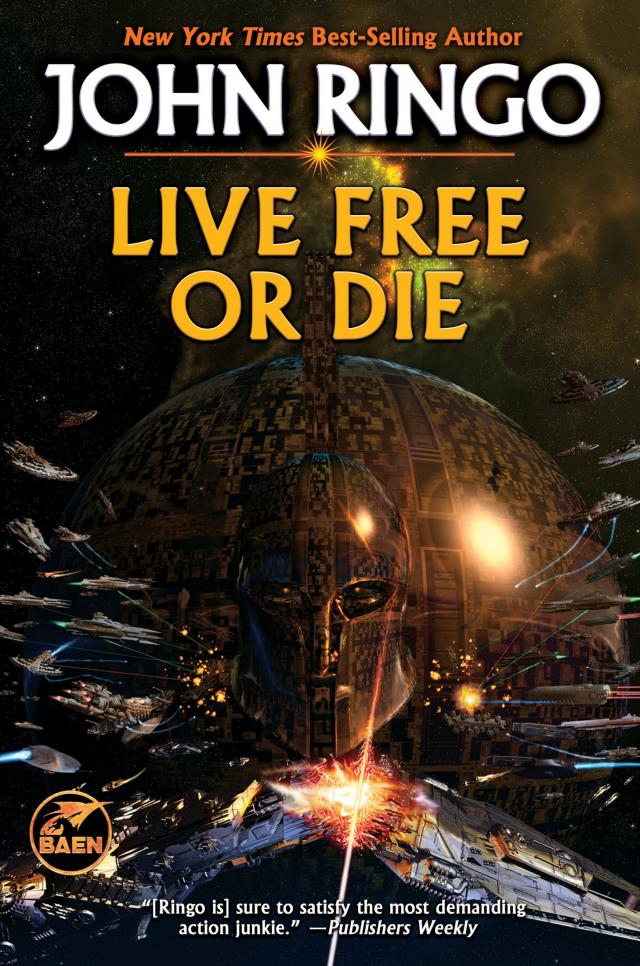


Table of Contents
ACKNOWLEDGEMENTS
FOREWORD BY HOWARD TAYLER
THE MAPLE SYRUP WAR PROLOGUE
ONE
TWO
THREE
FOUR
FIVE
SIX
SEVEN
SAPL ONE
TWO
THREE
FOUR
FIVE
SIX
SEVEN
EIGHT
NINE
TEN
ELEVEN
TROY RISING ONE
TWO
THREE
FOUR
FIVE
SIX
SEVEN
EIGHT
NINE
TEN
ELEVEN
EPILOGUE
AUTHOR’S AFTERWORD
AFTERWORD TO THE 2023 EDITION BY JAMES A. BEALL
LIVE FREE
OR DIE
SECOND EDITION
JOHN RINGO
Live Free or Die, Second Edition
John Ringo
WITH A NEW AFTERWORD BY JOHN RINGO
WILL THE PEOPLE OF EARTH BOW DOWN TO ALIEN OVERLORDS?
WILL THEY FIGHT BACK?
First Contact Was Friendly.
When aliens trundled a gate to other worlds into the Solar System, the world reacted with awe, hope, and fear. The first aliens to come through, the Glatun, turned out to be peaceful traders, and the world breathed a sigh of relief.
Who Controls the Orbitals, Controls the World.
When the Horvath came through, they announced their ownership of us by dropping rocks on three cities and gutting them. Since then, they’ve held Terra as their own personal fiefdom. With their control of the orbitals, there’s no way to win and Earth’s governments have accepted the status quo.
Live Free or Die.
To free the world from the grip of the Horvath is going to take an unlikely hero. A hero unwilling to back down to alien or human governments, unwilling to live in slavery, and with enough hubris, if not stature, to think he can win.
Fortunately, there’s Tyler Vernon. And he has bigger plans than just getting rid of the Horvath.
BAEN BOOKS by JOHN RINGO
TRANSDIMENSIONAL HUNTER (with Lydia Sherrer)
Into the Real • Through the Storm (forthcoming)
BLACK TIDE RISING
Under a Graveyard Sky • To Sail a Darkling Sea • Islands of Rage and Hope
Strands of Sorrow • The Valley of Shadows (with Mike Massa)
Black Tide Rising (ed. with Gary Poole) • Voices of the Fall (ed. with Gary Poole)
River of Night (with Mike Massa) • We Shall Rise (ed. with Gary Poole)
TROY RISING
Live Free or Die • Citadel • The Hot Gate
LEGACY OF THE ALDENATA
A Hymn Before Battle • Gust Front • When the Devil Dances
Hell’s Faire • The Hero (with Michael Z. Williamson)
Cally’s War (with Julie Cochrane) • Watch on the Rhine (with Tom Kratman)
Sister Time (with Julie Cochrane) • Yellow Eyes (with Tom Kratman)
Honor of the Clan (with Julie Cochrane) • Eye of the Storm
COUNCIL WARS
There Will Be Dragons • Emerald Sea • Against the Tide
East of the Sun, West of the Moon
INTO THE LOOKING GLASS
Into the Looking Glass • Vorpal Blade (with Travis S. Taylor)
Manxome Foe (with Travis S. Taylor) • Claws that Catch (with Travis S. Taylor)
EMPIRE OF MAN (with David Weber)
March Upcountry • March to the Sea • March to the Stars • We Few
SPECIAL CIRCUMSTANCES
Princess of Wands • Queen of Wands
PALADIN OF SHADOWS
Ghost • Kildar • Choosers of the Slain • Unto the Breach
A Deeper Blue • Tiger by the Tail (with Ryan Sear)
STANDALONE TITLES
The Last Centurion • Citizens (ed. with Brian M. Thomsen)
Live Free or Die, Second Edition
This is a work of fiction. All the characters and events portrayed in this book are fictional, and any resemblance to real people or incidents is purely coincidental.
Copyright © 2010 by John Ringo; afterword © 2023 by Jim Beall
All rights reserved, including the right to reproduce this book or portions thereof in any form.
A Baen Books Original
Baen Publishing Enterprises
P.O. Box 1403
Riverdale, NY 10471
www.baen.com
ISBN: 978-1-9821-9270-9
eISBN: 978-1-62579-921-0
Cover art by Kurt Miller
Second edition, July 2023
Distributed by Simon & Schuster
1230 Avenue of the Americas
New York, NY 10020
Library of Congress Control Number: 2009039759
Printed in the United States of America
10 9 8 7 6 5 4 3 2 1
Electronic version by Baen Books
www.baen.com
For Aunt Joan
May you find a cozy spot by the fire where the door never closes,
the owner runs credit, the taps never run dry
and the piano is always playing.
As always
For Captain Tamara Long, USAF
Born: 12 May 1979
Died: 23 March 2003, Afghanistan
You fly with the angels now.
ACKNOWLEDGEMENTS
The first acknowledgement is that this book is a total rip-off.
For many years I have been a fan of webcomics. Previous readers who have googled Bun-bun know of my affection for Sluggy Freelance.
Now look up Schlock Mercenary: www.schlockmercenary.com. Go ahead. I’ll wait.
For a looong time. Because Schlock has been peacefully (not) trundling along under the pen of one Howard Tayler, bon vivant and man about Salt Lake City, since June of 2000. And unlike some webcomics (and some authors who shall remain nameless), Howard has been able to stay on focus and deliver consistently amazing stories. Every. Single. Day. People talk about my output but I really don’t have a clue how he does it. It’s like voodoo. Sickness? Injury? Nothing has stopped Howard and I hope nothing does for a longer time. May he be given the gift of eternal life.
But while I like Schlock and Tagon’s Toughs, what really intrigued me as a writer was the first contact period which is only lightly touched upon. What would happen if an alien race suddenly trundled a gate to other worlds into our solar system? And Howard wasn’t perfectly clear what happened in the immediate aftermath. Instant “one-world”ness is, in my opinion, unlikely.
The next thing I love about Schlock: Back in the day in SF, people were willing to think grand. Since we’ve had problems with getting off this mud ball, writers seem to think that we have to think small. Howard (and I) disagree. Space is mind-bogglingly huge and vast and neat and scary and neat and huge. The main character in this book is a person who, possibly because of his stature, thinks “Cheops was insufficiently ambitious.” This is a book about grand vision. The hell with microsats. Give me vast fleets of roaring spaceships! Give me the vision to terraform worlds! Give me battles that make a human feel their tiny little cosmic insignificance and characters that shrug it off and go “Yeah, but we created these engines of war so who is really larger?”
And if I can’t get that in near-earth, near-term SF from anybody else, well, damnit, I’ll just have to write it myself!
The last thing that I love about Schlock is that Howard isn’t afraid to dive right into the science part of science fiction and dig hard. So you can expect a certain amount of science in this here science fiction. Get over it.
This is not a book for people who love the “other.” There are no “original” concepts of how otherworldly aliens would be. One of the nice things about Schlock is that aliens are just people. Not particularly good or bad, not particularly great or menial, not particularly otherworldly. Just people. As are Howard’s humans. They haven’t changed themselves into something unrecognizable. They’re just people doing their jobs. (In the case of Tagon’s Toughs, killing beings and breaking things for as much money as they can squeeze.) And in this book and the others that I hope follow, that’s what you’re going to get. People being people and aliens being not so much different.
Is this the prequel of Schlock? That’s up to Howard. With his permission, I’m sort of playing about in his universe. And loving every minute of it.
The second acknowledgement, very much as great as the first, is to the people who helped me with this novel. I believe, firmly, that if you’re going to write science fiction, you should get your science right. Don’t get me started on people who think they can write SF and don’t know basic chemistry, physics or astronomy. (M. Night Shyamalan comes to mind.) Alas, even my own knowledge of all three is limited. I am not, as Robert Heinlein was, an engineer. Nor an astrophysicist like David Brin.
Thus when I get big, crazy space ideas, I need help. Lots of help. In the Vorpal Blade books, that is ably supplied by Dr. Travis Taylor, Ph.D. Alas, Doc has a very busy day job currently and his own projects. In this case, I had to refer to others for assistance.
The most notable of the many people who gave input on this novel are assuredly Bullet Gibson and his lovely wife Belinda. Between the two of them they took a very rough manuscript and,
without any support but thanks, fixed not only the many problems of mass, volume and velocity but my (numerous) grammatical errors.
Any mistakes remain mine. But you should have seen what they had to work with!
Enough. Let the insanity begin.
FOREWORD BY HOWARD TAYLER
If you ask any two witnesses exactly how events unfolded at the scene of the crime, you are going to get two different stories. The less contact the witnesses have with each other prior to your questioning, the further divergent the stories get. Hair colors, car colors, even skin colors and names may change between their accounts.
The longer you wait to question these two following the event, the more their testimonies will begin to sound like tales spun around different characters in different universes.
In the Schlockiverse it has been a thousand years since the Gatekeepers barged in on Humanity and installed a new front door for Sol System. My own memory of that event is pretty fuzzy. Who am I to say that John doesn’t have it right? And if he got some of the hair colors, skin colors, or names (or species) mixed up, well…I’m pretty sure the tale is true in spirit.
It is often said that Truth is stranger than Fiction. This is not an aphorism. It is a formula. If this book isn’t the truth about how we go about carving the phrase “Humans were ARE here” on the great edifices of Galactic Society, it’s because Truth read John’s Fiction and said “Okay, I’ll have to do better.”
Of all the warriors of the world
Those of Troy were the most fell
They were those born of Winter.
THE MAPLE
SYRUP WAR
PROLOGUE
It is said that in science the greatest changes come about when some researcher says “Hmmm. That’s odd.” The same can be said for relationships: “That’s not my shade of lipstick…”—warfare: “That’s an odd dust cloud…” Etc.
But in this case, the subject is science. And relationships. And warfare.
And things that are just ginormously huge and hard to grasp because space is like that.
* * *
“Hmmm…That’s odd.”
“What?”
Chris Greenstein, in spite of his name, was a gangling, good-looking blond guy who most people mistook for a very pale surfer-dude. He’d found that he was great with the ladies right up until he opened his mouth. So his public persona was of tall, blond and dumb. As in mute. He had a master’s in aeronautical engineering and a Ph.D. in astrophysics. The first might have gotten him a really good paying job if he could just manage to get through corporate interviews without putting his foot in his mouth. The second generally boiled down to academia or “Do you want fries with that?” He had the same problem with academia he had with corporations.
Chris was the Third Shift Data Center Manager for Skywatch. Skywatch was an underfunded and overlooked collection of geeks, nerds and astronomy Ph.D.s who couldn’t otherwise find a job who dedicated themselves to the very important and very poorly understood job of searching the sky for stuff that could kill the world. The most dangerous were comets which, despite having the essential consistency of a slushee, moved very fast and were generally very big. And when a slushee that’s the size of Manhattan Island hits a planet going faster than anything mankind could create, it doesn’t just go bang. It turns into a fireball that is only different from a nuclear weapon in that it doesn’t release radiation. What it does release is plasma, huge piles of flying burning rock and hot gases. Over a continent. Then the world, or the biosphere at least, more or less gets the big blue screen of death, hits reset and starts all over again with some crocodiles and one or two burrowing animals.
One comet killed the dinosaurs. Most of the guys at Skywatch made not much more than minimum wage. It gives one pause.
The way that Skywatch looked for “stuff” was anything that was quick, cheap and easy. They had databases of all the really enormous amounts of stuff, comets, asteroids, bits, pieces, minor moons, rocks and just general debris, that filled the system. They would occasionally get a contact from someone who thought that they’d found the next apocalypse. Locate, identify, headed for Earth? yes/no? New? yes/no? Most of it was automatic. Most of it was done by other people: essentially anyone with a telescope, from a backyard enthusiast to the team that ran the Hubble was part of Skywatch. But thirty-five guys (including the two women) were paid (not much more than minimum wage) to sort and filter and essentially be the child of Omelas.
Chris was a nail biter. Most people who worked for Skywatch for any period of time developed some particular tic. They knew the odds of the “Big One” happening in their lifetime were way less than winning the lottery fifteen times in a row. Even a “Little Bang” was unlikely to occur anywhere that it mattered. A carbonaceous asteroid with a twenty-five megaton airburst yield like Tunguska was unlikely to occur over anything important. The world is seven-tenths ocean and even the land bits are surprisingly empty.
But living day in and day out with the certainty that the fate of the world is in your hands slowly wears. Most people stayed in the core of Skywatch for fewer than five years if for no other reason than the pay. Chris had started as a filter technician (“Yes, that’s an asteroid. It’s already categorized. Thank you…”) six years ago. He was way past his sell-by date and the blond had started going gray.
“It’s a streak. But it’s a really odd streak. The algorithm is saying it’s a flaw.”
The way that asteroids and comets are detected has to do with the way that stars are viewed. The more starlight that is collected the stronger the picture. In the old days this was done by having a photographic plate hooked up to a telescope that slowly tracked across the night sky picking up the tiny scatter of photons from the distant star. Computers only changed that in that they could resolve the image more precisely, fold, spindle and mutilate, and a CCD chip was used instead of a plate.
When you’re tracking on a star, if something moves across your view it creates a streak. Asteroids and comets are closer than stars and if they are moving across your angle of view they create such a streak. If they’re moving towards you it creates a small streak, across the view a large one. The angle of the Sun is important. So is the size of the object. Etc.
Serious researchers didn’t have time for streaks. But any streak could be important so they sent them to Skywatch where servers crunched the data on the streak and finally came up with whether it was an already identified streak, a new streak, a new streak that was “bad,” etc. In this case the servers were saying it was “odd.”
“Define odd,” Chris said, bringing up the data. Skywatch researchers rarely looked at images. What he saw was a mass of numbers that to the uninformed would look something like a really huge mass of indecipherable numbers. For Chris it instantly created a picture of the object in question. And the numbers were very odd. “Nevermind. Albedo of point seven three? Perfect circle? Diameter of ten point one-four-eight kilometers? Ring shaped? Velocity of…? That’s not a flaw, it’s a practical joke. Who’d it come from?”
“Max Planck. It’s from Calar Alto. That’s the problem. Germans…”
Calar Alto was a complex of several massive telescopes located in Andalusia in southern Spain and was a joint project of the Spanish and German governments. The German portion was the Max Planck Institute for Astronomy and despite its location, Max Planck did most of the work at Calar Alto.
“Famously don’t have a sense of humor,” Chris said. He looked at the angle and trajectory again and shrugged. The bad part of working for Skywatch was worrying about “The Big One.” The good part was that nothing was ever an immediate emergency. Anything spotted was probably going to take a long time to get to Earth. “Mark and categorize. It’s not on a track for Earth. Angle’s off, velocity is all wrong. Ask Calar to do another shot when they’ve got a free cycle. And we’d better keep an eye on it because with that velocity it’s going to shoot through the entire system in a couple of years and if it hits anything it’s going to be really cool.”


