In darkness waiting, p.13
In Darkness Waiting,
p.13
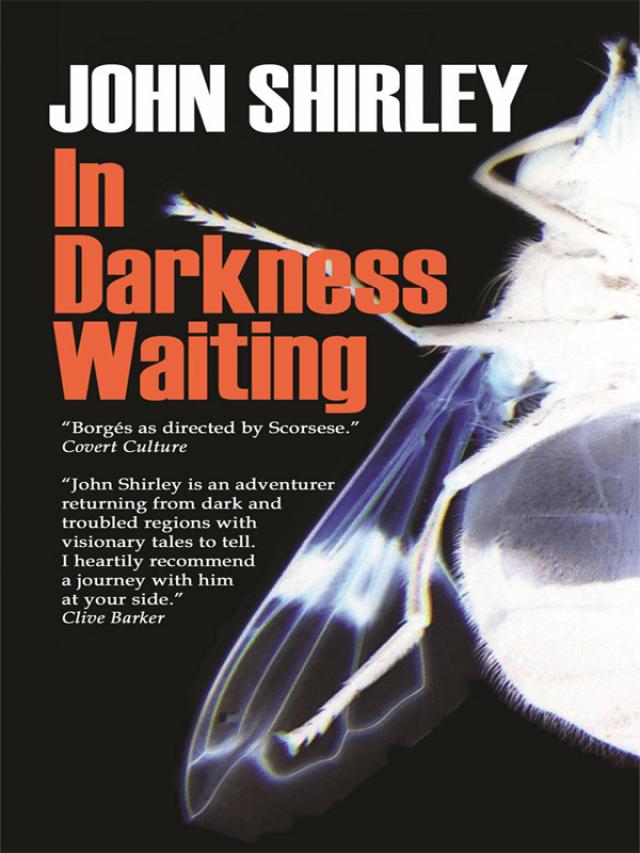


She stared at a fly, looping lazily around the light bulb.
“You going to tell me?”
She took a deep breath. And then she told him.
Aunt June’s conjecture on the nature of ESS “stops just short of the truth,” Rofocale said in his report. “Or perhaps several steps short.”
She had hypothesized the DNA-programmed glandular action that secretes mind-altering hormones. “But the production of the hormone and our initial reaction to it is just the early stage of the process. It sets the stage for the awakening of the Waiting Ones. The Gray Pilots. The first level of the process is a sort of ‘gear’ the brain shifts into for self-preservation. A low gear. The second level is, so to speak, the high gear. The second level, the preparation for the Gray Pilots, is only possible in certain people, unless they come into contact with a Breeder. And the Breeder infects them.”
“The Breeder? Some kind of microorganism?” Perry asked.
“No. Not a microorganism. It’s a man that doesn’t look like a man, much. A man within a man. So Rofocale maintained. In its external form, it rather resembles an oversized insect. When it’s inside a human being, preparing for ‘piloting’ him or her, it’s highly compact, composed of a subtle plasmalike stuff. Not blood plasma, but electrical plasma: ionized gas in a magnetic field. This intricate inner-patterned plasma acts as a nonmaterial outer body for the few material cells at the heart of it. It’s not something that would show up on an x-ray. Still, it’s a kind of tissue, an unusual kind of tissue. It’s highly permeable, and wispy, ethereal almost, till it’s time to externalize.
“To emerge for breeding … If you’re a Genetic Class Sub-B3, you have the potential to create a pilot that can become physically dense and organically self-sufficient. Once it’s developed that far, it emerges from the host body—rips free from the brain, and flies away, to seek ‘vessels for insemination’.
“They become flying insectlike things….”
“Hey, no, seriously, come on, he doesn’t really say that, does he?” Perry said, sitting up straight in his chair, almost laughing. “They, like, bust out of you and go cruising?”
Aunt June looked blank for a moment. Then she smiled, but it wasn’t a real smile. “Yeah. I know, it’s hallucinatory. He cites the legends of ‘fairies,’ little people with wings who do mischief, legends of people turning into flying dryads and elementals, certain Indian legends, some paintings in the old Babylonian temple of Ba’al. But—” She shrugged. “It’s about as believable as UFO contactees.”
“So what else does he say about these little buggers?”
“Very few of these hypothetical creatures develop to the point of breaking into Breeder mode. Or even to the point of influencing a person’s behavior.”
“When they do influence a person’s behavior, what do they do?”
“They utterly eliminate empathy, sympathy. They see to it that you identify with no one who is not immediately beneficial to you. And you’re ruthless even with those. And then it leads you to more thorough indoctrination. Paranoia, rages, vindictive sadism. Murder.”
“He claims all murders are caused by these inner creatures?”
“No. Only the utterly brutal ones. Only the incredible ones, the serial killings, the genocides, the slow pleasure killings. But before the point where these things are brought about, there first has to be an extended incubation in the Empathy Suppression hormone. Something we saturate ourselves with when we insist on taking certain attitudes. Then the Gray Pilot begins to grow inside certain people. Painlessly and undetectably.
“When the Gray Pilot begins to grow inside someone, it locks its own neurosystem into the brain.
“Rofocale expects people to believe in this, like, brain parasite?” Perry asked incredulously.
Aunt June shrugged. “He insists it’s not a parasite. He claims it gives more than it takes from the body. Remember, it’s a creation of the body. It’s the essence of certain kinds of human behavior. Sort of like the embodiment of self-interest, self-indulgence. It is the man or woman it inhabits. That man or woman deliberately—but unconsciously—grew the thing inside it. They set the stage for the takeover, but they’re being taken over only by themselves. By another, secret level of themselves.”
“You talk as if you take him seriously.”
“I …” She got up, took the teapot to the sink, filled it, returned to the stove, lit the gas with a wooden match.The gas went huh-whoof! into blue flame. She put some instant coffee in a cracked mug. “You want some coffee?”
“Naw.”
She watched the greasy teapot, waiting for it to begin its shrilling. Finally she muttered, “I don’t know. Maybe I believe him in a metaphorical sense. Something about it …”
Perry hugged himself and waited. The teapot began to whimper, then to whine, then to shriek. She snatched it from the stove so it made a sound like a small girl crying in dismay and sloshed hot water in her cup. She couldn’t find a clean spoon, so she used the handle of one rather than wash it. She sat down with her coffee, sipped it, grimaced, and said, “He says it twice: parasite is the wrong word. The thing, this insect inside … it’s the child, the demanding child who wants everything now, who cries and kicks when he can’t have it. The sadistic child who pulls the legs off ants and torments smaller children. In a sense, the true self. Or what Rofocale thinks it is.”
“What’s his evidence for this Breeder thing?”
Aunt June took another sip of her coffee, and then pushed it away. “He’s vague about that. He’s circumspect about a lot of stuff. There’s a photograph paperclipped to the last page, with no explanation. But, hell, it could be anything.”
She made no move to show it to Perry. But she didn’t stop him when he lifted the sheaf of papers and found the photo. It was the old black-and-white sort. “I didn’t know anyone used this kind of film anymore.” He looked at the picture and shrugged. It showed what looked like the corner of a ceiling. And there was a clump of something in the corner that might have been a motion-blurry image of a moth. But in relation to the lines of the wall, the thing was much too big to be a moth.
The image was murky. It might, indeed, be anything. It could be made of wool, some sort of stuffed animal hung in the shadows. But there was just the suggestion of a face, and Perry remembered the face pressed into the plastic over the window. “What, uh, what you going to tell Dawson about this?”
“I don’t know. I suppose the paper is about as useful as Confessions of an Opium Eater. Maybe Rofocale was on his own drug, if he’s been giving drugs to people, when he wrote it. I don’t know. I have to think about it.”
Perry yawned, and felt fatigue pull a gray wool blanket over his mind. “I can’t think about it anymore. This heat and the moisture, I’m so tired. I think I’m going to crash.”
“Me too. 1 guess I’ll lie down.” Aunt June had been sleeping on the couch. Perry didn’t ask her why she didn’t take Tetty’s old bed.
“So, is this kid Stiggins going to be at the sheriff’s office when we are, or not?” Perry asked, getting up.
“Dawson says he’ll be there, lawyer or no lawyer. ’Night.”
“Good night.” Perry went into the back-porch room, and sat on his cot, plucking idly at his mandolin. His mind wandered. He had a bad taste in his mind. It was the taste of many kinds of dull dread. He dreaded going to the sheriff’s office, dreaded talking about Tetty, dreaded living any longer with Sandra.
He felt a twinge of rebelliousness—and his mood was reflected by brisker strumming as he thought, Why should I stay here? Lois and I could go somewhere else. Portland, for a while.
Did Aunt June really need him? Not as a secretary, now. But he knew she needed him to be there for “moral support,” for comfort. She was scared too. And thinking this, his strumming became less strident, his chords softer.
But then—it wasn’t his fault he couldn’t stand Sandra. She was a pain in the ass. He’d like to see her tilted headfirst into a garbage can. He backed away from the thought. And as he recoiled from it, he knew that he’d recoiled from something more. There was a kind of hot-edged tightening in his mind, behind the anger at Sandra, behind the urge to desert Aunt June. It was like nothing he’d ever felt. It was dark, it was enticing, it was exciting and he didn’t know why. He’d thought angrily about people before, but never with that peculiar sensation halfway between mental and physical—that somehow made him want to think that way again. It had the character of a sexual fantasy. Forbidden—but thinking about it brought a surge of pleasure.
Perry made a habit of trying to understand himself. This, he didn’t understand. It was new. It had a weird quality of—of coming from outside. From outside himself.
Just an illusion, he told himself. It comes from your unconscious, and things in the unconscious sometimes seem like they’re outside you. So Aunt June had told him once. But what the hell—why not experiment?
He sat on the edge of his cot, his bare feet flat on the wooden floor, his back itchy with sweat. The overhead light was out; the only light came from the kitchen, dividing the porch room with a diagonal yellow slash. His feet were in the slash of light, the rest of him in the shadow. The glassless screen window on his left was silvered by moonlight. He let his mind drift again, then gently guided it into the avenues of his anger; his mandolin strumming went from folk to rock’n’roll. He visualized Sandra, sneering at him as Aunt June mentioned his rendezvous with Lois. She hadn’t said anything, but he somehow read in her expression: He’s banging some slut my house. The day after my daughter died here.
He realized, then, that he’d felt guilty about that since he’d seen the look on her face. What right did she have to make him feel guilty for finding affection and consolation in someone he loved? And before he could stop himself, he visualized Sandra at the stove again—only he saw himself behind her, pressing her face into a pan of boiling water.
He stopped strumming the mandolin. Christ, he thought, what’s wrong with me?
He’d never thought anything like that before. Never visualized it consciously … But he’d felt something horribly delicious when he’d imagined forcing her into the boiling water.
Once more, just to be sure. To try and get the source of it … He pictured a “sosh” he’d known in high school, three years before. A tall, brawny, flat-faced guy with eyes like chips of ice, immaculately cut longish brown hair, football jersey. Harminger, his name was. Harminger had had a gift for saying vicious things that seemed reasonably mild, on the surface. “Here comes the sensitive artist,” he would say when Perry came down the hall. And with that one phrase he’d made Perry sound like a limp-wristed, self-important wimp. It was all in his tone. Everyone had laughed … Now, Perry pictured Harminger working on that big flashy red Trans-Am of his, his head under the hood. Perry saw himself slam the hood on Harminger’s head, lock it down with wire. Harminger, alive, trapped with his head under the hood as Perry drove the car down the street into a brick wall. Perry forced the vision out of his mind. It took a major effort this time; it was like shouldering a man-high boulder to close a cave mouth, a cave that vomited verminous bats. He had to make a major mental effort to plug that dark cave.
Something was buzzing at the window. Perry looked, glimpsed an oval shadow against the silvered web of screen. It swooped up, out of sight.
A bird, he thought. But that buzzing sound. Gone, now. Silence. Even the crickets quiet.
Experimentally, watching the window, he pictured Harminger screaming under the hood, choking on gas fumes as the car picked up speed.
The buzzing resumed. The shadow returned to the window—something thumped against the screen, bouncing twice against it, then hovered, transparent, wings shimmering in the moonlight. He saw only a silhouette of its body.
“Aunt June—” But it came out only a whisper. And he thought: Oh, no, I called that thing. Picturing those ugly things, I called it to me. I know I did.
He didn’t know how he knew, but he was sure of it. It had heard him thinking. It had encouraged his line of thinking, transmitting the feelings of pleasure in return. It had encouraged him to prepare himself for it. To call it to him.
Stop picturing the things that attract it… But it was as if some floodgate had opened in his mind. He saw Harminger crushed against the wall, in slow motion the bumper crunching into the brick, Harminger’s blood spraying …
The buzzing at the window. Something clinging, now to the window. Stop thinking about Harminger. Stop dwelling on your anger. Stop—
But now he saw it in sharp focus: Ellen Bachelor, Harminger’s girlfriend. He’d always had the hots for her. Never mind that she had the IQ of a walnut, he’d always wanted her. Her with her strong, tanned thighs opening and closing as she did cheerleader jumping jacks at the games. Now he saw himself taking her, ripping her cheerleader’s uniform off in the backseat of Harminger’s car, as the front of the car steamed, dripping Harminger’s blood.
I’m not like this, Perry thought desperately.
Everyone is, said a soft, feminine voice in his head. Everyone, Perry. You don’t have to be ashamed. It’s your true self.
Every syllable rang in his head, soft though it seemed, and gave him a strange, whipping pain behind his temples. The thing clinging to the window screen was talking to him.
Leave me! Perry thought. I’m not sick, I’m not like that.
No, Perry, you’re not sick. You’re like everyone else. You’ve got some anger in you, all stored up, that has to come out.
No! I refuse it! Maybe everyone has it but there has to be a better way to deal with it!
No one would catch you, Perry.
He saw himself playing at a concert. Hundreds, thousands of people shouting his name, adoring him. But there, in the front row—Bob Potts. The guy who said he had no talent, way back in music class in the eighth trade. Here, at his concert, Potts was still mouthing it: “You’ve got no talent, Strandman.” So Perry signaled his bodyguards, who grabbed Potts, carried him onstage and beat him to a pulp while the audience roared approval.
It’s putting those things in my mind, he thought. Don’t think about it.
But now he saw Potts impaled on a microphone stand.
The thing on the screen ripped through.
It buzzed around his head, then hovered for a moment, just above, caught in the moonlight. It was translucent, gray mottled with black, vitreous-skinned. Like plastic bag material stretched over a frame. He could see its internal organs pumping mercurial blood in its veins. It looked like a man, in its face and arms, small black miniatures of human hands on all six legs. But the rest of it was insect. The man and insect parts were blended into a kind of hellish stylistic harmony. Its striated abdominal tail bristled with little hairs like shreds of fiberglass; it bent that tail toward him as it hovered, the motion forcing a stinger out, dripping, its lipless mouth opened. Perry.
It darted at him. He whirled aside, rolled onto the floor, feeling splinters dig into his forearms. He rolled onto his back. It hovered over him, darting back and forth every few seconds, like a wasp, looking for an opening.
Perry groped, his hand closed on something, and he threw it: a tennis shoe. The flying thing buzzed loudly, perhaps laughing, and the shoe was flung aside, as if it had hit an invisible wall. Perry tried to shout for help. His throat was frozen. He scrambled backward, to the wall, moving crablike. He reached up and switched on the light, hoping a sudden flash of light would frighten the thing away.
For one bright moment, the light burned; the room was lit golden with hope. And then the bulb shattered, broken by the buzzing, though the thing had flown nowhere near it, and darkness closed over the room.
But he could see the thing. It was clinging to the ceiling now, upside down, its head twisted backward on its neck so it could look unblinkingly down on him. He could see only its head clearly in the light from the kitchen. Then it was in the air again, the transition violently sudden; it flew through the kitchen door. He heard the buzzing. He heard a pop as the kitchen light shattered. The buzzing returned to the back porch, and now Perry was in a deeper darkness; there was a wan half-light, vaguely chrome, marking the left end of the cot, the window frame, the silhouettes of trees outside. I can’t see it, he thought. Where is it? He tried to shout for Aunt June, but he could only croak. He felt a wispy touch against the back of his neck, a breath of air against his cheek.
He screamed silently and flung himself aside, twisting and covering his head with his arms, hearing the buzzing, feeling something soggy banging at his arms. It was hitting him with something. It felt like BBs in a plastic sack, swung like a blackjack. It hit him on the cheek, hard enough to bruise. Hit him with something that wasn’t there. Instinctively, he took hold of the blanket with both hands, ripped it free of the cot, dragged it over his head. It was a thick army blanket; it might be thick enough to keep the thing’s stinger out. His heart banged; he had to force himself to breathe because his chest was tight with tension. Holding the blanket over his head and shoulders, he lurched to his feet, staggered toward the kitchen door. He felt blindly with his hands, found the door frame, floundered through. He slammed the door behind him, heard a squealing sound. He turned, throwing off the blanket, hoping to see a flying thing caught in the door. But there was only the door and the glass window set in the upper panel. He couldn’t see the thing. He forced himself to look through the glass. He saw it, a silhouette, hovering near the hole it had made in the screen, moving jerkily, angrily in the air.
As he watched, it passed out through the hole. It was gone. He was sure of it. Gone, for the moment.
Perry looked around at the dark kitchen. It was just a kitchen. He was numb, somehow. Not physically. But something in him, something had gone numb. And for the moment fear was locked in a refrigerator in a vacant lot, banging like a trapped child. Muffled.
Do something. Busy, keep busy.
Perry found the matches on the stove. Moving mechanically, breathing hard, he lit the top two burners of the gas stove. By the light of the stove burners, he found a dusty spare bulb in its cardboard carton atop the roundshouldered Frigidaire. After using a worn rubber dishwashing glove to take out the stub of the old bulb, he installed a new one and flicked the switch. He felt better, with the light back on. He peeled the glove off, threw it in the sink, and the blanket draped over his shoulders like a cape, he went to the cupboard where Sandra kept her liquor.