In darkness waiting, p.14
In Darkness Waiting,
p.14
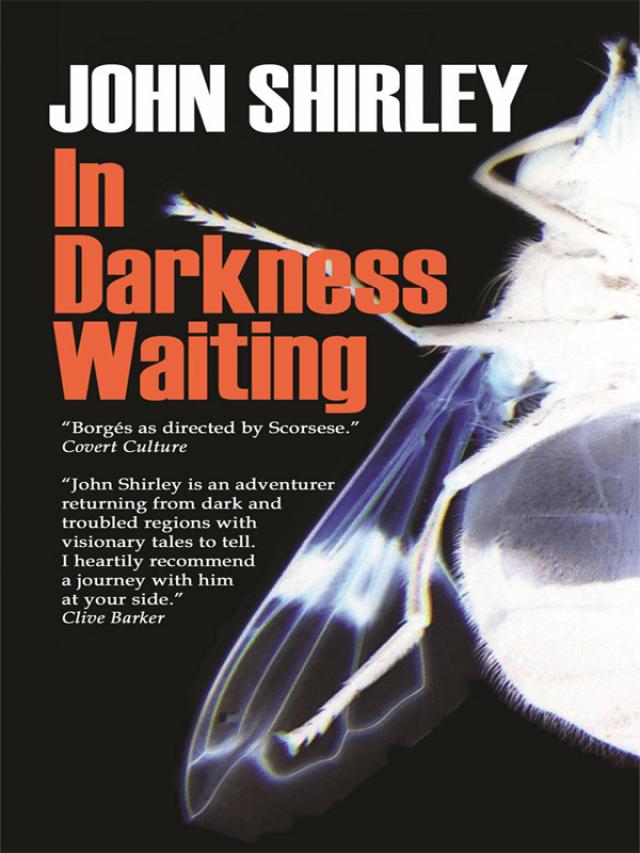


He didn’t realize how badly he’d been shaken until it came to him that he’d drunk three shots of straight gin, one after another, almost without noticing it.
He went to the bathroom, glancing uneasily at the dark square of the bathroom window, and looked at himself in the mirror.
There was a red-blue bruise on his right cheek. No dream did that, he thought. He turned sideways and, craning, looked at the back of his neck. It was unmarked. It hadn’t stung him. It had wanted to sting him on the back of his neck, he was sure of that somehow. That stinger—big as a barbed-wire spur—would have left a mark. He’d have felt that.
That meant it hadn’t achieved what it had come here for. It hadn’t finished with him. It had spoken to him. It had called him by name. By his first name. He looked at the window once more and wondered if he should rouse the house and try to convince them to board the windows over. He could just picture Sandra’s reaction. But the fly thing had said something about “we.” There were others. How many? Where were they now? He glanced at the opaque window. Were they clinging to the sill just outside that glass? Were they on the roof, discussing him with their lipless mouths? Were they crawling, swarming over the shingles, looking for another way in?
But they could break in whenever they wanted. So they were waiting for something. For the right moment. And when that moment came, they’d do to him what they’d done to Tetty. Or worse.
He shook his head and went into the living room; he was reeling, half drunk. He passed by the couch, looked at the slack face of his aunt, and tried to imagine telling her what had happened to him. It was unimaginable.
But—the fly thing might come back. He’d just have to stay awake, and on guard. He closed the kitchen door after him and rummaged in the cupboard. He made coffee and turned the radio on, softly. The announcer said it was twelve-thirty-two.
“Good morning,” the announcer said, and played a track. Perry listened to a lady country singer tell him sadly that her daddy had wasted his life working in a coal mine. Maybe he should go and wake Aunt June, and tell her what had happened. But he couldn’t. He told himself that the only reason he couldn’t tell her was that he needed time to decide how he’d put it so she wouldn’t think he was crazy.
He sat for hours at the kitchen table, alternating between gin and coffee, trying to think of a way to explain.
About three in the morning, the numbness melted away, and he began to feel deeply and overwhelmingly afraid. It hadn’t really hit him until now. Now, the fear came in crashing waves like the summer rainstorms. He felt as if he were about to be washed away in it, as if his sanity was going to melt like a sand castle in a rush of dark waters. “Oh, shit,” was all he said aloud. His hands balled into fists. He looked at the white, grease-streaked door of the gas oven. It was open just a crack, so he could see that it was dark inside it. He was, for a moment, utterly certain that if he opened that oven door, Tetty’s head would be inside, staring out at him, grinning, one eye missing; the mouth would creak open, and an enormous, rat-sized fly would crawl out on her lolling tongue.
He forced himself to stand, to go to the oven, to throw it open. Of course, it was empty.
He went back to the table, feeling no better. Because he knew that outside the kitchen window, on the strip of grass at the side of the house, Tetty was standing, one eye gouting blood, and something gray-black and brisling was crawling over her face, pausing to dip its proboscis into the bloody socket. All he had to do was go to the window, bend over the sink, look out through the glass.
He forced himself to do it. And of course, there was nothing out there. Nothing you could see.
Perry returned to stand by the table, one hand on it, jut looking around. He looked at the cabinet under the sink, (they could be in there, crawling on the pipe like oversized cockroaches, cockroaches who could call you by name); he looked at the refrigerator (anything could be in there); he looked at the kitchen door (they might be swarming over Aunt June as she slept, or they might have changed her already, and she would come out, and smile at him, and yawn, and offer him a piece of cake, and go to the drawer to get a knife to cut the cake, and then he’d realize that there wasn’t any cake, just as she’d turn and, still smiling, she’d drive the knife deep into his belly, twisting it, smiling, letting his intestines slop onto the floor, smiling, smiling).
Get a goddamn hold on yourself, Strandman, he thought. They like you scared. Don’t think about violence, or death. That attracts them. Like flies to shit. Careful, careful what you think about.
He had to shake off the paranoia, or go mad. Face the fear, then. Look it in the eye and laugh.
He went to the refrigerator and jerked it open. Nothing but a half stick of butter on a plastic dish, flecks of bread stuck to the butter; a couple of rubbery carrots, a quart of milk, the grimy yellow refrigerator light making a halo against the plastic at the back. That was all. Oh, the freezer. That too, pal. He reached up and opened the freezer door.
Tetty’s severed head was lying on its right ear, in the freezer’s coat of frost. Her jaws moved, her blue cheeks quivered; fresh blood oozed from the ripped eye. The head began to edge itself along the shelf toward him, using its jaw to pull itself.
He slammed the freezer door and backed away, mouthing, “Uh. Uh. Uh.”
He stood staring at the yellow-white refrigerator, rigid. Its motor started up, making a sound that, just then, was like mechanical laughter. Perry was afraid to look away from the refrigerator, afraid of what he might see somewhere else. Better not look at the window, the sink, the table. There might be anything.
And then he had a feeling he recognized: that sickly-sweet sensation in his nerves that had come when he’d found himself visualizing vengeance. He laughed, a laugh of nervous release. “Oh,” he said aloud. “I see. You’ve been putting things in my mind again.” He looked at the windows now.
“You hear me?” he asked softly. As if asking the night. “It’s because I know about you. Maybe you’re hoping I’ll flip out and get myself shot down by the local cops. No. No, I know what you’re doing. I know there’s a part of me that—that conspires with you. Like a part of my mind is a traitor, that wants to sneak out and open the gates, to break the siege, right? Forget it. I won’t let it happen.”
He went to the refrigerator. He gave it a vicious kick, only because it made him feel better. Then he reached out, opened the refrigerator door. His hand shook, just a little, as he stretched it out and opened the door to the freezer. The freezer was empty, except for a coat of blue-white ice, like a crystal cave. Rather pretty. He let out a long, relieved breath, closed the refrigerator, went to the stove. “I refuse to consider the possibility,” he muttered, making coffee, “that I am crazy. Stay out of my mind.”
He spent the next few hours sitting at the table, trying to think only about things that wouldn’t attract them.
He thought about Lois. He thought about music.
At dawn, he rose stiffly and went to tell Aunt June what had happened. But when she sat up on the couch, rubbing sleep dust from her eyes, looking old, rumpled in her nightgown, he couldn’t speak. He couldn’t tell her about the thing that had torn the screen and bruised his cheek and tried to sting him. The flying, smiling insect with small perfect human hands.
He wanted to say, It spoke to me, it called me by name. It wasn’t human, but it was. And it put ugly seeds in my mind and came buzzing around to change me when those ugly seeds grew into ugly flowers.
But he couldn’t say a word about it. His jaw locked when he tried.
Aunt June looked up at him with narrowed eyes when he struggled to speak. Something inside him was blocking his ability to speak about it. Something deeper than taboo. A kind of instinct. He shook his head dumbly when she asked, “There something you want to tell me, Perry?” He sat on the couch, his head cocked to one side, listening. Listening for the sound of its coming. Listening for the buzzing.
9
The Reverend Cyrus Martindale came to himself in the Grange Hall. Normally, the barnlike hall was used by ranchers for their agricultural club meetings; a big, echoing, dusty room with time-yellowed walls and exposed rafters. Martindale used it for a chapel, on Sundays.
Martindale stood on the foot-high stage at the far end from the door. He was leaning on the podium, gazing out over the empty room. He could see the diagonal floorboards in the patch of light given off by the fly-specked bulb above and behind him; he could just make out the folding, gray-painted metal chairs against the back wall, stacked three deep.
“So empty,” he said.
Every Sunday, the Grange Hall was turned over to Martindale. He would stand at the podium and preach his own peculiar mixture of theosophical occultism and Christianity. But he always emphasized the Christianity.
He leaned heavily on the podium. He was afraid that if he moved away from it, he might fall. He would fall into a spin like a World War I fighter plane, and he’d hit the floor and explode into flame.
Cyrus Martindale was stronger than Wendy Marsteller. So he was able to say to himself: “Something’s wrong.” He said it aloud. It sounded as if someone else had said it. He said it again, more loudly, so that it echoed a little. Wrong-ong-ong.
What was it that was wrong?
He realized: he couldn’t remember how he had come there, to the Grange Hall.
He had been sleeping, somewhere. And then he had awakened here. And why was the room going red?
It was like looking through dark red sunglasses. Through the red he saw the room the way it was on Sunday. Two rows of chairs set up, seven or eight to a row. Never more than twelve people in those chairs, usually two empty. At least two. He didn’t set up more chairs, though a church would normally have more, because it depressed him to see all the empty ones. Now, he could see his nine dependable church members. Mrs. Green, seventy-seven, and her friends Mrs. Goulter, seventy-six, and Miss Marmentia, eighty-one. And then the young set: Mr. and Mrs. Fairweather, in their sixties, old Dan Borrister, about sixty-seven, and two Indian women, in their fifties, who never spoke, and Lucy Angelino, about sixty.
“Old people,” he muttered. “Lonely, desperate, bored, attracted by the wrong thing. Why don’t the young come?”
But the youngest person he’d had in his congregation was Sandra Cummings. And she’d never come back.
Maybe he could have had some young people—if the regulars would bring their families. But they never brought anyone else. They made sheepish excuses when he asked them to. They were just parasites, really, leeching off him, soaking up a little reassurance from him because they were scared of dying and they could count on him to talk about life after death. Most of them probably had subscriptions to Fate magazine. They were sheep, really. And they all had one foot in the grave. He’d be doing them a favor, if he—“What?” His voice echoed from the rafters. What-at-at. “What was I thinking about? Jesus Lord.”
“What you were thinking about was only natural, Cyrus.” The man who had spoken was sitting in a chair a few feet in front of the podium. He hadn’t been there a moment before. Neither had his chair. But he was there now, in the shadow, just outside the little pool of rose-colored light. The shadow hid his face. He was in silhouette; and the silhouette showed something clinging to his shoulder. An insect big as a parrot.
“Why are you fighting yourself, Cyrus?” the man asked. His voice was soft, masculine, charismatic. “Fighting a perfectly natural desire to assert your anger. Your Self.”
Martindale felt nauseated, and weak. He felt as if he were hanging on the edge of a cliff, with the weight of his body and the gravity of the whole earth pulling him; he was hanging by his fingers alone and he was going to fall.
“I’m fighting it,” Martindale said thickly, “because it’s evil.”
“Evil is relative, Cyrus. Don’t you feel—tired? Weak? But if you stop fighting it, it will give you strength. You’ll have all the strength you need.”
“Who are you?” Martindale demanded.
“A part of you. The proprietor of your dark corners, Cyrus.”
“You’re not—not who I thought you were.”
“Beelzebub? The devil? Not exactly. But then again, yes. It depends on how you define these things. But I’m not the devil in the sense you mean. You know that, now; you’re a perceptive man and you could only keep kidding yourself so long.”
“I won’t do it: I won’t kill them.”
“Do you know what happens if you fight us to a standstill?”
“Why do you say ‘us?’ There’s a group of you, working together?”
“I ask you again: do you know what will happen if you keep fighting us?”
Martindale wanted a drink of water. His throat was so dry. It hurt when he swallowed. Why was everything red? “No,” he said, in a husky whisper. “I don’t know.”
“Simple: we kill you. From within. And you’ll be a father, of sorts—because something you made in you, almost like a child, is going to break out of you. Can you imagine how it will feel, the actual sensation, when your living brain smashes out through your eye, and flies away?”
“Uh.” Cyrus Martindale lost his hold. He clawed at the imaginary cliffside, then fell away, and went spinning down and down.
When he came to himself, the second time, he was at the payphone at the back of the Grange Hall. He’d taken his address book from his back pocket. He had two dimes, four nickels, three quarters in his pockets. He could call seven of them and ask them to come to the Grange for an emergency meeting. He put in two quarters, referred to his pocket address book, and dialed.
“Hello? Good morning, Mr. Fairweather. This is Reverend Martindale. I—really? Is it that early? Six-thirty? Sorry to wake you. But there’s an emergency. A great emergency. Please get your wife and come to the Grange Hall. It’s a matter of life and death.”
He hung up, and fumbled for another fifty cents. He felt better now. The redness had drained away. And everything was crystal clear.
Perry felt cold; cold and empty. But at the same time he seethed inside, with an insufferable tension.
He glanced at his watch, because checking the time made him feel more normal, more every day. It was 7:30 AM. He listened to the clop-clop of his footsteps on the sun-washed wooden sidewalk. Here and there, small green shoots poked between the boards, rustling at the canvas of his shoes as he passed.
It was odd, feeling so cold inside when it was so sunny out. The day was already hot, but it was a heat he didn’t feel. He passed a cafe; in the cafe’s gravel parking lot, against the white-painted concrete sidewalls, were two garbage cans brimming with food scraps; flies wove a mindless filigree in the air over the garbage. He could hear them buzzing. He wrenched his eyes away and walked faster, to get well past the flies. He pictured them coming at him, in a voracious cloud. But he walked on, and the world ignored him. Two grade-school boys rattled past on Stingray bicycles, hooting at one another. Neither glanced at Perry.
The sky was cloudless and the kind of perfect blue that looked almost painted, the blue of a child’s plastic toy. He walked across the asphalt parking lot of the Jasper Supermarket. The tarmac was patchy with gum wrappers and flattened beer cans. The store was well lit, but there was a wire padlock over the front doors’ handles.
The place was closed. He looked at the schedule. It would open at eight-thirty. Almost an hour. He shrugged. It was all the same to him. Aunt June had sent him for eggs, bacon, bread for toast. But he couldn’t eat eggs, or bacon, or toast that morning. He’d throw them up if he tried. He couldn’t eat—he wouldn’t—until he could tell Aunt June what had happened to him the night before. He’d tried three times. When he tried to talk about it, it was as if someone threw a switch in him, shutting off his voice box, paralyzing his fingers when he tried to write it down.
He wandered away from the supermarket—it was really too small to merit that name—and shuffled across to the sidewalk. He walked down the highway, gazing vaguely at the shallow stream of water in the ditch. A few cars passed; he looked up once to watch a pickup truck pulling a horse trailer as it rounded a corner, creaking. Two chestnut-brown mustangs champed uneasily in the blue trailer. They looked scarred and shaggy, had probably been caught wild on some nearby plateau and now they were being taken to the slaughterhouse to be sold for horsemeat. He watched the trailer, saw its turn lights flashing as the truck swung onto the dirt road at the edge of town.
He saw an old woman pruning bushes in her front yard and wanted to shout it at her. We’re all going to the slaughterhouse! But of course, he couldn’t say a word.
He shook his head and stuck his hands in his back pockets. He was strolling in sunlight, and everyone was out on their errands, and yet he was still on that back porch, in the dead of night, flailing at something that was somehow as much human as it was insect and as much insect as it was human.
He couldn’t get it out of his mind, and at the same time he couldn’t say a word about it. That was an awful feeling. That felt bad.
He looked wistfully at the telephone-booth, one of the town’s two payphones, in front of the Jasper Bar and Grill. But it was too early to call Lois. And it would be useless to even try to feel comfortable with her, until he could talk about what had happened.
It spoke to me, he thought. It knew my name.
Next door to the bar was a storefront that jutted from the lower story of a two-story house. Across the window, someone had painted, by hand, in deliberately uneven lettering, JASPER OLD WEST MUSEUM. The front door opened, jangling a small brass bell, and a hunched, whitehaired old man with a leathery face came out to sit on the wooden bench below the window. He squinted up at Perry, then down at his cigarette lighter, frowning when he saw it was almost empty. He lit a Camel, blew smoke at his Sears cowboy boots and said, “You like to see the museum, it’s open. One dollar.”