Lost roads, p.10
Lost Roads,
p.10
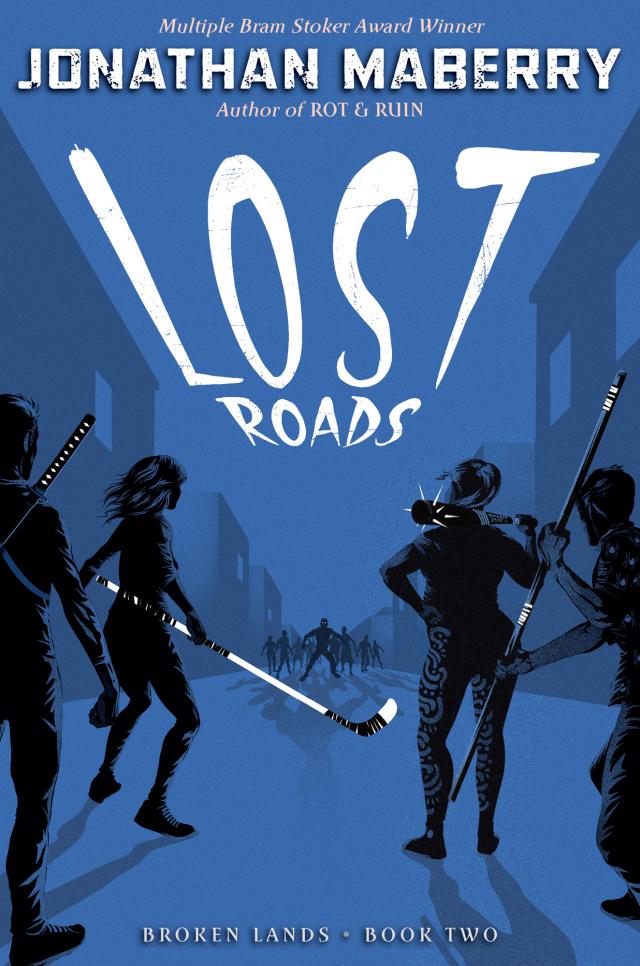


It was Nix and Benny who found her. Together with Benny’s older brother, Tom, they had destroyed Gameland. They took Lilah back to their town, where she met and fell in love with Chong.
However, neither revenge on her sister’s killer nor the love and support she found in Mountainside could bring Lilah all the way back from the remote places where her mind lived.
What Nix understood and Lilah probably knew subconsciously was that this love was built as much on fear of abandonment as it was on true affection. Maybe the Lost Girl believed that if she lost Chong, who else could ever love her as much or as freely?
As they drove, Nix’s mind wandered from Lilah to the troubles they were running from. Or was it toward? Her perspective seemed askew.
Nix thought about the name the people in New Alamo used instead of Rot and Ruin. The people here called it the Broken Lands. That almost made her laugh, because everything and everyone was broken in one way or another.
All the king’s horses and all the king’s men couldn’t put Humpty together again.
The rhyme jangled in her head like notes played on an out-of-tune piano.
Yeah, she thought. That’s all of us.
* * *
Lilah tapped her with an elbow, and Nix turned to follow her pointing finger. Ahead was a patch of smoke. Dark and oily, rising in a slow column into the blue sky.
Nix leaned close and yelled, “You think that’s the hidden base?”
“Has to be.”
“Don’t get too close,” Nix warned.
Lilah pointed with her spear. “Look, over there…”
A thousand yards from the smoking crater of what had been the base was a group of tattered figures. Lilah slowed and stopped so they could both study them through binoculars.
One corner of the exposed base was relatively undamaged, and several zoms milled around, pawing at flickering fire or curls of smoke. They all wore the burned tatters of military uniforms, and a few still had helmets and holstered sidearms.
“Are… are they zoms?” asked Lilah. “Or people from the base who managed to get out?”
Nix studied the figures. “I don’t know.…”
One of them must have seen her movement and raised his head. He stared at the two girls. She could see him peering through the haze. Then the zom did something Nix had never seen one of the dead do before: he used the flat of his palm to shade his eyes. Then the dead thing raised his other hand and pointed directly at them.
“He’s still alive—” Nix began, but then her mouth fell open in shocked silence.
The zom opened its mouth, not to moan with hunger but to utter an ear-splitting howl of inhuman hate.
And then it leaped like an ape onto the pile of debris and began climbing madly toward them. The girls flinched in horror and surprise. Lilah got to her feet and gripped her metal spear, while Nix backpedaled and whipped her sword free of its scabbard. The zombie climbed faster and faster, still howling—and now others joined it. They jumped onto the chunks of stone and pulled themselves up the twisted metal struts. First only a handful, but soon others came running out of the inner compound, out of what was left of the base. Ten more. A dozen. Twenty. More and more of the dead soldiers. They saw the figures on the edge of the crater, and the sight drove them to madness. They climbed over one another, kicking and snarling, howling with insane rage.
It wasn’t anything either of the girls had ever seen. It was wilder and yet somehow more dangerously focused even than the R3 zombie mutations they’d fought in Nevada the previous year. And it was stranger than the ravagers. This, they both knew, was some new mutation. Maybe it had been caused by the mix of all those chemicals and biological samples down in the base. Maybe it was something else entirely. All Nix and Lilah knew was that if those creatures got out of the pit, they were both going to die. Quickly and very badly.
This was a fight they could not win.
Lilah drove off as fast as she could. The wild zombies chased them. They were so whipped up into a frenzy that they slashed at the air with their fingernails, bit at the plume of dust behind the quad, and chased the girls for miles.
And miles.
And miles.
PART EIGHT THE ROAD TO ASHEVILLE
My first wish is to see this plague of mankind, war, banished from the earth.
—GEORGE WASHINGTON
32
MORGIE AND RIOT WERE MORE alert and nervous as they continued on their way—partly because the zebras had totally freaked them both out, and partly because everything seemed to be getting stranger. Wilder mutations in animals, insects, and plants. Strange clouds of chemicals that hung almost unmoving in the air. Rain that came in squalls and burned on their skin.
Morgie was jolted out of his troubled thoughts when he saw Riot, who was a quarter mile ahead, suddenly slow and pull over onto the shoulder of the highway. He stopped next to her. They were on the entrance to an overpass that crossed Texas 111. He turned off his engine and joined her over by the guardrail.
Below them, covering the whole of the road, was a gas station for big rigs, with huge white tank trucks and some scattered buildings. Everywhere, sprawled like broken dolls, were bodies. All around them, and splashed on every possible surface, was blood. Red and black. Human and zombie. Buzzards and crows pecked at the human corpses, and flies swarmed around the zoms. They could see small creatures—rats and lizards—scampering in and out. It was a frenzy of savage appetites.
“What happened here?” asked Morgie.
“Let’s go look,” Riot said.
Together they climbed down from the overpass toward the scene of the carnage. The birds, animals, and insects moved. The sluggish breeze toyed with torn strips of clothing. Everything else, though, was still.
Still as death, thought Morgie, appreciating the old simile for what it really meant.
They went all the way down and moved together through the mass of bodies, each of them angled to watch half the area, trusting the other to do the same.
Morgie’s sneakers crunched on shell casings, and he stooped to pick one up. Sniffed it and then handed it to Riot. She smelled it as well, and looked around with the critical eye of someone who has seen slaughter many, many times.
“How long ago?” asked Morgie. “Last night?”
“This morning,” said Riot. “Dawn or a little later. See? Some of them bigger pools of blood ain’t dried yet.”
Morgie straightened. “Seeing a lot of shell casings. Pistol, hunting rifle, and shotgun.”
Riot gave him a troubled nod. “How many living people, you reckon?”
“Has to be twenty or thirty,” Morgie said, looking around. It wasn’t always easy to tell regular corpses from those of freshly turned zoms.
“And at least three hundred zoms,” observed Riot. “I don’t see any guns.”
“Yeah,” said Morgie, frowning. “You think the people won and then grabbed all the guns before they left?”
“Maybe,” said Riot, but there was doubt in her voice.
“That soldier Benny talked to said something about the Night Army,” said Morgie. “Kind of wonder if this was them.”
Riot squatted down beside one of the dead humans. It was a woman of about thirty, with brown skin and a head cloth stained with blood. Riot gingerly lifted one of the woman’s hands, fighting the stiffness of rigor mortis. The arm only bent slightly, so she leaned close to peer at it, then indicated that Morgie should take a look. He knelt and saw a lot of dark specks against her skin.
“Powder burns,” Riot said. “She was firing a gun. Look at all the shell casings around her. She died hard.”
They moved among the dead, seeing more evidence of the fight and what had killed each of these people. Head or spine trauma in every case. Any who’d died in other ways would have turned to zoms long before now. But there was something strange about some of the corpses.
“Hey,” said Morgie, pointing to the face of a short, heavy Asian man. “Look at his face.”
“It’s a burn,” said Riot. “So what? Could have been from that rain.”
“I don’t think so,” he said. “We both got soaked. It hurt and all, but it didn’t do this to us.” He pointed to a white woman wearing camo pants and a T-shirt with similar burns on her face, neck, and upper arms. “See? And that woman over there? Same burns. And this big guy right here.”
“Yeah, I see.”
“You know what I’m not seeing? Burns like that on any of the zoms. Not the ones that look like they zommed out a long time ago.”
“You’re right,” said Riot. “It’s only on people who look like they died in this fight.”
They moved through the battlefield again, this time looking for the same kinds of burns, and finding them on nearly every person. Some extensive, and others only a little.
“Doesn’t look like the burns happened during the fight, though,” said Morgie. “Nobody’s clothes are singed.”
“Whatever it is,” said Riot, backing away, “I don’t like it. Let’s get the heck out of here.”
33
THEY REACHED THE TOWN OF Schulenburg that night and slept safely but uneasily in the storeroom of the Potter Country Store. They’d hoped to find some old, packaged food that hadn’t been looted, but the store looked to have been stripped down to bare shelves and floorboards. They pushed empty refrigerated-food cases in front of the doors, ate a meal of cold rabbit Riot had killed and smoked days before, and sat up late, both of them unable to sleep.
Morgie didn’t start any conversation but willed Riot to say something. After two hours of silence, she said, “Ain’t a soul in this town. Not one.”
“I know.”
“You got any theories on that?”
Morgie shrugged, then realized she couldn’t see that in the utter darkness of the locked office. “They didn’t all wander off,” he said. “Sign outside town said the population before the plague was over twenty-eight hundred. Some of them would have been living people who got out. Some would have zommed out and gone wandering off. But there should still be a bunch here, roaming around town or just standing and waiting. You thinking ravagers, maybe?”
Riot frowned. “Maybe. Or disease. Or it could have been reapers. We—I mean, they had strike teams this far east.”
Something occurred to Morgie. “You know, these ravager guys seem to be doing just about the same thing the reapers did. You think there’s some kind of connection?”
Riot thought about it. “I… don’t really know. Saint John and my mom had a lot of plots going on. They had scouts everywhere. Who knows what they were cooking up?”
“Yeah,” said Morgie, “but Night Army and Night Church… ? Two big armies using zoms as shock troops? Come on…”
Riot stared at him for a while, then shivered and looked away.
Eventually they fell asleep. In Morgie’s dreams the zoms had somehow shrunk down to the size of ants, and in the middle of the night they crept in through his ears and nostrils and open mouth. Once there, they began eating him from the inside out. He could feel the thousands of tiny mouths biting him, tearing at his veins and muscle tissue and tendons. And he could feel the infection of their bites flooding through his blood, polluting him, killing him without the mercy of permanent death.
He woke in absolute darkness, slapping at his skin with furious hands, gasping and on the very edge of screaming. Then he realized it was a dream and shoved a fist into his mouth to stifle the shriek.
Morgie sat there, quivering, sweating, telling himself that it was only a dream. Even though it felt like something far more real.
34
“LET’S GET OUT OF HERE,” muttered Riot as they finished packing the next morning. “This whole place gives me the heebie-jeebies. I’d be right happy to lose this town in my rearview.”
“Yeah,” Morgie agreed as he bent to pick up his gear. He suddenly turned aside as a massive belch erupted from his stomach. It seemed to come out of nowhere, and was so big it actually hurt. “Oh jeez… I’m so sorry…”
Riot laughed. “Wow. They could probably hear that all the way back home.”
Morgie mumbled more apologies as his face flushed with embarrassment.
Suddenly he belched again. Only this time he felt his breakfast rush up hot and acidic from his belly. He threw up behind the fender of a rusted car.
“Damn, boy,” said Riot. “You dying on me here?”
Morgie sagged against the car, his face greasy with sweat.
“Whoa… hey, now…,” Riot said in a voice suddenly punctuated with concern. “Are you sick or something?”
He pulled a handkerchief from his pocket and mopped his face. “I… I don’t know. Stomach’s suddenly all messed up.”
She came over and took him by the arm. “You need to sit down?”
Morgie thought about it, then slowly shook his head. “No. It’s okay. It’s passing, I think…”
“You look like death only slightly warmed over.”
“Gee, thanks.” He belched again, though not as dramatically this time. “Must be something I ate.”
They had both eaten exactly the same things, but Riot did not comment on it. Two deep vertical lines were etched between her brows.
“We can stay here for a bit, Morg. Hang out and then start fresh tomorrow.”
“No.” He began to walk toward his bike, his legs feeling like they were made of overcooked macaroni. “Let’s get out of here. We need to get to Asheville.”
Riot watched him walk to the quad. He didn’t fall, but he didn’t look all that stable. When he sat, he thumped down hard into the saddle.
“Morgie…,” she began, but he waved her off and started the engine.
“Fine, then,” she said under her breath.
They drove away, but the uneasy feelings did not fade with the town of Schulenburg. They passed through La Grange and got all the way to Denverado without seeing a single living person. They saw a few wandering zoms, but only a few. There were other places where it was clear a fight had taken place—each spot littered with those dead whose head or spine injuries either ended their undead lives or prevented them from reanimating. They found more of the strange burns on them.
In each massacre site there was plenty of ejected brass or spent shotgun shell casings, but no guns.
“How many ravagers can there be?” asked Morgie. “I mean… they can’t seriously be taking all those guns for the zoms to use, can they?”
“God, I hope not,” said Riot, looking very scared. Then she turned to Morgie and frowned. “You sure you’re okay?”
Morgie dragged a forearm across his brow and looked at the glistening sweat.
“It’s just the heat,” he said. “I’m fine.”
“You sure?”
“Yeah. Totally.”
A few miles past the scene of another fight Morgie had to pull sharply off the road. He grabbed a roll of toilet paper from his pack and went scampering off behind a wrecked dump truck.
PART NINE NEW ALAMO
I do not know with what weapons World War III will be fought, but World War IV will be fought with sticks and stones.
—ANONYMOUS
35
THE WINDOW GLASS EXPLODED INTO a storm of glittering knives. Joe Ledger hooked an arm around Gutsy and yanked her down as death filled the air above them. Gutsy felt some of the shards slice her vest and jeans, and there were tiny detonations of heat, telling her she’d been cut. No way to tell how much or how bad. And no time to care, as a pack of screaming people came pouring into the car wash.
“Kid—get back! Get into the tunnel,” cried Ledger as he shoved Gutsy away. “Grimm—hit, hit, hit!”
The massive dog uttered a ferocious growl and plowed into the attackers, slashing at them with the spikes that jutted from his heavy armor. Sombra, however, held his ground, growling but clearly too terrified to attack these strange creatures.
The attackers were not shamblers. They wore military uniforms or white lab coats, and a few had on the bland coveralls of janitors. She knew at once that these were the same kind of killers who’d attacked the school. Their faces were twisted into masks of total madness. They were faster and even more wild than ravagers, some carrying weapons like knives, scissors, tree branches, and rocks. One had a chopper torn from a paper cutter, which he brandished like a sword. They screamed terrible, prolonged wails of bottomless hate as they boiled through the shattered windows like cockroaches exposed to sudden light and attacked with a level of mania Gutsy had never seen.
Grimm tore apart the first wave of them, but many more were fighting their way past the razor-sharp teeth of glass still stuck in the window frame. Gutsy scrambled to her feet as Ledger rose to one knee, his big automatic in his hands as he fired and fired. Thunder boomed in the confines of the car wash, and every bullet the soldier fired hit a target, there were so many of these mad killers. Some fell, crippled and bleeding dark red blood, but even they tried to crawl forward to kill.
Gutsy had a machete strapped to her hip that she’d gotten from the general store. The crowbar had been useful, but it was heavy and slow, and she’d always preferred the wide-bladed knife. But as she pulled it free, the weapon felt suddenly inadequate. There were so many of them, and it felt like trying to stop a hurricane with an umbrella. She backed away, edging toward the big double doors to the underground corridor.
The slide locked back on Ledger’s pistol, and he reached for a fresh magazine, swapping it in place while backpedaling. Grimm, superbly trained, turned and attacked the infected who tried to take advantage of the brief pause. The new magazine in place, the slide snapped into position, and soon Ledger was firing again. The display of marksmanship was impressive, but Gutsy saw with horror that there were no additional magazines on the captain’s belt. Ten of the attackers lay dead and five others were wounded, but there had to be twenty or more still crowding in.