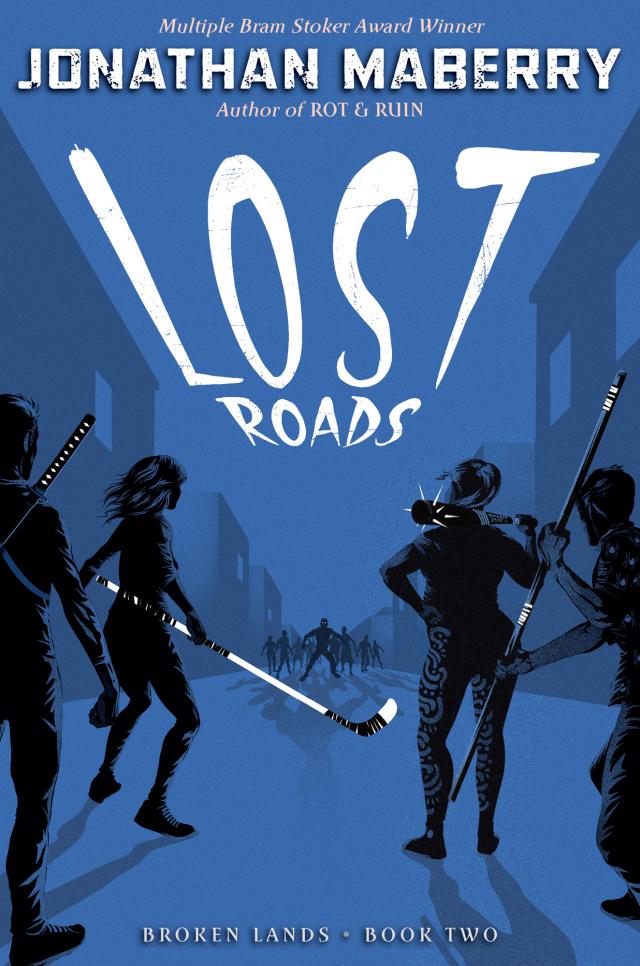
Lost roads, p.7
Lost Roads,
p.7


Morgie circled, glancing back to make sure the three fast zebras were still following only him. One of them was lagging behind, stumbling a bit, and he figured it must have injured itself during the collision.
“Come on,” growled Morgie as he shot out into the open field again with the animals in thundering pursuit, and turned in another wide circle, praying that the creatures couldn’t learn from their mistakes. He cut the wheel again, fought for balance, and shot forward, bisecting his own arc. The sudden turn caused another collision, and he grinned as they tumbled over one another while he drove back into the parking lot.
Morgie hit the brakes, sending the quad into a skidding, sliding, screaming sideways turn just inside the opening in the fence. He leaped from the quad, tore his bokken free, and grabbed the sun-heated metal of the gate’s upright pole. The dead zebras screamed at him and charged as Morgie threw his bulk against the wheeled gate. The old metal, pitted with rust and disuse, also shrieked. The single wheel on which the gate rested creaked like door hinges on a haunted house. But it began to move. He nearly had it closed when he ran out of time.
Morgie whirled and brought his bokken up in a two-handed grip. It was a sturdy piece of polished oak. Twenty-eight inches long, heavy and powerful. As the first zebra jumped at him, trying to smash him down with cracked hooves, Morgie threw himself sideways, twisted as he fell, rolled, and was back on his feet in a second, pivoting, raising his wooden sword, stepping in to put mass behind the blow. And he struck.
The bokken hit the zebra just below the knee of its left foreleg, and the cannon bone exploded inside the dead flesh, sending a reciprocal shock through the weapon and into Morgie’s hands. He gritted his teeth as he ducked the biting mouth and swung again, aiming for the other leg. The movement changed the angle of his swing, and the sword instead crunched into the long pastern bone. Again there was a big, wet crack, and, as Morgie backpedaled, the zebra’s legs buckled and the thing went down.
Morgie had no time for a killing blow, though, because there were still two other zebras approaching. He ran around the quad, making the first zebra turn sharply to follow, and then put a foot onto the saddle of the machine and leaped over it, slashing down with all his force. The bokken hit the zebra behind the ear, high near the spine, and the animal staggered. As Morgie landed, he instantly pivoted and struck above the knee of the left foreleg. The animal fell.
Now there were two crippled zoms on the ground, screaming with hate and hunger. The third limped forward with increasing fury. A sound of thunder made Morgie wheel, and he saw that the rest of the herd was rushing toward the small gap left between gate and fence. If they hit it, their weight would slide the gate open again.
He ran for it, dropping his sword, grabbing the gate pole, and shoving. The thing did not want to close—as if it enjoyed taunting him with only a lie of safety—but Morgie Mitchell was very strong and very scared. He forced the gate to clang shut, and then he dropped the security cuff in place a split second before the herd hit the chain-link wall.
The whole length of the fence bowed inward, and every scrap of metal it was made of screeched in protest.
But then the animals rebounded, falling, collapsing, howling in frustrated fury.
Morgie dove for his bokken and came up with it just as the limping zebra lunged forward to bite him. He bashed the thing’s head to one side, kicked the closest leg, and then brought the weapon up and down in a series of crashing, crushing, splintering blows.
It collapsed and lay silent.
Morgie staggered over to the others and silenced them.
Then he stumbled backward and sat down hard on the ground by his quad, his bokken falling with a clatter to the asphalt. He dragged a forearm across his face to wipe sweat from his eyes, and when he looked at his hand he was not surprised to see that it shook badly.
He was vaguely aware of the roar of Riot’s machine getting closer. She slowed to a stop five feet away but didn’t dismount. Instead she looked from Morgie to the dead creatures to the frustrated herd outside. And back again.
“Well,” she said very softly, “glory be. Ain’t you something?”
Morgie smiled, nodded, and then turned away to vomit onto the ground.
Interlude Two Brother Mercy
SIX YEARS AGO
AUTUMN WAS BURNING OFF, AND a stiff wind proclaimed winter’s advent with frosty insistence. Leaves skittered past the wiry saint and the lean, wolfish boy.
“Honored one,” said Brother Mercy, “tell me about god.”
The question pleased the older man, but they walked a dozen paces before he made a reply. Saint John laid his palm flat over the angel wings on his chest. “Our god is the only true god. He is Lord Thanatos—all praise his darkness—who was the son of Nyx, goddess of the night, and Erebus, god of darkness. Although they were his parents, he grew in power and was soon more powerful than them and all other gods. He rules all of time and space.”
The saint paused as a hawk screamed in the air far above them. They both stared up but did not see the bird.
“There have been some people,” continued the saint, “who heard the song of our god in the whispering shadows and in prophetic dreams. Long before the gray people were blessed with endless life, these prophets took up their knives and opened red mouths in the unholy. They were reviled, hunted, imprisoned, even executed. Called madmen and serial killers, but those were the words of sinners who did not understand. I was one such man.”
“You… ?”
“Oh yes.” Saint John sighed and shook his head. “Prophets are never understood or accepted in their own countries. They chained me, beat me, and sentenced me to death.” He smiled now. “As if death was a punishment.”
They both laughed at that. A squirrel squatted on a tree branch, munching an acorn, watching as the two men in black strolled past.
“God was always moving in our lives, though,” said the saint. “My first proof of this was that the sinners put me into a cell with another prophet. A greater one. A man of perfect vision and extraordinary power.”
“What happened to him?”
“When that time comes, I will take you to meet him. My heart tells me that you and he will have much great work to do together.” He paused. “We will speak more of him another time. For now, just know that I spent much time with him before I was sent to another kind of prison, and escaped from it just as the gray people awoke and the glory of god’s plan filled my mind. I strolled through burning cities, reveling in the beauty of the new age that was dawning. God led me to a church of a failed faith, and there, hidden behind the altar, I found Mother Rose and twenty-seven angels.”
Brother Mercy already knew this part from the daily religion classes all reapers had to attend. A favorite story was about how Saint John discovered a group of orphaned children who’d fled from a gang of sinners of the worst kind. A woman named Rose was running from the same savages, and they caught her outside of the church. Saint John intervened on her behalf, sending the men into the darkness. Together, he and Mother Rose, along with those children, founded the Night Church. Brother Peter, the strongest of the little angels, became the first reaper. Brother Mercy loved Peter as the truest hero of the faith.
“It is the beauty of our religion,” said the saint, “that with the simple perfection of our sanctified knives we can cut the perversion and sinfulness from the flesh of the infidel, and in doing so release them into the infinite peace of nothingness. The physical world belongs to the gray people now. That was the purpose of the plague. Our lord called all of the living to shuck off the bonds of the flesh and join with the eternal darkness.”
“So… our purpose in life is death?” ventured Brother Mercy, still trying to sort through it all.
“Yes,” answered the saint.
“But we are alive.”
Clouds drifted across the sky, and as they passed in front of the sun their shadows painted the landscape. “We are alive,” agreed Saint John, “but only as servants. It is our task to seek out any heretics who persist in being alive; they blaspheme with every breath.”
“But we fight to stay alive,” said Brother Mercy. “Doesn’t that make us sinners too?”
“We are not sinners,” assured Saint John, laying a comforting hand on Brother Mercy’s shoulder. “Many of our brothers and sisters were sinners, but since kneeling to kiss the knife they have become god’s chosen reapers in the fields of the world. We must bear the burden of life until the sinners have all been sent into the darkness, and then we shall join them.”
PART FIVE NEW ALAMO
“With fire and sword the country round Was wasted far and wide, And many a childing mother then, And new-born baby died; But things like that, you know, must be At every famous victory.”
—ROBERT SOUTHEY, “THE BATTLE OF BLENHEIM”
24
GUTSY GOMEZ STOOD ON THE highest point of the wall looking down into the town. Alethea and Spider were with her, and so was Alice. She and Gutsy held hands. Sombra sat like a gargoyle, leaning out to sniff the air. They were all pale and haggard from horror and sleeplessness.
But they were all alive.
The walls of stacked automobiles that ringed the town were broken in places—burned, blown apart, pulled down, fallen. Many of the homes and buildings inside the town had burned down, and only desperate actions by brave people had kept the whole of New Alamo from being destroyed. Smoke still curled up from piles of rubble.
Worse than that, below them were row upon row of corpses. They lay wrapped in sheets or tarps or whatever was handy. Killed during the two battles and silenced by friends and neighbors.
“How many is it now?” asked Alice.
“Too many,” said Alethea.
“Three hundred and eighty-six,” said Spider.
Gutsy didn’t ask how he knew the exact number. Spider counted things. It helped him to quantify the world, to contain it with facts and figures. Gutsy could relate. She always wanted to understand how things worked. And why they worked. And in thinking that, she realized that she was trying to shift away from how big and monstrous that number was.
Three hundred and eighty-six people. In history books, the phrase used to describe the number of people killed in battle was “butcher’s bill,” and that hadn’t made sense to her until now. There had been fewer than half that many dead at the end of the fight, though. The rest had succumbed to mortal injuries and bites.
They stood together, watching the teams of ordinary people they knew—a seamstress and a tomato farmer, a potter and a farrier, a schoolteacher and a kid from her own grade—work as undertakers. Moving from body to body, making sure each had been spiked in the back of the neck. Wrapping them in shrouds. Binding the corpses. Lifting them onto carts. They worked in a strange silence, and—apart from having to end her own mother’s unnatural life—it was the most horrible thing Gutsy had ever seen. The worst thing any of her friends ever saw.
Sombra whined softly and used his wet nose to push against her thigh.
“I should go home,” said Alice.
“Yeah,” said Spider, “I heard your mom was hurt this afternoon. Is it bad?”
“I haven’t really had a chance to see her,” admitted Alice. “Mrs. Frye from next door is taking care of her until I get back. Don’t think it’s too bad, though, or Mom would have said something. She hurt her hand.”
“Come on,” said Gutsy, “I’ll walk you home.”
They left the others on the wall and climbed down, walking hand in hand without either realizing they were doing it. The awareness crept into Gutsy’s mind, though, and she nearly let go out of some awkward reflex. A few days ago, Gutsy was tongue-tied and clumsy even talking to this girl, and now they held hands as if they’d been together forever. Somehow, in the midst of a terrible battle, she and Alice had become more than a thing.
They’d become a couple.
It sounded weird in Gutsy’s head, because she was sure everyone was staring at them in surprise or disapproval because Alice was so amazing and a catch by any standard. Gutsy did not consider herself to be even remotely in the same league. Not by a million miles.
When they reached the end of Alice’s block, Gutsy stopped.
“Look,” she said, “maybe we should say goodbye here.”
“Why?”
“Well… your mom…”
“My mom knows I’m like you, Guts.”
Gutsy blinked. “She does?”
“Sure. I told her weeks ago.”
“Wait—weeks?”
Alice kissed her. Then leaned back a few inches, her eyes searching Gutsy’s as her fingers traced a soft line down her cheek.
“If you don’t know that I’ve had a thing for you for a while now,” Alice murmured, “then you haven’t been paying attention.”
Gutsy smiled. “I’ve been paying attention about some things,” she said, and kissed Alice. The world went away for a long, sweet time.
Then a cart stacked with shrouded bodies rumbled past pulled by two horses, startling them, breaking the kiss. The reality of that cart seemed to hook the awkward beauty of the moment and drag it through the mud. When Gutsy glanced at Alice, there was no trace of a smile left on that lovely face.
“I’d better get home,” Alice said. “I want to see how Mom’s doing.”
“I—”
Alice silenced her with another kiss. Quick and light, and then she turned and walked the rest of the way home. Gutsy watched her go, aching to run after her. Hating that the moment was spoiled, and afraid that there might not be many moments like this for them.
Sombra leaned against her and whined softly, offering and needing comfort in equal measure. Gutsy bent and scratched his head. “You’d probably have been better off if you went feral and stayed out in the Broken Lands. You picked a real winner when you adopted me.”
Sombra wagged his tail anyway.
25
“MOM,” SAID ALICE SHARPLY AS she peeled back the bandage and gaped at her mother’s hand, “you didn’t tell me it was this bad. God. You need to have them set your fingers.”
“I’m fine,” Mrs. Chung insisted. “It’s just a sprain.”
Her mother’s hand was swollen and had turned a violent purple. The fore and ring fingers jutted out crookedly, each slanting at a forty-five-degree angle from the big knuckles.
“Come on,” said Alice. “I’ll take you over to the hospital so they can—”
“No,” said Mrs. Chung sharply. “They’ve got enough to worry about over there. It’s nothing.”
“It’s not nothing. What if they heal like that?”
“I can soak them in cold water. It’ll be fine.”
“No, it won’t,” said Alice, getting scared and angry. “If you won’t go to the hospital, then I’ll set them myself. You know I can do it.”
That sparked an argument that rose into a yelling match. Mrs. Chung was like that, always hating anyone to make a fuss over her. Alice won the fight, though. The clincher was when Mrs. Chung tried to prove the injury wasn’t as bad as it looked and attempted to make a fist. Her resulting scream got the neighbor’s dogs barking furiously. Alice sat back in her chair, arms folded across her chest, head cocked to one side. She sat like that, in a stony silence, until her mother sighed and nodded.
Alice went and got a tongue depressor from her first aid kit, a flexible bandage, and a thin leather belt, which she held out.
“What’s that for?”
“For you to bite down on.”
“Don’t be ridiculous.”
“Mom, you tried to make a fist and screamed loud enough to kill birds in flight. Setting those fingers is going to hurt a lot worse. Use the darn belt.”
“Don’t be fresh.”
“Bite,” growled Alice, holding out the tooled leather belt.
Her mother glared at Alice for ten long seconds. Then she took the belt and put it between her teeth. Alice took a breath, steadied her mother’s wrist with one hand, and with the other took each finger one at a time and pulled sharply. The broken bones came apart, and when she released, they snapped back into place.
They were both glad Mrs. Chung had the belt.
26
THE FOLLOWING MORNING GUTSY HEADED over to the Cuddlys’ place to see if Alethea and Spider were up yet, but ran into Joe Ledger along the way. He came striding across the street with his massive combat dog trotting beside him.
“Hey, kid,” the old soldier said amiably. “You going anywhere in particular?”
“To see my friends.”
“Can it wait?” he asked. “I’d like to talk with you.”
“Um… sure… ?” she replied. It came out as a question.
“Let’s walk.” He set off without waiting, and she hurried to catch up. “Listen, Gutsy, Sam and I are going to be heading out in a few hours. We should already have gone, but Sunny-Day Ray said they might get one—or possibly two—quads working. If there’s a chance of that, then it’s worth waiting a bit. If nothing else, it’ll give us more options if Site B isn’t where we think it is.”
“Okay,” she said, seeing the logic.
“In the meantime, I’m trying to get all of the facts straight in my head about what’s been going on in this crazy town of yours. I know most of it, but there are some gaps, and I have some questions.”
“Like… ?”
“Like, you went out to the base the night of the big attack, right? You saw it burn. But do you know if anyone from the base escaped?” asked the old ranger. “Any soldiers? Any lab staff, maybe carrying equipment cases?”
“If they did,” said Gutsy, “I didn’t see them. Why?”