I had two ponies, p.1
I Had Two Ponies,
p.1
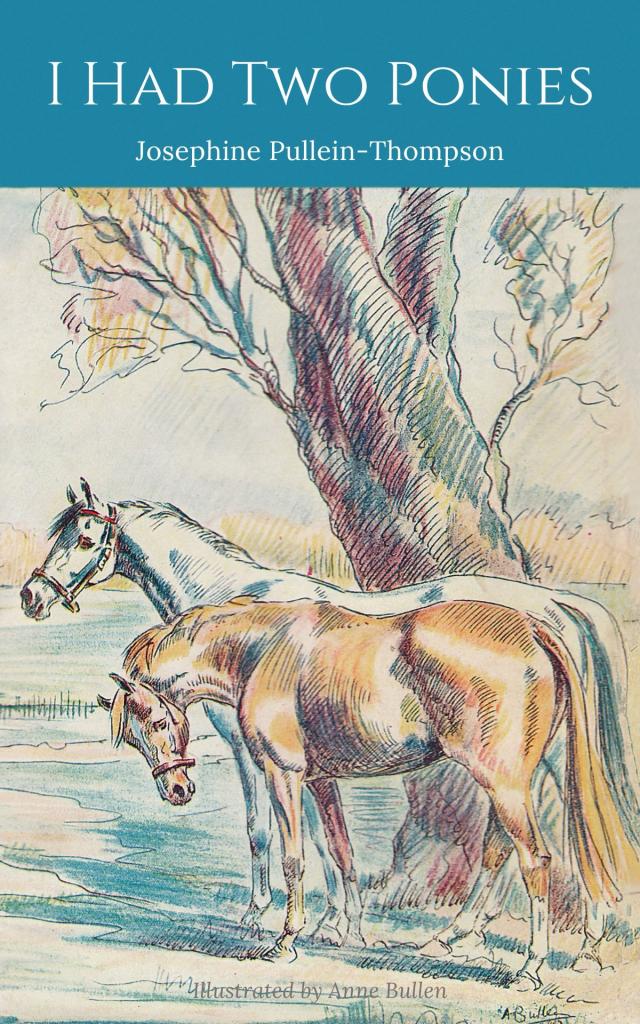


I Had Two Ponies
Josephine Pullein-Thompson
Contents
Josephine Pullein-Thompson
Chapter 1
Chapter 2
Chapter 3
Chapter 4
Chapter 5
Chapter 6
Chapter 7
Chapter 8
Chapter 9
Chapter 10
Also by Josephine Pullein-Thompson
Jane Badger Books
Josephine Pullein-Thompson
A SHORT BIOGRAPHY
* * *
Born in 1924, the eldest of the three Pullein-Thompson sisters (the others being the slightly younger twins, Diana and Christine), Josephine grew up in a somewhat bohemian household in Oxfordshire. With her sisters, she wrote several short stories and ran a riding school before firmly establishing herself as a writer. It Began with Picotee was the sisters’ first novel, published in 1946, and was written jointly by all three although they wrote individually from then on. At first, most notable for being the daughters of Joanna Cannan, a prolific writer whose work included children’s pony books and crime fiction, the sisters soon became well known as writers in their own right.
* * *
Josephine went on to write over thirty novels. Most are children’s books in the pony books genre that the sisters dominated in the post-war period, although she also wrote some detective novels and non-fiction. She lived in London and was active in the English Centre of International PEN, the writers' organisation which campaigns for authors’ freedoms under authoritarian or tyrannical regimes. Josephine Pullein-Thompson died in 2014.
* * *
Vanessa Robertson
1
I hope that you won’t take so violent a dislike to me in the first pages of this book that you slam it shut and, saying “Ugh! one can’t possibly read about such a beastly girl,” throw it aside. I know now how awful I was and I still blush when I think of some of the things I said and did when I first went to stay with the Westlakes. But during those Easter holidays events happened which changed me a great deal and, if you want to know what they were, you must stifle your disgust and read on.
It was at the beginning of the Christmas holidays that my parents told me they were going abroad. Apparently, Daddy’s business in India wasn’t being run properly and, as he is the sort of person who believes that if you want a thing done properly you must do it yourself, he had decided to go out and put the matter right. Mummy, who was bored and thought a change of scene would be nice, was going with him. Naturally, I wasn’t very pleased; few people are when they find that they have got to spend half-term at school and the Easter holidays with complete strangers, and I am afraid that I grumbled a good deal. Daddy said that he was sure that I would like the Westlakes; he had been at school with Mr., who was now a well-known actor, and Mummy thought that the companionship of the two girls, Gay and Lucy, would be nice for me. Nanny was the only person who sympathised with me; she said that now Daddy was a Lord he oughtn’t to demean himself by bothering about business and that if she was in his place she would wash her hands of it. But then she could hardly be expected to approve, because Mummy had decided that this was an opportune moment to give her notice.
Except for the actual Christmas celebrations, the whole holidays were completely ruined by my parents’ tiresome arrangements. Daddy seemed to think that this was a suitable time to do all the things that we had been putting off for years: he sacked Charles, the footman, who always became nervous at dinner parties and dropped or clattered the crockery, and the head gardener, because he had never been able to grow carnations; and then he started to bother about the ponies. They had been a birthday present from my parents and I was proud of them for they were both good-looking and had been very expensive. But I had only ridden Amber, a golden chestnut, about six times in the ten months I had had him, and Daydream, a grey mare, even less times than that. I must confess, and, in my imagination I hear your gasps of horror, that I never really liked riding. Perhaps rides accompanied by Small, our groom, on Daydream, or on Daddy’s hunter, King Cole, were not very amusing, but I think really that I was just rotten to the core. All my friends thought that I was very lucky to have two such smart ponies, especially those who had no pony of their own, or who had to share one with several brothers and sisters. I would have been quite glad to lend my ponies to some of these people but Small didn’t approve; he said that they were all worse riders than me and would spoil the ponies, or would let them down on the roads and break their knees. Actually this was nonsense, as I discovered afterwards, and I think Small must have been afraid that he would have to clean the tack.
Daddy had often grumbled before that the ponies stood in the stable, month after month, eating their heads off; and dozens of times he had threatened to sell them, unless I rode more often. But I used to cry and say that I loved them and that he had given them to me and couldn’t take them away, and nothing had ever happened. So, of course, when he started again in the library after dinner, I didn’t take him very seriously.
“What do you want to do with those ponies of yours, Christabel?” he asked. “I’m not going to have them standing idle in the stable while you’re away. I’m sacking Small and lending King Cole to Colonel Stanmore for the rest of the season. All the Westlake kids ride, I believe, so, if you don’t want to feel out of things I should certainly take one of the ponies with you, but you’ll have to look after it yourself and keep it turned out.”
“I don’t want to do that,” I replied. “I hate riding grass-fed ponies; they’re always dirty.”
Daddy looked rather cross. “A very foolish reason,” he said, “but obviously, if you’re not keen, we’d much better sell the animals. I’ll tell Small to send them to the horse sale next Saturday.”
“Oh, no,” I said, “can’t they be turned out in the park and then we can get a new groom when you come back?”
“No,” said Daddy firmly, “I’m fed up with seeing those ponies doing nothing, I wish I’d never bought them. Either you choose one to take to Underwood Farm and I sell the other, or I sell them both.”
“I won’t take either of them,” I said, stamping my foot. “I don’t want to spend the Easter holidays grooming a beastly muddy pony.”
“All right,” said Daddy, “we won’t say any more about it.”
I didn’t expect anything to happen; I thought that Daddy’s words were empty threats and that my ponies would continue to stand in the stable or wander about the park; and on Sunday, as usual, when it was fine, I walked down to the stables with their lumps of sugar. To my surprise, the familiar heads were not looking over their doors, nor were the ponies in the park. I realised with a start that Daddy must have carried out his threat and sold my ponies. At first I felt cross and sniffed into my smart linen handkerchief, but after a few minutes I realised what a lot of unpleasantness it would save: Daddy wouldn’t grumble because I didn’t ride the ponies, my friends wouldn’t be able to ask for rides and Small wouldn’t be able to complain if I gave my friends rides. So I stopped sniffing and walked into the house and started to fiddle with the expensive radiogram which, among other things, my parents had given me for Christmas.
The Christmas holidays passed quickly. Neither Daddy nor I ever mentioned the ponies again, but the parents really were very tiresome, talking endlessly about what clothes they would or would not take and if Monk, Mummy’s lady’s maid and Dale, Daddy’s valet, would be enough English servants, or whether they ought to take cook. Daddy said that an Indian cook would be quite adequate but Mummy said that she was going to give dozens of dinner parties and that she was sure that the Indian wouldn’t know enough dishes. Then Daddy had horrid business friends to stay so that he could discuss business with them at the same time as he saw that the packing was done properly. Altogether I was glad when the holidays were over and I was driven back to school with even more trunks than usual, stuffed with all the clothes which I might need during the Easter holidays as well as my school clothes.
At school, my friends were all very sympathetic about my misfortune in having to spend the holidays with horrid horsy friends of Daddy’s. Ann Dermott, my best friend, and I often imagined what the Westlakes would be like; at night — to our great delight we were sleeping together this term — we sometimes imitated them. Ann liked to be Gay and she was always very uncouth. Mummy had told me that the Westlake girls didn’t go to a decent school like Bramblewick Hall but were taught by someone in the village, so Ann and I thought they must be very peculiar. Ann said that they would be dirty, but I said I was sure that Daddy’s friends wouldn’t be as bad as that and I refused to agree when she said that actors were lazy, selfish, conceited and bad-mannered — her father was a business man, like mine. I argued, and, quoting Daddy, told her that successful actors weren’t like that; it was only the bad ones, who went on the stage because they thought it was an easy or glamorous life, who had these faults. However Ann wouldn’t agree with me and we argued quite angrily until matron came in and rowed us for talking. After that we didn’t dare speak a word in bed for several nights because we knew that if we were caught again we would be separated for the rest of the term.
As the holidays drew near I was filled with self pity and I bored everyone by grumbling about the horrid time I was going to have; then someone, I think it was a very earnest girl called Gillian, suggested that I should convert the Westlakes from their horrid ways, improve their manners and earn their undying gratitude. This
idea pleased me and I soon began to look forward to re-educating the poor ignorant Westlakes and I didn’t feel nearly so miserable as I had expected when, after a week of exams, the term was over.
2
I was rather worried when I left Bramblewick Hall; it was the first time that I had ever travelled anywhere alone and I was afraid of losing my ticket or getting out at the wrong station. However I avoided making either of these mistakes and arrived safely at Fritney, the nearest station to Underwood Farm. I leaped out of the train and looked round for a bevy of dirty uncouth-looking Westlakes. There was no one on the platform who looked the least like Ann and I had imagined the inmates of Underwood Farm would. But a tall stately woman with a great deal of wavy black hair approached me and said, “Are you Christabel Raffington?”
“Yes, that’s right,” I said.
“I’m Mrs. Westlake,” she said. “Is that all your luggage?”
“Yes,” I said, “the rest went in advance. I hope it’s arrived.”
“We’d better go round to the parcels office and find out,” said Mrs. Westlake. We had to wait ages while the wretched railway people searched for my trunks, but at last they found them and we were able to leave the sordid station. While the porter packed the luggage into the Westlakes’ battered and grimy car, I looked at the little grey stone town which rose above me, built into the side of the hill.
“Now,” said Mrs. Westlake, when the luggage was stowed away in the boot, “we’ve got to find Simon; he’s probably at the second-hand bookshop.”
“Who’s Simon?” I asked.
“My eldest son,” said Mrs. Westlake. “He’s sixteen and Adrian, the other one, is twelve.”
“What peculiar names,” I said.
“Peculiar?” said Mrs. Westlake, “unusual, perhaps; though, actually, they’re getting far too fashionable nowadays.”
Mrs. Westlake left me to wait in the car while she went into a dirty, musty-looking bookshop and, after an age, she emerged with a tall dark boy, who carried an armful of books.
“Gosh, you’ve been hours,” I said, as they got into the car.
“A slight exaggeration,” said Mrs. Westlake coldly. “Simon, this is Christabel.”
“How do you do?” asked Simon, holding out his hand. I shook it grudgingly for I was fed up with sitting in their beastly car, which I had discovered, to my horror, was of a cheap, mass-produced American make. Mrs. Westlake and Simon made stilted conversation as we covered the five miles which separated Underwood Farm from Fritney, but I was still sulking so I only gave non-committal replies and looked out of the window.
We passed through three villages, all built in grey stone, and then we turned down a long winding lane, which led to a white five-barred gate with Underwood Farm painted on it. Simon got out to open it and then stood on the running-board while we drove up to the house. It was also built in the universal grey stone, of which I was already beginning to tire. A low, sprawling untidy house with odd bits joined on at either end and windows and doors, which had once been white, it was separated from the farm buildings by a low stone wall and wrought-iron gate. As we carried my suitcases up the flagged path, between the mossy lawn and the tiny rose bed, I sighed for the magnificence of Bute’s Court, with its terrace, lily pond and park. When I saw my bedroom I sighed even more. At home I had a bedroom, bathroom and sitting-room all to myself; at Underwood Farm I was to share a bedroom, half the size of mine, with Lucy. It was a bare, plain room. The walls were white and almost completely covered with pictures of horses and on the chest of drawers and mantelpiece were dozens of tin and china animals, most of which were horses too.
“Gosh,” I said, looking round at the iron bedsteads and polished boards, covered with an occasional rug, “it looks just like school; except that we’re not allowed so many ornaments there, because of the dusting.”
“That’s Lucy’s horse collection,” said Mrs. Westlake, “but if you’ve brought any special ornaments, you must get her to clear a space for them.”
When I was left alone to unpack I explored my bedroom; but I found nothing to dispel my first impression of drear discomfort and I felt sure that I was going to dislike the horsy Lucy intensely. I unpacked my trunks, eyeing the party frocks sorrowfully; there wasn’t much prospect of wearing them in this bleak spot, I thought, and fell to cursing Nanny’s stupidity in not packing enough coat hangers. The room looked more civilised when I had arranged my pale blue brush and mirror set on the dressing table and placed my jewel box in a prominent position, hoping that its tasteful, and obviously expensive, elegance would make Lucy’s horses look gaudy and cheap, even in her unsophisticated eyes. I had just finished putting everything away when I heard a bell ring and there was a yell of “Lunch” from Simon. I washed and ran downstairs.
“Oh, there you are,” said Simon, as I entered the dining-room. “Didn’t you hear me shouting? You might have answered.”
“I didn’t know that you were shouting at me,” I said, “and anyway I was washing.”
“Washing?” said a voice. “Gosh, whatever for?”
“Shut up, Adrian,” said Mrs. Westlake. “Just because you’re filthy you shouldn’t expect everyone else to be.”
I was introduced to Gay, Lucy and Adrian, who had, apparently, all been out for a ride when I arrived. As we ate mutton chops, I studied the Westlakes. Gay was tall and dark, like Simon and her mother; she had a faintly scornful expression and vague grey eyes, which seemed to gaze into the distance. But the twins, Lucy and Adrian, were much more as Ann Dermott and I had imagined the Westlakes to be. With untidy fair hair, blue eyes and rosy cheeks, they had none of the slightly mysterious and exotic appearance of their elder brother and sister. Adrian’s face was dirty; he gnawed his chop bone and asked what was for pudding. The dining-room, which, like my bedroom was distinctly shabby, echoed with the Westlakes’ noisy chatter and my head had started to ache before we had finished the first course. To begin with they argued over names for a family of six kittens; then, when their mother had told them to shut up, Lucy and Adrian had a silly quarrel about which of them was the greediest. We all told them to shut up and then Gay started to tell me about their ponies. Dauntless, she said, belonged to Simon; Wisdom was hers, and Lucy and Adrian had to share Shadow, now that they had both outgrown Adolphus, who had retired. “You ride, don’t you?” she asked. “Have you got a pony?”
“I had two,” I replied, “but Daddy sold them when it was arranged that I should come here.”
“Gosh, how beastly,” said Lucy, a look of horror on her face.
“Whew,” said Adrian, “couldn’t you stop him?”
“What frightful bad luck,” said Gay, “you must have been fed up.”
“Ghastly,” agreed Simon.
“It was rather,” I said, “though, actually, I never rode them much.”
“Why on earth not?” asked Lucy.
“I don’t know,” I said. “I don’t think that I’m awfully keen.”
“Not keen on riding?” said Lucy in an incredulous voice. “Gosh!”
“Did they get good homes?” asked Adrian.
“Who?” I asked.
“Your ponies, of course,” he replied.
“I don’t know,” I said, “I wasn’t at the sale.”
“You don’t mean to say that you let them be sold at a sale?” said Gay.
“I didn’t know anything about it until afterwards,” I said, “but I don’t see how else Daddy could have got rid of them. After all that’s what sales are for.”
“But someone absolutely beastly may have bought them,” said Gay; “don’t you lie awake at night wondering what awful fates have befallen them? I can’t even bear to think of Wisdom being sold like that; I’ve left lots of instructions about what is to happen to her in my will.”