Dear husband stories, p.1
Dear Husband: Stories,
p.1
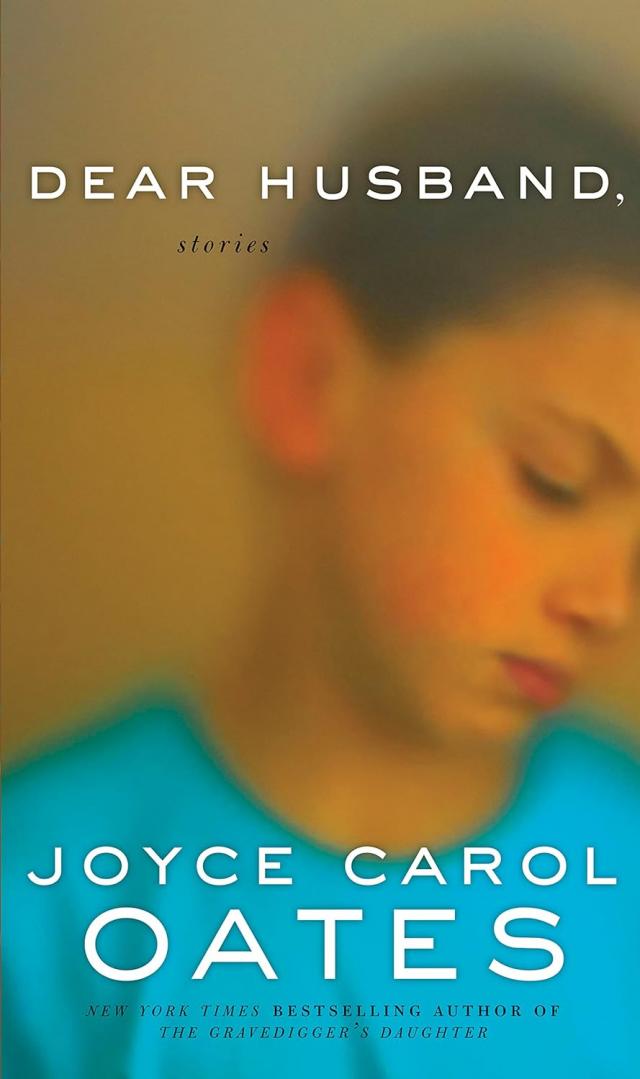


Dear Husband,
Joyce Carol Oates
k
for Susan Wolfson and Ron Levao
Contents
pa r t on e
Panic
3
Special
15
The Blind Man’s Sighted Daughters
38
Magda Maria
62
A Princeton Idyll
82
Cutty Sark
109
Landfi ll
144
Vigilante
165
The Heart Sutra
192
pa r t t wo
Dear Joyce Carol,
227
Suicide by Fitness Center
238
The Glazers
260
Mistrial
284
Dear Husband,
316
Acknowledgments
About the Author
Other Books by Joyce Carol Oates
Credits
Cover
Copyright
About the Publisher
Part One
k
Panic
He knows this fact: it was a school bus.
That unmistakable color of virulent high-concentrate urine.
A lumbering school bus emitting exhaust. Faulty muffl er, should be ticketed. He’d gotten trapped behind the bus in the right lane of the Chrysler Freeway headed north at about the exit for I-94, trapped at forty-five God-damned miles an hour. In disgust he shut vent on his dashboard. What a smell! Would’ve turned on the A/C except he glimpsed then in the smudged rear window of the school bus, a section of which had been cranked partway open, two heifer-sized boys (Hispanic? black?) wrestling together and grinning. One of them had a gun the other was trying to snatch from him.
“My God! He’s got a—”
Charles spoke distractedly, in shock. He’d been preparing to shift into the left lane and pass the damned bus but traffic in that lane of the Freeway (now nearing the Hamtramck exit) was un-relenting, he’d come up dangerously close behind the bus. Beside him Camilla glanced up sharply to see two boys struggling against the rear window, the long-barreled object that was a gun or appeared to be a gun, without uttering a word nor even a sound of 4 * joyce carol oates
alarm, distress, warning, Camilla fumbled to unbuckle her safety belt, turned to climb over the back of the seat where she fell awkwardly, scrambled then to her knees to unbuckle the baby from the baby’s safety seat, and crouched on the floor behind Charles. So swiftly!
In a hoarse voice crying: “Brake the car! Get away!”
Charles was left in the front seat, alone. Exposed.
Stunned at how quickly, how unerringly and without a moment’s hesitation, his wife had reacted to the situation. She’d escaped into the backseat like a panicked cat. And lithe as a cat. While he continued to drive, too stunned even to release pressure on the gas pedal, staring at the boys in the bus window less than fi fteen feet ahead.
Now the boys were watching him, too. They’d seen Camilla climb over the back of her seat, very possibly they’d caught a fl ash of white thigh, a silky undergarment, and were howling with hilar-ity. Grinning and pointing at Charles behind the wheel frozen-faced in fear and indecision, delighted as if they were being tickled in their most private parts. Another hulking boy joined them thrust-ing his heifer-face close against the window. The boy waving the gun, any age from twelve to seventeen, fatty torso in a black T-shirt, oily black tight-curly hair and a skin like something smudged with a dirty eraser, was crouching now to point the gun barrel through the cranked-open window, at an angle that allowed him to aim straight at Charles’s heart.
Laugh, laugh! There were a half-dozen boys now crowded against the bus window, observing with glee the cringing Caucasian male, of no age in their eyes except old, hunched behind the wheel of his metallic-gray Acura in the futile hope of minimizing the target he made, pleading, as if the boys could hear or, hearing, be moved to have pity on him, “No, don’t!—no, no, God no—”
Charles braked the car, desperately. Swerved onto the highway shoulder. This was a dangerous maneuver executed without premeditation, no signal to the driver close behind the Acura in a massive S.U.V. but he had no choice! Horns were sounding on all Panic * 5
sides, furious as wounded rhinos. The Acura lurched and bumped along the littered shoulder, skidded, began to fishtail. Both Camilla and Susanna were screaming. Charles saw a twisted strip of chrome rushing toward them, tire remnants and broken glass, but his brakes held, he struck the chrome at about ten miles an hour, and came to an abrupt stop.
Directly behind Charles, the baby was shrieking. Camilla was trying to comfort her, “Honey, it’s all right! We are all right, honey!
We’re safe now! Nothing is going to happen! Nothing is going to happen to you, honey. Mommy is right here.”
The school bus had veered on ahead, emitting its jeering exhaust.
Too fast. It happened too fast.
Didn’t have time to think. Those punk bastards . . .
Had he seen the license plate at the rear of the school bus, he had not. Hadn’t even registered the name of the school district or the bus company in black letters coated in grime at the rear of the bus. Hamtramck? Highland Park? As soon as he’d seen the gun in the boy’s hand he’d been walloped by adrenaline like a shot to the heart: rushing blood to his head, tears into his eyes, racing his heart like a hammering fi st.
He was shaken, ashamed. Humiliated.
It was the animal panic of not wanting to be shot, not wanting to die, that had taken over him utterly. The demonically grinning boys, the long-barreled object, obviously a gun, had to be a gun, the boy crouching so that he could aim through the cranked-open section of the window straight at Charles. The rapture in the thuggish kid’s face as he prepared to pull the trigger.
Camilla was leaning over him, concerned. “Charles, are you all right?”
He was cursing the boys on the bus. He was sweating now, and his heart continued to beat erratically, as if mockingly. He told Camilla yes, of course he was all right. He was fine. He was alive, 6 * joyce carol oates
wasn’t he? No shots had been fired, he hadn’t crashed the car. She and Susanna were unhurt.
He would climb out of the overheated car as, scarcely more than a foot away, traffic rushed by on the highway, and he would struggle with the God-damned strip of chrome that had jammed beneath the Acura’s front bumper, and then with mangled hands gripping the steering wheel tight as death he would continue to drive his family the rest of the way home without incident.
Camilla remained in the backseat, cradling and comforting the baby.
Comforting the baby she should be comforting him. She’d abandoned him to death.
He laughed. He was willing to recast the incident as a droll yet emblematic experience. One of the small and inexplicable dramas of their marriage. Saying, teasing, “You certainly got out of the passenger’s seat in record time, Camilla. Abandoned your poor husband.”
Camilla looked at him, eyes brimming with hurt.
“Charles, I had to protect Susanna. I only—”
“Of course. I know. It was remarkable, what you did.”
“I saw the gun. That’s all I saw. I panicked, and acted without thinking.”
“You acted brilliantly, Camilla. I wish we had a video.”
Camilla laughed. She was still excited, pumped up.
Susanna, eighteen months old, their first and to-be- only child, had been changed, fed, pacified, lain gently in her crib. A miracle, the baby who usually resisted napping at this hour was sleeping.
She’d cried herself into exhaustion. But she would forget the incident in the car, already she’d forgotten. The bliss of eighteen months.
Camilla was saying, in awe of herself, “Charles, I don’t think Panic * 7
I’ve ever acted so swiftly. So—unerringly! I played high school basketball, field hockey. I was never so fast as the other girls.”
Ruefully Camilla rubbed her knees. She was slightly banged up, she would be bruised, she guessed. Lucky for her she hadn’t broken her neck.
Yet Camilla was marveling at what she’d accomplished in those scant several seconds. While Charles had continued to drive the car like a zombie, helpless. She had unbuckled her seat belt and crawled over the back of the seat and unbuckled the baby and crouched with the baby behind Charles. Shielded by Charles.
Charles understood that Camilla would recall and re-enact her astonishing performance many times, in secret.
He said, “You hid behind me, which was the wise thing to do.
Under the circumstances. The kids had a target, it would have been me in any case. It was purely nature, what you did. ‘Protecting the young.’ ”
“Charles, really! I didn’t hide behind you. I hid behind the car seat.”
But I was in the seat. “Look, you were acting instinctively. Instinct is impersonal. You acted to save a baby, and yourself. You had to save yourself in order to save the baby. It must be like suddenly realizing you can swim.” Charles spoke slowly, as if the idea were only now coming to him, a way of seeing the incident from a higher moral perspective. “A boat capsizes, you’re in the water, and in terror of drowning you swim. You discover that you can swim.”
“Except you don’t, Charles. You don’t just ‘swim.’ If you don’t already know how to swim, you drown.”
“I mean it’s n
ature, impersonal. It isn’t volitional.”
“Yet you seem to resent me.”
“Resent you! Camilla, I love you.”
The truthful answer was yes. He did resent her, unfairly. Yet he knew he must not push this further, he would say things he might regret and could not retract. You don’t love me, you love Susanna. You love the baby not the father. You love the father but not much. Not enough. The father is expendable. The father is last season’s milkweed seed blown in the wind. Debris.
8 * joyce carol oates
Camilla laughed at him, though she was wanting to be kissed by him, comforted. After her acrobatics in the car, after she’d demonstrated how little she needed him, how comical an accessory he was to her, still she wanted to be kissed and comforted, she was a wistful girl of about fourteen. Her smooth skin, her face that was round and imperturbable as a moon, maddening at times in its placidity. Charles had been attracted initially by the calmness of the woman’s beauty and now he was annoyed. Camilla was thirty-six years old which is not so young and yet even in unsparing daylight she looked at least a de cade younger, her face was so unlined, her eyes so clear. Charles, forty-two, had one of those fair-skinned “pa-trician” faces that become imprinted with a subtle sort of age: reminding Charles, when he had to consider it, of calcifi ed sand beneath which rivulets of fresh water are running, wearing away the sand from within.
He was a corporation lawyer. He was a very good corporation lawyer. He would protect his clients. He would protect his wife, his daughter. How?
“Camilla, don’t misunderstand me. Your instinct was to protect Susanna. There was nothing you could have done for me if one of those kids had fired the gun.”
“If you’d been shot, we would have crashed anyway. We might all be dead now.”
Camilla spoke wistfully. Charles wanted to slap her.
“Well. We’re not, are we.”
Instead, they were in their bedroom in Bloomfield Hills. A large white Colonial on a hill in Baskings Grove Estates, near Quar-ton Road. Leafy hilly suburb north of the derelict and depopulated city of Detroit sprawled choked in haze where, years ago as a boy, Charles had lived in a residential neighborhood above Six Mile Road near Livernois until his parents, fearful of “coloreds” en-croaching upon them, had panicked, sold their property and fl ed.
They were living now in Lake Worth, Florida. Charles thought of them as he tugged off his noose-necktie and flung it down. Some of them, they’ d kill you as soon as look at you. They’re crack addicts, animals.
Panic * 9
In the car returning home, Camilla had tried to call 911 but the cell phone hadn’t worked and now they were home, and safe, Charles debated whether to report the incident to Detroit police, now that the emergency had passed. No one had been hurt, after all.
Camilla objected, “But they—those boys—might hurt someone else. If they play that trick again. Another driver might really panic seeing the gun aimed at him, and crash his car.”
Charles winced at this. Really panic. As if he, Charles, had panicked only moderately. But of course he had, why deny it. Camilla had been a witness. The swarthy-skinned boys laughing like hyenas in the rear bus window had been witnesses.
While Camilla prepared their dinner, Charles made the call.
He spoke carefully, politely. His voice did not quaver. . . . calling to report an incident that happened at about four-fifteen this afternoon on the Chrysler Freeway headed north at about the Hamtramck exit. A very dangerous incident involving a gun, that almost caused an accident. High-school boys, or maybe ju nior-high . . . Charles spoke flatly describing in terse words what had happened. What had almost happened. Having to concede, he hadn’t seen the license plate. Had not noticed the name of the school district. No distinguishing features on the bus except it was an old bus, probably not a suburban school bus, certainly not a private school bus, very likely an inner city bus, rust-fl ecked, fi lthy, emitting exhaust. No, he had not gotten a very good look at the boys: dark-skinned, he thought. But hadn’t seen clearly.
In the kitchen, Camilla seemed to be opening and shutting drawers compulsively as if looking for something that eluded her.
She was in a fever, suddenly! She came to the doorway to stare at Charles who had ceased speaking on the phone, which was their land-phone; he stood limply, arms at his sides, staring at the carpet at his feet. Camilla said, “Charles?”
“Yes? What?”
“Didn’t whoever you spoke with have more to ask? Didn’t he ask for our number?”
“No.”
“That seems strange. You weren’t on the phone very long.”
10 * joyce carol oates
Charles felt his face darken with blood. Was this woman eavesdropping on him? She’d left him to die, abandoned him to jeering black boys with a gun, now she was eavesdropping on his call to the police, staring at him so strangely?
“Long enough.”
Camilla stared. A strand of hair had fallen onto her forehead, distractedly she brushed it away. “ ‘Long enough’—what?”
“On the fucking phone. You call, if it’s so important to you.”
In fact, Charles had not called the police. Even as he’d punched out the numbers on his phone, he’d broken the connection with his thumb before the call went through. He hadn’t spoken with any police officer, nor even with any operator. None of what had happened that afternoon seemed very important to him now. The boys (Hispanic? black?) were punks of no consequence to him, living here on Fairway Drive, Bloomfield Hills; his revenge was living here, and not there, with them; his revenge was being himself, capable of dismissing them from his thoughts. The gun had (probably) not been a real gun and whatever had happened on the Chrysler Freeway, after all nothing had happened.
“But I didn’t get a good look at them, Charles. As you did.”
There was nothing on the local Detroit news stations, of interest to them, at 6 p.m. But at 11 p.m. there came BULLETIN
BREAKING NEWS of a shooting on I-94, near the intersection with Grand River Avenue: a trucker had been shot in the upper chest with what police believed to be a .45-caliber bullet, and was in critical condition at Detroit General. The shooting had occurred at approximately 9:20 p.m. and police had determined the shot had been fired by a sniper on an overpass, firing down into traffi c.
Camilla cried, “It was him! That boy!”
Charles switched stations. Film footage of I-94 near Grand River Avenue was just concluding. “Why would it be I-94? An overpass? The boys on the bus were headed in the other direction.
They’d have been off the bus, wherever they were going, hours before. And miles away. It’s just a coincidence.”
Camilla shuddered. “Coincidence! My God.”
Panic * 11
“You still do love me. Don’t you?”
“Don’t be ridiculous.”
“Don’t you?”
“Shouldn’t I?” A pause. “I’m so tired . . .”
Knowing he wouldn’t be able to sleep but he must sleep, he had an early meeting next morning: 8 a.m., breakfast. At his company’s headquarters. Must sleep. They’d gone to bed, exhausted and creaky-jointed as an elderly couple, and Charles lay now stiff as a wooden effigy, on his back. He’d dismissed the incident (urine-colored school bus, smudged-skinned young punks, the ambiguous long-barreled weapon) from his mind, it was over. Beside him Camilla lay warm-skinned, ardent. Wanting to push into his arms, to make love with him, or wanting at least to give the impression of wanting to make love which, in a long-term marriage, counts for the same gesture, in theory. See? I love you, you are rebuffing me. Charles was polite but unreceptive. What pathos in lovemaking, in stark
“physical” sex, when life itself is at stake! Civilization at stake!
Charles’s head was flooding with images like the screen of a demonic video game. (He had never played such a game. But he’d observed, in video arcades.) The ugly lumbering school bus he’d been trapped behind. The stink of the exhaust. How had it happened, had Camilla been speaking to him, he’d become distracted, hadn’t seen the bus in time to switch to another lane, and if he’d done that, none of this would have happened. Seeing now the rear window of the bus: craning his neck upward, to see. What were those boys doing? The rear window was divided into sections and only the smaller panes at the sides could be cranked open. The pane at the left, directly in front of, and above, Charles, had been opened and it was through this window that the long-barreled revolver had been pointed. No! Don’t shoot! Not me! Now Charles saw vividly, unmistakably, the faces of the boys: they were probably not more than twelve or thirteen years old, with dark, demonic eyes, jeering grins, oily-dark hair. As he stared up at them pleading with 12 * joyce carol oates