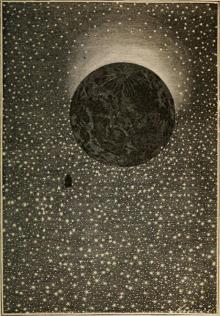
Round the moon, p.10
Round the Moon,
p.10


When he spoke thus Michel made his prosaic companions shrug their shoulders. Barbicane and Nicholl looked at the lunar map from another point of view to that of their imaginative friend. However, their imaginative friend had some reason on his side. Judge if he had not.
In the left hemisphere stretches the “Sea of Clouds,” where human reason is so often drowned. Not far off appears the “Sea of Rains,” fed by all the worries of existence. Near lies the “Sea of Tempests,” where man struggles incessantly against his too-often victorious passions. Then, exhausted by deceptions, treasons, infidelities, and all the procession of terrestrial miseries, what does he find at the end of his career? The vast “Sea of Humours,” scarcely softened by some drops from the waters of the “Gulf of Dew!” Clouds, rain, tempests, humours, does the life of man contain aught but these? and is it not summed up in these four words?
The right-hand hemisphere dedicated to “the women” contains smaller seas, the significant names of which agree with every incident of feminine existence. There is the “Sea of Serenity,” over which bends the young maiden, and the “Lake of Dreams,” which reflects her back a happy future. The “Sea of Nectar,” with its waves of tenderness and breezes of love! The “Sea of Fecundity,” the “Sea of Crises,” and the “Sea of Vapours,” the dimensions of which are, perhaps, too restricted, and lastly, that vast “Sea of Tranquillity” where all false passions, all useless dreams, all unassuaged desires are absorbed, and the waves of which flow peacefully into the “Lake of Death!”
What a strange succession of names! What a singular division of these two hemispheres of the moon, united to one another like man and woman, and forming a sphere of life, carried through space. And was not the imaginative Michel right in thus interpreting the fancies of the old astronomers?
But whilst his imagination thus ran riot on the “seas,” his grave companions were looking at things more geographically. They were learning this new world by heart. They were measuring its angles and diameters.
To Barbicane and Nicholl the “Sea of Clouds” was an immense depression of ground, with circular mountains scattered about on it; covering a great part of the western side of the southern hemisphere, it covered 184,800 square leagues, and its centre was in south latitude 15°, and west longitude 20°. The Ocean of Tempests, Oceanus Procellarum, the largest plain on the lunar disc, covered a surface of 328,300 square leagues, its centre being in north latitude 10°, and east longitude 45°. From its bosom emerge the admirable shining mountains of Kepler and Aristarchus.
More to the north, and separated from the Sea of Clouds by high chains of mountains, extends the Sea of Rains, Mare Imbrium, having its central point in north latitude 35° and east longitude 20°; it is of a nearly circular form, and covers a space of 193,000 leagues. Not far distant the Sea of Humours, Mare Humorum, a little basin of 44,200 square leagues only, was situated in south latitude 25°, and east longitude 40°. Lastly, three gulfs lie on the coast of this hemisphere—the Torrid Gulf, the Gulf of Dew, and the Gulf of Iris, little plains enclosed by high chains of mountains.
The “Feminine” hemisphere, naturally more capricious, was distinguished by smaller and more numerous seas. These were, towards the north, the Mare Frigoris, in north latitude 55° and longitude 0°, with 76,000 square leagues of surface, which joined the Lake of Death and Lake of Dreams; the Sea of Serenity, Mare Serenitatis, by north latitude 25° and west longitude 20°, comprising a surface of 80,000 square leagues; the Sea of Crises, Mare Crisium, round and very compact, in north latitude 17° and west longitude 55°, a surface of 40,000 square leagues, a veritable Caspian buried in a girdle of mountains. Then on the equator, in north latitude 5° and west longitude 25°, appeared the Sea of Tranquillity, Mare Tranquillitatis, occupying 121,509 square leagues of surface; this sea communicated on the south with the Sea of Nectar, Mare Nectaris, an extent of 28,800 square leagues, in south latitude 15° and west longitude 35°, and on the east with the Sea of Fecundity, Mare Fecunditatis, the vastest in this hemisphere, occupying 219,300 square leagues, in south latitude 3° and west longitude 50°. Lastly, quite to the north and quite to the south lie two more seas, the Sea of Humboldt, Mare Humboldtianum, with a surface of 6,500 square leagues, and the Southern Sea, Mare Australe, with a surface of 26,000.
In the centre of the lunar disc, across the equator and on the zero meridian, lies the centre gulf, Sinus Medii, a sort of hyphen between the two hemispheres.
Thus appeared to the eyes of Nicholl and Barbicane the surface always visible of the earth’s satellite. When they added up these different figures they found that the surface of this hemisphere measured 4,738,160 square leagues, 3,317,600 of which go for volcanoes, chains of mountains, amphitheatres, islands—in a word, all that seems to form the solid portion of the globe—and 1,410,400 leagues for the seas, lake, marshes, and all that seems to form the liquid portion, all of which was perfectly indifferent to the worthy Michel.
It will be noticed that this hemisphere is thirteen and a-half times smaller than the terrestrial hemisphere. And yet upon it selenographers have already counted 50,000 craters. It is a rugged surface worthy of the unpoetical qualification of “green cheese” which the English have given it.
When Barbicane pronounced this disobliging name Michel Ardan gave a bound.
“That is how the Anglo-Saxons of the 19th century treat the beautiful Diana, the blonde Phoebe, the amiable Isis, the charming Astarte, the Queen of Night, the daughter of Latona and Jupiter, the younger sister of the radiant Apollo!”
XII
Orographical Details
It has already been pointed out that the direction followed by the projectile was taking us towards the northern hemisphere of the moon. The travellers were far from that central point which they ought to have touched if their trajectory had not suffered an irremediable deviation.
It was half-past twelve at night. Barbicane then estimated his distance at 1,400 kilometres, a distance rather greater than the length of the lunar radius, and which must diminish as he drew nearer the North Pole. The projectile was then not at the altitude of the equator, but on the tenth parallel, and from that latitude carefully observed on the map as far as the Pole, Barbicane and his two companions were able to watch the moon under the most favourable circumstances.
In fact, by using telescopes, this distance of 1,400 kilometres was reduced to fourteen miles, or four and a-half leagues. The telescope of the Rocky Mountains brought the moon still nearer, but the terrestrial atmosphere singularly lessened its optical power. Thus Barbicane, in his projectile, by looking through his glass, could already perceive certain details almost imperceptible to observers on the earth.
“My friends,” then said the president in a grave voice, “I do not know where we are going, nor whether we shall ever see the terrestrial globe again. Nevertheless, let us do our work as if one day it would be of use to our fellow-creatures. Let us keep our minds free from all preoccupation. We are astronomers. This bullet is the Cambridge Observatory transported into space. Let us make our observations.”
That said, the work was begun with extreme precision, and it faithfully reproduced the different aspects of the moon at the variable distances which the projectile reached in relation to that orb.
Whilst the bullet was at the altitude of the 10th north parallel it seemed to follow the 20th degree of east longitude.
Here may be placed an important remark on the subject of the map which they used for their observations. In the selenographic maps, where, on account of the reversal of objects by the telescope, the south is at the top and the north at the bottom, it seems natural that the east should be on the left and the west on the right. However, it is not so. If the map were turned upside down, and showed the moon as she appears, the east would be left and the west right, the inverse of the terrestrial maps. The reason of this anomaly is the following:—Observers situated in the northern hemisphere—in Europe, for example—perceive the moon in the south from them. When they look at her they turn their backs to the north, the opposite position they take when looking at a terrestrial map. Their backs being turned to the north, they have the east to the left and the west to the right. For observers in the southern hemisphere—in Patagonia, for example—the west of the moon would be on their left and the east on their right, for the south would be behind them.
Such is the reason for the apparent reversal of these two cardinal points, and this must be remembered whilst following the observations of President Barbicane.
Helped by the Mappa Selenographica of Boeer and Moedler, the travellers could, without hesitating, survey that portion of the disc in the field of their telescopes.
“What are we looking at now?” asked Michel.
“At the northern portion of the Sea of Clouds,” answered Barbicane. “We are too far off to make out its nature. Are those plains composed of dry sand, as the first astronomers believed? Or are they only immense forests, according to the opinion of Mr. Waren de la Rue, who grants a very low but very dense atmosphere to the moon? We shall find that out later on. We will affirm nothing till we are quite certain.”
“This Sea of Clouds is rather doubtfully traced upon the maps. It is supposed that this vast plain is strewn with blocks of lava vomited by the neighbouring volcanoes on its right side, Ptolemy, Purbach, and Arzachel. The projectile was drawing sensibly nearer, and the summits which close in this sea on the north were distinctly visible. In front rose a mountain shining gloriously, the top of which seemed drowned in the solar rays.”
“That mountain is—?” asked Michel.
“Copernicus,” answered Barbicane.
“Let us have a look at Copernicus,” said Michel.
This mountain, situated in north latitude 9°, and east longitude 20°, rises to a height of nearly 11,000 feet above the surface of the moon. It is quite visible from the earth, and astronomers can study it with ease, especially during the phase between the last quarter and the new moon, because then shadows are thrown lengthways from east to west, and allow the altitudes to be taken.
Copernicus forms the most important radiating system in the southern hemisphere, according to Tycho Brahe. It rises isolated like a gigantic lighthouse over that of the Sea of Clouds bordering on the Sea of Tempests, and it lights two oceans at once with its splendid rays. Those long luminous trails, so dazzling at full moon, made a spectacle without an equal; they pass the boundary chains on the north, and stretch as far as the Sea of Rains. At 1 a.m., terrestrial time, the projectile, like a balloon carried into space, hung over this superb mountain.
Barbicane could perfectly distinguish its chief features. Copernicus is comprehended in the series of annular mountains of the first order in the division of the large amphitheatres. Like the mountains of Kepler and Aristarchus, which overlook the Ocean of Tempests, it appears sometimes like a brilliant point through the pale light, and used to be taken for a volcano in activity. But it is only an extinct volcano, like those on that side of the moon. Its circumference presented a diameter of about twenty-two leagues. The glasses showed traces of stratifications in it produced by successive eruptions, and its neighbourhood appeared strewn with volcanic remains, which were still seen in the crater.
“There exist,” said Barbicane, “several sorts of amphitheatres an the surface of the moon, and it is easy to see that Copernicus belongs to the radiating class. If we were nearer it we should perceive the cones which bristle in the interior, and which were formerly so many fiery mouths. A curious arrangement, and one without exception on the lunar disc, is presented on the interior surface of these amphitheatres, being notably downward from the exterior plane, a contrary form to that which terrestrial craters present. It follows, therefore, that the general curvature at the bottom of these amphitheatres gives us fear of an inferior diameter to that of the moon.”
“What is the reason of this special arrangement?” asked Nicholl.
“It is not known,” answered Barbicane.
“How splendidly it shines!” said Michel. “I think it would be difficult to see a more beautiful spectacle!”
“What should you say, then,” answered Barbicane, “if the chances of our journey should take us towards the southern hemisphere?”
“Well, I should say it is finer still,” replied Michel Ardan.
At that moment the projectile hung right over the amphitheatre. The circumference of Copernicus formed an almost perfect circle, and its steep ramparts were clearly defined. A second circular enclosure could even be distinguished. A grey plain of wild aspect spread around on which every relief appeared yellow. At the bottom of the amphitheatre, as if in a jewel-case, sparkled for one instant two or three eruptive cones like enormous dazzling gems. Towards the north the sides of the crater were lowered into a depression which would probably have given access to the interior of the crater.
As they passed above the surrounding plain Barbicane was able to note a large number of mountains of slight importance, amongst others a little circular mountain called “Gay-Lussac,” more than twenty-three kilometres wide. Towards the south the plain was very flat, without one elevation or projection of the soil. Towards the north, on the contrary, as far as the place where it borders on the Ocean of Tempests, it was like a liquid surface agitated by a storm, of which the hills and hollows formed a succession of waves suddenly coagulated. Over the whole of this, and in all directions, ran the luminous trails which converged to the summit of Copernicus. Some had a width of thirty kilometres over a length that could not be estimated.
The travellers discussed the origin of these strange rays, but they could not determine their nature any better than terrestrial observers.
“Why,” said Nicholl, “may not these rays be simply the spurs of the mountains reflecting the light of the sun more vividly?”
“No,” answered Barbicane, “if it were so in certain conditions of the moon they would throw shadows, which they do not.”
In fact, these rays only appear when the sun is in opposition with the moon, and they disappear as soon as its rays become oblique.
“But what explanation of these trails of light have been imagined?” asked Michel, “for I cannot believe that savants would ever stop short for want of explanation.”
“Yes,” answered Barbicane, “Herschel has uttered an opinion, but he does not affirm it.”
“Never mind; what is his opinion?”
“He thought that these rays must be streams of cold lava which shone when the sun struck them normally.”
“That may be true, but nothing is less certain. However, if we pass nearer to Tycho we shall be in a better position to find out the cause of this radiation.”
“What do you think that plain is like, seen from the height we are at?” asked Michel.
“I don’t know,” answered Nicholl.
“Well, with all these pieces of lava, sharpened like spindles, it looks like ‘an immense game of spilikins,’ thrown down pell-mell. We only want a hook to draw them up.”
“Be serious for once in your life,” said Barbicane.
“I will be serious,” replied Michel tranquilly, “and instead of spilikins let us say they are bones. This plain would then be only an immense cemetery upon which would repose the immortal remains of a thousand distinct generations. Do you like that comparison better?”
“One is as good as the other,” answered Barbicane.
“The devil! You are difficult to please,” replied Michel.
“My worthy friend,” resumed the prosaic Barbicane, “it does not matter what it looks like when we don’t know what it is.”
“A good answer,” exclaimed Michel; “that will teach me to argue with savants.”
In the meantime the projectile went with almost uniform speed round the lunar disc. It may be easily imagined that the travellers did not dream of taking a minute’s rest. A fresh landscape lay before their eyes every instant. About half-past one in the morning they caught a glimpse of the summit of another mountain. Barbicane consulted his map, and recognised Eratosthenes.
It was a circular mountain 4,500 metres high, one of those amphitheatres so numerous upon the satellite. Barbicane informed his friends of Kepler’s singular opinion upon the formation of these circles. According to the celebrated mathematician, these crateriform cavities had been dug out by the hand of man.
“What for?” asked Nicholl.
“In order to preserve themselves from the ardour of the solar rays, which strike the moon during fifteen consecutive days.”
“The Selenites were not fools!” said Michel.
“It was a singular idea!” answered Nicholl. “But it is probable that Kepler did not know the real dimensions of these circles, for digging them would have been giants’ labour, impracticable for Selenites.”
“Why so, if the weight on the surface of the moon is six times less than upon the surface of the earth?” said Michel.
“But if the Selenites are six times smaller?” replied Nicholl.
“And if there are no Selenites?” added Barbicane, which terminated the discussion.
Eratosthenes soon disappeared from the horizon without the projectile having been sufficiently near it to allow a rigorous observation. This mountain separated the Apennines from the Carpathians.
In lunar orography, several chains of mountains have been distinguished which are principally distributed over the northern hemisphere. Some, however, occupy certain portions of the southern hemisphere.
The following is a list of these different chains, with their latitudes and the height of their highest summits:—
Mount Doerfel 84° lat. S. 7,603 metres