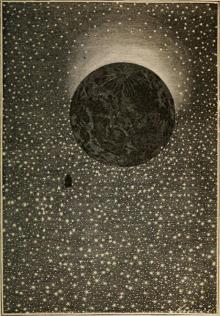
Round the moon, p.9
Round the Moon,
p.9


“Perhaps we have arrived too late,” suggested Nicholl.
“Too late?” said Barbicane.
“Yes,” resumed Nicholl. “The notice from the Cambridge Observatory said that the transit ought to be accomplished in ninety-seven hours thirteen minutes and twenty seconds. That means that before that time the moon would not have reached the point indicated, and after she would have passed it.”
“Agreed,” answered Barbicane. “But we started on the 1st of December at 11:13:25 p.m., and we ought to arrive at midnight on the 5th, precisely as the moon is full. Now this is the 5th of December. It is half-past three, and eight hours and a half ought to be sufficient to take us to our goal. Why are we not going towards it?”
“Perhaps the velocity was greater than it ought to have been,” answered Nicholl, “for we know now that the initial velocity was greater than it was supposed to be.”
“No! a hundred times no!” replied Barbicane. “An excess of velocity, supposing the direction of the projectile to have been correct, would not have prevented us reaching the moon. No! There has been a deviation. We have deviated!”
“Through whom? through what?” asked Nicholl.
“I cannot tell,” answered Barbicane.
“Well, Barbicane,” then said Michel, “should you like to know what I think about why we have deviated?”
“Say what you think.”
“I would not give half a dollar to know! We have deviated, that is a fact. It does not matter much where we are going. We shall soon find out. As we are being carried along into space we shall end by falling into some centre of attraction or another.”
Barbicane could not be contented with this indifference of Michel Ardan’s. Not that he was anxious about the future. But what he wanted to know, at any price, was why his projectile had deviated.
In the meantime the projectile kept on its course sideways to the moon, and the objects thrown out along with it. Barbicane could even prove by the landmarks upon the moon, which was only at 2,000 leagues’ distance, that its speed was becoming uniform—a fresh proof that they were not falling. Its force of impulsion was prevailing over the lunar attraction, but the trajectory of the projectile was certainly taking them nearer the lunar disc, and it might be hoped that at a nearer point the weight would predominate and provoke a fall.
The three friends, having nothing better to do, went on with their observations. They could not, however, yet determine the topography of the satellite. Every relief was levelled under the action of the solar rays.
They watched thus through the lateral windows until 8 p.m. The moon then looked so large that she hid half the firmament from them. The sun on one side, and the Queen of Night on the other, inundated the projectile with light.
At that moment Barbicane thought he could estimate at 700 leagues only the distance that separated them from their goal. The velocity of the projectile appeared to him to be 200 yards a second, or about 170 leagues an hour. The base of the bullet had a tendency to turn towards the moon under the influence of the centripetal force; but the centrifugal force still predominated, and it became probable that the rectilinear trajectory would change to some curve the nature of which could not be determined.
Barbicane still sought the solution of his insoluble problem. The hours went by without result. The projectile visibly drew nearer to the moon, but it was plain that it would not reach her. The short distance at which it would pass her would be the result of two forces, attractive and repulsive, which acted upon the projectile.
“I only pray for one thing,” repeated Michel, “and that is to pass near enough to the moon to penetrate her secrets.”
“Confound the cause that made our projectile deviate!” cried Nicholl.
“Then,” said Barbicane, as if he had been suddenly struck with an idea, “confound that asteroid that crossed our path!”
“Eh?” said Michel Ardan.
“What do you mean?” exclaimed Nicholl.
“I mean,” resumed Barbicane, who appeared convinced, “I mean that our deviation is solely due to the influence of that wandering body.”
“But it did not even graze us,” continued Michel.
“What does that matter? Its bulk, compared with that of our projectile, was enormous, and its attraction was sufficient to have an influence upon our direction.”
“That influence must have been very slight,” said Nicholl.
“Yes, Nicholl, but slight as it was,” answered Barbicane, “upon a distance of 84,000 leagues it was enough to make us miss the moon!”
X
The Observers of the Moon
Barbicane had evidently found the only plausible reason for the deviation. However slight it had been, it had been sufficient to modify the trajectory of the projectile. It was a fatality. The audacious attempt had miscarried by a fortuitous circumstance, and unless anything unexpected happened, the lunar disc could no longer be reached. Would they pass it near enough to resolve certain problems in physics and geology until then unsolved? This was the only question that occupied the minds of these bold travellers. As to the fate the future held in store for them, they would not even think about it. Yet what was to become of them amidst these infinite solitudes when air failed them? A few more days and they would fall suffocated in this bullet wandering at hazard. But a few days were centuries to these intrepid men, and they consecrated every moment to observing the moon they no longer hoped to reach.
The distance which then separated the projectile from the satellite was estimated at about 200 leagues. Under these conditions, as far as regards the visibility of the details of the disc, the travellers were farther from the moon than are the inhabitants of the earth with their powerful telescopes.
It is, in fact, known that the instrument set up by Lord Rosse at Parsonstown, which magnifies 6,500 times, brings the moon to within sixteen leagues; and the powerful telescope set up at Long’s Peak magnifies 48,000 times, and brings the moon to within less than two leagues, so that objects twelve yards in diameter were sufficiently distinct.
Thus, then, at that distance the topographical details of the moon, seen without a telescope, were not distinctly determined. The eye caught the outline of those vast depressions inappropriately called “seas,” but they could not determine their nature. The prominence of the mountains disappeared under the splendid irradiation produced by the reflection of the solar rays. The eye, dazzled as if leaning over a furnace of molten silver, turned from it involuntarily.
However, the oblong form of the orb was already clearly seen.
It appeared like a gigantic egg, with the small end turned towards the earth. The moon, liquid and pliable in the first days of her formation, was originally a perfect sphere. But soon, drawn within the pale of the earth’s gravitation, she became elongated under its influence. By becoming a satellite she lost her native purity of form; her centre of gravity was in advance of the centre of her figure, and from this fact some savants draw the conclusion that air and water might have taken refuge on the opposite side of the moon, which is never seen from the earth.
This alteration in the primitive forms of the satellite was only visible for a few moments. The distance between the projectile and the moon diminished visibly; its velocity was considerably less than its initial velocity, but eight or nine times greater than that of our express trains. The oblique direction of the bullet, from its very obliquity, left Michel Ardan some hope of touching the lunar disc at some point or other. He could not believe that he should not get to it. No, he could not believe it, and this he often repeated. But Barbicane, who was a better judge, always answered him with pitiless logic.
“No, Michel, no. We can only reach the moon by a fall, and we are not falling. The centripetal force keeps us under the moon’s influence, but the centrifugal force sends us irresistibly away from it.”
This was said in a tone that deprived Michel Ardan of his last hopes.
The portion of the moon the projectile was approaching was the northern hemisphere. The selenographic maps make it the lower one, because they are generally drawn up according to the image given by the telescopes, and we know that they reverse the objects. Such was the Mappa Selenographica of Boeer and Moedler which Barbicane consulted. This northern hemisphere presented vast plains, relieved by isolated mountains.
At midnight the moon was full. At that precise moment the travellers ought to have set foot upon her if the unlucky asteroid had not made them deviate from their direction. The orb was exactly in the condition rigorously determined by the Cambridge Observatory. She was mathematically at her perigee, and at the zenith of the twenty-eighth parallel. An observer placed at the bottom of the enormous Columbiad while it is pointed perpendicularly at the horizon would have framed the moon in the mouth of the cannon. A straight line drawn through the axis of the piece would have passed through the centre of the moon.
It need hardly be stated that during the night between the 5th and 6th of December the travellers did not take a minute’s rest. Could they have closed their eyes so near to a new world? No. All their feelings were concentrated in one thought—to see! Representatives of the earth, of humanity past and present, all concentrated in themselves, it was through their eyes that the human race looked at these lunar regions and penetrated the secrets of its satellite! A strange emotion filled their hearts, and they went silently from one window to another.
Their observations were noted down by Barbicane, and were made rigorously exact. To make them they had telescopes. To control them they had maps.
The first observer of the moon was Galileo. His poor telescope only magnified thirty times. Nevertheless, in the spots that pitted the lunar disc “like eyes in a peacock’s tail,” he was the first to recognise mountains, and measure some heights to which he attributed, exaggerating, an elevation equal to the 20th of the diameter of the disc, or 8,000 metres. Galileo drew up no map of his observations.
A few years later an astronomer of Dantzig, Hevelius—by operations which were only exact twice a month, at the first and second quadrature—reduced Galileo’s heights to one-twenty-sixth only of the lunar diameter. This was an exaggeration the other way. But it is to this savant that the first map of the moon is due. The light round spots there form circular mountains, and the dark spots indicate vast seas which, in reality, are plains. To these mountains and extents of sea he gave terrestrial denominations. There is a Sinai in the middle of an Arabia, Etna in the centre of Sicily, the Alps, Apennines, Carpathians, the Mediterranean, the Black Sea, the Caspian, etc.—names badly applied, for neither mountains nor seas recalled the configuration of their namesakes on the globe. That large white spot, joined on the south to vaster continents and terminated in a point, could hardly be recognised as the inverted image of the Indian Peninsula, the Bay of Bengal, and Cochin-China. So these names were not kept. Another chartographer, knowing human nature better, proposed a fresh nomenclature, which human vanity made haste to adopt.
This observer was Father Riccioli, a contemporary of Hevelius. He drew up a rough map full of errors. But he gave to the lunar mountains the names of great men of antiquity and savants of his own epoch.
A third map of the moon was executed in the seventeenth century by Dominique Cassini; superior to that of Riccioli in the execution, it is inexact in the measurements. Several smaller copies were published, but the plate long kept in the Imprimerie Nationale was sold by weight as old brass.
La Hire, a celebrated mathematician and designer, drew up a map of the moon four and a half yards high, which was never engraved.
After him, a German astronomer, Tobie Marger, about the middle of the eighteenth century, began the publication of a magnificent selenographic map, according to lunar measures, which he rigorously verified; but his death, which took place in 1762, prevented the termination of this beautiful work.
It was in 1830 that Messrs. Boeer and Moedler composed their celebrated Mappa Selenographica, according to an orthographical projection. This map reproduces the exact lunar disc, such as it appears, only the configurations of the mountains and plains are only correct in the central part; everywhere else—in the northern or southern portions, eastern or western—the configurations foreshortened cannot be compared with those of the centre. This topographical map, one yard high and divided into four parts, is a masterpiece of lunar chartography.
After these savants may be cited the selenographic reliefs of the German astronomer Julius Schmidt, the topographical works of Father Secchi, the magnificent sheets of the English amateur, Waren de la Rue, and lastly a map on orthographical projection of Messrs. Lecouturier and Chapuis, a fine model set up in 1860, of very correct design and clear outlines.
Such is the nomenclature of the different maps relating to the lunar world. Barbicane possessed two, that of Messrs. Boeer and Moedler and that of Messrs. Chapuis and Lecouturier. They were to make his work of observer easier.
They had excellent marine glasses specially constructed for this journey. They magnified objects a hundred times; they would therefore have reduced the distance between the earth and the moon to less than 1,000 leagues. But then at a distance which towards 3 a.m. did not exceed a hundred miles, and in a medium which no atmosphere obstructed, these instruments brought the lunar level to less than fifteen hundred metres.
XI
Imagination and Reality
“Have you ever seen the moon?” a professor asked one of his pupils ironically.
“No, sir,” answered the pupil more ironically still, “but I have heard it spoken of.”
In one sense the jocose answer of the pupil might have been made by the immense majority of sublunary beings. How many people there are who have heard the moon spoken of and have never seen it—at least through a telescope! How many even have never examined the map of their satellite!
Looking at a comprehensive selenographic map, one peculiarity strikes us at once. In contrast to the geographical arrangements of the earth and Mars, the continents occupy the more southern hemisphere of the lunar globe. These continents have not such clear and regular boundary-lines as those of South America, Africa, and the Indian Peninsula. Their angular, capricious, and deeply-indented coasts are rich in gulfs and peninsulas. They recall the confusion in the islands of the Sound, where the earth is excessively cut up. If navigation has ever existed upon the surface of the moon it must have been exceedingly difficult and dangerous, and the Selenite mariners and hydrographers were greatly to be pitied, the former when they came upon these perilous coasts, the latter when they were marine surveying on the stormy banks.
It may also be noticed that upon the lunar spheroid the South Pole is much more continental than the North Pole. On the latter there is only a slight strip of land capping it, separated from the other continents by vast seas. (When the word “seas” is used the vast plains probably covered by the sea formerly must be understood.) On the south the land covers nearly the whole hemisphere. It is, therefore, possible that the Selenites have already planted their flag on one of their poles, whilst Franklin, Ross, Kane, Dumont d’Urville, and Lambert have been unable to reach this unknown point on the terrestrial globe.
Islands are numerous on the surface of the moon. They are almost all oblong or circular, as though traced with a compass, and seem to form a vast archipelago, like that charming group lying between Greece and Asia Minor which mythology formerly animated with its most graceful legends. Involuntarily the names of Naxos, Tenedos, Milo, and Carpathos come into the mind, and you seek the ship of Ulysses or the “clipper” of the Argonauts. That was what it appeared to Michel Ardan; it was a Grecian Archipelago that he saw on the map. In the eyes of his less imaginative companions the aspect of these shores recalled rather the cut-up lands of New Brunswick and Nova Scotia; and where the Frenchman looked for traces of the heroes of fable, these Americans were noting favourable points for the establishment of mercantile houses in the interest of lunar commerce and industry.
Some remarks on the orographical disposition of the moon must conclude the description of its continents, chains of mountains, isolated mountains, amphitheatres, and watercourses. The moon is like an immense Switzerland—a continual Norway, where Plutonic influence has done everything. This surface, so profoundly rugged, is the result of the successive contractions of the crust while the orb was being formed. The lunar disc is propitious for the study of great geological phenomena. According to the remarks of some astronomers, its surface, although more ancient than the surface of the earth, has remained newer. There there is no water to deteriorate the primitive relief, the continuous action of which produces a sort of general levelling. No air, the decomposing influence of which modifies orographical profiles. There Pluto’s work, unaltered by Neptune’s, is in all its native purity. It is the earth as she was before tides and currents covered her with layers of soil.
After having wandered over these vast continents the eye is attracted by still vaster seas. Not only does their formation, situation, and aspect recall the terrestrial oceans, but, as upon earth, these seas occupy the largest part of the globe. And yet these are not liquid tracts, but plains, the nature of which the travellers hoped soon to determine.
Astronomers, it must be owned, have decorated these pretended seas with at least odd names which science has respected at present. Michel Ardan was right when he compared this map to a “map of tenderness,” drawn up by Scudery or Cyrano de Bergerac.
“Only,” added he, “it is no longer the map of sentiment like that of the 18th century; it is the map of life, clearly divided into two parts, the one feminine, the other masculine. To the women, the right hemisphere; to the men, the left!”