Tales of the dominion wa.., p.13
Tales of the Dominion War,
p.13


One of them, I assume, is being arrested as a spy. Another, I know, is waiting to be arrested as a spy. I am reasonably certain neither of these things will be happening in the immediate future.
This from the immediate past: The Vulcans are cured. Having reviewed notes with one of Dr. Crusher’s colleagues, I am of the opinion that she was already exploring close genetic analogs to Vulcans—Romulans, that is—in hope that a cure would present itself, but my “contribution” certainly sped up the process. She has already sent her findings to Starfleet Medical and the template for the vaccine is being distributed throughout the fleet. In the end, the Dominion may have been successful in their immediate goal. The station was disrupted for over seventy-eight hours, and the Vulcan intelligence group working here in secret will have to be disbanded. If I were judging this outcome from a Romulan intelligence officer’s perspective, I would have to consider it a success. As a member of Deep Space 9’s medical staff, my judgment would be that the impact was negligible.
Dr. McCoy’s suggestion that the pre-Federation databases be searched bore results. The EMH found a case file written by a Denobulan doctor named Phlox, something of an expert in Terran-Vulcan comparative physiology, that led to a cure for the—gods help us—“Vulcan Scourge.” Fortunately, we will not be hearing that name again anytime in the near future. As soon as the treatment was developed, Dr. Crusher put us all out of our misery and turned off the EMH. Never have I enjoyed silence so thoroughly.
And what of me? Ah, well, now there’s the question: What to do with the spy when the spy can no longer do her job? Dr. Bashir suggested a simple solution: Give her a new one. “As it turns out,” he said, “you’re a wonderful medical technician.”
But will my handlers accept this? Captain Picard and Colonel Kira assure me they will. The word “leverage” was used. I am not precisely certain what that means in these circumstances, but someone somewhere must have done something that they should not have done and someone else knows about it. I must assume my safety is secured, at least until the end of this war, this alliance. After that? Who can say for sure? One of my Terran associates in the infirmary tells me that there is a phrase from old Earth: “Que sera sera.” She seemed to think this explained everything.
Terrans still baffle me, all conflict and self-contradiction, but I am beginning to find their ways strangely comforting. They mirror something within myself.
Stok is recovered completely now and has returned to our rooms. She regards me with curiosity, though not, I am relieved to see, with any noticeable animosity. Do Vulcans permit themselves to feel suspicion? If not, then perhaps betrayal? I do not know. I might ask her later. Though there have been no pointed questions about my former profession since settling back in, last night, just before going to sleep, she asked me, “Is Seret your real name?”
“It is one of them,” I said. “You may continue to use it if you wish.”
“But not the name you were born with.”
“No.”
“And that was?”
And so, without thinking, I told her.
Twilight’s Wrath
David Mack
War correspondence: The movie Star Trek Nemesis introduced a Romulan-produced clone of Captain Jean-Luc Picard. After the project for which he was created was abandoned, the clone, named Shinzon, was exiled to live in the mines on Remus amongst the Reman slaves. However, as stated by Commander William Riker during a briefing seen in the film, Shinzon did serve the Romulan Empire with distinction during the Dominion War. “Twilight’s Wrath” tells one story of Shinzon’s service to the Empire…
David Mack
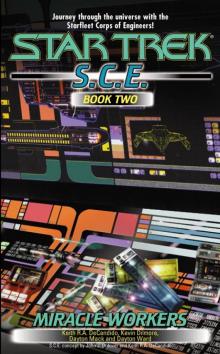
David Mack is a writer whose work spans multiple media. With writing partner John J. Ordover, he cowrote the Star Trek: Deep Space Nine episode “Starship Down” and the story treatment for the DS9 episode “It’s Only a Paper Moon.” Mack and Ordover also penned the four-issue Star Trek: Deep Space Nine/Star Trek: The Next Generation crossover comic-book miniseries Divided We Fall for WildStorm Comics. With Keith R.A. DeCandido, Mack cowrote the Star Trek: S.C.E. eBook novella Invincible, currently available in paperback as part of the collection titled Star Trek: S.C.E. Book 2: Miracle Workers. Mack’s solo writing for Star Trek includes the Star Trek: New Frontier Minipedia; the trade paperback The Starfleet Survival Guide; the best-selling and critically acclaimed two-part S.C.E. eBook novel Wildfire (to be printed in paperback form in early 2005); “Waiting for G’doh, or, How I Learned to Stop Moving and Hate People,” a short story for the Star Trek: New Frontier anthology No Limits, edited by Peter David; and the S.C.E. eBook Failsafe. Mack’s upcoming works include the S.C.E. eBook Small World and two Star Trek: The Next Generation novels, A Time to Kill and A Time to Heal. Mack currently resides in New York City with his wife, Kara.
Shinzon strode through the veils of oily smoke that rose from the burning Jem’Hadar corpses littering the battlefield. His footfalls pressed crisp bootprints into the soft, blood-soaked earth with muffled, grotesque squishing sounds. The sickly sweet odor of decaying flesh perfumed the sultry, predawn air as the youthful, slender human paused to look up at the stars.
The sky above the crater’s edge grayed with the approach of the Goloroth dawn. I’ve never seen a sunrise, Shinzon thought as he palmed a sheen of sweat off his smooth-shaven head. He had read elegant literary passages that described the sight of a solar mass emerging from beyond a planetary horizon, but living among the darkness-bound Remans had deprived him of certain experiences that he knew other humans took for granted.
Across the galaxy, trillions of humans lived their lives in the warm embrace of sunlight, as if it were their birthright and not a privilege. He envied and hated them for it.
He stepped carefully over the lifeless body of E’Mek, one of his Reman soldiers. Pale and fierce, the Remans were the only kin Shinzon had ever known. Creatures of eternal night, born of Romulan need and disdain, they were the Empire’s laborers and cannon fodder—both terms that, Shinzon noted grimly, were merely synonyms for what the Remans truly were:
Slaves.
Several dozen meters ahead of him, beyond a dense wall of smoke belching from the scattered wreckage of one of their Scorpion-class fighters, his few dozen surviving brothers in arms awaited him in the transport ships. Sixteen hours ago there had been hundreds more of these brave warriors, all since sacrificed in the name of victory—and Reman freedom.
Pain knifed through his gut. His vision blurred. He clenched at his abdomen and wished he could push his fingers through his armor, wished he could reach inside himself and tear out his soft, vulnerable parts. His knees buckled under him and his breath caught in his throat. Vkruk warned me this would happen, Shinzon thought. But it’s too soon…it’s not fair. His knees dug into the muddy ground. A shift in the wind enveloped him in the hot, choking smoke from the wrecked fighter. He felt himself pitch forward. Still clutching at his middle, he planted his free hand on the ground for support. Slime oozed up and swallowed his blood-caked fingers.
I cannot die here, not like this. Not yet. He fought back against the agony that dominated him. In the past sixteen hours he had risked everything for his people…for freedom…for revenge. He would not let it slip away now.
Sixteen hours earlier…
“They’re beaming over now,” Vkruk said, his baritone voice echoing in the mostly empty, windowless conference chamber. Shinzon nodded once to his monstrous-looking, gray-skinned Reman second-in-command and stood up from his chair.
Minutes ago, he’d been informed by T’Reth, the commander of the battle-scarred Imperial Warbird Draco—which Shinzon and his regiment of Reman shock troops had called home for the past five months—that they had been ordered to hold position and await VIP visitors from the Warbird Lykara. No other information had been offered, and Shinzon knew better than to inquire.
He pulled down his frayed tunic and straightened it as best he could. After five months and more than a dozen brutal engagements against the Dominion, his already rough-textured wardrobe had been left tattered and reeking of everything from blood to ketracel-white to sewage, depending on the mission.
A low-frequency hum built into an almost musical ringing. Swirling atoms materialized into three Vulcanoid shapes. They were surrounded by the shimmering, violet aura of the transporter beam, which cast long, muted shadows behind Shinzon and Vkruk. The duo shielded their eyes from the glare. As the pale glow subsided, Shinzon recognized two of the three Romulan dignitaries standing in front of him.
The first was Senator Tal’Aura, a high-ranking member of the senate. She was just as slim and regal as she had appeared in transmissions from Romulus.
The second was Imperial High Commander N’Vol, the supreme commander of the Romulan armed forces. Thin, graying hair framed his chiseled features, which were rapidly becoming creased by the pressures of prosecuting a much-dreaded war against the Dominion.
The third was an intense-looking Romulan man who Shinzon surmised was nearing middle-age, perhaps 140 or 150 years old. Despite his age, his hair was still jet-black, and his eyes gleamed with a keen intellect and a passionate, violent will.
To Shinzon, they all smelled immaculate—as if they had just washed and donned crisp, clean new uniforms. He doubted that these back-room schemers had ever seen the horrors of war with their own eyes, from the unique vantage point of a foot soldier on a battlefield.
He bowed his head, closed his right hand into a fist and pressed it to the left side of his chest, the ancient form of the Romulan salute. Out of the corner of his eye, he noted that Vkruk gritted his fangs and grudgingly did likewise, but kept his icy glare focused on the Romulans.
“Senator Tal’Aura,” Shinzon said, cautious to keep his tone diplomatic and untainted by the bitter contempt swelling in his heart. “High Commander N’Vol. We are honored to receive you.”
“Centurion Shinzon,” Tal’Aura said with a polite nod. N’Vol nodded curtly to Shinzon without speaking.
The one whom Shinzon didn’t recognize stepped forward. Shinzon noted with interest that Tal’Aura and N’Vol both stepped aside and slightly back, almost unconsciously subordinating themselves to the third Romulan. “I am General Valnor,” the intense Romulan said. “I’m here on behalf of the Tal Shiar. Time is short. Let us sit.”
Shinzon gestured with a sweep of his arm toward the conference table. He and Vkruk seated themselves to one side. Tal’Aura and N’Vol sat opposite them. Valnor sat down at the head of the table and inserted a data rod into a slot on the table surface. A holographic map of star systems along the Romulan-Federation Neutral Zone was projected above the table. The projection quickly zeroed in on one star system, then onto the fourth planet in that system.
“In the Neutral Zone lies the planet Goloroth,” Valnor said. He spoke quickly but with perfect diction as a blinking red dot marked a location on the planet surface. “On Goloroth is a top-secret Tal Shiar laboratory that is not supposed to exist.” The red dot expanded into a detailed schematic of the camouflaged underground facility. Shinzon eyed the schematic intently as the general continued. “It was created without official imperial sanction, and its presence in the Neutral Zone is a violation of our treaty with the Federation.”
Valnor pressed another touch pad, and a blue blinking dot appeared on a different part of the planet. “Forty-six hours ago, an advance team of Jem’Hadar landed on the planet and erected a Dominion communications relay.”
The hologram shifted to a detailed scan of the Jem’Hadar forces on the planet surface. “Thirty-seven hours ago we lost contact with our lab. Long-range scans have confirmed that it has not self-destructed. Because all attempts to remote-trigger the lab’s self-destruct system have failed, we must assume the Jem’Hadar have captured the lab.”
High Commander N’Vol reset the hologram to its original star-map configuration. It now showed numerous Federation and Klingon emblems accompanied by ship-registry data.
“Less than twenty-one hours from now, a combined force of Klingon Defense Force and Starfleet personnel will launch a counterattack against the Jem’Hadar forces on Goloroth,” N’Vol said. “Their objective is to capture the Dominion relay for analysis. Once they arrive, they will almost certainly discover the now-exposed Tal Shiar lab.”
Senator Tal’Aura deactivated the hologram and fixed Shinzon with a deadly look. “Such a discovery would be an extremely embarrassing incident for the Empire—”
“And a fatal one for many high-ranking members of the Tal Shiar,” Valnor interjected.
Shinzon studied the three Romulans’ faces. He saw contempt masked by transparently polite smiles. “How may I serve the Empire in this matter?” he said, mirroring their insincerity.
“We want you and your regiment to land on Goloroth ahead of the Klingon-Federation strike force,” Valnor said. “Destroy every trace of the lab’s existence.”
“No one must ever know of this meeting,” N’Vol said. “The senator, the general, and I were never here. Is that understood?”
“Perfectly,” Shinzon said. “And in return for our loyal silence…?”
The senator leaned forward and regarded Shinzon with a conspiratorial gleam. “If you succeed…command of your own warbird, with officers and crew of your choosing.”
Shinzon returned her unblinking gaze. “I accept.”
Beside him Vkruk drew a breath, a prelude to a protest. Shinzon silenced the hulking Reman with a gesture so subtle that it went completely unnoticed by the three Romulans. As recently as a few months ago, Shinzon would not have dared assert such authority over Vkruk. The elder Reman had adopted Shinzon when the human was abandoned by the Romulans in the mines of Remus. Shinzon had once regarded Vkruk as a surrogate father. But with the outbreak of war against the Dominion and the blossoming of Shinzon’s natural talents as a tactician and strategist, their bond had become more fraternal. And now that Shinzon was in command, he remembered the first lesson Vkruk had taught him as a child: Never show weakness.
Valnor stood and removed the data rod from the conference table. Tal’Aura and N’Vol rose from their seats half a second later. Shinzon and Vkruk followed suit.
“Success and glory,” Valnor said as he handed the data rod to Shinzon, who accepted it from the general with a courteous nod. Valnor touched a signal pad on his wrist. Moments later, the Romulans vanished into the unearthly nimbus of a transporter beam. The echo of the transporter’s high-pitched, melodic hum lingered after their departure.
Shinzon felt the rapid pulse of the Draco’s warp engines throb up through the deck. He looked at the data rod in his hand, then at Vkruk, who scowled at him.
“This is a fool’s errand,” Vkruk said. “The Tal Shiar cannot be trusted.”
Shinzon chuckled bitterly. “I never said I trusted them.” He put the data rod back in the slot on the conference table and called up the scan of the Jem’Hadar deployments.
Vkruk shook his head. “Accepting the assignment was a rash decision, Shinzon.”
“We had no choice. They weren’t asking.”
Vkruk turned his attention to the hologram. “The Jem’Hadar garrison is strong, well-equipped, and deeply entrenched,” he said in a voice that sounded like bootsteps on gravel. “Even if our warbird reaches orbit before they penetrate its cloaking device, there is no way to reach the surface without being detected.” The ashen-hued Goliath turned toward Shinzon and glowered disapprovingly. “This is a suicide mission.”
“Of course it is,” Shinzon said with a half-smirk. “That’s why they’re sending us.”
Shinzon deactivated the hologram, ejected the data rod and clutched it in his fist. This was the opportunity he had been waiting for since the day he and his Reman brethren had been conscripted as imperial shock troops. “Assemble the regiment,” he said. “I’ll brief them within the hour.”
Valnor stood in Senator Tal’Aura’s stateroom aboard the Lykara. He stared through his dim, semitransparent reflection on the panoramic window and gazed into the endless reservoir of darkness between the stars. Moments ago he had watched the Draco streak away at warp speed; now that it was too late to turn back, he was plagued by second thoughts.
He turned away from the window and faced Tal’Aura, who watched him with a well-rehearsed look of loving concern. “He accepted the mission far too eagerly,” Valnor said. “Either he has an agenda, or he has the wits of a bloodworm.”
Tal’Aura said, “He has neither. Shinzon is a good soldier who follows orders, nothing more.”
“He’s a human,” Valnor said with disgust as he walked away from the window, toward the table in the middle of the room.
Grinning beneath a wanly lifted eyebrow, Tal’Aura said, “He would say he’s a Reman.”
Valnor shook his head and frowned. He felt her eyes on him as he reached the table. “That’s hardly confidence-inspiring.” Picking up the bottle of violet-hued Saurian brandy from the table, he half filled a smoked-crystal tumbler. “I used to think the Remans were just savages, but they’re worse than that.” He lifted the squat, slightly opaque glass and sipped the sour beverage, swallowing hard to conceal his slightly puckered grimace. “They’re parasites, all of them.”
Tal’Aura strolled slowly along the room’s perimeter, drawing gradually closer to him. “Those ‘parasites,’ ” she said slowly, “built some of the most powerful weapons on this ship. They aren’t without their talents.” She let her fingertips glide over a computer panel. Half a second later, the adagio swells of bittersweet Deltan chamber music descended gently from speakers concealed in the ceiling.
Valnor had never found Tal’Aura the least bit attractive; he had never even tried to deceive her into believing that he did. However, that hadn’t stopped her from making it clear that if he wanted her help in a matter that could put her at odds with the senate, she expected from him certain discreet favors in return. Some of those favors were political in nature; others, apparently, were to be of a more personal variety.