Forge of the elders, p.27
Forge of the Elders,
p.27
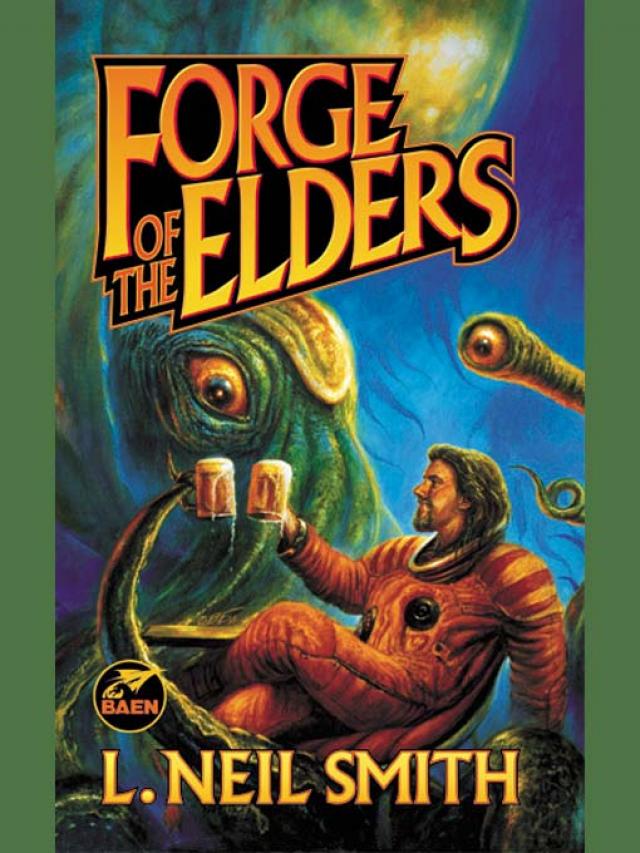


"Rather than a difference in anatomy." He saw that his guess was correct: she was more at ease in his presence than she was among her cosapients. Curious about what caused such an attitude, he couldn't help wondering what advantage might be made of it. He lifted a tentacle in encouragement. "Kindly elaborate."
"As far as clothing's concerned, one cylinder might provide for the . . . difference. But it would catch on things and get in the way. Imagine a cowboy or a steelworker in a skirt." She giggled again. "And it's confining. Would you like a cloth cylinder wrapped around your—" She stammered to a stop, clearly realizing for the first time that Mister Thoggosh was naked.
" `Tentacles' is acceptable, Toya." He set half a dozen wiggling before her face. "I'm no more embarrassed by it than you by mention of your fingers."
She swallowed. "I never visited before with anyone who had tentacles."
"I see," he replied with a tolerant chuckle, then let his voice assume a more serious tone. "You failed to mention the emotional discomfort your species experiences with regard to its reproductive function. One-cylinder garments conceal it. Two-cylinder garments disregard it altogether. An active male wearing one cylinder would be in constant danger of humiliating exposure."
She closed her eyes and grimaced. "I'm just about the worst person you could ask about this, Mister Thoggosh. In the first place, my primary interest is paleontology, not social anthropology, and in the second . . ."
"In the second," he observed, "discussing physical differences between the male and the female of your species embarrasses you."
"It does," she almost whispered. "It's just the way I am."
"It's just the way you were brought up, my dear, to deny the very aspect of your life which offers greatest gratification." He took a long draw on his beer, weighing his next words. "It's the same with many primitive cultures. Control that in a person, through repression and guilt, and what you call `society'—religion or the State—needn't control one other thing about you in order to control you altogether, to bend you from your own healthy, natural inclinations toward its own, which are invariably less natural and considerably less healthy."
"People need direction," she protested. "You can't have them chasing any old selfish whimsy, living empty, meaningless lives. Isn't it better to serve some higher purpose, larger than yourself, than no purpose at all?"
"The concept of purpose," he replied, "is just that, Toya, a concept, an idea, a product of individual sapience. It didn't exist before sapience evolved. It's meaningless applied to a random, inanimate universe. Similarly, it's irrelevant—life having arisen from that randomness—to nonsapient organisms governed by simple tropisms and instincts generated in the trial-and-error process of mutation and natural selection."
"But—"
"If you seek purpose, employ your own sapience to look within yourself. Your life has only one purpose, my dear, to be lived as you wish. Beware anyone who claims otherwise: the mystic, the altruist, the collectivist. One life isn't enough for him; he wants to live his own, and yours as well. His pleading and demands are baseless assertions thrown in the face of billions of years of evolution—itself without purpose, yet in response to natural law, invariably and inavoidably culminating in greater capacity, greater complexity, greater individuation—the very pinnacle of which, its crowning achievement and ultimate triumph over entropy, is self-directed intelligence.
"But this is small talk; I'd a more practical reason—a purpose, if you will—for asking you here."
She appeared relieved and at the same time wary. "What's that?"
"Among other things, to benefit from the human—the Soviet American—point of view on a number of difficult questions which presently confront me." He lifted a tentacle in a negligent shrug. "For example, I'd like very much to know whether my guesses about your general's thinking are correct."
Now she frowned. "Why don't you ask him?"
"Because he's a busy sapient at the best of times and right now he has a headache on his hands. (Can you say that? What a remarkable language.) I must know what his people are thinking, how well they see his reasons for doing things. I demand no betrayal, Toya, you needn't answer unless you wish to. But just now, General Gutierrez is thinking about the future, isn't he?"
"I suppose," she nodded, beginning to be interested, "we all are."
"And foremost among his thoughts must be this." He took a last sip and set the container aside, resisting the temptation to send for another. "If the United World Soviet has truly abandoned you, what's to become of thirty-odd surviving Soviet Americans on 5023 Eris?
"After all, you're completely dependent on alien monsters."
THIRTY-TWO Under the Microscope
"Alien monsters," Mister Thoggosh repeated, his tone gentler now. "You needn't be self-conscious about thinking it, my dear, nor deny that you do. With the best of intentions, I fear that I often think it of people like yourself. However in your case, they're monsters whose present kindness—"
She interrupted with a head-shake. "What bothers me, sir, is that your `present kindness' seems to contradict this `Forge of Adversity' philosophy of yours, at least as we understand it."
"It's scarcely an impenetrable notion," he answered thoughtfully, "nor some arbitrary superstition you are compelled to accept as you might some primitive tribal custom of diet or attire. It's simply that, for millions of years, we've understood—based on scientific reasoning open to reexamination at any time—that, as the product of eons of brutal weeding and pruning by natural selection, all sapients are the children of suffering and struggle."
"That's certainly grim." She gave him a brief, humorless smile.
"Not necessarily, Toya. After all, we've survived the process, something I think we're entitled to celebrate. And since successful struggle is what enabled us to become more than we were, hardier and brighter, we realize that shielding an individual or a species from what your poet termed `the slings and arrows of outrageous fortune'—from being shaped and hardened in what we ourselves somewhat lyrically refer to as the `Forge of Adversity'—however kindly the intention, represents the ultimate cruelty, depriving them, as it does, of their only motive or opportunity to transcend themselves."
" `That which doesn't kill us makes us stronger.' " She pursed her lips in disapproval. "Nietzsche, social Darwinism, dog-eat-dog, kill or be killed. Some humans have thought well of that philosophy. The Nazis, for example."
"Do you blame Nietzsche or Darwin for having been willfully misinterpreted—after their deaths, when they couldn't defend themselves or their ideas—to serve the political ends of villains?" Mister Thoggosh gave her the equivalent of a resigned nod. "But I see that—like these Nazis of yours—you're going to read into my words whatever you will. That being so, you must be wondering how long our `contradictory' kindness can be counted on. And what will happen if it eventually runs out?"
" `That is the question.' " She folded her hands in her lap, embarrassed. "Sorry—you're the one who started quoting Hamlet."
"Still, we approach the topic I wished to explore, nothing more than your general is asking himself this very moment: succinctly, in the otherwise hospitable environment of our terraformed asteroid, will you ultimately be allowed to starve to death where you sit? Or might you find yourselves evicted altogether, to suffocate or freeze in the depths of space?"
Pulaski shivered. "I wonder about that, myself."
"I'm sure you do." Mister Thoggosh paused to listen to a message coming over his implant. "Another matter: what of his authority, if the government it derives from has truly disowned you? It's a measure of his character, as I understand it, that this won't occur to him until he's considered the more urgent subject of his people's survival—Toya, please excuse my momentary inattention. I've received word that Eichra Oren has arrived and will presently be joining us. That is, if you don't mind."
"Why no," Pulaski answered, blinking. "Why should I?"
"Indeed." He noticed her countenance reddening again. Was this merely a demonstration of mammalian volatility or had he missed some nuance? Was his task about to prove easier than he'd believed? He had a deep distrust for things which came to him too easily.
"To continue, then, speculating upon your general's many concerns: authority would appear to be the lifeblood of your civilization, and this raises a number of questions. For example, is it exigent, in the absence of Earth-supported authority, that your expedition reorganize itself? If so, how is that to be accomplished?"
With a perplexed expression, she opened her mouth to reply.
"In America," a familiar human voice offered as, instead of speaking, Pulaski turned in her chair to see Eichra Oren and Sam swimming toward them through the fluorocarbon haze, "the law requires everyone to vote or suffer fine and imprisonment. And the franchise, as they call it, was an attractive and powerful custom long before it became compulsory." Man and dog back-paddled, settling to the floor. "Despite that fact—or because of it—Americans haven't had a truly free election since the early twentieth century."
Mister Thoggosh chuckled. "A cynic might amend that to the nineteenth century, citing the view of William Marcy Tweed, infamous boss of Tammany Hall and New York's Democratic Party, that he didn't give a damn who did the voting as long as he did the nominating. Good morning, Eichra Oren, Otusam, it's gratifying to see you at last. May I offer you something? I'm having beer."
"Coffee, thanks." He waited as a chair descended from the ceiling, then strapped himself in to avoid floating. The tentacle brought him a container. Unlike the beer, it was surrounded by mirage from the heat of its contents. Sam wasn't equipped to deal with a sipping tube. He sat beside Eichra Oren's chair, wedging his hindquarters under one leg in lieu of a seatbelt.
"They say—" the dog remarked, "and on Toya's Earth, mind you—that if voting could change things, it would be illegal."
"Doubtless." Mister Thoggosh sipped his own drink. "The question remains, will the Americans here hold an election to reconfirm the general's authority, or choose a new leader? Will they consider it conducive to their survival?"
Eichra Oren grinned and glanced at Pulaski. "When has authority ever been conducive to anyone's survival?"
Sam looked up. "I was going to say that."
"I'll have some coffee now, if it isn't any trouble." Pulaski had overcome her shyness. "I also want to say that if you've heard of Boss Tweed—I remember the name myself, from high school, mostly because of Thomas Nast, the cartoonist who introduced the elephant and the donkey—"
"As well as the Tammany tiger." Her host sent his tentacle to the wall again. "Sugar? Milk? Cinnamon? Chocolate? Brandy? You'd be surprised at the things various sapients put in their coffee."
"But not that they all drink it?" She shrugged. "I guess I'll try milk and chocolate—thanks—but that proves my point, the Tammany tiger, I mean. You've been studying a lot more than old movies."
Mister Thoggosh returned to his beer. "I'm sure you realize that your radio and television broadcasts—have I mentioned that your culture is uniquely noisy in that respect?—have been received, translated, and sifted by our computers for whatever information they may yield about you."
Pulaski took a dubious sip. "This is good! I know you've broken all our codes and—"
He made a many-tentacled gesture of denial. "Not `broken,' Toya, they're simply susceptible to the same protocols that sort out all those thousands of signals from one another, eliminate natural and mechanical interference, and enhance signal-to-noise ratios."
She looked up from her drink. "Don't we have any right to privacy?"
"You maintain that what you fling promiscuously into the air for anyone to receive is private? You're aware that we nautiloids have no voices in the sense you know. We communicate by natural, organic radio signals. At this moment, my words are being received, converted to sound, and relayed to you by those speakers against the wall. Must we stop our ears—are we morally obliged to—because someone else insists on shouting?"
Eichra Oren turned. "And exactly who do you mean `we'? Your government? Only individuals have rights, Sergeant. Proving that is a preschool exercise in our world. On the other hand, as far as I can see, your government recognizes no individual rights of any kind, let alone one to privacy."
"Indeed," Mister Thoggosh agreed, "given the predilections of government, any eavesdropping we do seems more like turnabout to me, and therefore fair play."
She lifted a defiant chin. "It doesn't matter. I can't stop you."
"No," the nautiloid agreed, "you can't. What you, your general, or this Banker fellow have no way of realizing is that we know you even better than that, Toya. We have observed your species with the minutest care, since our initial unbeinged surveys of this asteroid, long before it was terraformed. We never interfered—although I confess that the temptation's been all but overwhelming at times."
She looked up again. "You're talking over my head, Mister Thoggosh."
"And if I told you that we returned to this universe—for the first time in fifteen thousand years—in the late nineteenth century as you reckon it? The 1880s, to be precise?"
"Our observations peaked," Eichra Oren added, "in the late 1940s."
"Just about the time," Sam lifted a hind foot to scratch contemplatively at one ear, "that you people started dropping dirty little nukes on one another?"
"Roswell." Pulaski's eyes widened with honest surprise before self-conscious disbelief swept across her face to erase it. "Flying saucers?"
"Interdimensional peepholes," her host replied. "The objective ends, if you will, of survey devices physically based in our universe, and rooted in the same technology which brought us to this place. In normal use, they're handled rather like the beam of a flashlight. As you know, the use of such energies entails side effects—secondary discharges, conspicuous coronal displays—hence an occasional awareness of it by your people, despite the fact that our devices usually created apertures no larger than—"
"Like a flashlight beam," she repeated. "No wonder they could do right angles at six thousand klicks an hour! I guess there always was a certain percentage of UFO sightings never properly accounted for."
The mollusc regarded her. "And a greater percentage misaccounted for, by nation-states reluctant to admit that they can't control every event within their borders. Yet all we ever did was watch. It's all we were capable of at the time, barring the odd accident—although the number of alleged landings and personal contacts we inspired among the more fanciful was, to say the least, instructive."
She nodded. "'Intelligences vast and cool and unsympathetic'?"
"By turns, as seems required of us. And I believe the proper quotation is `intellects.' We can, of course, be quite as petty and irritable and sanguine as any species. However, unlike those Martians of Messrs. Wells and Welles, we've a perfectly good Earth of our own, and needn't regard yours or anybody else's with envious eyes."
"Also," Sam added, "we've managed to cure the common cold."
She and Eichra Oren laughed. "So what did all this . . . watching teach you about us?"
Mister Thoggosh considered. "In the main, that the less reliably an idea works, the more tenaciously you cling to it. Welfare payments drain your moral and economic vitality, so you approve more welfare. Criminal laws create crime where none existed previously, so you pass more laws. You defend yourselves from a tyranny you fear some foreign power may impose upon you, by imposing worse upon yourselves, then wonder why your freedom has evaporated. You brought Nazis into this, so you've no one to blame but yourself: Hitler's rise to preeminence took place in a manner fully reflecting the will of a legal majority. The ruination of your own country was achieved on precisely the same basis. Had half a billion years' bitter experience not prepared us to distrust majoritarianism, that would surely have done it."
"People get the kind of government they deserve," Sam grinned, "whether they deserve it or not."
It was Pulaski's turn: "One of our philosophers, Will Rogers, or maybe Winston Churchill, said democracy's a terrible system but it's better than anything else that's ever been tried."
"The Boss Tweeds of your world," Mister Thoggosh countered, "are very careful never to let the Will Rogerses or Winston Churchills try a genuine alternative to majoritarianism. They do exist, Toya, and they don't necessarily involve dictators or kings. Who says—what objective evidence supports the notion—that the majority has ever been right about anything, anyway?"
"More to the point," Eichra Oren put in, "what gives a majority its power to compel? Unless we're talking about brute force, why should anyone have to go along just because one over half of their fellow beings demand it?"
Pulaski blinked. "Because it's better than fighting?"
Eichra Oren grimaced. "It is fighting, Toya, with none of the satisfactions."
"Well, how about strength in numbers, then, or `Two heads are better than one,' or `United we stand, divided we—'?"
The nautiloid lifted a tentacle. "Toya, such attributes as virtue or intelligence aren't additive. It's absurd to maintain that two evil people can somehow be more virtuous than one decent person, or that two stupid people are brighter than one intelligent person. Why, then, does your culture assume that two people possess more rights than one?"
Her expression told them this was a new idea to her. She peered about with that reflex Eichra Oren had mentioned, as if she feared being overheard. At last: "I wish I could give you an answer, Mister Thoggosh. We're not encouraged to think about things like that."
"Whose interest does that serve?" He waved the rhetorical question away. "Never mind, Toya, skipping theory and fastening upon the urgently pragmatic, what if by some horrible—but typical—miscarriage of democracy, Arthur Empleado, let us say, were chosen to lead your expedition?"
"I—"
"Alternatively, what would happen if you tried, individually or as a group, to join what you know as the Elders' culture? Other species have, and other individuals. Setting aside the question of whether we would permit it, certainly it won't be permitted by your superiors here. And are your leaders at home really out of it? This `Banker' seems to have left certain contingencies open. If he should recontact you, which of the two—an unauthorized election, or an alliance with us—will he consider the more treasonous?"