Forge of the elders, p.35
Forge of the Elders,
p.35


" `Reality,' " Gutierrez sat beside Toya, "as opposed to `the universe'?"
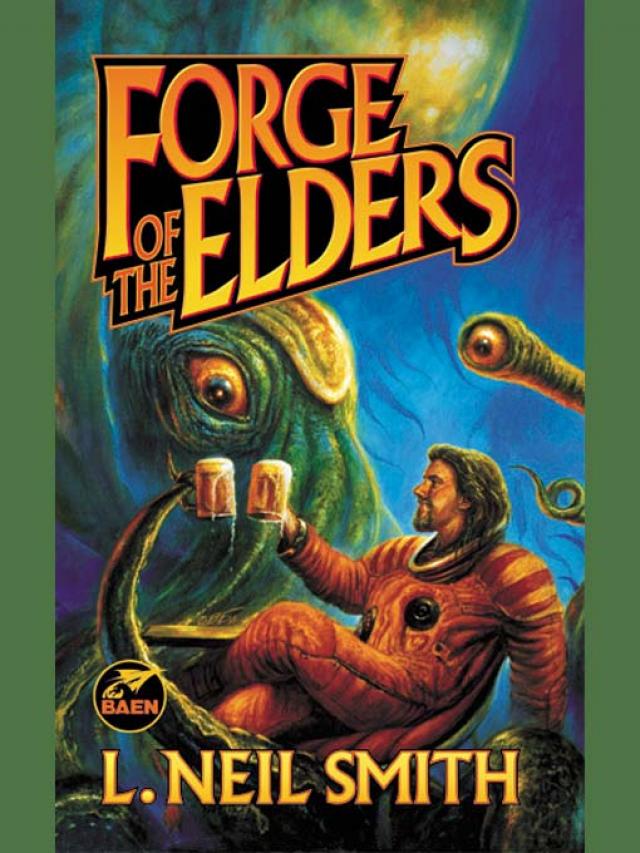
From Eichra Oren, Dlee Raftan Saon accepted a chair, folded in a different pattern to accommodate his insectile anatomy. He fished in a pocket of his lab coat and extracted an ordinary-looking briar pipe, stuffed it with what appeared to be tobacco, lit it, and puffed. Apparently, Toya thought, his species had outgrown spiracles. Aromatic smoke filled the tent. "The difference, General, is subtle, but significant."
Gutierrez grinned and pulled a pack of smuggled cigarettes from his own breast pocket. Giving it a characteristically American toss, he offered one to Eichra Oren, who raised a palm and shook his head politely. The Antarctican was sitting in a chair of his own, Sam on the floor at his knee as if he were an ordinary dog. Lighting his cigarette, the general said, "I'll take your word for it."
"Very well," declared the tentacle, settling itself lower on a second coil, "I suppose the place to begin, the first thing you should understand, is that the shrewdest among our philosophers who concern themselves with the origin and nature of the universe are presently in my employ. You might say I've recently taken a sort of `crash course' in the subject myself, although I'm still attempting to absorb the more slippery concepts involved. In any event, according to them, the universe possesses only six known fundamental forces."
"Is this anything human physics knows about?" Gutierrez inhaled smoke.
The surrogate gave the general another nod. "Three are known as the `Outer Forces,' familiar to you as gravity, magnetism, and electricity. Three more are the `Inner Forces': the strong nuclear force, the weak nuclear force, and what is still to humanity a `hidden' nuclear force often, and erroneously, referred to as the `fifth' force."
Gutierrez exhaled. "Why erroneously?"
"The name, General, overlooks the epochal work of your own Michael Faraday, or at least its cosmological significance. For you, the existence of this force has been inferred from other data. For us, it is an essential part of the machinery that brought us here. Together the two sets of forces, Inner and Outer, balance one another, creating a harmonious whole which your theorists would call symmetrical or `beautiful'. . . ."
"Beauty," Dlee Raftan Saon added, making clicking noises with his mouth parts which Toya knew signified amusement, "being in the optical receptor of the beholder." The insect-being drew on his pipe and exhaled a smoke-ring, making Toya think of the hookah-smoking caterpillar in Alice in Wonderland.
"Indeed," responded Mister Thoggosh with a trace of annoyance. "Likewise, General, the universe has long been known to possess six dimensions. Three are the familiar dimensions of space: breadth, depth, and height. Three are dimensions of time, the first and most familiar of which we call `duration.' The second is `probability,' along which we all traveled—all of us except your party—to arrive on this asteroid."
"And the third?" Toya startled herself by blurting the question. Embarrassed, she sank back in her chair, determined not to interrupt again. Beside her, Eichra Oren gave her hand a reassuring touch.
The snakelike object standing in for Mister Thoggosh was unperturbed. "The third, Toya, remains unknown, even to us. It is the `hidden' dimension of time. Nobody knows quite what this last mysterious dimension might consist of, even (I might say `especially') our philosophers, although they're certain it is something already quite familiar which everyone has overlooked."
"I'm not sure I understand, sir," Toya admitted, unable to help herself.
"Well, reconsider the second dimension of time. Didn't your people wager with one another long before Monsieur Pascal formally discovered the laws of probability? I assure you that they did in my version of reality."
"Mine, as well." The surgeon nodded, knocking his pipe out in an oddly shaped bowl he and Gutierrez had been sharing as an ashtray. Toya was sure it was some sort of bedpan. "In fact I'll wager that our guests would enjoy a bit of refreshment, perhaps even lunch. Is anyone else as hungry as I am?"
For a few minutes, the dissertation on metaphysics and cosmology was interrupted as their orders were relayed to the camp caterer via implant. The general put his cigarette out and asked for a cheeseburger, knowing it was a dish the nautiloids had recently discovered. Toya asked the physician to make it two. Sam and Eichra Oren sent their own requests. Whatever energy it drew from Mister Thoggosh's body, the appendage was incapable of refueling itself and continued lecturing while they waited for lunch.
"These two pairs of three forces and three dimensions comprise the twelve presumed `Elementals.' Just as we have found the hidden nuclear force—as your scientists have not yet—we all fondly hope to find the hidden dimension of time on 5023 Eris. It is believed by some, having done that, that we may discover yet another set of six—or even twelve—`hidden' Elementals."
Before anyone could ask him to explain, the meal arrived in insulated boxes carried by trainable insectile nonsapients. Except for the number of limbs, they bore little resemblance to the highly sapient Dlee Raftan Saon. Food was distributed as Mister Thoggosh went on.
"Which it will be—six, twelve, or none—is the subject of the most sanguine debate since those culminating in the Great Restitution. Careers are made, unmade, and remade every day depending on who's currently winning. Lifelong friends are known to stop speaking for centuries. It doesn't seem to matter that, so far, there are no hard facts to base an opinion on."
"Just like academics back home," Gutierrez observed around a bite of burger. Like Toya, he held the plastic container on his lap. The sandwich had come with lettuce, tomato, onion, and a pickle. Nor were French fries forgotten. A tall glass of lemonade stood beside his elbow on the computer table.
"Regrettably so. I even know of a duel fought over the subject."
"Now there's an idea for establishing priority!" Gutierrez laughed. Toya was unsure what he found so funny. "What do you think it is, six or twelve?"
"I've no idea whatever, General. However it turns out, these new Elementals are likely to be arrayed in either two or four subsets of three Elementals each, bringing the universe into full symmetry. These extra Elementals, like the hidden time dimension, can possibly be inferred from the workings of the Predecessors' Virtual Drive, our understanding and operation of which, it seems, depends on accepting an even more bizarre idea."
He waited for some reaction. Eichra Oren's attention seemed to be on his food, some unrecognizable but vaguely Chinese-looking dish. Sam was eating the same sort of thing from a container on the floor. Toya's hamburger was better than anything she'd ever had back home. She couldn't bring herself to examine too closely whatever Dlee Raftan Saon was sucking through the tube he'd inserted in one side of his food container. She was certain that all three were in fact focused intently on the nautiloid's words.
"Mass, as such, my associates inform me, doesn't really exist. Unlike the question of how many Elementals there are, nobody in the philosophical community seems to disagree with this idea, which, I confess, seems ridiculous to me. Subatomic particles, they say, are merely probabilistic ripples on the matrix of space-time. This includes, of course, those particles comprising sapient beings who wish to travel from place to place."
Sam looked up from his plate. "How's that?" It was the first time Toya had seen him eating and she understood now why he was shy about it. Lacking hands, he was reduced by the process to the animal nature he'd otherwise transcended.
The tentacle leaned over to address the dog. "As I understand it, Oasam, quantum physics holds that these particles are no more statistically likely to do their rippling in any one place than in any other. However intelligent and curious one may be, the concept almost makes one's brain ache."
"In other words," the dog offered, "if some particle can exist `here'—"
"By which I take it you mean the traveler's presumed point of departure . . ."
"Right—then why not over `there'?" Sam lowered his head to lap some liquid from a compartment of his plate.
"His intended destination?" The tentacle assumed a twisted posture, then relaxed. "According to physics, the two phenomena amount to the same thing. In theory, getting `there' should be no greater a problem than simply staying `here.' And after all, people and other objects seem to do the latter on a regular basis without difficulty, don't they?"
"Zen teleportation." Eichra Oren spoke for the first time in a while. "What you're saying, sir, is that the Predecessors traveled from one place to another more or less simply by changing the way they looked at things."
"And a pinch of pixie dust," Sam suggested.
Mister Thoggosh's answer began with a long pause. "One of the difficulties I find with this concept, gentlebeings, and I assure you that I find many, is that it sounds suspiciously like a free lunch. Over the course of a long career and an even longer lifetime, I've learned to distrust such propositions."
"Still, if it were true," Dlee Raftan Saon mused, "it would be a wonderful thing, brimming with possibilities."
"Indeed it would, Raftan. The concept, you see, doesn't involve real acceleration or its concomitant, uncomfortable, and rather inconvenient inertial and relativistic effects. It seems to be a matter of avoiding the speed of light, rather than exceeding it."
"Better yet," Sam suggested, "from a businessman's point of view, the process consumes no fuel."
"That thought had occurred to me, yes," replied the mollusc. "These would all seem to be costs of complying with what now look like merely local laws of physics. However, theory to one side for the time being, and from a strictly practical standpoint, things haven't been going smoothly for our enterprise here, which is why I've decided to tell you all the full truth and enlist your aid."
"About damned time!" Sam exclaimed, then looked up sheepishly at Eichra Oren. "Sorry, Boss."
"Don't be, Sam. I was about to say the same thing myself."
FORTY-TWO Hope of Redemption
"Geronimo, John Galt, this is Laika. Check your throttles again. My line feels slack, regardless of what the tension readouts tell me. Over."
Horatio Gutierrez, former Aerospace Force Brigadier General, officer in charge of the American Soviet Socialist Republic's expedition to the asteroid 5023 Eris, still captain of the twice-refitted and renamed space shuttle once known as the Honorable Robert Dole, peered out the left seat window at two other spacecraft, identical to his own, where they strained under their respective loads against a star-flecked background of blackest velvet. He'd never have believed it possible two weeks ago, but it felt good to be in space again, even if it meant resuming command of the small fleet of "Polish bombers" which in so many ways were the exact opposite of the sleek American Soviet interceptors he'd spent most of his life flying.
"Geronimo, here, Laika. We copy." The voice of Major Jesus Ortiz, captain of the former Honorable Orrin Hatch, issued from a speaker overhead. "This goofball of ours claims we're three hundredths of one percent over-throttled. I repeat, zero point zero three. I'm attempting to correct now. Over."
"John Galt to Laika," added Lieutenant Colonel Juan Sebastiano, captain of the former Honorable John McCain. "Our goofball's telling the same story. I'm not sure our control's that fine, but we'll give it a try. Over."
The "feel" Gutierrez had referred to was more a matter of how the modified engines sounded to him than of any tension reading or velocity indication. He was too preoccupied even to spare a glance at the computer, one of three onboard which struck him now as primitive.
Projecting from it, the alien interface Mister Thoggosh had supplied (the same casual way his chemists had cooked up the needed fuel) looked like a head-sized gray-green fungus. It had been created to help Laika and her sisters complete a mission which, like the expedition itself, they'd never been designed for. Hooked into the nautiloid cybernet, the "goofball," as his crew was calling it, performed calculations necessary to insert a miniature moon into orbit around the miniature planet. His own goofball told him, through a telltale on the already-crowded control board, that his adjustments were perfect.
Gutierrez didn't trust it.
Trailing on impossibly slender cables ten kilometers behind the craft (although in another sense they were trailing it as it preceded them in orbit) was a mountain of silica which would have been a kilometer in diameter had it been remotely spherical. To Gutierrez it resembled nothing in particular, "potato-shaped" in much the same way that every kind of unfamiliar meat is said to "taste like chicken." It was about twice as long as it was thick, and peppered with tiny impact craters. One curving surface was almost smooth except for a large elongated astrobleme (he'd thought craters weren't supposed to form like that) which was the most remarkable feature of the unremarkable rock. What was important was that it was the correct mass and composition. They'd found it, as Aelbraugh Pritsch had suggested they would, within a thousand kilometers, the average distance between asteroids in this region of the Belt.
Had it only been a week since Mister Thoggosh had confessed, during that remarkable conversation in Dlee Raftan Saon's tent, how weary he was of equipment failures and other technical problems associated with a ground-search for the Predecessor artifacts he was looking for? Looking back, it seemed much longer. What he wanted to do, he'd told the general, was place a smaller asteroid in a polar orbit around 5023 Eris. He'd reassured Gutierrez that, given the technology available to the Elders, such an undertaking was by no means impossible. There was no lack of small rocks circling the sun in this orbit and many were within easy reach of the nautiloid establishment.
"In aid of what, I suspect you are about ask," the appendage had responded to the general's upraised eyebrows. "Quite simply, I plan to establish an unbeinged base on our semiartificial moonlet. At that range, it can be directed quite as efficiently as one of our aerostats."
Gutierrez had grimaced, then laughed. He'd ridden here aboard one of the machines Mister Thoggosh was talking about. So had the tentacle, for that matter. Both bagel-shapes were parked just outside the door. Gutierrez had long since gathered that, had some calamity happened to the appendage, the mollusc could grow another, however long it took or painful it might be. He'd have a much tougher time growing himself a new Horatio, he thought with a morbid grin.
"It's the next step, General, no more impossible than the rest, I assure you, which takes one's intellectual breath away. We have in our possession certain instruments, new even to our science, which collect and interpret the galaxy's natural background neutrino-flux. They were imposed upon me at the outset of our expedition by certain individuals with a greater and more detachedly scientific interest in this affair than my own. They believe that each alternative universe has its own unique neutrino pattern. Now I'm rather grateful they were so adamant."
Gutierrez had listened as Mister Thoggosh explained to Dlee Raftan Saon (whose specialization lay in areas other than physics), that neutrinos were subatomic particles so small and swift they could pass through anything, including an entire planet, almost as if it weren't there. During the course of this explanation it had developed that the word "almost" (statistically a few neutrinos would be stopped or slowed by denser objects they attempted to pass through) was critical to the scheme.
"As these elusive particles pass, or fail to pass, through the world we occupy, which possesses roughly the same surface area as the region of your world known as `Texas,' these captured neutrinos will create, in effect, a spiraling X-ray or CAT-scan of the entire globe. This three-dimensional pattern of relative transmission and absorption will be detected on our little moon and relayed to our imaging and translating computers." The latter were devices which had "accidentally" broken Earth's most sophisticated military codes, having mistaken them for naturally occurring interference. "Since neutrinos are very small themselves," Mister Thoggosh had concluded, "resolution should be excellent."
"Giving us a peek," Dlee Raftan Saon suggested, "at what's inside."
"Precisely." Bent at the tip, the tentacle had given the impression it was turning to look at each of them. "I cannot bring myself to believe that the Predecessors, having taken care to leave so many tantalizing clues behind, would have made the task of recovering their technological legacy as difficult as it's seemed. Such a scan should reveal any great masses beneath the surface, including the object of our search, and possibly a method of getting to it. I can stop wasting my time, my investors' money, and the colony's dwindling supply of equipment on all this confounded blind drilling."
At this point the surrogate had turned to Gutierrez. "I believe this plan to be effective, General, but it's hindered by a lack of spacecraft to move the requisite small asteroid. I confess it was not a necessity I anticipated when I planned this expedition a century ago."
Gutierrez had nodded. "I assume you can't just send for a spaceship."
"Well, sir," Mister Thoggosh replied, "I've always been reluctant to employ, without the direst necessity, the expensive and somewhat unreliable facilities for interdimensional transport we have at our disposal. In this instance, both the difficulty and the expense increase as a function of the fifth power of the longest dimension of whatever's being sent."
"So it's especially dangerous to bring something as large as a ship?"
"And expensive." Even through a voice transducer, irony was audible in the nautiloid's chuckle. "What made the task appear absolutely insurmountable, however, was the utter impossibility I anticipated of accomplishing what I believe necessary under your watchful eye, sir. Thinking of you Americans, however, gave me an idea. You have the spacecraft, even if—I, er, that is . . ."
"Even if they're primitive by standards you're used to?"
Again the chuckle. "You've said it, sir, so I shan't have to. Might it be possible, I thought, given appropriate consideration, to borrow one or two of your craft and the crewbeings necessary to operate them?"
The general had laughed. "It wouldn't be unprecedented. It would be like people from our civilization borrowing a canoe from Pacific natives to recover the nose cone of a downed satellite. But you couldn't do it, could you, without giving the purpose of the search away?"