Nemesis, p.1
Nemesis,
p.1


About the Book
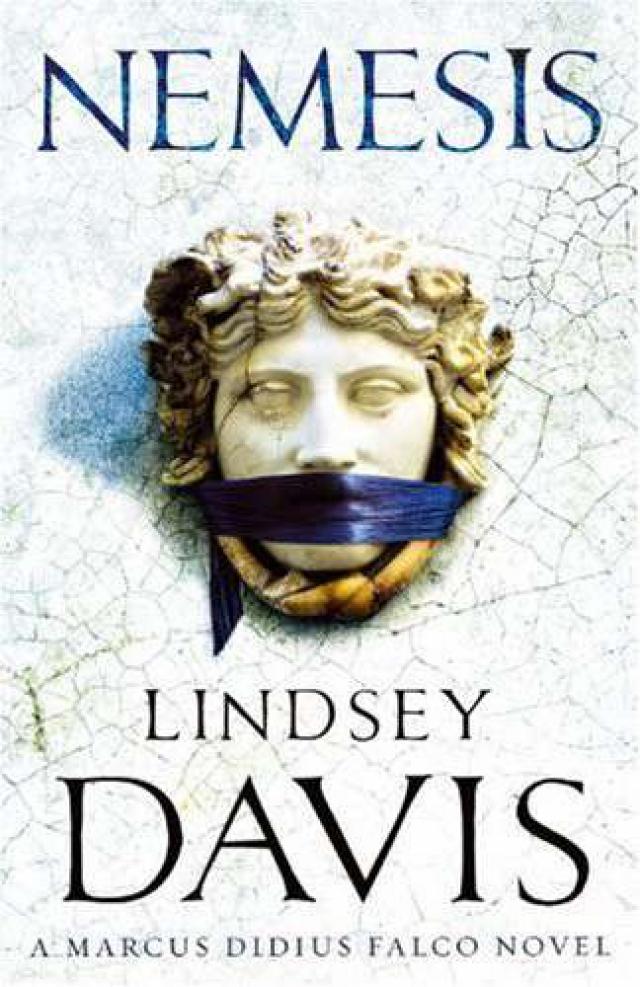
In the high summer of AD77, a middle-aged couple who supplied statues to Falco’s father, Geminus, have disappeared in mysterious circumstances. The Claudii, notorious freedmen who live rough in the pestilential Pontine Marshes, are the prime suspects. Falco, beset by personal problems, finds it a relief to consider someone else’s misfortunes.
When a mutilated corpse turns up near Rome, Falco and his vigiles friend Petronius investigate, only for the Chief Spy, Anacrites, to snatch their case away from them just as they are making progress. As his rivalry with Falco escalates, it emerges that the violent Claudii have acquired corrupt protection at the highest level. Making further enquiries after they have been warned off can only be dangerous – but when did that stop Falco and Petronius?
Egged on by the slippery bureaucrats who hate Anacrites, the dogged friends dig deeper while a psychotic killer keeps taking more victims, and the shocking truth creeps closer and closer to home …
NEMESIS
LINDSEY
DAVIS
Contents
Cover
About the Book
Title
Copyright
About the Author
Also available by Lindsey Davis
Principal Characters
Maps
Rome And Latium: Summer, AD 77
Chapter I
Chapter II
Chapter III
Chapter IV
Chapter V
Chapter VI
Chapter VII
Chapter VIII
Chapter IX
Chapter X
Chapter XI
Chapter XII
Chapter XIII
Chapter XIV
Chapter XV
Chapter XVI
Chapter XVII
Chapter XVIII
Chapter XIX
Chapter XX
Chapter XXI
Chapter XXII
Chapter XXIII
Chapter XXIV
Chapter XXV
Chapter XXVI
Chapter XXVII
Chapter XXVIII
Chapter XXIX
Chapter XXX
Chapter XXXI
Chapter XXXII
Chapter XXXIII
Chapter XXXIV
Chapter XXXV
Chapter XXXVI
Chapter XXXVII
Chapter XXXVIII
Chapter XXXIX
Chapter XL
Chapter XLI
Chapter XLII
Chapter XLIII
Chapter XLIV
Chapter LXV
Chapter XLVI
Chapter XLVII
Chapter XLVIII
Chapter XLIX
Chapter L
Chapter LI
Chapter LII
Chapter LIII
Chapter LIV
Chapter LV
Chapter LVI
Chapter LVII
Chapter LVIII
Chapter LIX
Chapter LX
Chapter LXI
Chapter LXII
This eBook is copyright material and must not be copied, reproduced, transferred, distributed, leased, licensed or publicly performed or used in any way except as specifically permitted in writing by the publishers, as allowed under the terms and conditions under which it was purchased or as strictly permitted by applicable copyright law. Any unauthorised distribution or use of this text may be a direct infringement of the author’s and publisher’s rights and those responsible may be liable in law accordingly.
Version 1.0
Epub ISBN: 9781446455258
www.randomhouse.co.uk
Published in the United Kingdom by Arrow Books in 2011
1 3 5 7 9 10 8 6 4 2
Copyright © Lindsey Davis 2010
Lindsey Davis has asserted her right under the Copyright, Designs and Patents Act 1988 to be identified as the author of this work
This novel is a work of fiction. Names and characters are the product of the author’s imagination and any resemblance to actual persons, living or dead, is entirely coincidental
This book is sold subject to the condition that it shall not, by way of trade or otherwise, be lent, resold, hired out, or otherwise circulated without the publisher’s prior consent in any form of binding or cover other than that in which it is published and without a similar condition, including this condition, being imposed on the subsequent purchaser
First published in the United Kingdom in 2010 by Century
Arrow Books
The Random House Group Limited
20 Vauxhall Bridge Road, London SW1V 2SA
Addresses for companies within The Random House Group Limited can be found at: www.randomhouse.co.uk/offices.htm
The Random House Group Limited Reg. No. 954009
www.rbooks.co.uk
A CIP catalogue record for this book is available from the British Library
ISBN 9780099536772
NEMESIS
Lindsey Davis began writing about the Romans with The Course of Honour, which tells the real-life love story of the Emperor Vespasian and Antonia Caenis. Her bestselling mystery series features laid-back First Century Roman detective Marcus Didius Falco and his partner Helena Justina, plus friends, relations, pets and bitter enemy the Chief Spy. She has also written Rebels and Traitors, a serious novel on an epic scale, set in the English Civil War and Commonwealth. Her books are translated into many languages, recorded for audio and serialised on BBC Radio 4. She has won the CWA Historical Dagger, the Dagger in the Library, and a Sherlock for Falco as Best Detective. She has been Honorary President of the Classical Association and is a past Chair of the Crimewriters’ Association. In 2009 she was awarded the Premio de Honor de Novela Historica by the Spanish City of Zaragoza, for her career as a historical novelist.
Also available by Lindsey Davis
The Course of Honour
The Falco Series
The Silver Pigs
Shadows in Bronze
Venus in Copper
The Iron Hand of Mars
Poseidon’s Gold
Last Act in Palmyra
Time to Depart
A Dying Light in Corduba
Three Hands in the Fountain
Two for the Lions
One Virgin too Many
Ode to a Banker
A Body in the Bath House
The Jupiter Myth
The Accusers
Scandal Takes a Holiday
See Delphi and Die
Saturnalia
Alexandria
Falco: The Official Companion
Rebels and Traitors
PRINCIPAL CHARACTERS
Marcus Didius Falco
a man of mixed fortunes and seeker after truth
Helena Justina
his true love, sought and won
Falco’s family
low grade, but not as bad as they seem:
Junilla Tacita
formidable wife to the deplorable Geminus
Maia Favonia
Falco’s sister, the best of the bunch
Flavia Albia
heart-broken and ready to break heads
Katutis
Falco’s secretary, a disappointed man
Helena’s family
high class, but not as good as they look:
Aulus Camillus Aelianus
keeping a low profile
Quintus Camillus Justinus
keeping his career on target, thanks to:
Claudia Rufina
his wife and financial backer
Lentullus
an accident waiting to happen
Falco’s associates in Rome
Lucius Petronius Longus
an upright vigiles enquirer (low pay)
Lucius Petronius Rectus
his brother, feeling off colour
Nero
their ox, another one gone missing
Tiberius Fusculus
Petro’s second in command
Sergius
their whip man (always encouraging)
Clusius
a devious rival auctioneer (low motives)
Gaius
a dubious apprentice (high hopes)
Gornia
a tight-lipped porter (no comment)
Septimus Parvo
a family lawyer (absolutely no comment)
Thalia
a contortionist with a problem to wriggle out of
Philadelphion and Davos
her lovers, keeping well off the scene
Minas of Karystos
a lawyer, on the up
Hosidia Meline
a bride (on the make?)
Also in Rome
Tiberius Claudius Laeta
a smooth bureaucrat with high aspirations
Momus
a rough-edged auditor with low habits
Tiberius Claudius Anacrites
the Chief Spy, a high-flyer of low worth
The Melitans
his agents (dodgy connections)
Perella
an assassin who wants a new job (her boss’s)
Heracleides
party-planner to the stars
Nymphidias
his thieving chef
Scorpus
a singer, spying on spies (an idiot)
Alis
a fortune-teller who blames Mum (a wise woman)
Arrius Persicus
a philanderer, oversexed and over-budget
A courier
newly wed and newly dead
Volusius
Mum’s boy, a numerate victim
In Latium
Januaria
a waitress at Satricum, an allrounder
Livia Primilla & Julius Modestus Sextus Silanus
complainants in high dudgeon their nephew in Lanuvium, in low spirits
Macer
their loyal overseer, gone missing
Syrus
their runaway slave, fatally roughed up
A butcher in Lanuvium
a very careless creditor
The horrible Claudii
neighbours from Hades:
Aristocles and Casta
cold-natured, hot-tempered parents (deceased)
Claudius Nobilis
so notorious, he has ‘gone to see his granny’
Pius and Virtus
the twins, ‘working away from home’
Probus
‘upholding the family name’
Felix
‘lost’
Plotia and Byrta
downtrodden wives
Demetria
runaway wife of Claudius Nobilis (low esteem)
Costus
her new boyfriend (asking for trouble)
Vexus
her father (anticipating the worst)
Thamyris
employer of Nobilis and Costus (over-confident)
Silvius
an officer of the Urban Cohorts, undercover
Plus full supporting cast:
Jason the python, dogs, missing persons, slaves (non-persons), personal beauticians, impersonal magistrates
And featuring:
The Praetorian Guards
bastards!
ROME AND LATIUM: SUMMER, AD 77
I
I find it surprising more people are not killed over dinner at home. In my work we reckon that murder is most likely to happen among close acquaintances. Someone will finally snap after years of being wound up to blind rage by the very folk who best know how to drive them to distraction. For once it will be just too much to watch someone else eating the last sesame pancake – which, of course, was snatched with a triumphant laugh that was intended to rankle. So a victim expires with honey still dribbling down their chin – though it happens less often than you might expect.
Why are more kitchen cleavers not sunk between the fat shoulders of appalling uncles who get the slaves pregnant? Or that sneaky sister who shamelessly grabs the most desirable bedroom, with its glimpse of a corner of the Temple of Divine Claudius and almost no cracks in the walls? Or the crude son who farts uncontrollably, however many times he is told …
Even if people do not stab or strangle their own, you would expect more to rush out into the streets and vent their frustration upon the first person they meet. Perhaps they do. Perhaps even the random killing of strangers, which the vigiles call ‘a motiveless crime’, sometimes has an understandable domestic cause.
It could so easily have happened to us.
I grew up in a large family, crammed into a couple of small, sour rooms. All around our apartment were other teeming groups, too noisy, too obstreperous and all packed together far too close. Perhaps the thing that saved us from tragedy was that my father left home – his only escape from a situation he had come to find hideous, and an event which at least saved us from the burden of more children. Later my brother took himself off to the army; eventually I saw the sense of it and did the same. My sisters moved out to harass the feckless men they bullied into marriage. My mother, having brought up seven, was left alone but continued to have a strong influence on all of us. Even my father, once he returned to Rome, viewed Ma with wary respect.
As she continually reminded us, mothers can never retire. So, when my wife went into labour with our third child, in came Ma to boss everyone about, even though she was becoming frail and had eyesight problems. Helena’s own mama rushed to our house too, the noble Julia Justa rolling up her sleeves to interfere in her genteel way. We had employed a perfectly decent midwife.
At first the mothers battled for dominance. In the end, when they were both badly needed, all that stopped.
My new son died on the day he was born. At once, we felt we were living in a tragedy that was unique to us. I suppose that is how it always seems.
The birth had been easy, a short labour like our second daughter’s. Favonia had taken a week to seize upon existence but then she thrived. I thought the same would happen. But when this baby emerged, he was already fading. He never responded to us; he slipped away within hours.
The midwife said a mother should hold a dead baby; afterwards she and Julia Justa had to wrestle to make Helena give up the body again. Helena went into deep shock. Women cleaned up, as they do. Helena Justina stayed in the bedroom, refusing comfort, ignoring food, declining to see her daughters, even distant with me. My sister Maia said this day would be black in Helena’s calendar for the rest of her life; Maia knew what it was to lose a child. At first I could not believe Helena would ever come out of it. It seemed to me, we might never even reach that point where grief only overtook her on anniversaries. She stayed frozen at the moment when she was told her boy was dead.
All action fell to me. It was not a legal necessity, but I named him: Marcus Didius Justinianus. In my place many fathers would not have bothered. His birth would not be registered; he had no civic identity. Perhaps I was wrong. I just had to decide what to do. His mother had survived, but for the moment I was alone trying to hold the family together, trying to choose what formalities were appropriate. It all became even more difficult after I learned what else had happened on that day.
The tiny swaddled bundle had been placed in a room we rarely used. What was I to do next? A newborn should receive no funeral rites; he was too small for full cremation. Adult burials must be held outside the city; families who can afford it build a mausoleum beside a highroad for their embalmed bodies or cremation urns. That had never been for us; ashes of the plebeian Didii are kept in a cupboard for a time, and then mysteriously lost.
My mother revealed that she had always taken her stillborns to the Campagna farm where she grew up, but I could not leave my distraught family. Helena’s father, the senator, offered me a niche in the tumbledown columbarium of the Camilli on the Via Appia, saying sadly, ‘It will be a very small urn!’ I thought about it, but was too proud. We live in a patriarchal society; he was my son. I don’t give two figs for formal rules, but disposal was my responsibility.
Some people inter newborn babies under a slab in a new building; none was available and I jibbed at making our child into a votive offering. I don’t annoy the gods; I don’t encourage them either. We lived in an old town house at the foot of the Aventine, with a back exit, but almost no ground. If I dug a tiny grave among the sage and rosemary, there was a horrendous possibility children at play or cooks digging holes to bury fish bones might one day turn up little Marcus’ ribs accidentally.
I climbed up to our roof terrace and sat alone with the problem.
The answer came to me just before stiffness set in. I would take my sad bundle out to my father’s house. We ourselves had once lived there, up on the Janiculan Hill across the Tiber; in fact, I was the idiot who first bought the inconvenient place. I had since worked a swap with my father but it still seemed like home. Although Pa was a reprobate, his villa offered the baby a resting place where, when Helena was ready for it, we could put up a memorial stone.
I wondered briefly why my father had not yet come with condolences. Normally when people wanted time alone, he was a first-footer. He could smell tragedy like newly cooked bread. He was bound to let himself in with that house key he would never give back to me, then irritate us with his insensitivity. The thought of Pa issuing platitudes to shake Helena out of her sadness was dire. He would probably try to get me drunk. Wine was bound to feature in my recovery one day, but I wanted to choose how, when and where the medicine was applied. The dose would be poured by my best friend Petronius Longus. The only reason I had not sought him out so far, was delicacy because he too had lost young children. Besides, I had things to do first.