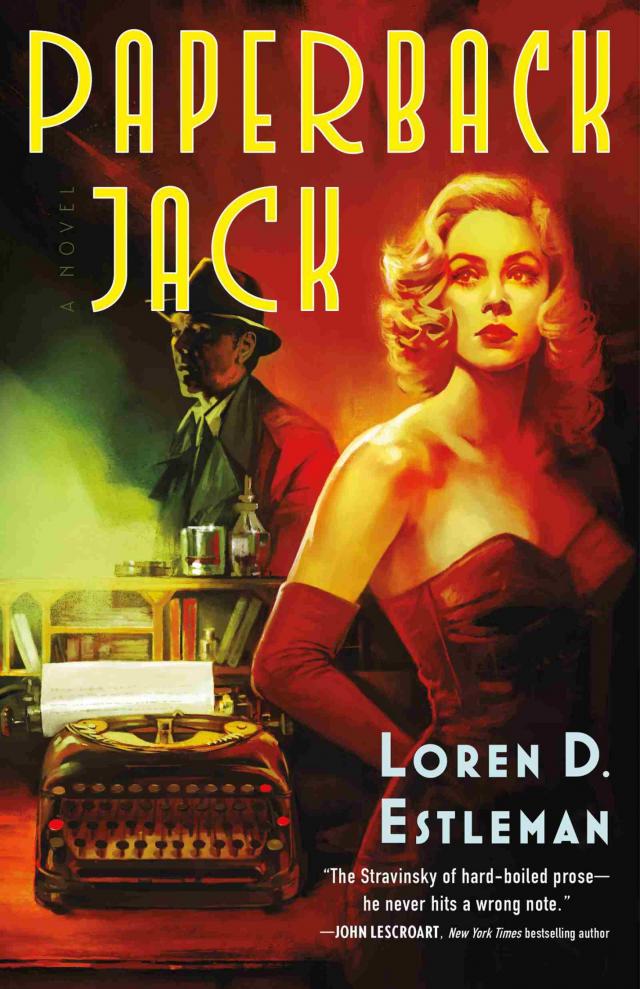
Paperback jack, p.10
Paperback Jack,
p.10


“Mickey’s a combination Robin Hood and Karl Marx.”
The little man glowered at the artist. “I’m no Commie. I take showers and I voted for Willkie.” He pointed a thumb at Jacob. “You write about me, I get first look. Otherwise you don’t leave the neighborhood.” He unbuttoned his suitcoat and spread it, exposing the walnut handle of a semiautomatic pistol in an underarm holster. “I can pick the eye out of a rat at fifty yards.”
Jacob nodded. He was glad he’d left the .45 behind.
“Swell.” Shannon buttoned the coat. “Getting started was easy. I spent a lot of time in hotels on the circuit, made friends with the help. They got keys to all the rooms and don’t get paid shit. But they don’t know where to lay off the merch. That’s where I come in.
“You meet all kinds hanging around the ten-dollar window: jewelers, salesmen, indies that deal out of car trunks. I split even. Think; half the cops are gone overseas. Business is booming on the black market, and the word’s out you get a square deal from Irish Mickey every time. Repeat customers, that’s the secret.” He shifted his gaze from Jacob’s sternum to Scarpetti’s. “See, that’s capitalism. Joe Stalin wouldn’t last a week in this racket.”
“I stand corrected.”
Jacob was wearing his army greatcoat. He put a hand on the lapel. “May I?”
“Depends on what you’re going for.”
“Just this.” Moving slowly, he opened the coat, drew out Chinese Checkers, and held it out. The little man took it, frowned at the cover, turned it over and read the back.
“Sex stuff. I want pussy, I go get it. I don’t read a book about somebody else getting pussy.”
“It’s to let you know Phil didn’t misrepresent me.”
He opened it to the title page. “What’s this?”
“My name. I signed it.”
“Nuts. I can’t sell a book somebody wrote in.” He tossed it into the gloom, where it landed on something other than the floor. But his mood was brighter. He rubbed his hands. “Let’s go see what Santa brought.”
They followed the little man down a narrow hallway, Shannon flipping wall switches as he went. The place was scarcely less bleak for the light.
They stopped finally in a room that ran the width of the house, with a ten-foot ceiling from which hung fluorescent tubes in metal troughs. Shannon walked through it, tugging chain switches. The tubes fluttered on one by one. Here the light entered every corner.
Jacob felt his jaw drop. The room was stacked with containers—cardboard cartons, wooden packing crates, steel drums, tins, shipping tubes—in rows eight feet high, with aisles running between them lengthwise and crosswise, like streets between skyscrapers. They were stenciled with familiar names: WESTINGHOUSE, MAYTAG, DUMONT, HOTPOINT, BERGDORF GOODMAN, MACY’S, LUCKY STRIKE, OLD MILWAUKEE, PHILCO; so many that after a while the letters began not to make sense, as if written in a foreign language. There were refrigerators, washing machines, TV sets, kitchen ranges, radios, cartons and cartons of cigarettes, cases and cases of beer, silk dresses, Arrow shirts, costume jewelry, men’s and women’s watches: A city built entirely of merchandise, and all of it apparently stolen.
“This baby here’s my retirement.” Shannon smacked a palm against an oblong crate that might have contained a coffin. It was stenciled CURTIS MATHES. “Combination radio, record player, and TV. All yours after forty-nine easy payments, unless you know yours truly, who’ll give you a sweetheart deal. Buy one of these, you’ll never have to take out the little woman again. Can’t keep ’em in stock.”
The tour continued. A stone lion that might have come from the porch of the New York Public Library roared silently in a crate with openings between the slats. A magician’s cabinet stood bare, decorated with stars and harlequins in glitter paint. (“Disappearing act,” Mickey said, “right off the stage at the Apollo during the show. I thought when I opened it the magician would still be inside.”) A cardboard box with holes in the top marked VIVANT ENFANTS POUSSINS. Jacob retained just enough French to know it was supposed to contain live baby chicks. He cocked his ears, but heard no cheeping from inside.
Mickey noticed. “French novels. Coast Guard seizes porno at the docks. Livestock goes straight to quarantine. I got people there.”
He gestured disparagingly toward a crate he could have stood up in: ROCK-OLA, the label read. It was a jukebox.
“That was a mistake. I was getting my tonsils out and the punk I left in charge bought it off a forklift driver with a bad sense of direction. Frankie Costello’s got all the juke routes sewed up clear down to Florida. If I was to try to move this myself, there’ll be a yard and a half less of Irish Mickey Shannon in the world.”
Scarpetti asked him how much he wanted for it.
“I just got through telling you it ain’t for sale.”
“I don’t plan to make money off it. I can use it as a prop when I’m painting a scene in a gin mill.”
“You don’t tell nobody where you got it.”
“I can’t spare a yard and a half of myself any more than you can.”
“For you, three-fifty.”
“Skip it. I’ll bring my sketchbook to a bar.”
“Suit yourself. I know one of Costello’s boys. I’ll make him a present. You can’t have too much goodwill.”
“Where does all this stuff come from?” Jacob asked.
Mickey smiled. His teeth were the biggest thing about him; his mouth seemed barely to contain them. “It’s a crime the way some guys drive trucks. Shit keeps falling off.”
“Sometimes at gunpoint,” Scarpetti said, sotto voce.
Shannon took a fat wallet from his hip. When he opened it, an accordion series of glassine pockets unfolded nearly to his shoes. A rainbow assortment of cards showed. “I pay dues to every union in town, not counting the Policemen’s Benevolent Association.” He ticked them off, folding each card back into the wallet as he came to it. “Teamsters, stevedores, pipe-fitters, electricians, switchboard operators, waiters, dishwashers, Linotypists, carpenters, hotel clerks, driving instructors, hacks, railroad porters, barbers, manicurists—”
“Manicurists?” Scarpetti grinned.
“Listen, that one was easier to get into than railroad porters. The high-class coloreds got that one nailed down.” He continued. “Stonemasons, bricklayers, housepainters, bookkeepers—here’s my favorite, projectionist. Ann Sheridan’s in town, she wants to screen her latest for her Park Avenue friends, I’m her man.”
Jacob said, “Has that ever happened?”
“I’d settle for Rin Tin Tin. Brewers, mechanics, sanitation. Stock boys smuggle all kinds of shit into trash bins; spoil your faith in human nature.” He put away the wallet. “These here affiliations are my biggest investment, also my best. I got a warehouse on the Hudson full of wire and pipe from the electricians’ and plumbers’, and I’m charging double now that people are building houses again.”
“What about the police?”
“My second biggest investment. They think I’m a millionaire.”
“You are a millionaire,” Scarpetti said.
Shannon stuck his thumb at Jacob. “You don’t write that. I don’t need Internal Revenue snooping around.”
“This is all off the record. I’m writing about a garden-variety fence, not General Motors.”
“I didn’t start at the top. It’s a regular Horace Alger story.”
“I’d be accused corrupting our youth. They’d jail me for contributing to the delinquency of minors.”
“Unless you kill the guy off,” Phil said.
Mickey shuddered. “Cut that out. It’s bad luck.”
* * *
They left the little man and walked back to Scarpetti’s loft. It was snowing, but the flakes dissolved when they reached the sidewalk. The seasons had begun to turn just while they were inside.
“Nobody patted me down,” Jacob said. “I didn’t even see any henchmen, unless you count Methuselah at the door.”
“That was Mickey’s Uncle Sid. He keeps him around for luck. I didn’t really think you’d get the full treatment. But you never know when a guy’s seen too many movies.”
He stepped up the pace. “You know, that’s not a bad idea, telling Mickey’s life story. Change his name, make him life size, and cut him up with a chain saw in the end. I’ll order more Cadmium Red.”
“No chain saws. I’m not writing a horror comic book.”
“You’re writing, though, right now. I know that look. I’ve seen it in the mirror.”
“Jack Holly’s writing. I haven’t the slightest idea what Jacob Heppleman’s up to.”
CHAPTER TWENTY
“You know what today is, don’t you?”
* * *
Oh, dear God.
He decided not to try and bluff his way through. “I’m guessing it’s significant. Let’s get the fight out of the way so we can make up in the sack.”
They were in Ellen’s new apartment. She’d moved in a month before. That took roommate Ann out of the equation, with no objection from him. There were still things in cardboard cartons in the living room, which had come furnished in someone else’s taste; but the neighborhood was respectable and the building super was an ex-marine, with the protective instincts of a mastiff.
“Silly. I first saw you six months ago today.”
Had it been that long? Yep: He’d started writing The Fence at the end of January, and now the galley proofs were on his dining room table. “So what’d you think?” he asked.
“Good posture. I had you down for a colonel at least. One of those battlefield promotions, where someone who looks like Tyrone Power storms a machine-gun nest and takes Hitler prisoner, then comes home to sell war bonds.”
“I thought I looked like Jimmy Stewart.”
“Don’t be a goof. You had broad shoulders and lean hips. A cowboy, if not a colonel.”
“I’ve filled out a little since.”
“What’d you think of me?”
They were sitting on a red plush sofa that belonged in a shabby hotel lobby, her head on his shoulder.
“Nice legs.”
“That’s all you remember?”
“You called that instructor—what was his name?”
“Tharp.”
“Tharp. You called him a son of a bitch.”
“That was you. I called him a shit. So I had nice sticks and a potty mouth. Great first impression.”
“Is this the fight?”
“It is if you don’t kiss me right away.”
That attended to, he said, “I’ve been meaning to ask you something.”
“It’s henna rinse. Mouse-brown at the roots.”
“I knew that. I’ve been in your medicine cabinet.”
“You snooped?”
“I was doing research.”
“So you know all my secrets.”
“Not all.” He hesitated. “Ann told me you lost the love of your life in the war. I thought you’d been engaged or something and he was killed in action. But you never mentioned it, so—”
“Is it important?”
“I need to know who my rival is so I can compete.”
“It’s not much of a competition when he’s dead.”
“It’s worse. He’s not around to make an ass of himself from time to time so I don’t make an ass of myself running down the dear departed.”
She leaned away from him and lit a Lucky. “Ann’s quite the storyteller. I’m surprised she doesn’t write books herself; juicy ones they keep under the counter.”
“Look, if it’s too painful—”
“It is, and I’d rather not go into it now. Is that okay? I’m not trying to be mysterious.”
“Okay.”
But it wasn’t, and after a few more minutes he left.
Back in his apartment he fixed himself a drink and nursed it for an hour proofing The Fence. He hadn’t seen galleys since before the war, and had forgotten how pleasant it was to read his own writing in print, when he’d finished second-guessing himself. Now he could concentrate on typos and last-minute bursts of inspiration.
Somewhere on Long Island, a Linotypist had cast Jack Holly’s words in lead alloy, then used an ink roller to press the letters onto cheap newsprint, four pages per sheet. In the weeks to come, the corrected copy would be duplicated twenty thousand times on a cylinder press, trimmed, bound, and shipped to every retail outlet in the U.S. that contained a paperback rack. There, some browser might pick it up, intrigued by Phil Scarpetti’s arresting artwork, skim the description on the back (“He made his living off the misfortunes of others: until fate—and a blonde named Marcy—made it his dying!”), look at the excerpt on the flyleaf (“‘If you won’t buy my grandmother’s watch, what can I sell you?’ Marcy implored the fence.”), and possibly plunk down two bits to read the rest.
Jacob would never get over the wonder of it; that a grown man should make up stories, write them down, and expect sane people to buy them. It filled him with pride and shame at the same time.
His research had only begun with Irish Mickey Shannon. He’d spent weeks in the Battery interviewing dock workers, in bus stations and truck depots and taxi garages talking to drivers, buying trinkets in Macy’s and Gimbels to get salesgirls to open up; plundering the Bronx, Brooklyn, and Queens for authentic color. It was important to get the working class right, because Robin Elk believed it to be Blue Devil’s core market.
“Jack Holly’s” fence, Mike Moynihan (Good-bye, Herbert Jackdaw), belonged to that world. He was in a hurry to make his fortune, and the first step was to shitcan scruples. He bore little resemblance to Irish Mickey Shannon; not because Jacob feared his displeasure, but because even anti-heroes must be pleasant to look at. Elk was a stickler on that point: “It’s women who buy books, Jack; they’re the ones who go shopping.” Scarpetti’s men were slightly battered matinee idols with powerful physiques.
Mike Moynihan starts out desperate. Fresh from the war and broke, he steals a typewriter from a pawnshop hoping to turn it into cash. Caught by the owner, he repents, and moves the kindly old soul (Good-bye, Linus Pickering, hello Father Flanagan type) to take him under his wing and show him the pawnbroking business. But a sudden opportunity to profit from stolen goods leads him deeper and deeper into the black market, and higher and higher on the criminal ladder until he controls most of the contraband traffic in New York.
Jacob had moved Shannon’s base of operations to Harlem, partly to shield his source, but also for artistic reasons: No other neighborhood in the city offered so thorough an atmosphere of an alien culture, a world complete unto itself. Jacob had wanted to make his protagonist colored, but Elk vetoed that after reading the early pages: “Sad to relate, old boy, but a Negro in the lead would wipe out the market down South: Piggly Wiggly accounts for fifteen percent of sales there.” And so he was reborn shanty Irish.
There was a woman, of course: Marcia “Marcy” Elliott. In the first draft she was Ellen; but that was for his eyes only. In revision he fell back on subterfuge yet again. Women had peculiar notions about broadcasting their private acts to the world.
Marcy was Moynihan’s undoing, that was a given from the beginning, when she wandered into his shop, desperate (that word again) to sell her grandmother’s gold lapel watch to pay for her mother’s (scratch that) father’s (scratch that) brother’s (scratch that) operation (revise; it was too much like Dickens. Make it dreams of Broadway stardom, reduced to the reality of a cold-water flat on Tenth and the rent two months past due). Moynihan, callous cad, buys her virtue instead. Her revenge comes when she tricks him into buying and selling a stolen jukebox, bringing him to the attention of “Blinky” Fantonetti, the Juke King of Jersey.
On the last page Mike turned the key in the ignition of his Cadillac, and Phil Scarpetti got his explosion: a bonus panel on the back cover, a rare extra outlay on the part of Robin Elk, the Penny-Pinching King of Manhattan.
Raw melodrama, everything but the villain twisting his moustache, dished up without apology. Not David Copperfield; not even Varney the Vampire, which at least had the virtue of originality; but steps above Lash Logan, Private Eye. He was satisfied enough to put the name Holly to it; the pseudonym had by now acquired a legitimacy of its own.
Scarpetti approved. He’d even given him the original art, which hung now unframed on a wall: A dissolute-but-dashing rogue in the foreground, counting crumpled and greasy bills onto the counter of a shop filled with looted treasures, ignoring the blonde disrobing behind him, despite her center spot in the composition. On the book, THE FENCE in bulbous yellow letters, by Jack Holly in smaller type in white, with the bratty Blue Devil leering in the upper right-hand corner, the size of a penny stamp.
But what to do about Ellen? She’d kept asking to read the book, but he’d put her off, saying it wasn’t ready to show. Now here it was in print, the intimate details of their relationship public property.
Then again, she had her own secrets, didn’t she?
CHAPTER TWENTY-ONE
Dear Valued Contributor:
You and a guest are cordially invited to attend a
celebration of Blue Devil Books’s new line of
original fiction, to take place
Saturday, June 7, 1947
at 7:30 P.M.
in the offices of Blue Devil Books
16 University Place
New York, NY
Dress casual. Refreshments will be served.
Thank you for joining us in this bold new venture.
Yours most sincerely,
Robin Llewellyn Elk, Esq.
Elk’s decision to host the festivities in the publishing house, with all the doors open to aid the flow, gave the occasion the air of an office Christmas party. People talked too fast and laughed too loud, drinks spilled without apology, and someone had squashed the shrimp from a cocktail into the carpet in Elk’s office like a cigarette butt. Blowups of the covers of the summer line (was it Jacob’s imagination, or was The Fence bigger than the rest, and the half-naked female model’s resemblance to Ellen more pronounced?) hung on every wall and the company mascot leered down from congratulatory banners printed on Long Island, blue pitchfork in hand.