Paperback jack, p.2
Paperback Jack,
p.2


“Hello, Ira. I see you’re still too cheap to hire a secretary.” He felt himself grinning. It was as if he’d never left. It might have been the same pile on the desk.
“I thought about it a couple times, but they were all busy being Rosie the Riveter, building planes and shit. Anyway, what’s the point?” The word rhymed with burnt. “They’d slide right off my lap.” He patted his paunch where his vest wouldn’t close and got up to extend a hand. Withered he might have appeared, but his grip could crush gravel. “Jesus, you look like Randolph Scott. I bet the Fräuleins wet their pants every time you liberated a town.”
“Mademoiselles, you mean. I never got to Germany.”
“French ass; even better. At ease, soldier.” He sat.
Jacob nestled himself into yet more oak, polished by hundreds of buttocks, and laid the scuffed leather briefcase in his lap.
Winderspear saw it. “Been working, good. I was afraid you gave me the brush-off. I expected you a week after V-J Day.”
“V-E Day, for me; but there was talk of shipping us to the Pacific. The marines were hard up for help. After Truman dropped the pill on Hiro-whatever and my discharge came through, I wintered in Paris: Been back six months. Here’s what took so long.” He drew forth the outline and three chapters and put them in the agent’s hands.
Winderspear hooked on his glasses and read rapidly. That was another thing that hadn’t changed. The first time Jacob saw it, he thought he couldn’t be taking it all in; then he’d pointed out everything that was wrong in detail.
This time, though, he hesitated, which wasn’t like the Ira he remembered. He took off the glasses, sighed, tapped the top page with an earpiece, sat back, curled his gnarled fingers over the arms of his swivel, where they appeared to have been carved from the same wood.
“Did I dangle a participle?” Jacob smiled, a ghost of his greeting grin. Suddenly he felt the way he did every time his unit was called up to the front, the same old butterflies in the stomach.
“Hell, no. It’s good. You couldn’t write a bad line in a hurricane, that was never a problem. You see these?” He lifted a hand and aimed it at the papers in front of him. “Pick one up and read it. Any one, doesn’t matter. They’re all the war. Every day a fresh load comes in over the transom. You’d think there’d be one G.I. didn’t go over there Willie Gillis and come back Ernie Pyle.”
“So what? How many private eye stories did you place before the war?”
“That was different. Public couldn’t get enough of those. They’ve had five years of blood and guts till they’re green in the face: army green. If Audie Murphy came through that door right now with his memoirs under his arm, I’d have to turn him away.”
“Okay, so no regular publisher. But if we serialize—”
“Yeah, but where?”
“Where? Combat Action. Guts and Glory. Battlefield.”
“They all went south with Hitler’s brains. And it’s not just the war rags. Whole pulp market’s kaput. First it was the wartime paper shortage—seen The Creeper lately, Racket Busters? Gone digest size. Cut the material they buy in half. Then they just stopped selling. Thirty years—hell, eighty, counting Buffalo Bill yarns—up in smoke.” He blew an invisible smoke ring. “Want to write for the comic books? That’s where the market is now.”
“Comic books are for kids.”
“We’ll be up to our asses in kids just as soon as all those Johnnies finish putting their Class-As in mothballs and start banging the old lady. Wait till television gets going. It’s not much now, old movies and boxing, but the sets are outselling toasters five to one, and it isn’t toast that’s in trouble. Wouldn’t surprise me if the schools stop teaching the little bastards to read.”
“When Edison invented the phonograph they said it was the end of live orchestras. Been to the Philharmonic lately?”
“Phonograph records cost dough. You have to go on buying them or you’ll flip your lid listening to Kay Kyser all day long. Television programs are free, and they just keep coming, even when you’re sleeping, like a hard-on. Ten cents for a pulp? Might as well be ten bucks.”
Jacob felt the abyss at his feet. He sat back to keep from falling in.
Winderspear opened a gnarled fist in a gesture of dismissal. “Cheer up, kid. There’s a cloud around every silver lining.” He rolled his chair back far enough to open the top drawer of his desk without bumping his belly. “I know you’ve seen these. The government put ’em in with the K rations, free from the publishers.” He slid something down an aisle between papers.
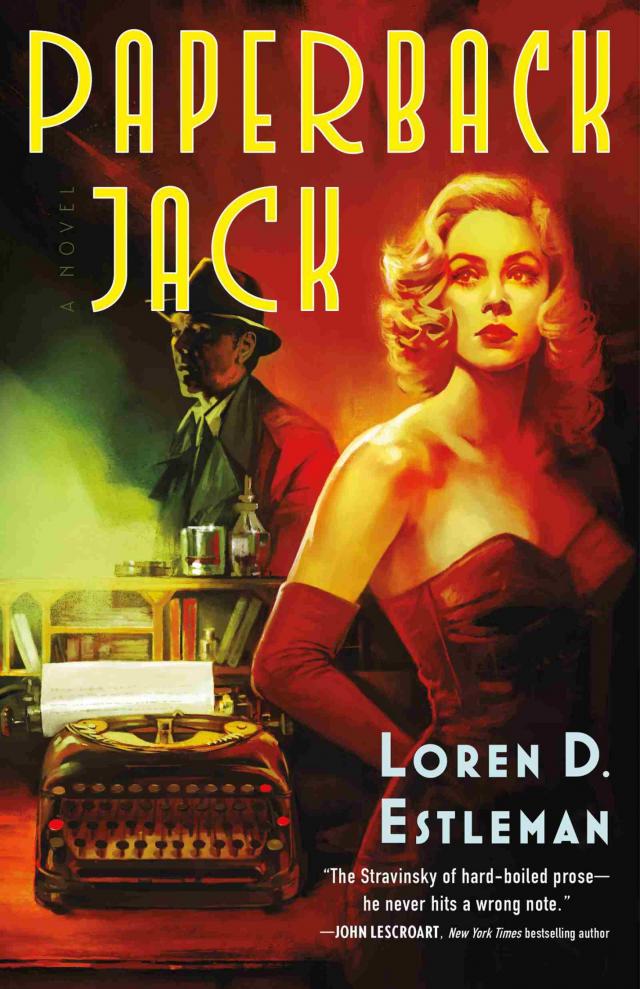
It was a slim book about the size of a cigarette case, bound in paper with page-ends dyed red and a glossy cover, varnished and sealed in laminate. In the foreground stood a man with his back half-turned away, watching an overripe blonde undressing in the background. She was clearly the focus of the picture, painted in rich oils: blood reds, cerecloth blacks, and school bus yellows. The title, Half-Past Midnight, was in white sanserif letters, as was the smaller-type byline, Clifton Eldridge.
“I got Armed Services editions along with every other dogface,” Jacob said. “I know what they look like: cheap and tawdry. I read this book before the war, in cloth. I don’t remember any women undressing in front of men in it.”
“Not the point. How many copies you figure sold?”
“It’s been around for years. Ten or twenty thousand.”
“This one sold just under a million.”
“Bullshit.”
“Glad to see you expanded your vocabulary abroad. I know Eldridge’s agent; well, Eldridge croaked in ’forty, so he represents the widow. She bought a house in Florida last winter. Paid cash. I’m telling you, these two-bit editions fly off the racks.”
“You think you can sell That Mad Game to this outfit?”
“What mad game?”
“You just read it! It’s from Swift: ‘That mad game the world so loves to play.’”
“Yeah. I never look at titles. Waste of time. Publishers are always changing ’em. No, I just got through telling you war books are a drug on the market. Here.” He reached inside the drawer again, pushed another book after the first, only this time he covered it with his hand.
Jacob felt the butterflies again.
Winderspear looked up at him from under his burled-oak brow. “This is a mock-up. Blank inside. The publisher wanted you to see how it’ll look when it’s finished.”
The painting might have been by the same artist, using the same splashy color scheme as Half-Past Midnight. This time the woman was Asian, with short, blue-black hair in bangs, dressed in a silk kimono open almost to her nipples. What appeared to be the same man, stripped to the waist and tied to a chair, watched with a snarling expression as the woman advanced on him holding a stiletto with a blade as thin and sharp as a needle. Chinese Checkers. The title of Jacob’s novel. There was no byline.
“I swung the deal while you were gone. It’s not kosher, but I didn’t know how to reach you and the publisher was hot to trot. You know how often that doesn’t happen. Jack, all I’m asking is don’t blow your top till you hear me out.”
“My name is Jacob.”
“Not anymore.”
CHAPTER FOUR
“What’s the matter with Jacob Heppleman?”
“Guess.”
“Ira Winderspear thinks my name’s too Jewish?”
“It’s not my name on the cover. Look, everyone knows what you did over there, liberating the camps.”
“Those were in Poland. I never got that far.”
“I mean you brave guys. There are people kvetching that we went to war just for the Jews. They’re punks, but their two bits spend the same as everyone else’s. Let things settle a couple years, then you can put everything back in print: Jacob Heppleman, thirty-six-point type: writing as Jack Holly, eighteen. Jack Holly, a swashbuckler of a name. Errol Flynn wishes he had it.”
“It sounds like a card sharp. Who thought of it?”
“I came up with Jack. Holly was Robin Elk’s.”
“He could use a new name himself. Who is he?”
“Elk. You know, like the moose. He’s the money.” Winderspear tapped the upper left corner of the mock-up.
Jacob looked at an image the size of his thumbnail, a caricature of a cherubic blue demon with button horns, rocket-trail eyebrows, a naughty grin, and a dished-in nose like the swoop of a roller-coaster track. “Blue Devil Books,” he read. “Never heard of it.”
“It’s new. Elk wants to publish new work in cheap editions: Paperback originals, he calls ’em. Nobody’s ever done that. It’s less of a gamble to issue a book with a publishing history by an established author. Personally I think he’ll lose his shirt, but meantime you’ll get dough up front to stake you till you get your toe back in.”
“What happened to those million-copy sales?”
“I won’t jack you around, kid. The cancer didn’t stop with the pulps. Another Eldridge, Harbor Girl, didn’t sell through. Maybe the vets are too busy buying houses in the suburbs and going to college on the G.I. Bill to read for pleasure. Blue Devil’s looking to cut its costs by developing its own authors: Deal out the middle man, go short up front, and split the royalties fifty-fifty. Maybe he’s onto something, I don’t know. It’s a different world since you went away. Nobody’s got a handle on it just yet.” He held out That Mad Game. “Stick this in a drawer till the next war. Write another Chinese Checkers.”
Jacob left him hanging while he turned over the mock-up and read the copy on the back. The top line was printed in red, in type twice as large as the rest in black:
“I HUNGER FOR A WHITE MAN!”
Paul Matson came to Chinatown looking for a good time. The times found him, but they weren’t good; in fact, they were wicked. He had barely set foot in Ah Lo Wing’s Garden of Celestial Delights when sinuous, inscrutable Lee Sin pounced from the shadows like a panther from the Far East, with lust in her heart and evil on her mind.
“I hunger for a white man,” she purred in Matson’s ear. “Come, and I will show you the ancient Oriental ways of love.”
He was suddenly violently ill; partly from the betrayal, as much from the unexpected exposure to the blind racism of youth, before experience had opened his eyes. His face was hot. “Nix. I didn’t fight a war to land back where I started.”
“War’s over, kid. You remember those ads for trusses and hemorrhoid cream? Gap in the action. Sure, they paid the bills. All you boys paid the bills. But the public doesn’t buy toothpaste to read the label on the back. The war, it was a gap: a time-out, like in football. You turn the page, get back to the game where it left off.”
“Gee, I missed that in the recruiting posters. JOIN THE ARMY, BE A GAP.”
“What do you think people want, after all those stories of bayonetings and machine-gun massacres? It’s the flag-waving they got tired of. So you give ’em what they want, only without the brass bands. Brother, you thought the pulps were bloody, but you ain’t seen nothing yet.”
A siren wailed fifteen floors down, stopping as abruptly as it had started, as if the prowlie was testing it. A Michigan farm boy who’d shaken loose the dirt as soon as he had bus fare, Jacob had never gotten over how New York racket managed to penetrate the ritziest buildings.
“Last time I looked at my contract with Thornberry, it said I had to approve subsidiary offers. Back then it meant moving pictures and radio, but I’m sure it covers this. What’d you do, forge my signature?”
“I resent that. I traced it from the original contract.”
He knew his agent was a millionaire: His office rent was more than the government had spent on Jacob’s bed and board from boot camp on. He’d survived a Depression and a war and from the look of his belly hadn’t missed a meal at Sardi’s or 21 since before the Blitz. He was a man of means and power. So Jacob chose his words carefully.
“You’re fired, Ira.”
Winderspear blinked. His eyes were the only animated feature in that petrified-wood face. “You don’t want to do that. I’m a rabbit’s foot. Everyone who’s ever fired me wound up in Dutch, starting with Arnold Rothstein when I ran liquor for him in Jersey; clients were hard to come by, I had to make ends meet. Six weeks after he canned me, somebody put a slug in him in the Park Central Hotel.”
“You’re threatening me. I don’t believe it. What are you, some kind of gangster?”
“Christ, I didn’t shoot him. But if he kept me on, who knows? The slob might’ve missed. I got more stories, but that’s your racket, not mine. I just sell ’em.”
“I’ll risk it. And if I see so much as one copy of that piece of shit in a drugstore or bus station, I’ll tell Robin Elk what you did. If he’s any kind of businessman he’ll have you arrested for fraud.” He got up.
“I was looking after your interests. How was I to know you got religion over there? The guy that wrote this book, him I could reason with. He’d’ve jumped all over this deal.”
“He grew up.”
“Easy, Jack. Don’t go off half-cocked.”
“Why not? That’s how I came in. And don’t call me Jack!” He opened the door.
“What are you going to do?”
“Go back to school, what else? I can’t afford a house in the suburbs.” He slammed it.
CHAPTER FIVE
He worked for a Manhattan advertising agency, Barlow, O’Keefe, Brogan, & Associates, for a week. It had four floors in a bank building on Madison Avenue, a glossy skyscraper that resembled a buzz-bomb stood on end. A giant four-color poster of a loaf of bread shaped like a sleek locomotive greeted him when he stepped off the elevator, wind lines streaming along its sides: Sunrise Bakeries was the account that had put the firm on the map.
The offices were glass fishbowls and you signed a time sheet instead of punching in, but apart from the show it was the same kind of dirty-neck job he’d traded for a typewriter all those years ago; the foremen just wore Arrow collars. The pace reminded him of D-Day, except only the enemy was armed. When the copy he’d submitted for the Best Buddy Dog Food account came flying out the Creative Director’s door folded into a paper plane, he quit.
After pounding the pavement for three weeks, he sat down with the city editor of The Greenwich Clock, a daily paper that had started out catering to the Bohemian artistic community, then had gone head-to-head with the tabloids, running headlines like WIFE SLAYS HUSBAND, MISTRESS, SELF, just before the stock market crashed and readers bought copies only to line their worn-out shoes.
By that time there was no going back; the painters, hoofers, and would-be Eugene O’Neills who used to subscribe were operating forklifts. Somehow the newspaper hung on, crowded into one floor of a former glove factory in SoHo with a Chinese restaurant at ground level. Every square inch smelled of frying oil and when Jacob handed the editor his application, grease from the staircase banister left transparent fingerprints on the sheet.
The editor, Sam Rosetti, might have modeled for a comical illustration in Paper Tigers, a journalist-themed pulp: His hairline started two fingers above his bushy brows, the tracks of the comb as visible as tread marks in tar, grew back and down inside his collar, getting steadily blacker and more coarse until it sprang from his rolled-up sleeves like uncoiled wire. The dead cigar in the corner of his mouth was just something to hold the place for the next. He spread the sheet on his filthy blotter and shoveled fried rice from a cardboard container into his mouth as he read. He was clumsy with chopsticks: When he finished, the application looked like a used placemat.
“When can you start?”
“Today.” Jacob was surprised into an unseemly show of eagerness.
“’Kay. There’s your desk. You’ll have to clean it out. Keep what you can use, throw out the rest. Our last rewrite man croaked himself on wood alcohol last month.”
“That’s terrible.”
“No shit. I had December in the pool. It don’t say here you have newspaper experience, but it looks like you can string together a sentence, which is more than I can say for the jerk you’re replacing, rest his soul.” Rosetti crossed himself with his chopsticks. “Anyway, I’m sick of filling in. You know the job?”
“I think I can guess.”
“Guessing’s for radio. You wait for the phone to ring, you take down notes, you put ’em in English, and you get ’em in on deadline. Plain English, Shakespeare; we don’t circulate on Park Avenue. Think you can handle that?”
He said yes. He’d hoped for a byline, but then he didn’t plan to make journalism a career. His rent was ten days past due and he was sitting on his last twenty dollars like eggs in a nest, eating in automats and walking fifty blocks at a stretch to avoid paying bus fare.
The pulp picture wasn’t quite as dismal as Winderspear had painted it—there were still plenty of titles on the stands, bright red and yellow as always, like ketchup and mustard containers in a railcar diner—but the heady days of editors buying stories hand over fist were no more. Double-Barreled Detective was gambling only on proven best-sellers from its glory days, Goon Squad was gone, Third Degree had shrunken to half its former size and was bought up into 1947 (if it lasted that long); inquiries around town confirmed that. The racy magazines, Silk Sheets, Sultry Stories, Gams and Guns, and Muff Pistols (Good God!) had, in their desperation to attract the lowest common denominator, sunk to pornographic depths that practically invited postal inspectors to seize them at the loading docks. The covers still walked the tightrope between tasteless and trial-by-jury, but the pen-and-ink drawings inside would make Mae West blush. Too bad, because they paid three times better than the others; but just the thought of writing such dreck made him want to take a bath.
The war pulps were gone, or as good as. Daredevils and Dogfaces and Trench Tales were still there, but they’d gone monthly, and the material seemed worn out even to him, who’d lived it. He doubted they’d last out the year.
There was a disturbing incursion of women’s confession magazines—My Secret Sin, Forbidden Romance, Broken Vows—spilling out their litany of overripe confessions (i.e., female fantasies, or what the men who wrote them under names like Molly Ann Thompson and Susan Marie Klein assumed them to be), and shabby true detective rags with grainy photographic covers and real-life rape-and-slash stories catalogued up front, like a menu taped in the window of a doubtful eatery. And among them their bastard children, “tell-all” exposé rags with movie stars and lounge singers caught in unflattering moments by the glare of flashguns. By and large their contents were written by a handful of staffers under a variety of pseudonyms or assembled from newspaper clippings by anonymous file clerks. A daily diet of newsreels from the front had stripped away the last Edwardian vestiges of privacy and discretion.