Collection 6 the summe.., p.22
Collection 6 - The Summer of '65,
p.22
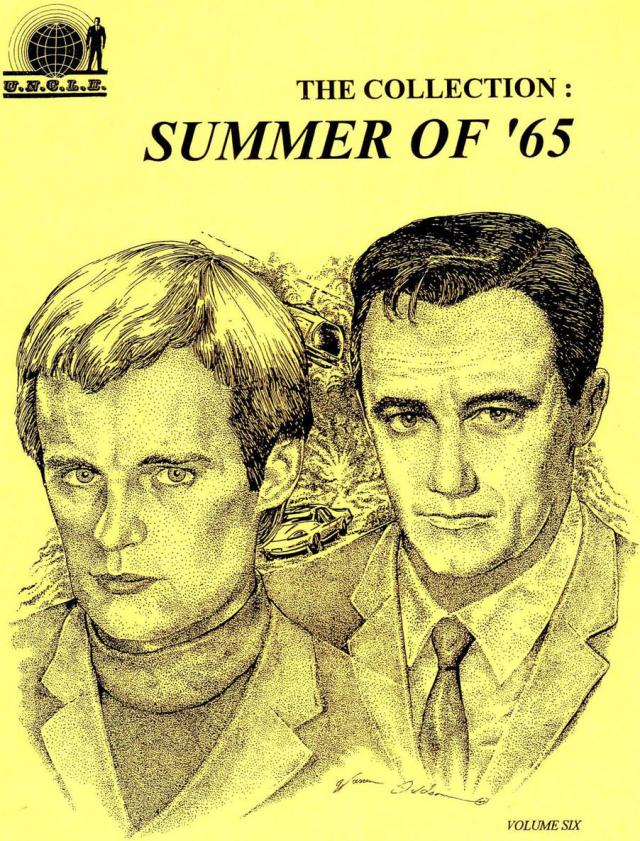


The senior agent went to pour the contents out and make a fresh cup, deciding it, and the residue of his partner's energy, would at least revive him enough to change out of his dirty clothes and shower. "I was never that young," he told his kettle, waiting for it to boil. "He is crazy. No sane person would go. A really sane person would never have registered at all."
But his partner was still enthralled with his latest activity. Once Kuryakin had discovered how universities in America worked: that they were not controlled by the government, that they accepted foreigners, and that all he had to do was show them his previous academic credentials, fill out some forms and pay some fees, the Russian had acted like a kid at Christmas. Solo had found him one day sitting on the floor of his apartment, surrounded by every college catalog and schedule of classes in the New York City area, trying to decide where to go and what to take. Kuryakin had handed him some sheets of paper.
"Napoleon, I filled out the application, but I am supposed to write an essay defining myself as a person and describing my accomplishments."
"Do they accept essays in words of only one syllable?"
"Very funny. Read this for me and tell me what you think."
Solo took the scribbled page, not quite sure of his partner's mischievous look and read:
I am a dynamic figure, often seen scaling walls and fighting forces bent on world domination. Using only my wits, a small quantity of explosives and a coil of rope, I have been known to liberate small countries, large quantities of diamonds, and keys locked in cars. I speak seven languages fluently and am currently taking a crash courses in American and pig Latin. I know what lies behind the coat hook.
Women fall for my ice blue eyes and golden hair. I have landed a helicopter on a moving truck, parachuted out of burning planes, and ridden the elevator to the top of the Empire State Building. I will eat anything, and often do. I am an expert safe-cracker, a terrible hospital patient, and a crack shot. No matter what I plan for my vacations, I usually spend them bird-hunting.
I play jazz balalaika, English horn, and excellent poker. I have danced with the Kirov, dined with the President, and been wanted for criminal activities in numerous countries. My guide to the best jails of the world has never been written but would be instantly rejected by the eminent publishers. My formal education credentials include a masters from the Sorbonne, a doctorate from Cambridge and a certificate from the U.N.C.L.E. survival school. Answer blanks, equal signs and small electronic devices are irresistible to me. Sometimes I live for days entirely under artificial light.
My talents include judo, akido, karate, origami, and paying all my bills in cash. I have found diplomatic immunity does not extend to bullets, but was told the discovery is not original. My employer calls me expendable, women call me inscrutable, my partner has called me certifiable, and my family calls me Sunshine. I have been followed by the CIA, FBI, KGB, GRU, MI6 and the security guards at Macy's, but the Macy's guards apologized and gave me a free gift certificate. Last month, Her Royal Britannic Majesty decorated me for exemplary service to her country. Last week, I was caller number nine and won the free toaster oven.
I have been briefed in the Kremlin, blessed in the Vatican, and busted in the Pentagon.
But I have yet to be accepted by your college.
Solo tossed the paper down. "Who put you up to this?"
"I will never tell."
"You don't plan on actually turning this in?"
"Why not?" Kuryakin's lips were quirking mischievously. "Is something wrong with the grammar? Spelling? Punctuation?"
"Try content!"
"It's all true," Kuryakin defended. "I really did win a toaster last week."
Solo snorted. "True or not, you're supposed to be serious about something like this."
"I am very serious. I have often been told I am too serious. Maybe I should add that as a fault."
"Very funny." Solo watched as Kuryakin added a scribbled line to the essay. "Go ahead. Send it in. I dare you. Waverly will have your hide if he finds out. But it might be worth it; after all, they might have a lunatic quota."
"Why don't you apply then, Napoleon?" Kuryakin asked innocently.
They crumpled several applications before Solo had his partner pinned and saying U.N.C.L.E.
Solo doubted the essay did it, but Kuryakin was accepted at several schools. Unfortunately, the lifestyle of an U.N.C.L.E. agent did not allow for the kind of scheduling stability necessary to complete the classes once he had registered for them. Even his partner's numerous degrees, including his prestigious Cambridge doctorate in quantum mechanics, had not helped when it came to his inevitable absences. It had taken Waverly's intercession and a sympathetic physics dean at Columbia before Kuryakin had found a school willing to deal with his inadvertent scheduling irregularities and let him make up the work he missed. Kuryakin had taken and actually completed two graduate physics classes there last semester; his sporadic attendance compensated for by several research projects. Buoyed by that success, he had signed up for another physics class and one in law. Unfortunately, the law dean had not proved as flexible as the physics one and Kuryakin had been dropped from the class after several absences.
"I don't know why you want to take law anyway," Solo complained to his partner, who was staring mournfully at the notice of his academic dismissal. He'd pulled Illya into the relative privacy of his office when he'd found the usually impassive Russian looking like someone had shot his dog, revoked his citizenship, and invalidated his green card, all at once.
"Napoleon, we work for the United Network Command for Law and Enforcement," Kuryakin emphasized.
"So that's what it stands for."
Kuryakin gave him a disgusted look. "I understand the enforcement part—"
"They shoot us. We shoot them. Not much to it, even for your limited comprehension."
Kuryakin ignored him. "I want to understand the law part, too." He crumpled the notice into a ball and lobbed it viciously into Solo's wastebasket.
"That's why we have a legal department."
"I want to understand it myself," Kuryakin said, his jaw set with the stubbornness Solo knew was usually hopeless to try and circumvent. He tried anyway.
"We always get around the laws."
"Always?" Kuryakin stared at him in astonishment.
"Usually," Solo amended.
"Then why do we spend so much time in various jail cells around the world?" Kuryakin asked, still frowning in the direction of the discarded notice.
"Because you're still trying to figure out the enforcement part," Solo dead-panned, ignoring the dark look the comment earned him. "Look, it's a nice thought, but an exercise in futility. Even supposing you had the time and the schedule to take all the classes you want, too often we have to skirt the edges of the law. We just don't have the luxury, in our profession, to obey every antiquated rule on every two-bit country's books. It's better not to know. That's why we have diplomatic immunity. That's why our salaries are so very small, because they cover the fat salaries of our legal teams, who bravely go in, pencils wielding, after our gun-smoke clears, and get our charges dropped, our damages paid, and our fines cleared, while we, the heroic gunslingers, bind our wounds and head off into the sunset toward our next battle."
"You have been watching too many western American movies," Kuryakin said, disgusted.
"That's American western movies, not the other way around. And, no, I haven't. But you have been reading too many college catalogs."
Kuryakin shrugged despondently. "Perhaps international law is too large a subject with which to begin. But we have many assignments here in America and that would be a place to start."
"I told you—"
"As a citizen," Kuryakin said the word as if it still tasted strange to him. "I have a certain responsibility. I should at least know what laws I am circumventing."
"Don't worry. The FBI will let you know. Right after they arrest you," Solo grinned.
Kuryakin visibly winced. "That is what I am afraid of."
"See what I mean? It's better for you not to know. When you don't know what laws you're breaking, you don't worry about it."
"Perhaps you—" Kuryakin said heatedly.
"And one class is enough anyway, especially when it's physics. How you can read the stuff anyway boggles my mind, but you already have a doctorate in it. Not to mention a few other degrees. Why take more classes? E equals MC squared, right? Exactly how much physics does an enforcement agent need?"
The Russian sighed wearily. "Napoleon, physics is not like anatomy. A clavicle is a clavicle for all time, but physics changes."
"All the more reason to avoid it," Solo advised, preaching the Napoleon Solo Theory of Energy Conservation. "Why study something that will be obsolete in five years? Nothing but an exercise in futility. Time to get your nose out of those books. Study something useful. Grow up a little. Now, take girls—that's something American you need to research. The habits and practices of our lovely female citizens. That's a sensible study. What can you do with physics? Tack another useless degree on your wall?"
"Useless!" Kuryakin sputtered.
"You haven't even hung up the others. We're not even talking wall coverage here. But girls—now, you can put that knowledge to good use every day."
"You're the expert," Kuryakin said dryly. "You write me a field guide."
"A true scientist does his own research. Not to mention the fact that it's more fun."
Kuryakin had ignored him, but had not stayed despondent long, signing up for a martial arts class to replace the law class. Solo found his schedule wearying just to think about it. Monday and Thursday he kept up with training in two different martial arts, Tuesday was his graduate physics class, and Wednesday was his usual night for working late in his lab, catching up on paperwork in his office, doing homework, or reading the stack of science journals he subscribed to or borrowed from the U.N.C.L.E. library. Friday nights Solo insisted he keep free, in his ongoing attempts to get his partner's nose away from the grindstone and have some fun. Rarely did Kuryakin make it home before ten p.m. and then he stayed up until midnight, or sometimes till two in the morning, reading and working. Then he slept five hours and did it again.
Solo was no slackard. Being Chief Enforcement Agent for U.N.C.L.E. North America meant he was constantly playing catch-up between his own field work, managing Section Two, and a flood of paperwork. As CEA, he worked long hours and during the little time he had free, he put as much energy into relaxation. Solo found the slight Russian's energy and the directions he put it to a little disconcerting. He understood that, at least in part, Illya pursued his studies for the same relaxing effects his partner received from pursuing girls. So far he'd just been unsuccessful in convincing the younger agent that girls were more fun.
"Arrested development," he muttered and blinked, waking from his reverie as the kettle started to whistle. Solo made his tea, took his shower and had been peacefully sleeping for some hours when his partner finally came home.
***
Somewhere in the Soviet Union
The apartment was shabby and poor by American standards, but solidly 'middle-class' in the supposedly classless Soviet society. The agent on duty flattened against the wall at the soft knock, even though it was in the prearranged code. CIA agents in the Soviet Union could never be too careful. He drew his gun as the door opened, but lowered it immediately as he recognized the agent entering. "Did you retrieve Antipov?"
"He's dead." The voice was flat with defeat and anger.
"The plans?"
"Who knows if he got them out? They might have been in his head, for all we'll ever know. He never regained consciousness."
The first agent slammed his fist against the wall. "Damn these amateurs."
"No use getting upset, Daniels. It happens."
"Yeah and we have to go back and explain how it happened on our assignment."
"The assignment's not over yet. They don't know that he's dead. The word is still out on the street. The KGB are still searching for him."
"What good does that do us, Nelson? He'd dead."
"Not to them. For now we need time. A decoy. Wire this photo back to HQ. We need some ringers on the streets. Something for the KGB to chase but not catch while we set up an operation. That part won't be hard—the decoys will have to be slight and short, but that and a blond wig are all they'll need. Keep the KGB interested. Make them believe he's still alive and see if they are willing to negotiate. Don't promise anything, don't offer anything, just set up a dialogue. We still might be able to salvage this operation. I'm flying back to HQ this afternoon—with Antipov's body. We're already set up to smuggle the corpse out. The American Ambassador's aide de camp just 'died of an asthma attack'."
"Right."
"I'll be in touch." Nelson slipped soundlessly out the door.
Daniels turned to the picture in his hand and grimaced. Even jaded CIA agents grew weary of pictures of dead bodies. This had not been a peaceful death, but the agent ignored the blood and the empty expression in the blue eyes and started to sketch out a description of the clothes and hair they needed to replicate. "Why couldn't the damn bastard have lived?" he swore softly under his breath.
***
CIA Headquarters, Langley, Virginia
The Director of Central Intelligence frowned down at the report and tossed the folder to the head of his Soviet-Russia Division. "Do a personnel search. Find me an agent who can pull this off."
"Just how many Soviet nuclear physicists do you think we have in this organization? Who could pass for the subject?" Donald Johnson took the photographs and file specifications from his superior.
"That reactor must not be allowed to go operational. I want those reactor plans. I want that reactor compromised, if possible. I don't need to remind you gentlemen that this country is engaged in a serious nuclear arms race with the Soviet Union. If this reactor is successful then the amount of plutonium the Russians could produce is unimaginable. If it is successfully duplicated before we can even get our own models in production, then they could win the arms race. This is a chance to get near it, maybe our only chance. And we don't have much time. The KGB is not going to chase its tail forever. You've got a week—no more than two, if absolutely necessary—to get someone in the field. You know the relevant personnel in our organization. Find someone."
Johnson opened the file folder and his eyes widened. "You know who could pass for this?" He handed the folder to the Peter Baker, the head of Soviet Counterintelligence sitting next to him.
Baker glanced at it. "Kuryakin."
"Fine," the DCI answered. "Brief him, prep him, get him out in the field."
"Sir, he's not one of ours."
The agency head's eyes narrowed.
"Illya Kuryakin. You remember, he was an assignment just—"
"Waverly's assistant enforcement chief." The Director frowned. "The KGB defector. Zadkine."
"His physical profile is close. It's damn near identical. And he has the physics background," Johnson said reluctantly.
"No," the DCI snapped. "Do you know what I would owe Waverly if I had to go to one of his agents? Damn it, we have thousands of men all over the world. I want one blue-eyed, young, quasi-blond, quasi-Russian, who knows enough physics and espionage to bluff his way into that Russian plant, get me those plans and get out. Considering what the two of you cost me in budgets, you ought to be able to come up with one. If you can't, then you call the FBI. You contact the Joint Chiefs at the Pentagon and get someone in military intelligence. Or Rickover in the nuclear navy. You find me an agent with this background, because I'll be damned if I have to go to U.N.C.L.E to pull off a CIA assignment concerning the defense of this nation. This country does not need U.N.C.L.E. to take care of its own. Dismissed, gentlemen."
***
U.N.C.L.E. Headquarter, New York City
Waverly put down the intelligence report and reached absently for his pipe. Then he pulled his hand back, frowning slightly. At his last physical, the medical chief at headquarters, Dr. Samuel Lawrence, had insisted he cut back on his smoking. In fact, Lawrence, relying on medical intelligence reports still not generally accepted, had embarked on campaign to eradicate that habit throughout U.N.C.L.E.
The physician's crusade was carrying only limited weight among enforcement agents who claimed with some amusement that they needed to worry more about bullets than lung cancer. Undaunted, knowing how his agents' minds worked, Lawrence had simply made the practice cost them points in their field fitness evaluations. Lawrence had then arranged with the head of Section Three, who was also trying to dissuade his younger agents from acquiring the habit, a small demonstration to prove how easily an agent with a sophisticated sense of smell could pick out a hidden intruder—if that intruder smoked. They'd gone after Illya Kuryakin to be their tracker and he'd done remarkably well; the demonstration had been a definite and convincing success. Under this combined attack, agents grumbled and complained, but many had begun slowly cutting back.
Waverly had not paid much attention to the scheme, though he'd attended the demonstration and received some mild amusement, both from watching Kuryakin exhibit his here-to-unknown talent and from listening to Solo's teasing comments and nicknames for his partner over the next few days. But his amusement was short-lived when Lawrence had then gone after his own habit, claiming Waverly needed to set a good example.
Irritating, to be asked to give up one of his few luxuries. He was no field agent, after all. Waverly rose and turned away from the tempting pipe and went to stand at the window, staring out at the lights of the United Nations building shining a few hundred yards away. Although it was too late for the General Assembly and no emergency session was in progress, the building glowed in the gathering dusk of the summer evening. Nightfall came late in this season of the year, but the UN bustled long after even that delayed close to the day.
Tonight, the lights seem to reproach him.
Waverly turned back to his desk and defiantly lighted his pipe, puffing until a wreath of smoke wound around him. When the pipe was drawing well, he reopened the folder and studied the reports.