Collection 6 the summe.., p.24
Collection 6 - The Summer of '65,
p.24


"And did he defect?" Solo asked.
"He tried to. The father never made it out at all. We're not sure if he was unwilling or just unable. The boy's escape attempt encountered problems as well. He was shot. We recovered him still alive, but he subsequently died from his injuries. The Soviets don't realize he was injured, though, and they are currently searching the area where he was last seen with a fine toothed comb. Plus, they've upped security on all their borders. They have good reason to want him back. Now that they don't have the son to hold over his head, or perhaps in an effort to force the Soviets to retrieve the boy alive, the father is currently refusing to work on the reactor. He's designed so much of it that handing the project over to another head physicist would set their timetable back considerably. They want them both badly enough that they are willing to negotiate. Or at least they are pretending to negotiate. They are claiming they'll allow them both to defect if they'll complete their assignment on the reactor and familiarize the next chief physicist with their research."
"If the boy is dead, with whom are they negotiating?"
"With us, of course, under an appropriate cover organization, a society dedicated to the non-politicizing of scientific information. The Soviets made a smart move, since this organization just doesn't have the resources to get the boy out of the country. We know they don't; we have cover agents in that organization." Baker met the Chief Enforcement Agent's eyes frankly. "We want the plans for that reactor, Solo. With the boy dead, we only have two likely possibilities. Right now, the Soviets have the father under such tight security, we could never snatch him. But the Soviets want the boy badly enough, that they made this counter-offer. They are counting on the boy believing that offer, of course. That's our way in."
"Except for the little fact of his death."
"We planned to send in a ringer, one of our own agents. But we've run into a snag."
"How inconvenient," Solo murmured.
Baker ignored the sarcasm. "Selecting the right agent is critical. We need an agent who is fluent in nuclear physics, can pass for the subject, is extensively familiar with Soviet life, and who speaks Russian like a native."
"I imagine those last two criteria would be a bit of a problem for your agency," The CEA remarked caustically.
"Don't kid yourself, Solo. We frequently have to work undercover in the Soviet Union, as you very well know."
"Then why are you here?" Solo responded.
For the first time, Baker looked slightly uncomfortable. "This is going to be a precision mission and the success of it depends on obtaining the best agent, not merely the most convenient one for us. Our organization has several agents who meet one or more of the criteria. We have agents who can match this boy physically, agents with the nuclear physics background, agents with knowledge of Russian culture, agents who can speak the language, agents with experience impersonating others. But none of our agents meet all of these criteria together well enough to make a successful mission. We then did a routine check of all agents within affiliated U.S. agencies, the F.B.I, the Secret Service, some of the more exotic branches of the military. That turned up several more possibilities, but in checking those out, they were also all eliminated for one reason or another. Another computer search of agents in allied international organizations revealed several more possibilities."
Baker shrugged almost casually. "Your Mr. Kuryakin headed the list."
Solo glanced at the group around the table, but apparently no one else, his partner included, seemed inclined to react to this. "Mr. Kuryakin," Solo said bluntly, "fails the criteria on one important point. He's not eighteen, nor could he pass for that."
"None of our agents would, Solo. We wouldn't use anyone that young anyway, this operation requires an experienced agent. And unlike the KGB, we don't start training our field agents at age nine. Or was it age four?"
That oblique reference to his partner's past sent a flush of anger to Solo's normally polished facade. He glanced at Kuryakin, but the Russian hadn't stirred, still staring glassily down at the same spot on the conference table.
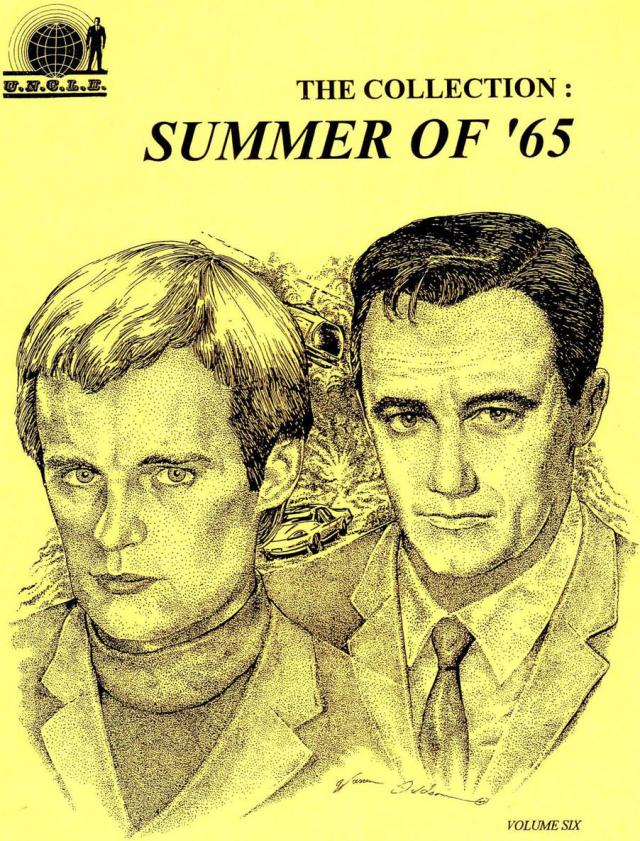
Baker went on. "Physical features are what put Mr. Kuryakin at the head of the list. The other criteria are more easily replicated. Antipov's son is a blue-eyed blond, slight, 5' 7", just a little under Mr. Kuryakin's height. His features are similar to your agent's." Baker displayed a slide and they all studied the figure displayed.
At a careless glance, Solo might have mistaken it for a slide of his partner, or a younger version of him.
Baker then put up a file photo of Kuryakin next to it, so they could study the similarities and differences. The blue eyes, the straight blond hair, the wide forehead and Slavic features were twins of the agent at Solo's side. This boy's face was thinner, lacking Kuryakin's maturity; there was less steadiness in the eyes, more uncertainty in the posture. He looked younger, frightened, Russian. Not at all like the agent at his side, but disturbingly like the young man in a film Solo knew was in Waverly's files, a film of Illya when he first defected. Looking young, frightened, and impossibly Russian.
Baker let them look a moment. "There are differences, as you can see. But I'm told by our own experts the differences are relatively easy to correct, or conceal. That's better seen with a more appropriate representation of your agent." Baker replaced the slide of Kuryakin with another and for the first time the Russian reacted, straightening in his chair, a muted murmur of protest dying in his throat.
Solo could see why Illya was distressed. The former slide had showed his partner in his typical black suit and severe expression, a look he seldom strayed from at HQ and one that lent his slight frame a touch more presence. Apart from the disguises necessary to their work, Solo rarely saw him in casual clothes. This picture was a candid shot of the agent, a surveillance slide. The imprinted date marked the occasion as a Fourth of July picnic at the home of Norman Graham.
The head of Washington U.N.C.L.E., Graham had 'adopted' Illya Kuryakin into his family when the Russian had first defected. Graham's wife, Trish and stepson Tony had emigrated from Russia and Waverly had steered Illya toward them to give the then twenty-two-year-old some badly needed security and family life. Four years later, Illya still spent most of his days off with the Grahams in Washington, relaxing there as he never did in New York.
This slide displayed an impromptu baseball game. Illya, up at bat, squinted into the sun at the pitcher. The worn jeans, sneakers and a faded team T-shirt were obvious cast-offs of Tony's. Overlong blond hair, desperately in need of cutting, stuck out haphazardly from a baseball cap jammed brim backwards on his head. Tanya Graham, laughing as she crouched behind in the catcher's position, might have been his twin, so alike were they in coloring and build. Tony Graham, taller, dark-haired and stockier, jeering from the pitcher's mound, looked every inch the older brother, in spite of being Kuryakin's age.
His partner seemed a different person than the cool, reserved agent in the file photo, both younger and unequal to his real position in U.N.C.L.E..
Solo frowned at the slide. He had never known about his partner's 'adopted' family until the facts had come out during a case six months before. Illya had never told him. Not that the information was anything he needed to know, but he'd come to think of the Russian as something of a lone wolf: cool, aloof, untouchable, perpetually reserved with everyone, even, to a large extent, his partner. It had been a bit of a shock to realize his lone wolf was somebody else's kid brother and wolf cub.
One of the things that had first impressed Solo about the Russian was his reserved professionalism, as well as the lack of grandstanding so common in new field agents. Kuryakin showed a compliant obedience to orders one usually only saw in those seasoned by a few years in the field, too often not even then. Solo had congratulated himself on landing such an emotionally mature partner, especially considering he'd expected anyone with Kuryakin's undeniable field skills to have the ego to accompany them.
Solo had teamed with him on a few assignments before he realized that Kuryakin's acceptance of the secondary role stemmed not only from a lack of ego but also from a very real lack of certain kinds of experience. Kuryakin could shoot up the bad guys with the best of them, more than hold his own in a fight, and handle any technical issue with ease, but he frequently drew a complete and utter blank at dealing with people. It was when he saw Illya interact with the Grahams that he noticed how much Illya's 'mature thirties' behavior started to look more like a 'well-behaved ten'. It was a little disconcerting that his partner knew well how to fight, even was skilled at leading a group into a fight, but put him in a social situation with ordinary Americans, and he became silent and almost insecure.
Solo was grateful his partner had the support of a family while he found his feet in American society. But as time and familiarity began to show him glimpses of Kuryakin's acerbic tongue and occasionally mischievous spirit, he wondered what the future held in store for him as Kuryakin integrated his personal and professional selves. Would Kuryakin instantly mature from tongue-tied ten to adult, or was there was a rebellious teenager somewhere buried inside, waiting to inflict itself upon his partner? If so, Solo wasn't looking forward to it.
Considering what a riddle his partner was, it wasn't such a ridiculous thought. Depending on the situation, Illya could seem like two different people. It was hard for Solo to reconcile the cold, formal, emotionally distant agent from U.N.C.L.E. headquarters, who spoke the bare minimum for politeness, never touched, and rarely showed any expression, with the Illya he'd discovered at the Graham's home, who had his hair tousled and was kissed like a child and was—too often, in Solo's opinion— treated like one.
Part of it was the openness of Russian emotions practiced in the Graham household. Certainly, they could afford to indulge in that in a way that Solo, as Kuryakin's immediate superior, could not. But Solo had noticed that Kuryakin's status in that family seemed to fluctuate from a position between Tony and Tanya, to between Tanya and eight-year-old Michael. While U.N.C.L.E.'s number two enforcement agent seemed entirely comfortable with the dichotomy, Solo never quite knew how to deal with Illya on such varying levels. The Chief Enforcement Agent preferred to avoid the issue entirely, trusting Illya would continue to leave that part of himself either back with the Grahams or professionally buried.
Solo definitely had some problems with the CIA trying to merge the two now. "How did you get this?" he asked.
Baker brushed it off. "Routine surveillance. Your partner was still being investigated prior to his American citizenship. Don't be ridiculous, Solo, Graham knows his residence and the attached U.N.C.L.E. Safe House are under routine surveillance by any number of agencies. Privacy is a luxury we can't afford in our profession. The point of this is not to outrage your outmoded notions of privacy, but to illustrate the difference clothes and setting can make. A little plastic surgery will add to the effect."
"Plastic surgery?"
"Nothing major. The removal of any noticeable scars or slight facial lines, adding or removing a mole or birthmark, if necessary. We have physicians on staff expert in this sort of work. Fortunately, they would not have to do much to make your partner convincing in the role."
"If you couldn't get the boy out the first time, when they weren't expecting it, how do you expect to get my partner out when the mission is over?"
"We weren't involved in the original defection. Our department is working on plans right now to ensure Mr. Kuryakin's safety."
Solo glanced at his partner, but Kuryakin had gone back to staring fixedly at the desk top after his muted protest. "Mr. Waverly?"
Waverly was fumbling, as usual, with his pipe, and took his time lighting it and puffing at it, until a wreath of fragrant smoke issued from the bowl. "This would be a cooperative mission, not an U.N.C.L.E. operation, per se. I am interested in hearing Mr. Kuryakin's opinion of being lent to the CIA in this effort."
"Mr. Kuryakin?" Baker questioned, when it seemed as if the Russian would never speak.
He stirred slightly and looked at Waverly alone. "I am an agent for the Command. I will go where you send me, sir."
Waverly harrumphed and sent more smoke issuing from his pipe. "Very well. Since you have declined to have an opinion in this matter, you are excused while further discussions take place."
Kuryakin pushed back his chair, rose smoothly from the table, and left the room. Solo gaped from his exiting back to Waverly, who had turned to his communication console.
"Ask Mr. Graham and Dr. Lawrence to come to my office immediately," Waverly requested.
Once the Washington U.N.C.L.E chief and the head of the HQ medical division were briefed on the assignment, Waverly came quickly to the point. "While there is no question that Mr. Kuryakin can handle the technical aspects of this assignment, there is some concern on the part of the CIA that Mr. Kuryakin's prior experiences with their agency might impair his ability to function as an operative within their organization."
"Seeing as how they have been trying for years to implicate him as a mole and a traitor, and threatened at one point to permanently eliminate him as a risk, I can understand why," Solo said sourly.
"Mr. Solo, your comments will be solicited in due course. Until then, please contain yourself," Waverly remonstrated. "Mr. Graham, as well as being our primary CIA liaison, you perhaps know Mr. Kuryakin best."
Though it might be hard to determine which of the three U.N.C.L.E. men at the table had the most investment in the Russian-born agent, Waverly as an employer, Solo as a partner, or Graham, the latter's investment was largely personal. After absorbing the young defector into his family, the Washington U.N.C.L.E. chief had become a quasi-father figure to Kuryakin. Graham had listened to the summary with a slight frown on his craggy handsome face. "I'm not sure what you're asking, Alexander. Illya is a professional. If he is lent to the CIA for this assignment, he may not choose to go out for a beer with them afterwards, but he'll do what he is told."
"That early KGB training must serve U.N.C.L.E. in good stead," Baker commented.
There was a frozen silence around the table and then Waverly said with quiet authority, "My agents also understand obedience, Mr. Baker."
"I was just making a point. The CIA is not an international organization like U.N.C.L.E.. This operation is in the Soviet Division and there is no love lost between our agents and the KGB or the GRU, much as you probably have no love lost for Thrush. Mr. Kuryakin is going to hear comments like that and worse while he is with us. They won't necessarily be directed at him, nor will he be the only agent with some Russian background in our organization. We require some agents capable of infiltrating the Soviet Union, as you would expect. But we don't normally work with defectors, or former KGB agents. We can't treat Kuryakin with kid gloves, or change the basic attitudes in our organization for his brief tenure with us. If it will be a problem, we need to know."
There was no comment around the round conference table, until Graham sighed. "Illya is a professional," he repeated again. "He's not going to be affected by a few rude comments."
"Mr. Baker?" Waverly said.
Baker was staring at Graham, then nodded slightly. "Very well. I'll tell my superiors Kuryakin is available. They'll make the final decision." He glanced at Waverly. "But you might as well start briefing him. I'll be in touch. Gentlemen."
Solo waited till the CIA man had cleared the room before exploding. "It's a suicide mission. They've been trying for years to eliminate him. Since they washed out trying to prove he was their mole, they've decided on this way to take him out."
"Mr. Solo, I have verified the facts in this case, as you should well have imagined, and I am satisfied as to its legitimacy. While as U.N.C.L.E. agents you are all necessarily expendable, I draw the line in deliberately sending my agents on suicide missions. I realize that as Mr. Kuryakin's partner, you have personal inclinations, but you are expected to keep those to yourself and give us the benefit of only your professional evaluations. Information on this operation is presently being delivered to your office. I anticipate receiving a more appropriate appraisal of the situation."
Solo glanced at the rest of the conferees, grimaced at the reprimand, and walked out.
Graham stood, looking resigned to the inevitable. His office largely handled intelligence, rather than enforcement work. But as a former Section Two agent, he knew better than to dwell on the risks, or allow personal considerations any weight in his decisions. "If you don't need me further, Alexander, I have a plane to catch."
Waverly shook his head and waited while the Washington U.N.C.L.E. chief left, before turning to the head of his medical section. "You have been unexpectedly quiet, Samuel."
"You could hardly expect me to discuss this in front of the CIA." The physician twirled a pen between his fingers. "We agreed we were not going to do this to him."
The U.N.C.L.E. chief was silent in turn.
"The Soviets—the GRU, the KGB—used him too often this way in the past. When he was fifteen he looked twelve. When he was twenty he still looked sixteen. The echoes from that past could still be deafening. He has enough adjustment problems without us mimicking the exploitations of the very agencies he defected from."
Waverly made an abrupt gesture. "He has been in the field almost two years."
"Really? More like eighteen months. And let's tally up that time: Months off for the Rotterdam mess. Another few months recuperating from various injuries. And let's not forget the times you've had to restrict him from the field because the CIA was tailing him. It adds up to less than a year, in my book."
"He was also two years in our labs."
"Regardless, we agreed we were not going to use him this way. I don't like it. The Soviet Union and the CIA together, in one assignment. Plus the impersonation. This could tear him apart."
"He did not indicate any unwillingness."
"You knew he wouldn't. Did you honestly expect him to refuse an assignment in front of the CIA? His earlier training precludes challenging his superiors and you damn well know he practically worships you. At the very time he lost his father he met someone doing what he considered to be the very same work. You offer the closest to following in Nikolai Kuryakin's footsteps that he can get."