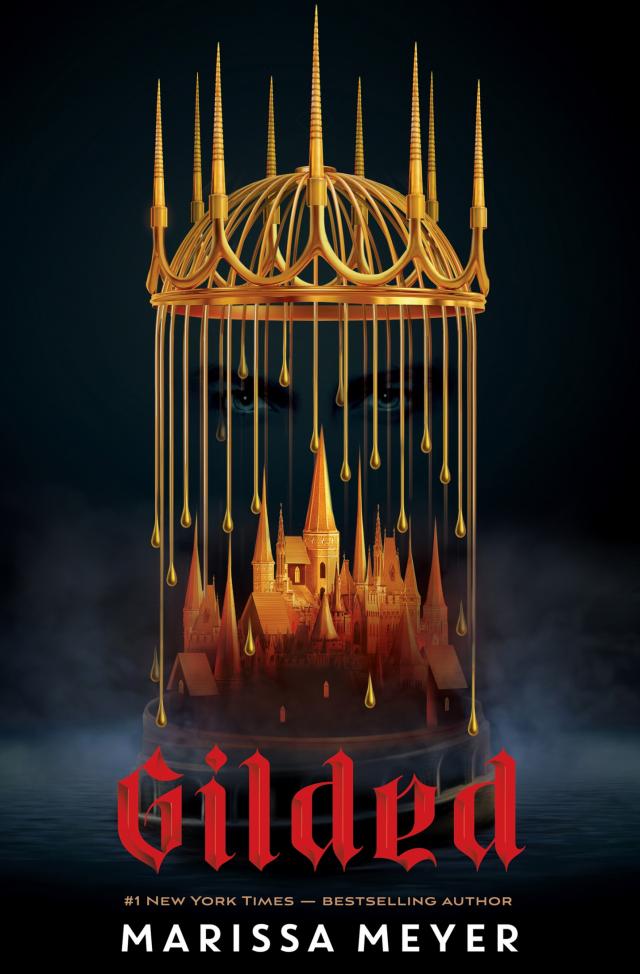
Gilded, p.18
Gilded,
p.18


The moment Serilda slid from her mount, the spell over her shattered. She drew in a sharp breath, and the air was not sweet. It did not fill her with buoyancy. All she felt was horror as she spun around and her gaze landed on Zelig.
Poor old Zelig, who had collapsed onto his side just inside the castle wall. His sides were heaving as he tried to drag in breaths. His entire body was shaking from the exertion of their long ride, his coat covered in a lather of sweat. His eyes had rolled back into his head as he panted.
“Water!” Serilda screamed, grabbing the stable boy’s arm as he returned for another steed. But then, worried that she would crush his fragile bones beneath her grip, she quickly released him and jerked her hand back. “Please. Bring this horse some water. Quickly.”
The stable boy gaped at her, wide-eyed. Then his gaze darted to something past Serilda’s shoulder.
A hand clasped her elbow, swiveling her around. The Erlking’s expression was murderous.
“You do not command my servants,” he growled.
“My horse is going to die!” she screamed. “He’s old! He shouldn’t have been pushed so hard tonight!”
“If he dies, he will die having tasted the greatest thrill any gelding could hope to enjoy. Now come. You’ve wasted enough of my time tonight.”
He started to drag her toward the keep, but Serilda yanked her arm from his grip. “Where is my father?” she shouted.
In the next moment, the king had twisted Serilda’s braids around his fist and yanked her head back, pressing a blade to her throat. His eyes were piercing, his voice low. “I am not in the habit of asking twice.”
She clenched her jaw against the urge to spit in his face.
“You will follow me,” he said, “and you will not speak out of turn again.”
He released her and stepped back. As he stalked toward the keep’s steps, every muscle in Serilda’s body tightened with rage. She wanted to scream and rail and grab whatever was in reach and hurl it at the back of his head.
Before she could do anything, a ghost in a blacksmith apron ran out from the keep. “Your Grim! There’s a … a problem. In the armory.”
The Erlking slowed his steps. “What sort of problem?”
“With the weapons. They’re … well. Perhaps you should see for yourself.”
With a low growl, the Erlking swept back through the massive doors, the blacksmith on his heels. Only when the blacksmith turned around did Serilda see the half-dozen arrows jutting from him like pins in a cushion.
Serilda stood, heart still racing, fury still clouding her thoughts. She looked back at Zelig, relieved to see the stable boy carrying a pail of water in his direction.
“Thank you,” she breathed.
The boy blushed, not daring to meet her gaze. She looked past him, toward the open gate. The lowered bridge.
Her entire body was sore, but mostly her thighs and rear end, which summoned dizzy memories of charging across the land on the back of that magnificent horse. She had done little riding in her life. She was reminded now that her body was unaccustomed to it.
But she thought she might still be able to run.
If she had to.
“I would not advise that.”
The coachman appeared beside her. His warning from before returned to her.
If you run, he will only further relish the chase.
This night had shown her how right he was.
“I believe he told you to follow,” continued the coachman. “I would not make him come searching for you later.”
“He’s already gone. I’ll never find him.”
“They were heading to the armory. I will show you the way.”
She wanted to ignore him. To run. To find her father—who was out there alone. One more victim of the hunt, abandoned in a field or at the edge of the forest. He could be anywhere. What if he was hurt? What if he was—
She exhaled sharply, refusing to allow the word into her thoughts.
He was alive. He would be all right. He had to be.
But if she didn’t do as the Erlking wanted, she would never leave this castle alive. She would never be allowed to go find him.
She faced the coachman and nodded.
This time they did not descend into the dungeons but ventured into a series of narrow hallways. Servant halls, if she had to guess, with her limited knowledge of castle architecture. After a dizzying number of turns, they arrived at an open barred door. Beyond it, a large table stood at the center of the room. The walls were hung with shields and various pieces of armor, from chain-mail jerkins to bronze gauntlets. There were a number of bare spots on the walls, too, where weapons might be hung.
The weapons weren’t on the walls, though.
Instead, they were hanging, suspended from the tall ceilings. Hundreds of swords and daggers, mallets and axes, javelins and maces, dangling precariously by bits of twine.
Serilda hastily stepped back out into the hall.
“When did he do this?” the Erlking was saying, his voice rough with anger.
The blacksmith shrugged helplessly. “I was in this room just yesterday, my lord. He must have done it since then. Perhaps even after you left on the hunt?” He sounded like he was trying not to be impressed.
“And why wasn’t anyone watching the armory?”
“There was a guard posted. There’s always a guard posted—”
With a snarl, the king struck the blacksmith on the side of his face. The man was thrown to the side, his shoulder hitting the corridor wall.
“Was that guard posted on the outside of this gate?” roared the king.
The blacksmith did not answer.
“Fools, all of you.” He jerked a hand toward the hanging weapons. “What are you waiting for? Get one of those useless kobolds to climb up there and start cutting them down.”
“Y-yes, Your Grim. Of course. Right away,” stammered the blacksmith.
The Erlking swept back out of the room, lips peeled back against his sharp teeth. “And if anyone sees that poltergeist, use the new ropes to string him up in the dining hall! He can hang there until next—”
He stopped abruptly when he spotted Serilda.
For a moment, he looked startled. Clearly, he’d forgotten she was there.
Like a curtain dropping over a stage, his composure returned. His eyes iced over; his sneer shifted from furious to respectably irked.
“Right,” he muttered. “Follow me.”
Again, Serilda was sped through the castle, past big-eyed creatures gnawing on candles and a ghost girl weeping in a stairwell and an older gentleman playing a sorrowful tune on a harp. They all went ignored by the Erlking.
Serilda had found some measure of calm since leaving the courtyard. Or, at least, her rage had been tempered by a swell of new fear.
Her voice was meek, almost polite, as she dared to ask, “Your Darkness, might I know what’s become of my father?”
“You no longer need concern yourself with him,” came the abrupt reply.
It was a stab to her heart.
She almost couldn’t stand to ask, but she had to know—
“Is he dead?” she whispered.
The king stopped at a doorway and rounded on her, eyes blazing. “He was thrown from his steed. Whether or not the fall killed him, I neither know nor care.” He gestured for her to enter the room, but Serilda’s heart was trapped in a vise and she didn’t think she could move. She remembered seeing him during the hunt. His exulted smile. His wide-eyed wonder.
Could he really be gone?
The king stepped closer, towering over her. “You have wasted my time and yours this night. Sunrise is mere hours away. Either this straw will be gold come morning or it will be red with your blood. That choice is yours to make.” Grabbing her shoulder, he shoved her through the door.
Serilda stumbled forward.
The door slammed and locked behind her.
She took in a shuddering breath. The room was twice as large as the prison cell had been—which is to say, still quite small, and still lacking in windows. Empty hooks were spaced along the ceiling. The scent of mildew and misery had been replaced with the smell of salted, drying meats—and the sweet smell of more straw, of course.
A larder, she guessed, though it had been cleared of preserved foods to make space for her task.
Another pile of straw stood in the center of the room, significantly larger than the first, along with the spinning wheel and more stacks of empty bobbins. A candle sat flickering in the corner, already burned down to the height of her thumb.
She stared at the straw, lost in her thoughts. Anguish was crushing her rib cage.
What if he was gone? Forever?
What if she was all alone in the world?
“Serilda?”
The voice was hesitant and gentle.
She turned to see Gild a few steps away, his face taut with concern. His hand hovered in the air, like he’d been reaching out for her, but had hesitated.
No sooner had she laid eyes on him than tears blurred her vision.
With a sob, she threw herself into his arms.
Chapter 22
He held her and let her cry, solid as a rock in the surf. Serilda didn’t know for how long. It was an embrace that asked for nothing. He did not stroke her hair or ask what was wrong or try to tell her everything would be all right. He just … held her. His shirt was soaked through with her tears by the time she managed to still the tremors in her breaths.
“I’m sorry,” she said, pulling back and sniffling into her sleeve.
Gild’s arms loosened, but didn’t release her. “Please don’t be. I heard what happened in the courtyard. I saw the horse. I…” She met his gaze. His face was tight with emotion. “I’m sorry. This was a terrible night to be pulling pranks, and if he takes his anger out on you…”
Serilda rubbed the tears from her lashes. “The armory. That was you.”
He nodded. “I’d been planning it for weeks. Thought I was being so clever. I mean it was kind of clever. But he was already in a mood, and now … If he hurts you…”
Her breath hitched. His voice was thick with distress. The candlelight was catching on golden specks in his eyes.
And he was not flinching away from her. He held her gaze with no apparent disgust.
That alone made her heart skip.
And also … there was something different about him. She squinted, unable to place it. Her hands settled against his chest and Gild’s arms tightened around her waist again, drawing her closer. Until—
“Your hair,” she said, realizing what had changed. “You combed it.”
His body stilled, and a moment later, pink splotches appeared on his cheeks. He stepped back, his arms falling away. “Did not,” he said, self-consciously digging his fingers into his red hair. It still fell loose past his ears, but it was definitely tidier than before.
“Yes, you did. And you washed your face. You were filthy last time.”
“Fine. Maybe I did,” he spat. “I’m not a schellenrock. I have pride. It’s nothing to write a sonnet about.” He cleared his throat uncomfortably and looked past her toward the spinning wheel. “There’s a lot more straw this time. And a much shorter candlestick.”
She sagged. “It can’t be done,” she said, on the verge of crying again. “I tried to run away. My father and I went to another town. We tried to hide, so he wouldn’t be able to find me. I shouldn’t have done it. I should have known it wouldn’t work. And now, now I think he would take any excuse to kill me.”
“The Erlking doesn’t need excuses to kill someone.” Gild stepped closer again and took her face into his hands. His palms were rough and callused. His skin was cool to the touch, but gentle, as he tenderly brushed aside a strand of hair that was stuck to her damp cheeks. “He hasn’t killed you yet, which means he still wants to use your gift. You can take poison on that. We just have to spin the straw into gold. And it can be done.”
“Why doesn’t he just kill me?” she said. “If I were a ghost, wouldn’t I be trapped here forever?”
“I’m not sure, but … I don’t think the dead can use god-gifts. And supposedly, you were blessed by Hulda, weren’t you?”
She sniffed again. “That’s what he believes, yes.”
Gild nodded. Then he swallowed hard and slid his hands away from her waist to grasp her fingers. “I will help you, but I need something for payment.”
His words felt distant, almost foreign. Payment? What did payments matter? What did any of this matter? Her father might be dead.
She shut her eyes with a shudder.
No—she couldn’t think of that now. She had to believe that he was alive. That she only needed to survive this night and she would soon be with him again.
“Payment,” she said, trying to think, though her mind felt clouded. What could she offer as payment? He had already taken the necklace with the girl’s portrait—even now she could see a hint of its chain around his neck.
There was still the ring … but she did not want to give it to him.
Another idea occurred to her and she met his gaze again, hopeful. “If you spin this straw into gold, then I will spin you a story.”
Gild’s brow furrowed. “A story?” He shook his head. “No, that won’t work.”
“Why not? I’m a good storyteller.”
He eyed her, thoroughly unconvinced. “All I’ve wanted to do since the last time you were here is get that horrendous story you told out of my head. I don’t think I can stomach another one.”
“Ah, but that’s just it. Tonight I will tell you what is to become of the prince. Perhaps you will appreciate this ending better.”
He sighed. “Even if that did interest me, a story won’t fulfill the requirements. Magic requires something … valuable.”
She glared at him.
“Not that stories aren’t valuable,” he hastened to add. “But don’t you have anything else?”
She shrugged. “Perhaps you could offer your aid as a show of gentlemanly honor.”
“Much as I enjoy knowing that you think I might be a gentleman, I’m afraid I can’t. My magic won’t work without a payment of some sort. It isn’t my rule, but there it is. You’ll have to give me something.”
“But I have nothing else to offer.”
He held her gaze a long moment, as if willing her to speak the truth. The look made her bristle.
“I don’t.”
His shoulders sank. “I think you do.” He ran his thumb over the golden band on her finger. “Why not this?” he asked, not unkindly.
The caress made her skin tingle. Something coiled tight in the pit of her stomach. Something she couldn’t quite place, couldn’t quite name … but something she thought might be related to yearning.
But it was smothered beneath her sudden frustration.
“Don’t be absurd,” she said. “I’m sure you’re fond of me, but to ask for my hand in marriage? I’m quite flattered, but we barely—”
“Wha—marriage?” he blurted, jerking away from her in a way that was just a little insulting.
Serilda hadn’t meant it, of course, but she couldn’t help but scowl.
“I meant the ring,” he said, gesturing wildly.
Serilda was tempted to play ignorant, but she felt suddenly bone-weary, and the candlewick was burning too fast, and not a single piece of straw had been spun.
“Obviously,” she said dryly. “But you can’t have it.”
“Why not?” he said, challenging. “I somehow doubt it was your mother’s.”
Her fists clenched. “You don’t know anything about my mother.”
Gild started, surprised at her sudden anger. “I … sorry,” he stammered. “Was it your mother’s?”
She peered down at the ring, tempted to lie, if it would keep him from asking for it again. Every time she saw it, she remembered how she had felt so very alive that night, when she ushered the moss maidens into the cellar and dared to lie bald-faced to the Erlking himself. She had always wondered until that night if she could be as courageous as the heroes in her stories. Now she knew that she could, and this was proof of it. This was all the proof she had left.
But as she was staring at the ring, another thought occurred to her.
Her mother.
She might be here, somewhere in this castle. Was it possible that Gild did know something about her after all?
But before she could gather these thoughts into a question, Gild asked, “I don’t mean to pressure you, but tell me again what His Darkness will do to you if this straw has not been spun into gold by morning?”
She scowled.
Then, teeth gritted, she pried the ring from her finger and held it out to him. He snatched it away, quick as a magpie, and tucked it into his pocket. “I accept your payment.”
“I should imagine so.”
Again, magic pulsed around them, sealing their bargain.
Ignoring the chilly look she was shooting him, Gild rolled out his shoulders, popped the joints of his knuckles, and took his seat at the spinning wheel. He began without fanfare, setting immediately to work, as if he’d been born at a spinning wheel. As if it were as natural to him as breathing.
Serilda wanted to wallow in thoughts of her father, her mother, her necklace and ring. But she didn’t want Gild to snap at her like he had the last time. And so she removed her cloak and folded it into a pile in the corner, then rolled up her sleeves, and tried to make herself useful. She helped push the straw in his direction and form the raw mess into neat little bundles.
“The king called you a poltergeist,” she said once they had found a steady rhythm.
He nodded. “That’s me.”
“Then … last time. You were the one who set that hound free. Weren’t you?”
He grimaced. His foot faltered over the treadle, but he quickly found his pace again. “I didn’t set it free. I just … broke its chain. And maybe left the gate open.”