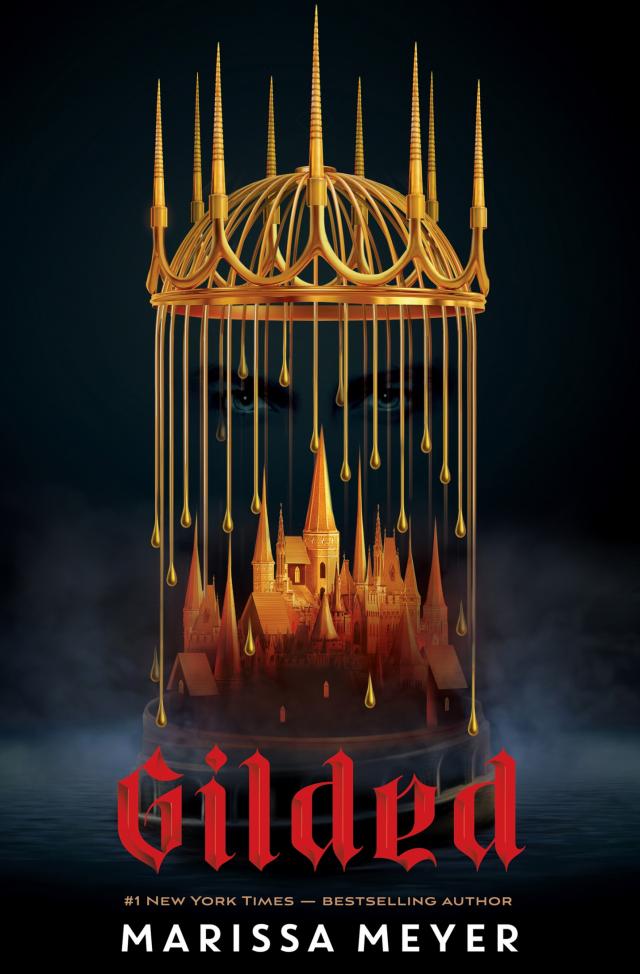
Gilded, p.8
Gilded,
p.8


The strands of straw were tough, the ends scratchy against her forearms. She stared at them and tried to picture tufts of wool like those Mother Weber had sold her countless times.
The straw was nothing like the thick, fuzzy wool she was used to, but she inhaled a deep breath anyway and loaded the first empty bobbin onto the flyer. She spent a long time looking from the bobbin to the fistful of straw. Usually she started with a leader yarn, to make it easier for the wool to wrap around the bobbin, but she had no yarn. Shrugging, she tied on a piece of straw. The first one broke, but the second held. Now what? She couldn’t just twist the ends together to form one long strand.
Could she?
She twisted and twisted.
It held … sort of.
“Good enough,” she muttered, running the leader yarn through the hooks, then out through the maiden hole. The entire setup was beyond precarious, ready to fall apart as soon as she pulled too tight or released those weakly connected strands.
Afraid to let go, she leaned over and used her nose to push down on one of the wheel’s spokes, so that it gradually started to turn. “Here we go,” she said, pressing her foot onto the treadle.
The straw pulled from her fingers.
The tenuous connections disintegrated.
Serilda paused. Growled to herself.
Then she tried again.
This time, she started the wheel sooner.
No luck.
Next, she tried knotting a few ends of straw together.
“Please work,” she whispered as her foot started to pedal. The wheel turned. The straw wound around the bobbin. “Gold. Please. Please turn into gold.”
But the plain, dry straw continued to be plain, dry straw, no matter how many times it slipped through the maiden hole or wound around the bobbin.
Before long, she had run out of knotted strands, and what had been successfully looped around the bobbin started to splinter as soon as she took it off the flyer.
“No, no, no…”
She grabbed a fresh bobbin and started over.
Pushing, forcing the straw through.
Her foot mashing against the treadle.
“Please,” she said again, pushing another strand in. Then another. “Please.” Her voice broke, and the tears started. Tears she’d hardly known were waiting to be released until they all flooded forward at once. She hunched forward, clutching the useless straw in her fists, and sobbed. That one word stuck on her tongue, whispered to no one but the cell walls and the locked door and this awful castle full of awful ghosts and demons and monsters. “Please.”
“What are you doing to that poor spinning wheel?”
Serilda screamed and tumbled off the stool. She landed on the ground with a bewildered grunt, one shoulder smacking the stone wall. She looked up, pushing away the strands of hair that had fallen into her face and stuck to her damp cheek.
There was a figure sitting on top of the pile of straw, cross-legged, peering at her with mild curiosity.
A man.
Or … a boy. A boy about her age, she guessed, with copper hair that hung in wild tangles to his shoulders and a face that was covered in both freckles and dirt. He wore a simple linen shirt, slightly old-fashioned with its generous sleeves, which he’d left untucked over emerald-green hose. No shoes, no tunic, no overcoat, no hat. He might have been getting ready for bed, except he looked wide-awake.
She looked past him to the door, still shut tight.
“H-how did you get in here?” she stammered, pushing herself upright.
The boy cocked his head and said, as if it were the most natural thing in the world, “Magic.”
Chapter 11
She blinked.
He blinked back, then added, “I am extremely powerful.”
Serilda’s brow furrowed, unable to tell if he meant it. “Is that so?”
In response, the boy grinned. It was the sort of look that was meant to hide secrets—lopsided and laughing, with flecks of gold sparking in his eyes. Standing, he brushed away the bits of straw that clung to his hose and glanced around, taking in the spinning wheel, the cramped room, the barred window in the door. “Not the most pleasant of accommodations. Lighting could be improved. That stench, too. Is this meant to be a bed?” He toed at the pile of straw.
“We’re in a dungeon,” Serilda said helpfully.
The boy cast her a wry look. Obviously they were in a dungeon.
Serilda flushed. “In Adalheid Castle, to be precise.”
“Never been summoned to a dungeon before. Wouldn’t have been my first choice.”
“Summoned?”
“Must have been. You are a witch, aren’t you?”
She gawked at him, wondering if she should be offended. Unlike all the times she’d called Madam Sauer a witch, this boy did not cast around the word like an insult. “No, I’m not a witch. And I didn’t summon you. I was just sitting here, crying, contemplating my own demise, thank you muchly.”
His eyebrows rose. “Sounds like something a witch would say.”
With a snort, Serilda rubbed a palm into her eye. It had been a long night, full of novelty and surprise, terror and uncertainty, and now a most unwelcome threat against her life. Her brain was foggy with exhaustion.
“I don’t know. Perhaps I did summon you,” she conceded. “Wouldn’t be the strangest thing that’s happened tonight. But if I did, you have my apologies. I didn’t mean to.”
He crouched down so that they were eye level with each other and studied her, his expression dark with suspicion. But a moment later, the shadow vanished. His face split into that wide, teasing grin again. “Are all mortals as gullible as you are?”
She frowned. “Pardon?”
“I was only joking. You didn’t summon me. Did you really think you might have?” He clicked his tongue. “You did. I can tell. That suggests a fair bit of egotism, don’t you think?”
Her mouth worked, but she was flustered by the swift changes in his mood. “You’re toying with me,” she finally stammered, launching to her feet. “I have only hours left to live, and you’ve come here to mock me.”
“Ah, don’t look at me like that,” he said, peering up at her. “It was only a bit of fun. You seemed like you could use a laugh.”
“Am I laughing?” Serilda asked, suddenly angry, perhaps even a little embarrassed.
“No,” admitted the boy. “But I think you would be. If you weren’t locked inside a dungeon and, as you say, probably going to die in the morning.” He trailed his hand through the straw. Picking up one strand, he stood and appraised Serilda. Really looked at her this time. She could see him taking in her plain dress, her muddied boots, the twin braids of dark brown hair that hung to her waist. She knew she must be a wreck from crying, with a red nose and blotchy cheeks, just as she knew it was not these things but the golden wheels in her eyes that garnered that flash of curiosity.
In the past, when Serilda would meet an unfamiliar boy in the village or the market, she would shy away from his roving attention. Turn her head, lower her lashes, so that her gaze could not be seen. Try to stretch out those brief moments when a boy might look at her and wonder if she had a suitor, or if her heart was free to be captured … before they saw the truth of her face and flinched away, dismissing that momentary interest as quickly as it had come.
But Serilda cared nothing for this boy or whatever he might think of her. For him to treat her desperation like a game made him almost as cruel as the king who had locked her in here. She swiped her sleeve across her nose, sniffling, then straightened beneath his scrutiny.
“I’m beginning to reconsider,” he said. “Maybe you really are a witch.”
She lifted an eyebrow. “Let’s find out. Shall I turn you into a toad or a cat?”
“Oh—a toad, most definitely,” he said, not missing a beat. “Cats don’t get much notice. But a toad? Could cause all sorts of trouble at the next feast.” He cocked his head to one side. “But no. You’re not a witch.”
“Met many witches, have you?”
“Just can’t imagine a witch ever looking as pitiful and helpless as you did just now.”
“I’m not pitiful,” she said through her teeth. “Or helpless. Who are you, anyway? If I didn’t summon you, then why are you here?”
“I make it my business to know everything of note that happens in this castle. Congratulations. I’ve deemed you noteworthy.” He flourished the piece of straw toward her, as if he was bestowing her with a knighthood.
“I’m flattered,” she deadpanned.
The boy laughed and lifted his hands in what might have been a show of peace. “All right. You’re neither pitiful nor helpless. I must have misunderstood all the weeping and moaning and so on and so forth. Forgive me.” His tone was far too light for it to sound like a real apology, but Serilda felt her anger beginning to cool nevertheless. The boy turned around, examining the room. “So. The Erlking brought a mortal to the castle and locked her up. A bunch of straw, a spinning wheel. Easy enough to guess what he wants.”
“Indeed. He wants some straw baskets for storing all the yarn that’s going to be spun on this wheel. I think he means to take up knitting.”
“He does need a hobby,” said the boy. “One can only go around kidnapping people and butchering magical creatures for so many centuries before it gets tiresome.”
She didn’t want to, but she couldn’t help the way her mouth twitched into an almost-smile.
The boy caught it and his grin widened further. She noticed that one of his canine teeth was a bit sharper than the other. “He wants you to spin this straw into gold.”
She sighed, the momentary humor evaporating. “He does.”
“Why does he believe you can do it?”
Serilda hesitated, before answering, “Because I told him that I could.”
Surprise flashed across his face—genuine, this time. “Can you?”
“No. It was a story I made up to … it’s complicated.”
“You lied to Erlkönig?”
She nodded.
“Direct to his face?”
She nodded again, and was rewarded with something more than mere curiosity. For a moment, the boy looked impressed.
“Except,” Serilda hastened to add, “he doesn’t really believe me. He might have at the time, but not anymore. This is a test. And when I fail, he will have me killed.”
“Yes, I heard about that. Might have been eavesdropping upstairs. To be honest, I thought I’d come down here and find you wallowing in self-misery. Which you were, clearly.”
“I wasn’t wallowing!”
“I have my opinion, you have yours. What I find more interesting is how you were also … trying.” He gestured to the spinning wheel, and the bobbin wrapped with broken and knotted bits of straw. “I didn’t expect that. At least, not from a girl who is decidedly unwitchy.”
Serilda rolled her eyes. “Not that it did me any good. I’m not a gold-spinner. I can’t do this.” A thought occurred to her then. “But … you have magic. You got in here, somehow. Can you get me out of here?”
It was only a temporary solution, she knew. The Erlking would come for her again, and next time, she knew he would follow through on his threats. He might not just come for her, but for her father, perhaps for the entire village of Märchenfeld.
Could she risk that?
From the boy’s crossed arms and shaking head, though, it seemed that she wouldn’t need to make the choice. “I said I’m extremely powerful, not a miracle worker. I can go anywhere in the castle, but I can’t pull you through a solid door, and I have no key with which to unlock it.”
Her shoulders sank.
“Don’t look so discouraged,” said the boy. “You aren’t dead yet. That’s a distinct advantage over just about everyone else in this castle.”
“I find that only mildly comforting.”
“I live to serve.”
“I doubt that.”
His eyes danced briefly, but then became unexpectedly serious. He appeared to be considering something for a long moment, before his gaze turned intense, almost cunning.
“All right,” he said slowly, as if he’d only just made up his mind about something. “You win. I’ve decided to help you.”
Serilda’s heart lifted, filling fast with untethered hope.
“In exchange,” he continued, “for this.”
He pointed a finger at her. His sleeve slipped back toward his elbow, revealing a ghastly knot of scar tissue above his wrist.
Serilda gaped at his extended arm, momentarily speechless.
He was pointing at her heart.
She stepped back and placed a protective hand to her chest, where she could feel her heartbeat thudding underneath. Her gaze lingered on his hand, as if he might reach into her chest and tear out the beating organ at any moment. He didn’t exactly look like one of the dark ones, with their majestic figures and flawless beauty, but he didn’t look half-faded like a ghost, either. He seemed harmless enough, but she couldn’t trust that. She couldn’t trust anyone in this castle.
The boy frowned, confused at her reaction. Then understanding hit him and he dropped his hand with a roll of his eyes. “Not your heart,” he said, exasperated. “That locket.”
Oh. That.
Her hand shifted to the chain around her neck. She gripped the locket, still hanging open, in her fist. “It will hardly suit you.”
“Strongly disagree. Besides, there’s something familiar about her,” said the boy.
“Who?”
“The girl in the—!” He paused, his expression darkening. “It would appear that you’re trying to be aggravating, but that is my talent, I’ll have you know.”
“I just don’t understand why you would want it. It’s a painting of a child, not some great beauty.”
“I can see that. Who is she? Do you know her?”
Serilda looked down, tilting the portrait toward the candlelight. “You’re the one who just claimed to know her.”
“I didn’t say I know her. Just that there’s something familiar. Something…” He seemed to be struggling to find the right words, but all that came out was a disgruntled growl. “You wouldn’t understand.”
“That’s what people say when they can’t be bothered to explain.”
“It’s also what people say when someone else truly won’t understand.”
She shrugged. “Fine. The girl is a princess. Obviously.” The words were out before she had thought to say them. In the next moment she considered taking them back, confessing that she had no idea who the girl was. But what did it matter? Maybe she was a princess. She certainly looked like she could be. “But one with a very tragic story, I’m afraid.”
With that mysterious statement hanging between them, she snapped the locket shut.
“Well then, it must not be a family heirloom,” he said.
She bristled. “I could have distant royalty in my blood.”
“That’s about as likely as me being the son of a duke, don’t you think?” He swept an arm down his plain clothes, practically undergarments, to prove his point. “And if it isn’t a family heirloom, then it must not be all that precious. Surely not as precious as your life. This is a bargain I’m offering you. My help for an apple and an egg.”
“A bit pricier than that,” she muttered. But her heart was sinking. She knew he had already won the argument.
He must have known, too, as a smug smile crossed his mouth. He rocked back on his heels. “What’ll it be? Do you want my help or not?”
She looked down at the locket, lightly tracing the golden clasp with the pad of her finger. It was almost heartbreaking to part with it, but she knew that was silly. This boy seemed convinced that he could help her. She didn’t know what he could do, but clearly he had some bit of magic, and besides—she didn’t exactly have a lot of options. His appearance was miraculous enough for one night.
Scowling, she lifted the chain from around her throat. She held it out to him, hoping he wasn’t about to laugh at her gullibility, again. He could easily grab the offering, cackle, and disappear as fast as he’d come.
But he did not.
In fact, he took the chain with the utmost care, a hint of deference on his face. And in that moment, it was as if the air around them pulsed. Pressing in against Serilda, muffling her ears, squeezing her chest.
Magic.
Then the moment passed, the magic evaporating.
Serilda inhaled deeply, as if it were the first real breath she’d taken all night.
The boy slipped the necklace over his head and jutted his chin toward her. “Move.”
Serilda tensed, startled by his abruptness. “I beg your pardon?”
“You’re in the way,” he said, gesturing at the spinning wheel. “I need space to work.”
“Would it hurt to ask politely?”
He fixed her with a look so openly annoyed, she wondered if his irritation might rival her own. “I’m helping you.”
“And I’ve paid you for the honor,” she said, indicating the necklace at his throat. “I don’t think a shred of civility is unwarranted.”
He opened his mouth, but hesitated. His brow furrowed. “Would you like me to give the necklace back and leave you to your fate?”
“Of course not. But you still haven’t told me how, exactly, you plan to help me.”
He sighed, a bit dramatically. “Suit yourself. After all, why be accommodating when one can be difficult?”
He stepped toward her—and kept coming, as if he might trample her like an errant mule cart if she didn’t get out of the way. Teeth gritted, Serilda planted her feet.
She did not move.
He did not stop.
He collided into her, his chin smacking her forehead, his chest knocking Serilda back with such force she stumbled and fell onto the straw with a surprised oof.
“Ow!” she yelped, resisting the urge to rub the sore spot on her rump where the straw had only barely softened her fall. “What is wrong with you?” She glared up at him, both infuriated and baffled. If he thought she was going to let him intimidate her—!