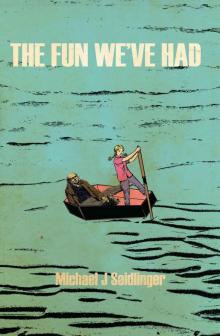
The fun weve had, p.5
The Fun We've Had,
p.5


Quick to nag, quick to be numb, she wasn’t swimming to escape him. She swam to escape herself. The fact that seeing him meant having to see that vain smile, the threat to be perfect that made her a threat to everyone brought close, only tightened the tether, soaked it in kerosene, ready to spark with a single shift of the situation. If anything went wrong, she was the tantrum to turn everything to cinders. Burnt ash. Blame. Can’t carry the blame so she tosses it to the person nearest, closest, most dear.
Flicker but nothing fades. She was still here.
Bathed in sunlight, the borrowed body felt heavier, and she watched, distantly felt, as it began to stink. The sweat was yellow, the bodily fluids escaping the drying body, a murky brown, it was an odor that only she could smell. The water would wash it away, she thought. A smell so overpowering and bitter when she brought back up the past, every single time she had treated him as less.
Less a man and more a burden.
She banked on herself before she would any bond.
The water tempted her, the mock-mouth opening and closing as she heard the thoughts in mind resonate across the waves.
He would do anything for you. You were on your deathbed and he tried to save you. He did all he could and listened through all your nonsense, all your bullshit and stupid blaming. Even when you forgot how to breathe, how to blink, he breathed for you. He remained at your side, putting drops in your eyes.
Her with a question. Her with an answer.
The waves mouthing the word:
Sorry. But when she tried to speak, she saw that words alone weren’t what had begun to expire. Beyond the sundrenched scene existed a limitation; a borrowed body was a body all the same. Past-due and setting sail across curious waters that no physical map would ever reveal, not even so much as a mark, the body becomes the final marker, the final compass pointing the direction of expiration. Sorry. Say it.
I am sorry.
She tore open the mouth stitched closed by dry lips, saying all that she believed she had heard. Everything that she needed to have told him, meant to tell him for so long, as long as it will take to tell the entire tale, the hundreds of pages, and perhaps so much more, but for all the effort, all that she had wanted to say, every line that had been fought over in her mind, became invisible as it left her mouth. Invisible to both line and page. The only words that came out were the same words he had told the sea.
“I love you.”
Neither character heard each other, relegated to speak without using speech, but for that one moment, when she listened to what she had said, articulated in his voice, a fire rose that gave her the cue to turn and face him.
If it meant saying “I love you” a thousand times to rid herself of the smell, she would drench the coffin in the word “love.”
HIS TURN
He met her eye-to-eye, blinked when she blinked, and breathed out when she pretended to breathe. He saw a sweaty, double-chinned, bald face, a face so familiar, it took him this long to get the lines right. It took an entire life; by now, those lines were the length of waves headed in no clear direction.
He met her mouth with his and then said, “Are we having fun?” Imagining what she might be thinking, he bartered another “I love you,” and watched the sparkle in those eyes.
How dull he must appear to her from behind those old, apathetic eyes. Desperate though he may have been, he bargained that she saw only a fraction of the sunlight, understood only a small flicker of his apology.
“I love you” was her response.
“I love you” was his only reply.
“I love you” once again, he began to see tears welling up, tears that had seldom been shed from those sorrowful, admittedly unremarkable eyes.
He said it again, and watched as they started down her face. He wiped them away before they could travel down her cheek; dragging a finger across her face forced him to feel the various blemishes and pockmarks, grime and skin tearing of a body he had misused.
“I love you,” he said and meant every word.
“I love you,” she replied and seemed to retreat into that body. Their faces flush, hands held, potbelly and nearly flat-breasted chest pressed, he could sense her fleeing him in the one way possible. He had so much to tell her.
He met her fault with his, which came out as a forlorn and melancholy “I love you.”
It is admirable to see someone care about another so much that he’d say anything to conceal true feeling, to keep her here. I love you, I love you, I love you—repeated in a rhythm that matched what’s missing:
A heartbeat.
Blurred sight, tears fell. His, much like hers, was a silent cry, tears that blinded him as much as they seemed to blind her.
And though they continued to look, they could no longer see. All he saw was the cloudy black of those two eyes.
This was the result of forced feeling, and though they felt, neither him nor her could grasp the language to let it all out.
They settled on “I love you.” He laundered feeling underneath the word “love.” When the tears did not stop, he languished, feeling an all-too-familiar loneliness. Blinded by the tears, he no longer saw her. All he could smell was his own body odor, his own foul breath, as she exhaled in panicked, practiced bursts. He closed the eyes, opened them, and closed them again. He flushed the fresh tears, letting them fall down the borrowed body’s cheeks, her rosy cheeks, and felt each eyelid. He felt as her eyes anxiously moved left to right, as if reading how this will end.
What you must do.
He opened the eyes and used the same fingers to feel them out of their sockets. He handed them back to her alongside a forlorn, apologetic “I love you.”
She reached for them and blinked.
Tears beyond what she needed to feel, he was glad when she took them and, best of all, when she gave him his.
“Are we having fun?” as if to inquire how she felt. She nodded and placed her eyes in her borrowed face.
Blink, and he did the same.
HER TURN
“I love you,” she could finally see him through the worry. “I love you” she could recall the good between the bad. “I love you,” the words did not come but she remembered a time when coming froze everything until she felt every little thing, touch, taste, smell… until she exhaled, never more confident that she was alive.
“I love you,” became a cipher for dead speech, what he had said to her and what she said back. Tongues remained tight, and mouths dry, but a breath could be brought up if she felt it right.
“Are we having fun?” she might ask even though there was no answer because there really was no question. Yes, him and her together were a fun time, a fun coupling, no bother about the impossibility of their fun, and how really their past was as nonexistent as their future. It was what could be read between the lines, what happened between those transitory moments of reality, that she found escape.
Theirs was a fictional story, but it resembled the friction of affection when it did not fit for society.
“I love you,” the cipher to speak and say I’m sorry.
An “I love you” in return acted as an acceptance.
A follow-up from him “I love you” was to say that he wanted to apologize too.
Fun was the bargain they had bought, and though it might have never happened, in the dead of all dead seas, this vacant sea as invisible as it wanted to be, she fixed an image and hid behind what she couldn’t imagine herself to be.
But he brought her back.
He always brought her back. He was in tears, and so was she. Their’s was a past that could only be told here, after each perished, pardoned themselves from the life they never had.
Too young, maybe, but she reached as far as she could and, she knew him fully, knew him best. He lived twice as long as she but never breathed out once.
Never really blinked. His was a tense life, one full of held back tears and dozens of cries for help.
It was only now, after having borrowed his eyes, that she realized that he held it all back. Much like she was certain that he saw the ugly and the alien, the random grudges and the unneeded hate, that she fled and fought back with apathy, with ignorance.
He had seen all that and still said, “I love you.”
“I love you,” he handed back her eyes.
“I love you,” she gave him back his.
“I love you,” she would rather be blind than be alone.
“I love you,” embedding agreement with the inflection added to the “I” in “I love you.”
He could keep her smile. He gave her enough: He chose not to let go. Eventually they would.
The sea, maybe calm, would soon change. Nothing remained the same, and neither would she, no matter what she did to stay with him.
HIS TURN
Seeing with his own eyes, he could pick out a horizon of his choice. It was his to choose, for it was his eyes that would see. He traced the air into partitions and within those partitions he formed invisible pages. Extending a finger, he wrote onto the air and squinted to read what it became.
With his own eyes, he could see and could feel without tears forming; he could feel what little he felt and let it settle. Him and her could feel and soon, as they returned what they had borrowed, they would admit to themselves that this is what they’ve become.
They have met death and will be unable to escape it.
Words propped up like a skyline view in the distance; he observed the sea, waited for the sun to begin to set, before touching her. Sun never set until it was too late, and by the time it did, he discovered what, maybe, she already knew.
He could not touch her without touching himself.
“Are we having fun?” laundered the question of giving her a hand. When she gave, he gave both, gave both of her hands back, and she did the same.
With his calloused and fat fingers, he felt a body, his body, as she felt a body, hers.
This scene does not work.
The romance is clearly off the page.
He wanted to kiss her, but to kiss her, those lips would be so bitter. She reached below but felt his set rather than hers.
To make love was to make love with oneself, masturbation of a stranger duped into becoming you. It was sickening, and even more sickening was how he felt nothing, the severed senses, halved by demise, a demise that continued to loosen his grip, tempting him ceaselessly to just let go, die.
Die. You are dead.
What little he had to hold onto he still held, and never, not even once, did he question whether or not she would let go.
No letting go of each other.
A kiss he couldn’t take back, a kiss meant for her, but she still carried his complexion, and he was still girlish.
Worst of all was how he smelled; his odor on her did not match. It could have never been as wrong as it was here.
Sickness overcame them, and it was horrible to think that only sickness, the ugly of anything, could feel so bold on the wide-open sea. In fact, the sickness, the nausea, the disease felt sharper out here, wherever they were.
He could so easily succumb to it but instead he said, “I love you,” and she said it back.
Nothing laundered, no feeling, no sickness.
It was genuine, a genuine “I love you.”
HER TURN
More, much more than anyone could bargain for, she had returned to herself, felt with her own fingers, grasped with her own hands, and now able to hold back the tears, each feeling, no matter how construed and defeated, held there on the air, for her to see. Those blue eyes of hers could easily forget to blink.
Much like breath, she made a conscious choice to continue, and she continued mostly to be able to continue alongside him.
The coffin is the loneliest place for a person.
But with touch given back to her, she tried and he tried. She felt the sickness on her mouth, and soon she ran to the edge. She could see it so well, his reflection on the water, as she began to pretend to dry heave.
Exchanging “I love you’s” made it better, as perfect as can be. He held her hand and she held his.
No matter how ready they were, the sex eluded them.
It eluded them before, back when they had the heart to feel, the breath to breathe, the sight to savor. It will continue to elude them here.
“Are we having fun?”
It was a question. For once it was a question whose only answer was a definitive silence.
A silence that is left to the reader to determine if theirs was ever anything but poor timing, a poor fit of two similar personalities; everything about them clashed and yet something else made them fit so well.
Nonsense was their own true sense.
“I love you.” She knew what had to be done and signaled, gestured, for him to do the same.
She pulled his face from the borrowed body, the nonsense dripping in dark red onto the coffin, and she gave it to him.
In that instant, she was death incarnate.
She saw it then as he did exactly the same, trailing with another “I love you” that was genuine, as if to imply that he remained only for her, and she took it at face value, believing, really believing, that he would.
She could believe that she would do the same for him, and maybe she would. However, it was deeply written into her to think firstly about herself and if her actions were in any way selfless it was because she was concerned with how the people around her felt about her. She skewed her actions in favor of getting an unfair, overly favorable, judgment.
With her face in her hands, they both held onto their faces, letting the blood red outline how high the invisible water had risen in the coffin.
Soon it would be above the ankle.
She examined the shape of her skull, watched as his eyes scanned his own skull, before they both placed their faces in place.
Underneath their skulls were still borrowed mechanisms, bone ill fitting, but wearing their own faces somehow made it better. Even when their faces hung there, she leaned in and said, “I love you.” They kissed and she considered again the sex that she craved.
HIS TURN
Sundown. He played with language on the air, letting the lines he loved most highlight the horizon. He had accepted the fact that he would be unable to share this with her and, quite possibly, she had something that she would be unable to share with him.
They occupied the coffin, wondering and waiting for the coffin to sink.
But it wouldn’t sink.
Ciphers clipped their conversation into hardly felt statements, but somehow it felt like forever ago when they traded hands and eyes, scent and faces, when really it could very well have been a mere moment ago.
Sense of time draped the bottommost depths of the sea much like nonsense framed every single aspect of their meeting and subsequent, short-lived, relationship. If it could be called that.
But he loved the words that seemed to answer and prove what he felt.
The study had been right, the study of death during life was his plight and even now he looked to prove that it was not a waste, when perhaps everything that uses life can be wagered and ranked in as possible waste.
No wasted “I love you’s,” for every so often it will be his turn to say “I love you” and it would result in a return to anger if either failed to give reply.
He no longer sat at the so-called front, the “bow,” of the coffin, their buoy, their boat. He shared the entire coffin with her. He carefully moved in circles, and she fell into the same routine, circling the coffin so that it never tipped over, never became docile or prone to further damage.
The water that continued to fill seemed to slow its ascent if they remained mobile. How they discovered this to be true is unclear; however, he took to bigger steps. It was his way. He couldn’t deny the fact that he made sure to be quicker, more mobile than she, and it might be the one reason why he did not trade the rest of her body for his. At least not yet. He enjoyed sampling a more youthful, nimbler, body.
His face hung there like dry and dead skin; every couple circles he would catch a glimpse of himself on the water and it would catch him off guard. It made him feel something he could not express. No matter how many words he saved for the horizon, it was something unnamable.
It was guilt. It had to be guilt. For this to be a romance, he could never be pardoned from the guilt of feeling as though he could have saved her. From what exactly, it wasn’t defined until this very chapter. He cared enough in life to still feel, in death, that he might have saved her life.
Fault would be the anchor that pulled him under.
HER TURN
Encircling the coffin, she greeted them over and over, once a rotation, and the rotations never ceased. She walked, seldom sat, as if she were walking his body, giving it some exercise.
“I love you,” every time, every single time, she saw him.
And never was it in question.
It was not an empty statement.
There was a momentum that continued to anchor them, continuing to fill the coffin, and yet the splashing of that water never seemed to worry her. She felt as though she were entitled of his worry. It was his responsibility to save the two of them.
So instead she played a different part.
It was difficult enough to cater to them. She was hardly ever the socialite but they chose to visit her again here, of all places, and really though, now was the perfect time for these sorts of visitors. The ghosts that visited her had become social acquaintances, neighbors out at sea.
Their speech had no reason to sit between quotation marks.
They spoke in thought and it didn’t seem like he could eavesdrop. Only she could see their words on the air, fading so casually, like comic strip speech bubbles without the ink.