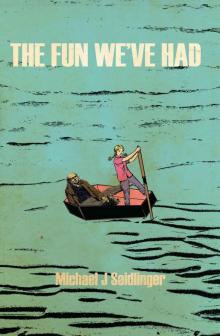
The fun weve had, p.8
The Fun We've Had,
p.8


Something won’t let her sink.
Something that is most dearly nothing.
But his turns continue because she chooses to imagine that he is still with her.
She does not embellish, she does not prefer or have any preferences. She imagines him as he would be, even though only the faintest image of him could be imagined.
She imagines the coffin and his sheltering embrace.
She imagines him as a hero, and plays out what would have been his hero’s end.
Not that he wasn’t a hero. She would consider him nothing less, and yet he was flawed for having found in her a strange partner. Would he call it significant, she can’t say.
But it was significant to her: His role in her life, death, and the roundabout end that this had become.
She imagined his exit.
How she’d have preferred him to leave.
Her at fault, she featured him in her memory as the person who might have shared her coffin. In this version, she was the one to be buried in the coffin, not him. In this version, she would cease to exist as a burden before he had to see her off, a burial it would not be. She would pass on, let go, and live on in his memory. The hero would survive and would have saved her because he would have needed to save her in order to survive.
Survival is what she imagined.
His survival.
Using the few turns that remain, she imagined for the sake of a man that tried twice to save her.
It would never be his fault.
He tried to save what could not be saved.
How can one save a person who cannot begin to save herself?
Much of what she imagined existed in the white of the page, the blankness that echoes out much like this:
…echoing her wishes would have been his voice calling in the distance, near the horizon, a call that had everything to do with telling her that he was fine.
Still holding on.
Instead, there was a hero’s fantasy.
And there was loneliness. But it’s saved for her turns.
The loneliness does not bleed into his turns.
HER TURN
In this turn, she felt the loneliness beginning to restrain, pull her in such a way that she had to keep swimming to keep from being consumed by the conditions. What is clear to her now:
There is no going back.
He was here, but now he isn’t.
She was young.
Life had that way about withering and her life withered in the time it took most to get started.
She affected too many people, and those people became burdened by her demise.
Demise before it became hers was something desirable. It was an interesting concept, danger, a thrill sought after being stung by the consequences. She never could have assumed that one adventure would lead to this.
She felt cheated. She felt like a cheater.
Equally, she took too much and inevitably it was her life that was taken.
It was penance for her precarious actions, her lifetime in advance, running toward the bitter end right from the beginning.
And now she was where there were no explanations. She occupied the drift between the two phases of life. She existed, just barely. She had it better but resisted. She could not simply accept it until it was too late. These are the conditions, and this is what placed her loneliness in perspective. After acceptance came the void, emptiness of having little else to feel, no one near, only the few items she would rather forget.
All she had left was her imagination.
But if it hadn’t been explained earlier in the tale…
Indeed she did:
She swam through scalding waters to recover his body. She recovered the body and what’s more, she pulled it toward the coffin. When it wasn’t there, she went ahead and opened her eyes. She saw for long enough to see the coffin. Her eyes open in the boiling water was enough for her to lose sight of everything else.
When she reached the coffin, his body was whole. Not that it wasn’t a skeleton. Not that it hadn’t become unrecognizable.
In the dead end of acceptance, she lost sense of everything but touch. And after swimming through the waters, she lost that too. She chose to imagine him as he was, and her as she would have wanted to be.
Her imagination omitted the shark at the front of the coffin, waiting until she closed the coffin so that it could pull him finally away from her. She constructed an entire scene, one that plays out in these last few turns.
In the remaining lines of this turn, she fell back into his embrace. For one moment, her skeleton gripped his and it was perfect. As perfect as can be.
Finally in the coffin, the seawater cooled.
The coffin began to take on water.
It wouldn’t stop until the shark pulled it under, bringing whatever was left of him to the depths of death. Right where any that still floated on the seas belonged.
HIS TURN
For this turn, she assumed that the water was still boiling, that the coffin still floated, and that she was still in his tender embrace.
She focused on him.
What he would think before finally jumping into the water to collect the shards that had once been the moon.
She mulled over whether or not the moon needed to shatter, and yet it was strangely romantic of him to seek out the light.
It had to continue in the very same way. He would have preferred it.
During his turn, he told her it was okay.
Maybe it was even a little fun.
That became his excuse: “We’re having fun.” Only they could have fun in such a dire situation. However, that’s what brought him to her. She was an out of control child, barely even a teenager; she had, perhaps, grown up too quickly.
But the way she imagined it, she sought out fault because she still believed that she could be a good person.
A person like him could not have cared for someone that could be nothing but a burden.
In this imaginary scene, they both laugh.
“It is fun, actually.” That’s what she says.
It’s always about fun with you.
Actually no—she changes that.
He says something cliché. He tells her, “I have fun whenever I’m with you.”
She adds, “It doesn’t matter what we do, where we go, or where we’ve gone. It’s fun when you belong and I belong with you.”
Hold back a sentimental tear. She tends to the bittersweet scenario. By definition, the hero has to be a real charmer. He was a charmer, a real charmer, even though that couldn’t be further from the truth. Really he was just some guy who had chased foolish ideas, received a modicum of success from a small group of peers, and let himself fall over the deep end after they had told him that he might not be full of shit.
Death was no closer to being a disease than love being something that you overcome. If you felt anything pure about a person, you wouldn’t surely fight to get away.
Maybe only if you were her.
But this is her imaginary scenario.
Her fantasy.
And in this they swam for miles in each other’s arms, the sharks following them, maybe attacking, but his own return attacks, using a weapon she incorporated into the fantasy in order to apologize for pinning down one of his arms when he could have really used both.
She wanted it to be something she wouldn’t need to accept. She wanted it to be something that didn’t need any accepting.
Something before the inevitable nothing.
HER TURN
“Are we having fun?” she shouted out to the sea. She shouted because there wasn’t anything else she could do. She imagined that the sharks circled the coffin. She imagined that her flesh had fallen off her bones in large sheets and the jellyfish had continued to grip onto various parts of his and her bodies.
It was worth accepting that it would continue to be pain until the very last moment.
She shouted to the shark, the one that watched and directed the entire onslaught, “Are we having fun?”
She meant for it to be a question, meant for it to be loud, carried out in an echo that might be heard elsewhere, but she could not hear her own voice. Because she couldn’t hear her own shouts, she imagined them as gruff whispers, barely anything but a wheeze from her mouth.
What she must look like, she decided to leave off the page.
One love buries another.
His burial required her vigil. Though he fought so that she would never have to be in such a position, her role as burden in so many lives transformed into purpose, her very real purpose in continuing to hold on. Her loneliness became a deadly buoy in an already dead place. Indeed, she accepted her role.
Burden is always yours, never theirs. She accepted what she needed to accept. Her mom’s passing. The life that was a waste, the life she didn’t do much to protect or save.
Everything without a name, burned like a cigarette lit to be put out on her thigh.
She had finally accepted everything. Summarized as such:
Once upon a time a young preteen sought danger because that foolish person thought danger asked for nothing in return. Risk was simple. Risk was face value.
She never understood that danger would inevitably require a life. It took hers because she hadn’t been careful enough.
The stage, the final stage, lives passing on like the shark fins poking through the cooling waters.
If she could, she would feel his face. If she could, she would run her own hand across the sockets where her eyes had once been; if she could, she would separate herself from this body.
If she could, but she couldn’t because the small part of feeling that remained had a very physical connection. The ghosts in place, the ghosts she could hear calling her name, speaking beyond speech, beyond sound, faulting her for yet another fault, she ignored because they simply couldn’t understand.
She must tend to his burial.
She must feed the sharks.
“Are we having fun?”
HIS TURN
This is the turn where he continues to fight back and gathers all the shards. There are as many as she thinks there should be to put him in a positive light.
By that you can expect a lot. With each shard she places him in heroic situations:
He fights the shark that had watched them from the start. And wins.
He swims to the horizon and pulls back a rope bridge. And they walk it over the horizon, back to their still-beating hearts.
He swims circles around the sharks and gets them to cannibalize each other.
He builds a second coffin for her and they both sleep side-by-side.
He freely controls the temperature of the sea.
He makes sense of the nonsense in their lives. He tells her that this was all just a dream, and maybe, depending on how traumatic this had been, a nightmare, and she wakes up.
It’s all part of his study.
She wakes up and feels so much better.
Key word: feel.
He makes her feel again.
Say goodbye to numbness.
He makes death as distant as possible. But even she can’t completely imagine how that might be possible.
The one that works best is the one where he gathers the light and places the moon back on its perch. It is the one where he kicks the sky back up to its typically impossible-to-reach distance.
He places her on his back, tells her to grip on, and paddles back to the coffin. In that coffin, they sit and enjoy. They watch as the sky becomes a real sky, full of stars, the moon looking like it had never been broken. Their senses return and they share a perfect moment.
Demise sticks to its ocean depths.
They share the dream of a starry night.
By dawn, they let go. She figures if it must be over, it ends at once, together, with a single breath, a single blink of an eye. Most of all, she imagines him as a hero.
Her hero.
HER TURN
Acceptance, all along. Each turn of a thought led to the inevitable.
Accept the impossible. Deny it and admit defeat.
Restrict and remain closed to the possibilities and you let demise infect your senses. Soon you feel numb, muted—a life being wasted. A person has fun because they feel.
“Are we having fun?” she shouted.
The ghosts were there to respond.
Their replies may have been yes, but the majority would say no. The ghosts, the few that posed as her demons, began to disappear. They concluded their own passing, and perhaps they took with them a piece of her peril.
She felt the pressure, the burden, lifting, and yet she could not change the fact that she must face this alone. Seeing off someone you knew, someone you cared for, more than yourself.
Some would arrive and some would leave, but the ghosts, they would always be there, watching and waiting for what they couldn’t let go of in life.
Much of what they held onto is what they denied, what caused them great anger, something they bargained for, or something they outright feared. The ghosts held on because they denied it from the start. So then, the reader accepts it no matter the unfortunate ending to an already unfortunate tale.
Accept that she had to let him go in order to loosen her own grip. Sadness isn’t all she felt. What she couldn’t imagine, the reader of this tale might offer a hand, suggesting alternatives to how the tale can be told. For this telling at least, she must step out of the coffin. She must take to the shark-infested waters, the water that once again began to cool into a freeze. Blind to all sense, she will step in and envision herself standing on water.
And it would be all she saw.
Burden layered the body that had been his, the body she had borrowed, in the texture of the coffin. The texture of velvet and that of a tender embrace cradled his body, the one she could no longer cradle.
The shark that directed is the shark that watched as she pushed the coffin away. A pretend breath and then that one gentle push…
And the lapsing moment, one that goes on for way too long but then it might not have been very long at all:
She was the one that treated it as forever.
After forever lengthened to the shark swimming with the coffin trailing it, she stood still on the water.
After three steps, the water below her feet turned to ice.
After that, she stepped on shark fins, fighting off the inhibition. She tempted them. Go ahead and bite.
Of course, what she imagined to be sharks might have been nothing but frozen waves jutting up like pointed rocks.
For this to work, she continues as our point-of-view, and because she is our means of seeing the story to its end, she really does feed the sharks and it is treated with surprise when the sharks do not bite, perhaps full or lacking an appetite.
She had to continue on her own.
There wouldn’t be a sudden end.
HIS TURN
She counts the steps she takes as one year’s time together. In a place where time is meaningless, the duration that might have been “the rest of their lives” looks a whole lot like this:
But then they were already dead, and this line would be most acceptable as an indication of how much time they had together.
Her imagination filled in the blanks.
Everything changes. Nothing is true.
The water whispers, the depths shout.
She is a different person.
He always was.
HER TURN
In the end, his turns became hers.
Her swimming had become a walking.
A long walking. The walk was her penance.
The walk was her search for him.
This tale had come to its conclusion.
It was an emptiness that she accepted.
The emptiness can be seen on the page.
The blank of the page is death’s take.
What remains is what a life leaves behind.
The more you accept the less exists on the page.
HIS TURN
She imagines his last turn as flat desert terrain built on a dead, frozen sea that would never again thaw.
She imagines that she has been walking for her entire life.
She imagines an expanse of time where she carries the zest for life. It looks like a tiny coffin, a little pocket-sized trinket that she holds in one of her hands.
Time goes on like this. Walking. Adventure.
No need to think about tomorrow.
He shows up. They meet because they are walking in the same direction. They seek out the same destination.
Adventure.
Each line invisible are events that transpire while she is alive.
The lines visible here are of events that either never happen or happen after demise. These are the lines that take place where there is no longer any life.
If she could imagine the page, she would see that her life wasn’t a waste.
They are able to throw their speech, share and borrow their bodies, and collectively remain significant in each other’s life.
But they never meet until they stop walking.
When she stops walking, it all stops.