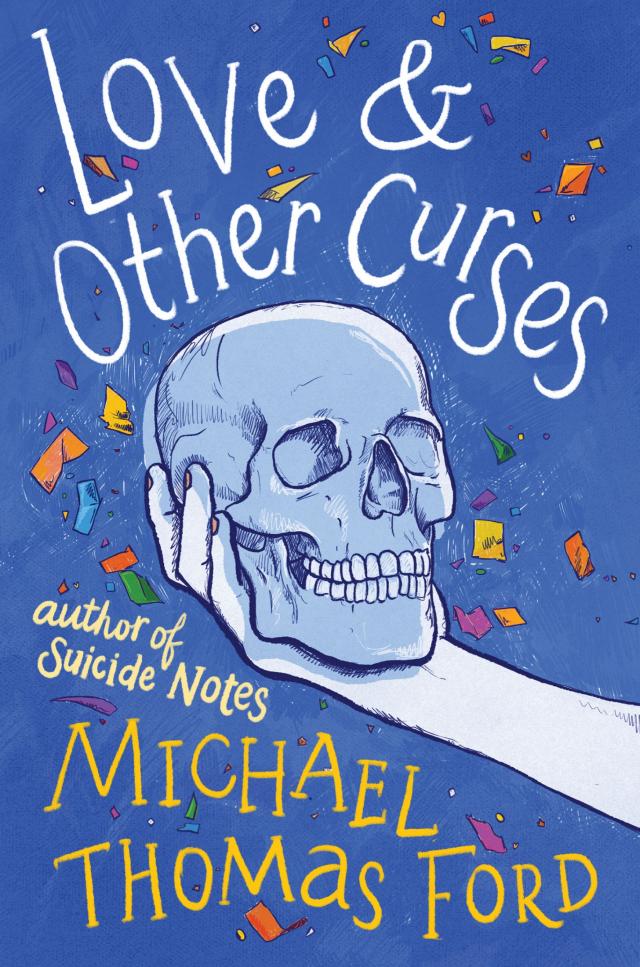
Love and other curses, p.23
Love & Other Curses,
p.23


“Good at fixing things, are you?” Rhonda asks.
“Machines, anyway,” I say as she opens the door.
We step into a kitchen. Like the outside, it’s a little shabby, but neat and clean. I get the feeling that Rhonda works hard to maintain as much order in her life as she can.
“You want some coffee?” she asks. “Or did you get enough of it back at the diner? I think I have tea. Or how about a pop?”
“Don’t you want me to look at the car?”
She shakes her head. “Talk first, car later. Sit.”
I sit down at the table. It reminds me of being in our kitchen at home, and I wonder what the Grands are up to. I watch Rhonda bustle around, pulling mugs from the cupboards and spoons from a drawer.
“Since you didn’t say, I’m assuming coffee,” she says as she spoons coffee into a pot on the counter and adds water. “This is the good stuff. Not that crap we have at the restaurant.”
As the coffee brews, she takes cream out of the refrigerator and sets it on the table along with a bowl of sugar. The sugar bowl is a ceramic clown head, and a small spoon sticks out of his mouth. Rhonda sees me looking at it and says, “I hate that thing, but it used to make my daughter laugh like crazy when she was little, so I keep it around for sentimental reasons.”
Again I want to ask her about her daughter, and again I don’t. A few minutes later, she brings two mugs of coffee over. She sets one in front of me, then takes a seat on the opposite side of the table.
“So,” she says. “You want to tell me what you’re running from?”
“What makes you think I’m running?”
A sad smile briefly creases her face. “Working at a place like the Perk Me Up, I see a lot of kids who are running. Edgesea is halfway between Somewhere and Somewhere Else. You get to know the look.”
I pick up my mug and sip from it. When I set it back down I say, “I’m actually not running from anything. More like running to it.”
Rhonda quirks an eyebrow. “Looking for answers?”
I sigh. “It’s a long story.”
“I’ve got time.”
I look at her. “Do you believe in magic?”
I expect her to laugh, or to ask if I’m crazy. Instead, she says, “I’ve seen some things.”
I tell her about the Weyward Curse, and about coming here to see Livvie Comstock and see if she would call it off. The whole time I’m talking, Rhonda doesn’t say a word. But she also doesn’t look like she’s trying to figure out a way to secretly notify the cops that an insane person is sitting in her kitchen.
What I don’t tell her about is my dream. I figure the curse is a hard enough story to swallow. Adding the fact that I dreamed about her, but that I had no idea she would be here in Edgesea, where I expected only to find Livvie, seems like too much. I’m hoping I can figure out what she has to do with things first. If I scare her off, I might never find out.
“Sounds like one of those fairy tales where the hero has to confront the wicked witch,” she says when I’m done. “Or an ogre. Something bad, anyway.”
“Yeah,” I agree. “That’s what my friend said too. Only I didn’t win. Livvie did. So the curse is still out there.”
“That’s why they’re called fairy tales,” Rhonda says, “and not documentaries. Stories where the bad things win don’t generally play as well to audiences. Think about it. What if the shark in Jaws had eaten everybody and swum off? Or if Darth Vader hadn’t fallen down that whatever it was?”
“I’d actually be okay with that,” I say. “It’s more interesting than the good guys always winning.”
“People tend to like happy endings,” Rhonda says. “The thing is, real life doesn’t usually have them. If you ask me, fairy tales were invented to distract people from how awful life can be.”
“You remind me of my friend Linda,” I say. “She said something like that too.”
“Sounds like a smart girl. Look, I’m not trying to make you feel bad about this whole curse thing. All I’m saying is, life is hard, curse or no curse, and sometimes you just have to go on living it anyway, and be happy for the parts that are beautiful.”
“You should totally put that on mugs,” I say. “You’d make a fortune.”
Rhonda snorts. “You and my daughter would get along great.”
Since this is the third time she’s mentioned her daughter, I decide to ask, “Does she live here too?”
“No,” Rhonda says, shaking her head. “She’s dead.”
I immediately regret asking. “I’m sorry.”
“It was a long time ago,” she says. “Not that that makes any difference. Nineteen eighty-five. She was seventeen. She ran away from here.” She looks at me. “Or maybe, like you say, she was running to something.” There’s nothing mean or angry in the way she says this; it’s more like she never thought about it this way before.
“What was her name?”
“Persephone.” She laughs. “I know. It’s strange. I wanted her to have a unique name, though. Not be just another Rhonda or Jennifer or Linda.”
“It’s a pretty name,” I say.
“I probably should have thought a little more about it,” Rhonda says. “You know the story of Persephone, right? Hades, the god of the underworld, falls in love with her and kidnaps her. But her mother fights to get her back. Eventually, she ends up having to spend half the year underground and half the year up top. It’s not ideal, but at least she’s happy part of the time.”
I wonder if she means that her daughter was kidnapped and killed, which would be horrible. But she says, “Percy—that’s what we called her—fell for a guy who might as well have been the king of hell. Not that he was mean. Just sad. Doomed. Fancied himself a musician. Percy was the one with real talent, but she couldn’t see it. Didn’t believe in herself. She thought he was the genius. So when he told her shooting heroin helped him write better songs, she believed it.”
I have a feeling I know where this story is headed, and it makes me sad. I almost want to tell Rhonda to stop. But I think it has something to do with why I’m here, so I sit quietly and let her continue.
“One day I came home from work and there was a note from her, saying she and the king of hell had taken off for San Francisco,” Rhonda says. “She called me when she got there, to say she was okay. I tried to get her back. Even sent her a plane ticket. The day the flight came in, she wasn’t on it. I called the police, and they found her in a crappy little motel by the beach. Dead. She’d overdosed.”
“And the king of hell?”
“Never found him. He took off. I don’t even know his real name, so he could be anywhere. Probably dead.”
I don’t know what to say to her. “I’m sorry,” never feels like enough. It’s just what you say because you have to say something. Instead, I say, “I wish that hadn’t happened to you. Both of you.”
Rhonda smiles at me. “Thank you, Sam. Of course, for a long time I thought it was my fault. I asked myself what I did wrong, or what else I could have done to convince Percy to come home. My husband told me to let it go and move on. Not that he didn’t love her. He did. He just didn’t see any point to asking ‘What if?’ Eventually, we couldn’t live with how each other was dealing with it, and we divorced.”
“Do you still ask yourself ‘What if?’”
“Not as much. Sometimes. Mostly, I wonder what she might have become. The thing is, people choose what road they’re going to take. You can try to tell them that this road is harder than that road, or that this one has prettier scenery and better rest areas than that one, which you know because maybe you’ve been down it yourself. You can even come along and help them out when they break down. But where they end up is ultimately up to them.”
She’s quiet for a minute as she sips her coffee.
“The night she died, Percy called me,” Rhonda says. “I wasn’t home, so she left a message. I still have it on the machine. I know, nobody uses answering machines anymore. But I kept it. I couldn’t bear to erase the last thing she ever said to me.”
“What did she say?”
“Listen for yourself,” Rhonda says. She gets up, goes to the counter, and returns to the table with a small box. She sets it down and presses a button. There’s a beep, and then a girl talks.
“Hi. It’s me. Are you there? I’ll wait a little bit. Okay, I guess you’re not. Well, I’ll see you tomorrow anyway, right? I’m pretty much ready to go. I’m just sitting here listening to the foghorn. It sounds so sad. I had this crazy idea that maybe it’s not really a foghorn. Maybe it’s a lonely sea monster, calling to the other sea monsters out there.” She stops talking, and there’s a faint hiss. “That’s weird, isn’t it? Sorry. I’m a little tired. Okay, I’m going to go. I’ll see you soon. Love you.”
Rhonda pats the machine, as if it’s a living thing. “I think that’s how she saw herself,” she says. “A lonely sea monster looking for another one like her.”
In movies there’s sometimes this moment where a character who has been trying to solve a mystery sees or hears something that suddenly makes all the bits and pieces make sense. As I sit in Rhonda’s kitchen, holding a coffee mug in my hand and trying to keep my hands from shaking, this is what goes through my mind: Linda, San Francisco, Rice-A-Roni, foghorn, the midsummer dream, sea monsters, Janis Ian, Scarecrow and Mrs. King, songs.
Once my brain puts all the clues together and I see what they add up to—what I think they add up to—all I can do is sit there, trying to convince myself that I’m wrong. Rhonda, who has no idea that there’s a tornado spinning through my head, looks out the window.
“So,” she says. “It looks like it’s stopped raining. Feel like taking a look at the car while I make some lunch?”
“Sure,” I say, trying to sound normal.
Rhonda gives me the keys to the car, and I go outside and pop the hood of the Neon. I poke around, but I can’t really focus. All I can think about is Linda and our conversations. Is it really possible that for the past couple of months I’ve been talking to Rhonda’s daughter? Rhonda’s dead daughter? Honestly, I’m used to weird things going on around me, but this is a little weird even for me. Not that I’m afraid that I might have talked to a ghost. That part is actually fine. What I can’t figure out is why.
I thought I was coming to Edgesea to see Livvie. Now I get that my trip is about Rhonda and Linda. Persephone. Is there something I’m supposed to tell Rhonda? What? I don’t know anything more than she does. And she doesn’t seem like she’s looking for closure, or needs to hear that her daughter is, what, still out there somewhere?
I work on the car for an hour or so. Pretty quickly, I figure out that it needs a new alternator. But I keep monkeying with it because I don’t know what to say to Rhonda when I go back inside.
Finally, she comes out and tells me that lunch is ready. I go in, tell her about the alternator, and then sit down at the table. Rhonda has made grilled cheese sandwiches and tomato soup. But there’s something else sitting on the table. It’s an old notebook.
“What’s this?” I ask.
“Percy’s songwriting notebook,” Rhonda says. “One of them, anyway. She had a couple. She took most of them with her when she left, but this one was under her bed. I guess she didn’t see it. I don’t know why, but while I was getting lunch ready, I started thinking that maybe you would like to look at it.”
I stare at the notebook, afraid to touch it. I don’t know why. Assuming Linda really is Percy, I’ve already heard a bunch of her songs. But this is different. This is something physical that I can touch. Something she has touched. I feel like I’m looking at her diary.
“Maybe after we eat,” I tell Rhonda. “I don’t want to get it dirty.”
All through lunch, I steal glances at the notebook. I talk to Rhonda about other things: her alternator, my mother, the Grands. I don’t say anything about Persephone, but she’s always there in the back of my mind. For some reason, I’m trying to convince myself that it’s all a coincidence, that Linda is someone else who just sounds an awful lot like this girl who died more than thirty years ago and who also is obsessed with lonely sea monsters.
I’ve just finished the last of my soup when I realize Rhonda has asked me a question. “I’m sorry,” I say. “What was that?”
“I said you look like you’re about to fall asleep right in that chair,” Rhonda says.
I yawn. I’ve been awake for a long time, and it’s been a weird, rough day. “I guess it’s catching up to me,” I say.
“You need to lie down,” Rhonda says. “Sleep for a bit. Then you can get on the road.”
I start to protest, but she stands up. “I’m not having you get into an accident because you nod off at the wheel,” she says. “Come on.”
I stand up, pick up the notebook, and follow Rhonda as she leads me down a hallway and opens a door. I look inside, into what is obviously a teenage girl’s room.
“I haven’t changed it since she left,” Rhonda says. “Don’t worry, though. I clean it once a week.”
I’m hesitant to step inside, but Rhonda is waiting. I go in and sit down on the bed. I look around the room. The walls are covered with posters of bands like the Cure and Siouxsie & the Banshees. A bookshelf beside the bed holds well-loved copies of books including Watership Down, The Hobbit, The Bloody Chamber, collections of fairy tales from various cultures, and pretty much every Stephen King novel ever written.
“Rest for as long as you need to,” Rhonda says. “I’ll be right out here if you need anything.”
She shuts the door, leaving me alone. I get up and walk around, looking at things but touching nothing. On top of the dresser there’s a framed photograph. I recognize Rhonda, or a younger version of her, anyway. She has her arm around a girl. Like Rhonda, the girl has red hair. She’s smiling, but she looks sad at the same time. I touch my fingertip to her face for a moment.
I go back to the bed and pick up the notebook. Flipping it open, I look at the first page. It’s covered in words, a lot of them crossed out. There are things circled, with arrows pointing to where they should be moved. At the top is written “Spacewalk.” But it’s crossed out, and in smaller letters underneath it says “Astronaut of Love.”
I read the lyrics to the song that Linda sang me weeks ago. Now there’s no doubt in my mind that Linda and Percy are the same person. I flip through the pages and see a couple of other songs I remember. But most are new to me, page after page of lyrics. I imagine Linda—Percy—sitting in this very room, scribbling the words onto the pages.
On the bedside table is a phone, an old rotary one like the one in my room. I pick it up, close my eyes, and dial. I don’t know if the magic will work here, but I think it might. I listen as the phone on the other end rings.
“Hello?”
“Hey,” I say to Percy. “It’s me. We need to talk.”
Thirty-Two
There’s really no good way to tell someone she’s dead.
“I think you might have overdosed,” I say after running through the evidence that makes me believe Percy isn’t currently among the living. She actually takes it pretty well.
She sighs. “I kind of suspected that might be it,” she says. “That explains why it’s always foggy outside the room, and why I never get anywhere when I try to leave. I just end up back at the door.”
“It sounds as if you’re trapped in the day you died,” I say. I mention the foghorns, and how Rhonda played me her last message to her.
“So, she thinks that I think I’m a monster,” Percy says. “I guess that’s not too far off.”
“She thinks that you’re lonely. Are you?”
“I was,” she says. “Until you called. How do you think that worked, anyway? Like, why you? Why me? Why at all?”
“Does magic always need an explanation?” I say. “Isn’t that kind of why it’s, you know, magic?”
“I don’t like things that don’t have explanations,” Percy says. “It’s too much like religion. ‘We can’t tell you exactly how this works, or why. You just have to believe that it does. Oh, and if you don’t believe it, you’re going to suffer forever.’ Uh-uh.”
“Yeah,” I say. “I know. But this is working. We’ve talked a bunch of times.”
“Maybe I’m dreaming you,” she says. “Or you’re dreaming me. Maybe one of us is crazy and this is all in our head.”
“Do you really think that’s what’s happening?”
“No,” she says. “So what happens now? If this is all happening for a reason, what is it? Are you supposed to help me cross to the other side or something? You know, ‘Run to the light, Carol Anne!’ and all that.”
“Who’s Carol Anne?”
“Sorry,” Percy says. “Outdated cultural reference. I forget you’re not in my year. Hey, what’s it like now? Do we all have flying cars yet?”
“Not yet,” I tell her. “But you can get famous for posting photos of yourself on the internet.”
“What’s the internet?”
I explain it to her as best I can. “Mostly people use it for arguing and looking at porn,” I conclude.
“I think I might be glad I’m dead,” Percy says. “It doesn’t sound like things have gotten much better.”
“Maybe a little better,” I say. “I think the world takes baby steps. Gay people can get married, but you can also get shot going to school or to the movies. On the plus side, you missed 9/11 and Nickelback and a bunch of terrible Star Wars prequels.”
She’s missed a lot of things, both good and bad. I spend some time telling her about them. “Oh, and Madonna is still making records,” I say. “But I have bad news about Michael Jackson and Whitney Houston.”
“Maybe they’re hanging out wherever I’m supposed to go next,” Percy says.
Or maybe they’re stuck in the places where they died, I think. I hope it isn’t true.
A knock on the door interrupts us.
“Is that my mom?” Percy asks.
The door opens, and Rhonda sticks her head in. “Sorry,” she says. “I thought I heard you talking.”