Love and other curses, p.4
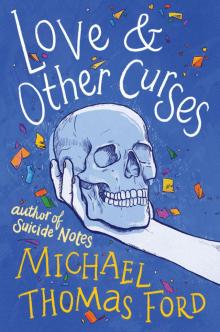
Love & Other Curses,
p.4


But when I think about doing it, it generally involves—how do I put this—something Tom Swift doesn’t have. And what Tom does have is not something I’ve ever thought about. Not that I’m freaked out about girl parts or anything. I’ve just never considered what I would do with them.
Not that I think of Tom as a girl. I don’t. He’s Tom. I get that. I mean, I’m not new. I’ve read books. I know what trans is. And everything isn’t about sex. But a lot of things are, and I can’t help thinking about it. Which makes me feel guilty, like I’ve failed some kind of test for being an enlightened person.
“Hey,” Tom calls out. “What’s this? And that’s not a personal question, so it doesn’t count.”
I look over at him. He’s on his stomach on his tube, peering down into the water with his hands cupped on either side of his head.
“It looks like a pair of boots,” he says. “Stuck on the bottom.”
By accident he’s discovered one of the secrets of Coldwater Creek.
“They are boots,” I tell him. “Wading boots, actually. Fishermen wear them. Those are bronze ones, but they were cast from a pair that belonged to Ezra Browncow.”
“Ezra Browncow,” Tom repeats. “You’re kidding, right?”
I shake my head. “That was his name,” I say. “When he was nineteen he came here fishing for trout. It was his favorite place to be. He hooked one, and was trying to reel it in when the dam opened. He tried to get out of the creek, but his foot got wedged between a couple of rocks. The creek rose, his boots filled up with water, and he drowned. Everybody in town liked him, and they felt terrible, so they took up a collection and used the money to have those bronze boots made as a memorial. His ashes are mixed in with the metal, so basically he’s buried here.”
We’re long past Ezra Browncow’s boots now, but Tom keeps looking down into the water.
“I think that’s the best story I’ve ever heard,” Tom says. “When did it happen?”
“Nineteen eighty-three,” I answer. “October third.”
Tom looks over at me. “You remember the exact date?”
I nod. “I kind of have to,” I explain. “He was my grandfather.”
Five
According to Farrah and Paloma, you have two basic options when choosing a drag name: you can be funny, or you can be fabulous. A funny name is usually a play on words, like calling yourself Anita Mann, Sharon Needles, or Lois Common Denominator. A fabulous name is something that just sounds great.
“Like Paloma,” Paloma says as he applies a glue stick to his eyebrows. “Paloma sounds exotic. People see Paloma and ask themselves, where does Paloma come from? What does Paloma do? Who does Paloma love? I’m a mystery. Like Cher, or Madonna. Or that place with all the stones. The ones the aliens made.”
“Stonehenge?” I suggest.
Paloma points the glue stick at me. “That’s it,” he says. “I am a mystery like Stonehenge.”
“You’re a mystery all right,” Farrah says. “The mystery is how the hell you manage to say things like that without laughing at your damn self.”
I stifle a laugh. Paloma can be touchy about being teased. When he’s not Paloma, he’s Ricky Escovedo. And Ricky Escovedo is not a very good-looking boy. He has bad skin, a wonky nose, and eyes that are a little too far apart. If you were to see him busing tables at the Mexican restaurant he works at during the day, you probably wouldn’t pay any attention to him.
But Paloma is something else. Paloma is beautiful, and fierce, and everyone pays attention to her when she performs. Paloma has a comeback for everything, and she doesn’t let anyone take advantage of her.
There’s an old animated Christmas special about Frosty the Snowman, who is just a plain old snowman until a little girl places a magic top hat on his head and he comes to life. That’s what it’s like when Ricky turns into Paloma. As the makeup goes on, he comes to life, and when he takes it off again at the end of the night, it’s like a flower wilting.
Farrah is different. Even as Brandon Thomas he’s still funny and loud and doesn’t care what anyone thinks. He’s also really handsome. He has a couple of different boyfriends, and isn’t shy about giving his number out to potential new ones either. I’ve actually seen men get into fistfights over him, both as Farrah and as Brandon. He even has another name for himself when these things happen: Mama Dramarama. “Mama Dramarama does not have time for this!” he’ll shriek, laughing as he walks away from whatever trouble he’s the center of.
Paloma rolls his eyes and looks at me. “She’s just jealous because I have a new pair of Louboutins,” he says, lifting one leg to show me a ridiculously high-heeled shoe.
“Louboutins?” says Farrah, slapping a tube of mascara on the dressing table and putting his hands on his hips. “Bitch, I know you got those at the Payless for nine ninety-nine and just spray-painted the bottoms red.” He reaches over, as if he’s going to run his fingertip down the sole of Paloma’s shoe to see if any of it rubs off.
Paloma pulls his foot away and wags a finger at Farrah. “Do not sit there in that Tina Turner fright wig that looks like some kind of mangy Pekingese sitting up on top of your head and criticize my footwear.”
Farrah gasps. “I know you did not just drag Miss Anna Mae Bullock into this. You did not.” He turns to me as he pretends to remove one of his rhinestone earrings. “Gurl, hold my clip-ons, because there is going to be a fight.”
Now we do all laugh. This is what I like about drag queens. Everything is over the top. But it’s usually all just in fun. Usually.
“Sammy, tell that bitch I apologize for pointing out that her heels are knockoffs,” Farrah says primly as he picks up a lipstick and begins applying it.
I turn to Paloma. “Farrah would like you to know that he is . . .”
“Pronouns!” Farrah and Paloma say in unison.
“Sorry,” I apologize. “That she is very sorry for insulting your Louboutins.”
“More like Foolboutins,” Farrah says under her breath.
“Shh!” I hiss.
“Thank you,” Paloma says, powdering her nose. “And please tell my sister that I forgive her rudeness and am sorry about pointing out the tragedy of her wig. I did it out of love.”
“Now back to you,” Farrah says to me. “How many times do we have to tell you to say she and her when talking about a person’s drag self?”
“I know,” I say. “I know. But it’s confusing. Like, do you only use she when someone is in full drag? What about while he’s putting on his face but doesn’t have his hair on?”
Drag has its own language, and I haven’t mastered it yet. I’ve finally gotten the difference between girl, which just means a girl, and gurl, which means, well, different things depending on how you say it. Mostly it’s something some gay guys call one another. And the only difference is that when you say gurl, you kind of draw the word out. But that difference is important.
“When in doubt, use she,” Paloma instructs me. “Most guys won’t be offended if you call them she, but call a queen a he and you’re asking for a slap.”
This conversation makes me think about Tom Swift. For some reason, I have no problem thinking of Tom as he. Even after his grandmother let his other name slip out, I’ve never once considered him a she. Maybe because Tom is who Tom is. Jennifer is who he was, but isn’t anymore. But Paloma is usually Ricky, and Farrah is usually Brandon. They’re only Paloma and Farrah a couple of times a week.
Which brings us back to what we were talking about earlier. Who I am.
“Funny names are kind of old-school,” Farrah says, picking up the conversation as if we’d never left it. “Usually girls with funny names are comedy queens.”
“Clowns,” Paloma adds.
“Kind of,” Farrah agrees. “But really fucking funny ones. Not the creepy-ass kind like they have at the circus. But finding a name no one has used already is a bitch.”
“Where did you get yours?” I ask Farrah.
He—she—points to a poster taped to the wall beside the mirror. It shows a gorgeous blond woman wearing a red one-piece swimsuit.
“Miss Farrah Fawcett,” Farrah says. “The star of Charlie’s Angels.”
“One of the stars,” says Lola, who has walked into the middle of the conversation, and who now sits down in an armchair to watch the other queens get ready. He’s still dressed in his regular clothes, so I think of him as, well, him. He’s holding a drink in one hand.
“The star,” Farrah insists. “Child, just look at that hair. In 1976, every man and boy in America had that poster on their walls. Even the gay ones. Everybody loved Farrah Fawcett. Everybody.”
“You weren’t even alive then,” Lola says.
“That’s true,” Farrah agrees. “As you know, I am only twenty-one years of age.”
Paloma and Lola snort. Farrah flips her middle finger at them. “Anyway, I saw the show in reruns, and I thought Miss Farrah was the prettiest thing I had ever seen. So when it came time for my naming, she’s the first thing that came to mind. And my last name, Monroe, is a play on Farrah’s character’s name in Charlie’s Angels. Hers was Jill Munroe, with a ‘u.’ Mine is Monroe, with an ‘o,’ because it’s also an homage to Miss Marilyn. Farrah Monroe. And there you are.”
“Kind of ironic, a little black boy wanting to be a pretty white girl, isn’t it?” Lola says.
Farrah doesn’t respond, and I can tell Lola has said something that hurts her. But a moment later she snaps out of it and says, “Better than naming myself after a demon, old man.”
“A demon?” I say.
Lola takes a sip of his drink. “Lola is a character from the musical Damn Yankees,” he explains. “She’s a kind of demon who works for the devil and tries to seduce the show’s main character, Joe Hardy. When I was eleven, I visited my uncle in New York City. He was a homosexual, although back then everyone just called him a confirmed bachelor. He took me to the show. I’d never seen anything like it. The whole rest of the week I went around singing ‘Whatever Lola Wants,’ which was Lola’s big number from the show, and his friends all thought I was adorable. But when it came time to put me on the train to come home, my uncle told me not to sing it around my parents. I didn’t understand why, but I told him I wouldn’t. But whenever I was alone in my room, I’d sing it and remember how it felt to have all those people clapping for me.”
He starts singing, and I recognize the song as a tune I’ve often heard him humming. But I didn’t know it had words. I wonder why he doesn’t do it in his act, but before I can ask him he gets up and leaves without saying anything else.
“Now you’ve done it,” Paloma says to Farrah. “She’ll be drunk before we even open the doors.”
“She’s already drunk,” Farrah says.
“Why?” I ask. “What’s wrong?”
“That uncle she talked about?” Paloma says. “He killed himself.”
“Why?”
“He was a schoolteacher,” Paloma explains. “Taught English to eighth graders. Someone found out about him and reported him. Back then, you couldn’t be gay and teach kids. They fired him. He was afraid everyone would find out, so he killed himself. Family told everyone he’d had a heart attack, but Lola found out the truth when a letter came from him for her a week after he died. That letter also had a check in it. A big one. He left her the money that she used to open this place.”
“That’s horrible,” I say, feeling bad that I asked Lola about his name.
“You scratch anybody and you’ll find some tragedy just below the surface,” Farrah says. “It’s called life.”
That makes me think about the curse, which is something I really don’t want to think about right now. So I ask Paloma, “Is there a story behind your name?”
“Paloma means ‘dove’ in Spanish,” she says. “It’s what my abuelita Marisol always called me.”
“I didn’t know that,” Farrah says. “That’s sweet. I thought you named yourself after Paloma Picasso.”
“Who?” says Paloma.
Farrah lowers her eyelids. “Really? And you call yourself a fashion queen? Look it up.”
“Has anyone in your families ever seen you perform?” I ask them both, trying to head off another squabble.
Paloma shakes her head. “My brothers think I work a night shift washing dishes,” she says. “My parents are still in Mexico.”
“Mine know, but we don’t talk about it,” says Farrah. “As long as I show up to sing in the choir come Sunday, we don’t have a problem.”
I try to picture Hank, Starletta, and Clodine standing in front of the stage at the Shangri-La, watching me perform. Oddly enough, I don’t have any trouble imagining it. I think they’d actually probably enjoy themselves. But I’m not ready to tell them about this part of myself. Not yet.
I stick around while Paloma and Farrah finish getting ready. But I leave earlier than usual. I haven’t talked to Tom Swift since our tubing adventure, and I want to call him. It would be easier if he had a cell phone, but his parents took it away when they sent him here for the summer. He says it’s so his grandparents can monitor who he talks to.
When I get home, I talk to the Grands for a few minutes before heading up to my room. I dial Tom Swift’s number, but it just rings and rings, with no answer. It’s not that late, but I worry that maybe his grandparents go to bed early. I don’t want to wake them up and get him in trouble, so I decide to try him in the morning.
I lie there for a while, thinking about the stories I heard earlier at the Shangri-La. And I think about what Farrah said, about all of us having tragedy in our lives. My family certainly does. The Grands have all lost their husbands. My father has lost his wife. I’ve lost my mother.
Suddenly, I need to see my dad. I go downstairs and tell the Grands I’ll be back in a little while. Then I get in my truck and drive to the Eezy-Freezy. It’s really busy, and a bunch of people wave and talk to me. But I need to get inside. For some reason, I have this horrible feeling that when I open the door, my father won’t be there.
But he is. He’s standing in his usual spot by the stove. He’s got six burgers going at once. Sweat is running down his forehead, and his apron is covered in grease. He’s tapping the spatula against the grill, playing the drum part to Lita Ford’s “Kiss Me Deadly,” which blasts from the radio. He looks tired and totally happy.
“Hey,” he says when he sees me watching him. “What’s up? Everything okay at home?”
For a moment, I think I might start crying. I don’t even know why. “Yeah,” I say. “I just drove by and saw you were slammed, so I thought you and Becky might like some help.”
He smiles. “That would be great,” he says. “Want to work the window or help me put together burgers?”
I take an apron from the hook on the wall. “I think I’ll stay back here with you,” I tell him. “If that’s okay.”
“Of course it’s okay,” he says. He turns the radio up even louder. “You’re just in time. The guitar solo is coming up.”
Six
On Sunday, Tom Swift spends the night at my house.
I wasn’t planning on asking him to come over, but when I call him earlier in the day, he tells me that his grandparents have friends coming to visit. He’s not looking forward to it, so I suggest a sleepover. I think we’re both surprised when his grandparents say yes, but they agree to bring him to the Eezy-Freezy that evening so that he can ride home with me.
I don’t get to meet them. Tom is sitting at one of the picnic tables when I finish up and go outside. He has a backpack with him.
When we get to my house, I take a shower while Tom hangs out in my room. I put record number four on the stereo before I leave. It’s Dusty Springfield’s Dusty in Memphis, from 1969. The songs are short, and by the time I get back, side 1 is almost over.
“I’ve never heard anything like that,” Tom tells me. “Her voice is really . . . I don’t know how to describe it.”
“I know,” I say. “It’s something else, isn’t it?”
I haven’t told him yet about my mother, who said that Dusty Springfield’s voice sounds like what a heart feels like when it breaks. I take the note she left for me inside the album sleeve of Dusty in Memphis, but before I can start reading it, Tom says, “I’m going to the movie at the VFW with Anna-Lynn on Wednesday.”
“Really?”
“Yeah. I went grocery shopping with my grandmother on Friday, and I ran into Anna-Lynn at the Bi-Rite. She works as a checker there.”
“You’re sure it wasn’t Lynn-Anna?” I joke.
“Pretty sure,” Tom replies. “I didn’t have a baseball, but I kind of let an apple roll toward her, and she picked it up with her left hand. Besides, she was wearing a name tag.”
We both laugh, but I have a question. “Did you ask her out in front of your grandmother?”
Tom snorts. “Are you nuts?” he says. “I pretended I’d forgotten to buy a pack of gum, and went back inside while she was getting in the car.”
I have another question, a bigger one, but I don’t know how to ask it, so I don’t. Instead I say, “Good for you.”
Tom shrugs. “I guess,” he says. “I’ve never asked a girl out before.”
“This is a big deal,” I tell him. “Your first date. We should celebrate. Let’s go get some Cokes.”
We go downstairs to the kitchen. I’m surprised that the Grands aren’t in there. Then I hear their voices coming from outside. I look out the screen door, and they’re wandering around in the yard with flashlights.
“How many do you have?” Starletta calls out.
“Three,” Hank answers.
“Six,” says Clodine. “I’m going inside.”
“Wait a minute,” Starletta says. “Let me see those.”
I see one of the flashlights cross the lawn. Then Starletta says, “Ma, that’s a tomato from the garden. And that’s a zucchini. Those aren’t flowers.”
“The fruit grows from the flower,” Clodine argues. “I say they count.”