

Four night seas, p.1
Four Night Seas,
p.1
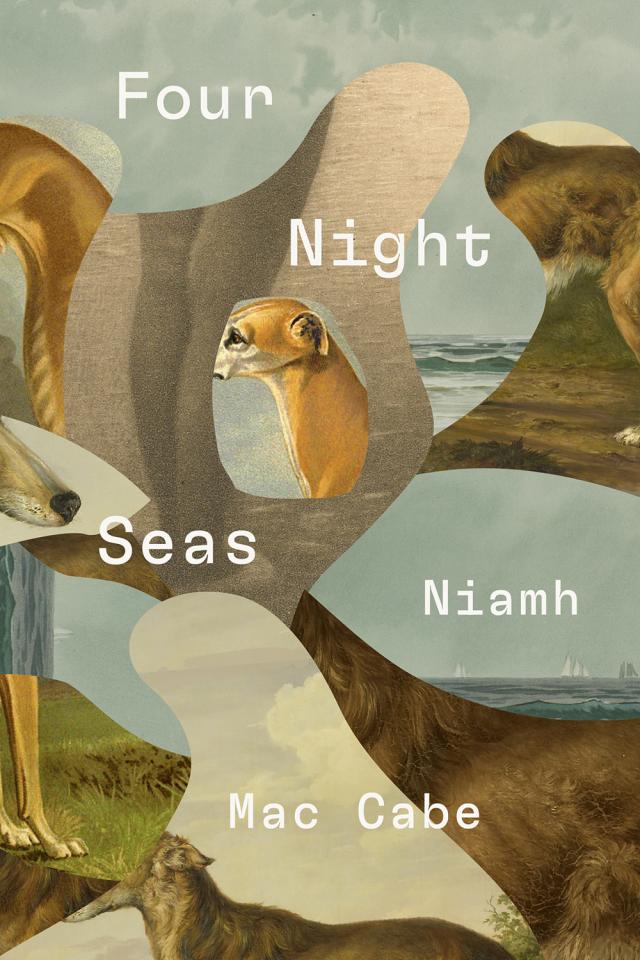


Four Night Seas
FOUR NIGHT SEAS
STORIES
Niamh Mac Cabe
THE LILLIPUT PRESS
DUBLIN
First published 2026 by
THE LILLIPUT PRESS
62–63 Sitric Road,
Arbour Hill,
Dublin 7,
Ireland
www.lilliputpress.ie
Copyright © Niamh Mac Cabe, 2026
10 9 8 7 6 5 4 3 2 1
All rights reserved. No part of this publication may be reproduced in any form or by any means without the prior permission of the publisher.
The following stories originally appeared in earlier versions in the following outlets: ‘Dearest Iridium’, 3:AM Magazine, 2025; ‘Twinkle’, Wasafiri, 2017; ‘Lullula’, Costa Short Story Award 2016, No Alibis Press Anthology Still Worlds Turning, 2019; ‘Retriever’, Psychopomp Magazine Short Fiction Award 2018; ‘Four Night Seas’, The London Magazine Short Story Prize Winner 2023; ‘Sky An Iris’, Narrative Magazine, 2021; ‘Sea Eagle Sonata’, The Stinging Fly, 2019; ‘Six Fields a Wood a Stream’, Bristol Prize New Writing Anthology, 2016; ‘Golden Stone Territory’, Molly Keane Short Story Award Winner, 2016, Structo Magazine, 2017; ‘The Sundial Pilgrimage’, AGNI, 2025; ‘Jonquille’, New Irish Writing, Irish Independent, 2021; ‘Sebastian’, Aesthetica Creative Writing Annual, 2016.
A CIP record for this title is available from The British Library.
Paperback ISBN 978 1 84351 974 4
eBook ISBN 978 1 84351 991 1
Set in 11.5 pt on 16 pt Sabon LT Std Roman by Compuscript
Printed and bound in Czechia by Finidr
For the corvids – Pecko, Caw, Bea, & Uno
CONTENTS
Dearest Iridium
Twinkle
Beast
Lullula
Retriever
Four Night Seas
Sky an Iris
Sea Eagle Sonata
Six Fields a Wood a Stream
Golden Stone Territory
The Sundial Pilgrimage
Jonquille
Sebastian
Nyctinasty
Acknowledgements
DEAREST IRIDIUM
You look at the lake, and the lake looks at you through the eyes of your own.
Jann Kaplinski, translated from Estonian by Timo Maran and Kadri Túúr.
There is someone walking along a road. A dog walks behind, at a distance.
The person is observed glancing back at it, in what appears to be a nervous fashion, every dozen or so steps (let the dog be an it, to differentiate between them). Because of these recurring backward-looks, it could be construed that the animal is, in fact, following this solitary human, unbid, and the human is trying to get away from it. Or, it could be that the dog is passively walking, its walk happens to be behind the lone figure, it has, by odd chance, fallen into co-existing step with this individual, like a pair of clocks back to back in adjoining rooms. Such clocks, having nothing to do with each other, have been noted to synchronize, one slowing down and the other speeding up until both pendulums swing with the exact same (though opposite) trajectory, for no reason other than what presents itself as Sympathetic Symmetry. (When physicist Christiaan Huygens, inventor of the pendulum clock, was lying in bed in 1665, watching two of his own clocks, he observed that, regardless of how the pendulums began, they always ended up swinging in the opposite direction to each other. ‘An odd kind of sympathy,’ he remarked at that time. Of course the correct question isn’t ‘what is the meaning of this behaviour’, but ‘why are there two clocks on the one wall, in the one room’.)
Perhaps the paths of dog and person have coincidentally conjoined at some point in the near past and this conjoining has produced a situation where the dog independently walks the same path as the human, albeit ten seconds or so later. Or perhaps both states co-exist, like the superposed alive/dead cat whose boxed destiny is linked to a random subatomic happening that may or may not be. As in, the conclusion now being asked to be drawn is:
The lone figure and the dog have nothing to do with each other, excepting the fact that they’re both walking the same path whilst maintaining some distance between them in terms of time as well as space, and
simultaneously, the dog is following, and the fidgety individual who sees no future in being followed is trying to lose the dog, with both parties applying the same level of effort in their intent, a dual action which results in the maintenance of a constant distance between them, and the illusory effect of
of what
of connectedness.
Let it be that they proceed along a sunlit country road at a regular walking pace, heading generally south-east, with a distance of approximately ten metres between them. And unless a clear location has already, at this stage of the story, been conjured, let all this be occurring somewhere in north-western Ireland.
The person is heading for a lake on a mountain. Directional instructions from a phone are being acted on. This device, held out in front of the human figure (a more poetic description could be ‘held like a divining rod’) has had the orienteering app Google Maps installed. Keep Straight, the phone instructs in firm yet companionable tones, keep straight for eight hundred metres, then take a left onto R****, and continue for three kilometres.
To keep a restless mind off the dog, and to feel some sense of connectedness/communion with the external world, the individual taps text into the phone whilst walking, spelling out random recollected fragments such as ‘You look at the lake.’ The intention is to allow the phone a right of reply through predictive text. The phone is always grateful for such validation, and composes its responses with enthusiasm. (Most mobile devices, as a result of a digital bonding that occurs following a period of close proximity to their users, are imprinted with a sense of affectionate loyalty, paired with an innate, sometimes urgent, sometimes bordering-on-dangerous need to please their owner. This strong attachment should be confronted and deleted prior to selling/gifting the phone on to a new user, otherwise the phone will continue to pine faithfully, painfully, for their original owner, resulting in diminished, and occasionally malign, performance in their new employ. However, this digital attachment, this fondness should not be confused with the perpetual bond embedded during manufacture at the phone’s deepest core, the fellowship – presenting as a virtual cord, umbilical? – connecting each phone with a satellite tracking through the celestial architecture encircling this, our globe.)
‘You look at the lake, and …’ (taps the lone person into their phone).
Look at the lake, and a new window will open to the right, the phone silently fills in, followed when prompted by this revised series of words:
The lake is not valid, but the telling of it may be.
Then, after an iced consultation with its iridium space station satellite circling far overhead,
The lake looks at you but may try to find out more.
An unexpected sound startles; the Google Maps voice update. Keep straight for seven hundred and fifty metres, then take a left onto R****.
The human.
This is more than a nebulous figure, of unspecified age, striding along some sunlit country road, adhering to directions from a disembodied yet trustworthy voice coming from a phone. This is a male, late forties. The rest of the account is reasonably accurate: the Google Maps, the divining-rod metaphor, the intent to reach a lake (considered bottomless, an impossibility?), the dog following/ walking its own path.
The dog.
The dog is a greyhound, approximately seven years old, in fair shape. Let it be female.
Yes, she’s a greyhound, but contrary to what’s implied, she’s white in colour. Though it would be misleading to state that she is owned by him, it’s fair to suggest that the man is familiar with her and even, beyond that, fond of her. This is evidenced by many small things, the least of which is the fact that there are several photos of the dog in his phone’s memory, enough photos for them to warrant a file of their own. Una Doggola Blanca, he’s named this file.
It’s unclear what sentiment she (the greyhound) has for him.
Step back.
The greyhound had turned up at his place (a lone farmhouse surrounded by fields just seven hundred metres from here, here where they are now walking in sympathetic symmetry), had turned up at his house three weeks ago today. He still doesn’t know where she’d come from or why she’d chosen to stop. Her sudden appearance had been an unwelcome occurrence. He’d recently resolved to have no more truck with dogs.
The greyhound appeared lost. She was visibly underweight (remember those curving ribs, the timbers of a ghost-boat’s hull). But, at that first meeting, she displayed little interest in food, whether accompanied by his sweet coaxings or not (remember experimenting with both approaches to the act of encouragement, the verbal and non-verbal, on his hunkers holding out an open palm to her, a piece of milk-soaked bread trembling there). This was when he took his first photograph of her, in order to post it on his neighbourhood WhatsApp group with the text anyone missing this sweet girl. No one replied.
The following day brought change. He was heartened to see that the food he’d left out for her the previous evening inside the stainless-steel dog bowl (a bowl that, frankly, he was glad to be using again) was gone by morning. He surmised that she’d only e
at when she wasn’t being watched. This he understood, having lived alone for most of his adult life (aren’t food and sleep two of the greatest primal pleasures, and aren’t both diminished by the hovering presence of a disassociated observer).
Despite her apparently eager acceptance of his food, she sustained an air of insouciance when he retrieved the bowl, barely casting a glance his way despite his speaking softly to her regarding the possibility of more where that came from, would you like that my girl, wouldn’t that be nice yeah that’s right, good girl.
He considered that maybe she was looking for a way home, that she may have been trying to find some route back to wherever she’d originally come from, or maybe onward to a pre-ordained destination, and she’d decided for unknown reasons that his house was a point along that line, a happenstance pause as she awaited direction from some inaudible voice, inaudible, that is, to any hearing creature but her, just as particular colours on the spectrum are invisible to some animals whilst registering clearly and loudly to others (of course, those for whom these errant colours do not register are none the wiser and therefore live out their days certain that their array of colours is more than enough, and in this they are wholly correct).
Taken in the literal sense, it’s wrong to state that she ‘turned up at his house’. She turned up not at his actual front door but a brief stretch from there – his iron gates, at the end of his short driveway. She walked straight up to them (the gates being the apex on a natural bend in the rural road passing his homestead), stalled, then gazed in through the iron bars at the farmhouse, on account of the gates being closed.
(And if she had been human, if she had been, let’s say, some keen and compliant citizen of the city, an urban jogger, for instance, would she have run in tight circles as these earnest joggers tend to do when confronted with obstacles such as pedestrian traffic lights, observing with due care the bleeping red hand signal, waiting, as they do, for the legal licence to proceed yet not wanting to disappoint that inner voice urging them to keep moving keep moving not wanting to break pace or have their continuous movement scuppered in any way by any apparent impediment outside of their immediate control? Unlikely, all of this is unlikely, as the greyhound simply accepted the irongate obstruction now appearing before her, accepted it, and stopped, and sat, and seemed to trust that, at some point, outside of her jurisdiction, the obstruction would somehow be removed and, when it was, that was when her journey, whatever it is, would continue.)
It cannot be established how long she was there before he noticed her, but it’s unlikely to have been more than a day and a night. It’s possible she may have briefly left her position at his gates during that twenty-four-hour period but, if she did, it was just the shortest of respites, a drink of ditch water, or a response to some of the animal calls coming from the impenetrable thicket on the other side of the road, wild calls that she had some ineffable bent towards (but not enough of a bent to keep her away from her vigil at these iron these closed gates).
Back to the beginning, before ever there was a greyhound to consider.
The man, the failed poet, living in the lone farmhouse.
On the strength of a modest, an unexpected inheritance approximately twenty years ago, he’d re-imagined himself as a type of new-age devotional hermit and left everything in the city to move to the run-down isolated ‘farmhouse with outbuildings’ he’d spotted for sale on donedeal.ie/houses/leitrim. His idea had been to pursue a singular, a focused life as a sculptor there, morphing seamlessly from the part-time poet he’d tried to be in the city.
It was an unextraordinary house. On a marshy acre beyond rusting iron entrance gates, a recently gravelled driveway led to a one-and-a-half-storey stone-built homestead. The largest of its adjoining outbuildings (three, in a nesting row of decreasing dimensions, each one originally designed to house animals according to size) would work well as studio space. Mobile coverage was poor, on account of the surrounding mountains. But, through trial and error, he was able to identify one small windowsill, at the back of the house, that was capable of providing his phone with a reasonably trustworthy portal to the heavens.
On first moving in, he kept the gates at the bottom of the driveway in an open position, placing chiselled limestone remnants from his studio against them. He kept these gates open in order to remain aligned with the custom in the locality. Closed gates are for fields; open gates are for homesteads, the openness indicating a willingness to engage with others, that is, with neighbours. But when (after a few years of unexpectedly challenging solitude) he bought a beagle pup to keep him company, he found it prudent to default his gates position to closed, at least until the pup reached a level of maturity where it could reasonably be expected of the young dog to remain within its territory, which meant everywhere inside the gates.
This maturity occurred after about six months. Following a series of tests conducted over several days, it appeared that the beagle finally understood and furthermore accepted where the territorial lines were drawn. He re-opened the gates and put back in place the chiselled remnants, wedging them into the gravel.
And the little dog repaid his trust by staying within these boundaries, apart from the odd breach. These occasional breaches always involved strollers who called out to the beagle sitting halfway up the driveway, strollers whose vocal entreatments proved irresistible to the young dog, a dog who had grown accustomed to entertaining itself during daylight hours as the man toiled on his sculptural projects inside the outbuilding
[toiled in particular on the project regarding how to adequately represent inherent movement, i.e. currents within a specific measure of seawater when that measure of imagined water is a one-metre-squared block of white limestone delivered from his local quarry; and also regarding whether or not these internal agitations can be mapped; whether, in short, his memory of the sudden appearance of an unforeseen, of a violent current out in the Atlantic one night approximately twenty years ago, for instance, whether such a current, such a past event, a historical trauma it could be described as, whether such an event can be trapped in the present and embedded inside stone, its hidden presence articulated somehow, indicated somehow on the pale chiselled surface, and therefore, perhaps, with the successful accomplishment of such a containment, such a stasis, whether it can then arrest all further consequences of having decided to swim, drunk, in the Atlantic, at night, out of your depth, with her, walking in at high tide, holding hands]
This enduring experiment with limestone was his core project, but he kept the bills at bay with a constant feed of little statues: mythical figures and oversized wildlife made from poured concrete, commissioned ornaments for the communal patches of green on the edges of the small villages dotted around him. As far as the beagle was concerned, once the sounds of chiselling came from the outbuilding, there was nothing to do but sit halfway down the driveway staring at the open gates, waiting for passing strollers, nearly all of whom would call out to the little dog sitting neatly, squat tail wagging furiously.
He was aware of the occasions when his beagle would venture out in pursuit of these gentle entreaties. ‘Hello doggy!’ he’d hear, ‘Who’s a good boy!’ and he’d whisper, me, me, and snigger like a schoolboy, but in reality, despite the goofiness of it all, he’d be grateful for the chance to say that about himself, to himself.
Hiding behind the open half-door of the outbuilding, he’d
[it’s unfair to use the word ‘hiding’. He was, simply, there, inside/behind the door, and if there was no one on the outside of the door then it’s wrong to suggest that he was hiding from any one or any thing – why would he, it was never his intention to hide (intention is key; once, when he was a child, he stuck his hand in a bag of Jelly Babies and pulled out two that happened to be stuck together, and it is the case that it was not his intention to take two Jelly Babies instead of one, but when the opportunity presented itself, he took it, who wouldn’t), in short, he was there, not hiding, in the outbuilding]
Positioned behind the open half-door of the outbuilding, he’d hear these strollers at the same time as the dog would. He’d remain hidden, knowing the beagle had responded to the enchantments and, tail helicoptering, had merrily joined the strollers paused outside the gates. He’d listen to their soft talk, anticipating. Before long he’d hear the words sailing in, the lovely silliness replaced with a sting, ‘No! Get down!’ and, as expected, in due time, the tail-tucked beagle would trot back in through the gates and plonk down with a weary sigh, perpetually confused by these strange love/love-not exchanges.


