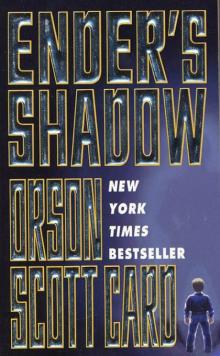
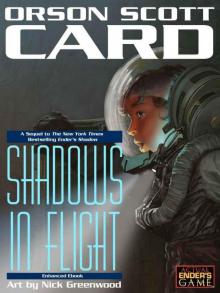
The shadow quintet, p.1
The Shadow Quintet,
p.1


Tor Books by Orson Scott Card
Note: Within series, books are best read in listed order.
—–
ENDER UNIVERSE
Ender Series
Ender Wiggin: The finest general the world could hope to find or breed.
Ender’s Game
Ender in Exile
Speaker for the Dead
Xenocide
Children of the Mind
Ender’s Shadow Series
Parallel storylines to Ender’s Game from Bean: Ender’s right hand, his strategist, and his friend.
Ender’s Shadow
Shadow of the Hegemon
Shadow Puppets
Shadow of the Giant
Shadows in Flight
The First Formic War Series
One hundred years before Ender’s Game, the aliens arrived on Earth with fire and death. These are the stories of the First Formic War.
Earth Unaware
Earth Afire
Ender novellas
A War of Gifts
First Meetings
The Authorized Ender Companion by Jake Black
A complete and in-depth encyclopedia of all the persons, places, things, and events in Orson Scott Card’s Ender Universe.
THE MITHER MAGES SERIES
Danny North is different from his magical family. And when he discovers his gift, it is greater than he ever imagined—which could earn him a death sentence.
The Lost Gate
The Gate Thief
THE TALES OF ALVIN MAKER SERIES
Visit the magical America that might have been, marvel as the tale of Alvin Maker unfolds.
Seventh Son
Red Prophet
Prentice Alvin
Alvin Journeyman
Heartfire
The Crystal City
HOMECOMING SERIES
Earth has been rendered uninhabitable. But it is still vital.
The Memory of Earth
The Call of Earth
The Ships of Earth
Earthfall
Earthborn
WOMEN OF GENESIS SERIES
Fiction exploring the human side of Biblical women.
Sarah
Rebekah
Rachel & Leah
THE COLLECTED SHORT FICTION OF ORSON SCOTT CARD
Experience Card’s full versatility, from science fiction to fantasy, from traditional narrative poetry to modern experimental fiction.
Keeper of Dreams
The Changed Man
Cruel Miracles
Flux
Monkey Sonatas
STAND-ALONE FICTION
Hart’s Hope: dark and powerful fantasy.
Lovelock (with Kathryn Kidd): a startling look at the ethics of bioengineering.
Pastwatch: In this novel of time travel, can the past be changed?
Saints: a novel of the early days of the Mormon Church.
Songmaster: an SF classic and a haunting story of power and love.
The Worthing Saga: the tale of a seed ship sent out to save the human race.
Wyrms: the story of a young woman’s journey to confront her destiny, and her world’s.
The Folk of the Fringe: when America is destroyed, it’s up to those on the fringes to rebuild.
—–
www.tor-forge.com
Contents
By Orson Scott Card from Tor Books
ENDER’S SHADOW
Foreword
I. URCHIN
1. Poke
2. Kitchen
3. Payback
4. Memories
II. LAUNCHY
5. Ready or Not
6. Ender’s Shadow
7. Exploration
8. Good Student
III. SCHOLAR
9. Garden of Sofia
10. Sneaky
11. Daddy
12. Roster
IV. SOLDIER
13. Dragon Army
14. Brothers
15. Courage
16. Companion
V. LEADER
17. Deadline
18. Friend
19. Rebel
20. Trial and Error
VI. VICTOR
21. Guesswork
22. Reunion
23. Ender’s Game
24. Homecoming
Acknowledgments
SHADOW OF THE HEGEMON
I. VOLUNTEERS
1. Petra
2. Bean
3. Message in a Bottle
4. Custody
5. Ambition
II. ALLIANCES
6. Code
7. Going Public
8. Bread Van
9. Communing with the Dead
10. Brothers in Arms
III. MANEUVERS
11. Bangkok
12. Islamabad
13. Warnings
14. Hyderabad
15. Murder
IV. DECISIONS
16. Treachery
17. On a Bridge
18. Satyagraha
19. Rescue
20. Hegemon
Afterword
SHADOW PUPPETS
1. Grown
2. Suriyawong’s Knife
3. Mommies and Daddies
4. Chopin
5. Stones in the Road
6. Hospitality
7. The Human Race
8. Targets
9. Conception
10. Left and Right
11. Babies
12. Putting Out Fires
13. Caliph
14. Space Station
15. War Plans
16. Traps
17. Prophets
18. The War on the Ground
19. Farewells
20. Home
SHADOW OF THE GIANT
1. Mandate of Heaven
2. Mother
3. Coup
4. Bargain
5. Shiva
6. Evolution
7. An Offer
8. Ender
9. Pension
10. Grief
11. African God
12. Allahu Akbar
13. Found
14. Virlomi’s Visitors
15. Ratification
16. Jeesh
17. Boats
18. Yerevan
19. Enemies
20. Plans
21. Papers
22. Rumors of War
23. Colonist
24. Sacrifice
25. Letters
26. Speak for Me
Acknowledgments
SHADOWS IN FLIGHT
Chapter 1: In the Giant’s Shadow
Chapter 2: Seeing the Future
Chapter 3: Watching the Sky
Chapter 4: Strangers Are Enemies
Chapter 5: What Can’t Be Done
Chapter 6: Show and Tell
Chapter 7: Into the Ark
Chapter 8: At the Helm
Chapter 9: Drones and Workers
Chapter 10: The Giant Moves
The author and publisher have provided this e-book to you without Digital Rights Management software (DRM) applied so that you can enjoy reading it on your personal devices. This e-book is for your personal use only. You may not print or post this e-book, or make this e-book publicly available in any way. You may not copy, reproduce or upload this e-book, other than to read it on one of your personal devices.
Copyright infringement is against the law. If you believe the copy of this e-book you are reading infringes on the author’s copyright, please notify the publisher at: us.macmillanusa.com/piracy.
ENDER’S SHADOW
ORSON SCOTT CARD
This is a work of fiction. All the characters and events portrayed in this novel are either fictitious or are used fictitiously.
ENDER’S SHADOW
Copyright © 1999 by Orson Scott Card
All rights reserved, including the right to reproduce this book, or portions thereof, in any form.
Edited by Beth Meacham
A Tor Book
Published by Tom Doherty Associates, LLC
175 Fifth Avenue
New York, NY 10010
www.tor-forge.com
Tor® is a registered trademark of Tom Doherty Associates, LLC
ISBN 978-1-429-96398-5
First Edition: September 1999
TO DICK AND HAZIE BROWN
IN WHOSE HOME NO ONE IS HUNGRY
AND IN WHOSE HEARTS
NO ONE IS A STRANGER
FOREWORD
This book is, strictly speaking, not a sequel, because it begins about where Ender’s Game begins, and also ends, very nearly, at the same place. In fact, it is another telling of the same tale, with many of the same characters and settings, only from the perspective of another character. It’s hard to know what to call it. A companion novel? A parallel novel? Perhaps a “parallax,” if I can move that scientific term into literature.
Ideally, this novel should work as well for readers who have never read Ender’s Game as for those who have read it several times. Because it is not a sequel, there is nothing you need to know from the novel Ender’s Game that is not contained here. And yet, if I have achieved my literary goal, these two books complement and fulfill each other. Whichever one you read first, the other novel should still work on its own merits.
For many years, I have gratefully watched as Ender’s Game has grown in popularity, especially among school-age readers. Though it was never intended as a young-adult nov
el, it has been embraced by many in that age group and by many teachers who find ways to use the book in their classrooms.
I have never found it surprising that the existing sequels—Speaker for the Dead, Xenocide, and Children of the Mind—never appealed as strongly to those younger readers. The obvious reason is that Ender’s Game is centered around a child, while the sequels are about adults; perhaps more important, Ender’s Game is, at least on the surface, a heroic, adventurous novel, while the sequels are a completely different kind of fiction, slower paced, more contemplative and idea-centered, and dealing with themes of less immediate import to younger readers.
Recently, however, I have come to realize that the 3,000-year gap between Ender’s Game and its sequels leaves plenty of room for other sequels that are more closely tied to the original. In fact, in one sense Ender’s Game has no sequels, for the other three books make one continuous story in themselves, while Ender’s Game stands alone.
For a brief time I flirted seriously with the idea of opening up the Ender’s Game universe to other writers, and went so far as to invite a writer whose work I greatly admire, Neal Shusterman, to consider working with me to create novels about Ender Wiggin’s companions in Battle School. As we talked, it became clear that the most obvious character to begin with would be Bean, the child-soldier whom Ender treated as he had been treated by his adult teachers.
And then something else happened. The more we talked, the more jealous I became that Neal might be the one to write such a book, and not me. It finally dawned on me that, far from being finished with writing about “kids in space,” as I cynically described the project, I actually had more to say, having actually learned something in the intervening dozen years since Ender’s Game first appeared in 1985. And so, while still hoping that Neal and I can work together on something, I deftly swiped the project back.
I soon found that it’s harder than it looks, to tell the same story twice, but differently. I was hindered by the fact that even though the viewpoint characters were different, the author was the same, with the same core beliefs about the world. I was helped by the fact that in the intervening years, I have learned a few things, and was able to bring different concerns and a deeper understanding to the project. Both books come from the same mind, but not the same; they draw on the same memories of childhood, but from a different perspective. For the reader, the parallax is created by Ender and Bean, standing a little ways apart as they move through the same events. For the writer, the parallax was created by a dozen years in which my older children grew up, and younger ones were born, and the world changed around me, and I learned a few things about human nature and about art that I had not known before.
Now you hold this book in your hands. Whether the literary experiment succeeds for you is entirely up to you to judge. For me it was worth dipping again into the same well, for the water was greatly changed this time, and if it has not been turned exactly into wine, at least it has a different flavor because of the different vessel that it was carried in, and I hope that you will enjoy it as much, or even more.
—Greensboro, North Carolina, January 1999
Part One
URCHIN
1
POKE
“You think you’ve found somebody, so suddenly my program gets the ax?”
“It’s not about this kid that Graff found. It’s about the low quality of what you’ve been finding.”
“We knew it was long odds. But the kids I’m working with are actually fighting a war just to stay alive.”
“Your kids are so malnourished that they suffer serious mental degradation before you even begin testing them. Most of them haven’t formed any normal human bonds, they’re so messed up they can’t get through a day without finding something they can steal, break, or disrupt.”
“They also represent possibility, as all children do.”
“That’s just the kind of sentimentality that discredits your whole project in the eyes of the I.F.”
Poke kept her eyes open all the time. The younger children were supposed to be on watch, too, and sometimes they could be quite observant, but they just didn’t notice all the things they needed to notice, and that meant that Poke could only depend on herself to see danger.
There was plenty of danger to watch for. The cops, for instance. They didn’t show up often, but when they did, they seemed especially bent on clearing the streets of children. They would flail about them with their magnetic whips, landing cruel stinging blows on even the smallest children, haranguing them as vermin, thieves, pestilence, a plague on the fair city of Rotterdam. It was Poke’s job to notice when a disturbance in the distance suggested that the cops might be running a sweep. Then she would give the alarm whistle and the little ones would rush to their hiding places till the danger was past.
But the cops didn’t come by that often. The real danger was much more immediate—big kids. Poke, at age nine, was the matriarch of her little crew (not that any of them knew for sure that she was a girl), but that cut no ice with the eleven- and twelve- and thirteen-year-old boys and girls who bullied their way around the streets. The adult-size beggars and thieves and whores of the street paid no attention to the little kids except to kick them out of the way. But the older children, who were among the kicked, turned around and preyed on the younger ones. Any time Poke’s crew found something to eat—especially if they located a dependable source of garbage or an easy mark for a coin or a bit of food—they had to watch jealously and hide their winnings, for the bullies liked nothing better than to take away whatever scraps of food the little ones might have. Stealing from younger children was much safer than stealing from shops or passersby. And they enjoyed it, Poke could see that. They liked how the little kids cowered and obeyed and whimpered and gave them whatever they demanded.
So when the scrawny little two-year-old took up a perch on a garbage can across the street, Poke, being observant, saw him at once. The kid was on the edge of starvation. No, the kid was starving. Thin arms and legs, joints that looked ridiculously oversized, a distended belly. And if hunger didn’t kill him soon, the onset of autumn would, because his clothing was thin and there wasn’t much of it even at that.
Normally she wouldn’t have paid him more than passing attention. But this one had eyes. He was still looking around with intelligence. None of that stupor of the walking dead, no longer searching for food or even caring to find a comfortable place to lie while breathing their last taste of the stinking air of Rotterdam. After all, death would not be such a change for them. Everyone knew that Rotterdam was, if not the capital, then the main seaport of Hell. The only difference between Rotterdam and death was that with Rotterdam, the damnation wasn’t eternal.
This little boy—what was he doing? Not looking for food. He wasn’t eyeing the pedestrians. Which was just as well—there was no chance that anyone would leave anything for a child that small. Anything he might get would be taken away by any other child, so why should he bother? If he wanted to survive, he should be following older scavengers and licking food wrappers behind them, getting the last sheen of sugar or dusting of flour clinging to the packaging, whatever the first comer hadn’t licked off. There was nothing for this child out here on the street, not unless he got taken in by a crew, and Poke wouldn’t have him. He’d be nothing but a drain, and her kids were already having a hard enough time without adding another useless mouth.