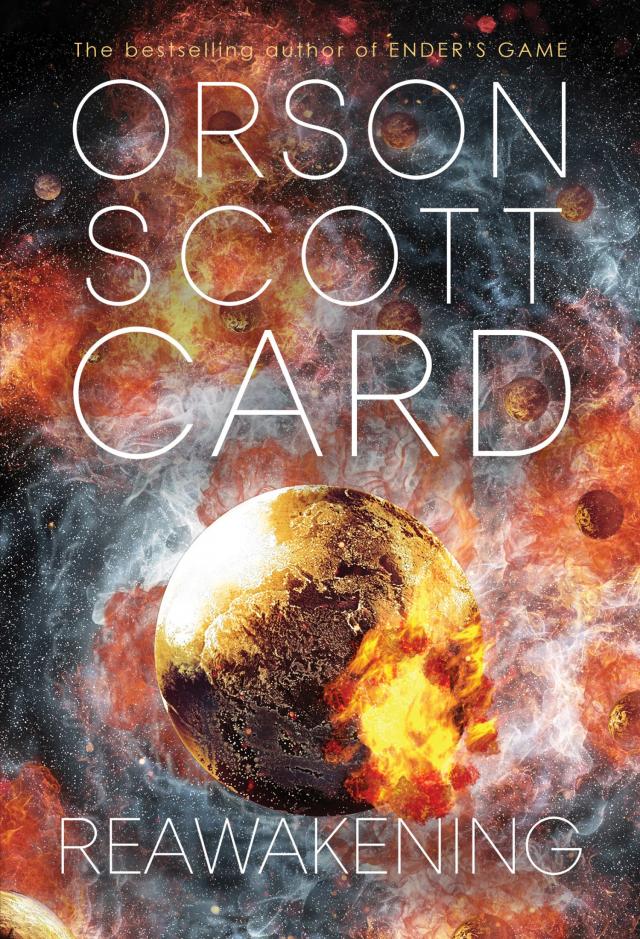
Reawakening, p.22
Reawakening,
p.22


“If he isn’t baffled and perplexed,” said Laz, “then he’s lying to us.”
“Or to himself,” said Ivy.
“He’s the least of our worries anyway,” said Laz. “We’ve got invisible people who can come and go wherever they please.”
Ivy added, “And at least one of them is pissed off at us.”
“At me,” said Laz.
“You think because Mumbo didn’t trash my room, he has a soft place in his heart for me?”
“That’s exactly what I think. You look like his mom.”
“You look like his dad,” said Ivy.
Laz pointed at her, nodding wisely. “Maybe he has a favorite parent,” said Laz.
“He says it wasn’t him who broke up our house. Why deny it?”
Laz had no idea, so he answered facetiously. “Because he and Nasty were once hurt by the truth, and now they try to avoid it as much as possible.”
“Everybody’s hurt by the truth all the time,” said Ivy. “It doesn’t make us all into pathological liars.”
Laz brought the conversation back to things they might be able to figure out. “Ron is playing world-shaping games,” said Laz. “And we’re helping him. Why do we think he’s the good guy?”
“He woke us up?” suggested Ivy.
“It wasn’t to help us, though, was it,” said Laz.
“No,” said Ivy. “It was so he could use us.”
“Ron claims he’s protecting interstream trade, interworld science, freedom everywhere,” said Laz. “But I haven’t heard of Central Time holding any elections.”
“The individual nations have elections,” said Ivy.
“But Ron holds all the power,” said Laz, “and nobody elected him.”
Ivy flagged down a slow-moving bus. It didn’t have any passengers, so the bus came to a stop, settling to the ground to make it easier to step onto. There were no seats, just a long row of stairsteps on each side, with straps dangling at various heights. But with an empty bus, there was no reason not to sit down on the third step with their feet resting on the lowest one.
The bus gave a couple of low toots. Laz waved to give the all clear. Whatever camera had them in view, the bus got the message, rose up, and continued moving slowly on its cushion of air.
“I wonder if this bus could go any slower,” said Ivy.
Immediately the bus slowed nearly to a stop. Of course the bus could hear them perfectly, no matter where they sat or stood.
“Okay, bus,” said Ivy, “I was just being sarcastic.”
The soothing contralto voice of a woman answered, as the bus picked up speed again, “Buses in Central Time are programmed to travel at the maximum safe speed for passengers to get on and get off while the bus is in motion.”
“Thanks for proving that you can go slower,” said Laz. “And thanks for speeding back up.”
“You’re thanking a machine?” asked Ivy.
“Shh,” Laz remarked. “She can still hear you.”
“Oh, she’s offended because I called her a machine—”
“Shh!” Laz insisted. “Maybe she doesn’t know.”
Ivy sniffed. “You think nobody’s told her about Santa Claus, either?”
“What about Santa Claus?” asked Laz, feigning suspicion, as if he still believed.
Ivy gave him a perfunctory chuckle. Then silence as the bus glided along streets full of pedestrians. A few people stepped up on the bus as it passed, but not enough passengers that Laz and Ivy felt they needed to stand up or move.
Ivy broke their silence. “What was he like? Mumbo, I mean.”
“Like a blend between you and me. Takes after you a lot, so he’s good-looking,” said Laz.
“And takes after you,” said Ivy, “so he’s smar—”
“Perfidious,” said Laz. “Don’t go giving me credit just because OrigiLaz is reputed to be so smart. We know better.”
“I don’t,” said Ivy.
“Then pay attention, it’s obvious. The great Lazarus Hayerian was a regular dumb kid.”
They came to their getting-off place and they stepped off the bus. They ambled down a slope to their lane, walked to their front door, which opened as they approached.
The house was as tidy as Ron’s people had left it. Except Laz’s room. He had left leave-it-alone orders.
“You must have worked all night, you poor thing,” said Laz.
“I slept in while Ron’s cleaning crew worked.”
“It’s convenient being highly valued wards of the state,” said Laz.
“They let me sleep because my room was immaculate,” said Ivy.
“Ron’s guys probably installed more surveillance equipment.”
“As if they needed any more,” said Ivy.
“Maybe they needed to change out some batteries.”
“Why is he still spying on us?” asked Ivy. “We come straight to him to report. Shouldn’t that count toward earning trust?”
“They probably upgraded the equipment, so they can get everything in all-around.”
“And that would enhance the surveillance how?” asked Ivy.
“They can walk around and look from another angle while they’re watching you dress and undress,” said Laz.
“I never undress,” said Ivy. Saucily, so Laz knew she was joking.
“Not even to shower?”
“These clothes are made of an incredibly fast-drying and soap-absorbing fabric,” said Ivy. “Ron promised me that he and his goons respect my privacy.”
“Meaning they watch and do freeze-frame and view you again and again from every angle, but they won’t tell you they do that, so you’ll feel like you still have privacy.”
“They can do pretty much what they want,” said Ivy. “So why try to hide anything?”
“One of the bonuses of living in a totalitarian state,” said Laz.
“People in Central Time have their liberty. There are no thought crimes, no political prisoners—”
“That we know of,” said Laz.
“And they have free local elections, in which the candidates are not handpicked by Ron.”
“They’re all cleared by Ron,” said Laz. “Only approved candidates get on the ballot.”
“You don’t know that,” said Ivy.
“Don’t I? With absolute power, Ron’s the only emperor in history who doesn’t control who gets into power under him?”
“What made you so cynical?” asked Ivy.
“Everything in Central Time runs too smoothly. Everybody doing what they’re told, paddling in the same direction. Not my idea of liberty.”
“We don’t do what we’re told,” said Ivy.
“We’re the most obedient of all. If he didn’t think he could control us, would he have turned us loose in the world?”
“He’s not stupid,” said Ivy. “He knows he can’t control us.”
“He controls us the way a hypnotist does,” said Laz. “He creates an illusion of the real world that leads us to want to do what he thinks we should.”
“You’ve made a few Portals Ron still doesn’t even know about,” said Ivy.
“We don’t know what he knows and what he doesn’t,” said Laz. “We’ve been manipulated ever since we woke up.”
“You’re really getting me down right now.”
“If Mumbo is really involved in all this Tessera rebellion stuff,” said Laz, “meeting me might have triggered him. They’re probably making their move against Central right now.”
They stood and looked at each other in silence.
“No,” said Ivy.
“That would be too much of a coincidence,” said Laz.
“Not a coincidence at all, if you triggered it.” Ivy turned on the television.
There was video of shooting and explosives in the streets. Dead civilians lying in grotesque positions all around what looked like the entrance to a school. The screen was saying, “Hundreds of casualties in Central Time elementary school. Many have been taken to hospital. Many others were pronounced dead at the scene.”
It was clear at once that the Tesserans had attacked Central Time at the most painful place: the lives of their children. These children had nothing to do with the Portal Commission. But by killing them, the Tesserans had guaranteed that the entire world of Central Time would unite against them.
“I’m beginning to think Mumbo’s not such a nice guy,” said Laz.
“He didn’t kill you, and he could have,” said Ivy.
“I think he prefers to have surrogates do his bidding.”
“We don’t know that he induced Tessera to start this war through the Portal,” said Ivy.
“People really like to please him. That’s his power.”
“So he dominates violent idiots,” said Ivy. “He sends them to commit atrocities.”
“Violence evolved right along with human intelligence. We don’t know they’re idiots.”
“I can call them idiots if I want,” said Ivy. She muted the sound, but the horrifying images continued.
“It’ll be dangerous,” said Laz, “if we make our plans based on a belief that they’re stupid.”
“What plans?” asked Ivy.
“Ivy, we’ve got to do something about this war.” As if to underline his statement, the television was showing detailed pictures of the dead laid out on tarpaulins. Some of them had been beheaded, or maybe they just had their heads blown off in explosions. Still equally headless, equally dead. And with the sound off, it took Laz a while to realize that those bodies, including the beheaded ones, were all children.
“So how do you think we can end this?” asked Ivy. “Everybody in Central Time will be thirsty for bloody retribution. They’re going to demand that their governments retaliate.”
“We can stop it. We’re the only ones who can.”
“How, Laz?”
“We have to unmake the Portal to Six so they can’t pass any more troops over into Central Time, and Central Time can’t send any retaliatory strikes into Six.”
“Cut the strings? Pull in the chains? You don’t think that’s the first thing they tried?” said Ivy.
“The Portal between Six and Central Time is made of concrete and steel. It’s as strong as a highway overpass. If there’s any string left between those timestreams, that’s not what’s holding the Portal open anymore.”
Ivy shook her head. “Ron undoubtedly has the weaponry to obliterate that highway. What if he and his people tried, and it didn’t work. What if those connectors aren’t the actual Portal. What if the strings and the chains and the concrete only mark the Portal so we can find it.”
“I don’t think so, Ivy. I think that because the strings dwell in both timestreams at once, they’re what keep the Portal open so anybody can use it. I mean, when I side step, that doesn’t leave an open Portal behind me.”
Ivy looked thoughtful. “So get some string, Laz, and let’s make a teeny little Portal and see if cutting the string causes the Portal to go away.”
Between finding any string in the house and figuring out a timestream to side step to, and then cutting lengths of string and picking a spot with lots of old trees so there was a good chance of finding somewhere to tie the other end of the string, it took them more than an hour to set up the experiment. The whole time, though neither said anything about it, they were hurrying, because they knew that the longer they dithered, the more people would die in this war.
Laz side stepped. He was holding two strings, and he tied them to trees on the other side, being careful to keep the strings from crossing.
He had chosen a timestream with no human population—a timestream that didn’t have Shiva, but which the Zees had not used to establish a new human population. So there was nobody there to see him tying the strings to trees—and to Laz’s great relief, there was also no message scratched into the dirt. Maybe Mumbo was too preoccupied with the war to waste time on trying to control Laz’s behavior.
Laz was also relieved not to have an invisible knife stabbing him to the heart or cutting his throat. If Mumbo or Nasty could do that while they were strobing. Laz still understood too little about timestreams to know anything. Origi-Laz had a whole lot more science in his head, and maybe he understood things a lot better than Laz did. But Origi-Laz wasn’t here, so Laz couldn’t ask him anything. Origi-Laz couldn’t explain anything.
Laz walked through the Portal, not side stepping, because there really was a Portal where the strings marked it out.
Ivy walked through in the other direction. Then she turned and walked through again. “Definitely a working Portal,” said Ivy. “When I’m on the other side, I don’t see any of the residential buildings or roads.”
“So how do we do this?” asked Laz.
“I don’t think we have to work very hard on it. We have scissors, let’s cut the string, pull the strings back so none of them spans the Portal, and then see if the Portal is still there.”
“How?” asked Laz.
“I try to walk through, and if I don’t get transported to the other timestream, the Portal must be gone.”
“Why you?” asked Laz.
“Because if I do go through the Portal, but then I can’t find it to make the return trip, you’ll know where I am so you can come and get me.”
“So you do believe the Portal will disappear without string.”
“I have no idea,” said Ivy. “I’m talking about just in case.”
Laz stayed on the side of the Portal that contained his and Ivy’s house. Ivy walked into the middle, picked up both strings, cut them both, and walked on out of sight. She was in the other timestream.
Was the Portal there or not, now that Ivy had carried her strings to the other side, and Laz had pulled his strings out of the Portal area? Laz grew impatient and walked to where the Portal had been marked off by strings.
If cutting the strings had broken the Portal’s connection, Laz should have found himself still in Central Time, still able to see all the buildings, including their house. But all those things were gone.
Ivy sat on a fallen log and waved at him wanly. “I was afraid that would happen,” she said. “That the Portal would still be there whether the string was there or not. Or did you side step to get here?”
“Just walked through,” said Laz. “Cutting the connections doesn’t destroy the Portal. It just makes it impossible for other people to find. That way nobody uses it, so it’s effectively closed.”
“Unless they memorized where it is,” said Ivy.
“It didn’t matter before,” said Laz. “Closing the Portals to the Old Place—it was Earth that moved away and got incinerated. I think that made the Portal unusable.”
“We made a lot of Portals that went from random places to random places,” Ivy reminded him.
“On old Earth,” said Laz. “Gone too.”
“So dismantling the connection doesn’t break it.”
“Forgetting where it is makes the disconnection complete. Especially if one side of the Portal ceases to exist.”
“Well, now, listen to you. A scientist after all, Laz.”
“Working on it,” said Laz, though in fact he wasn’t really expending much effort on it. But he now realized that continuing his education might yield interesting results. Bringing himself to a point where he could actually think of possible solutions to the big questions—that would make researching the scientific end of things potentially worthwhile.
“Is the Portal actually a thing?” asked Laz. “An object? Something real?”
“Is a hole actually a thing, or just the absence of a thing?” Ivy retorted. “You should have read more philosophy.”
“I asked because I didn’t know,” said Laz, irritated. “So chiding me because I didn’t know something is not advancing our understanding.”
“The Portal exists at a particular place and came into existence at a particular time,” said Ivy. “That makes it real. Depending on what ‘reality’ is.”
“What about dimension?” asked Laz. “The major Portals seem to have been as big as they needed them to be. Trucks passing through, buses. Aircraft.”
“Starting with strings, then ropes, then massive chains to mark the connection,” said Ivy. “Does the Portal grow? And when those physical links are removed, does it shrink? And keep shrinking?”
“So you’re saying maybe the Portal will fade over time. But if we ever actually marry and have babies—”
Ivy interjected, “Though God forbid they should be anything like Mumbo and Nasty.”
“Will we have to move to another house,” asked Laz, “so they don’t accidently step into this Portal and disappear?”
“There has to be a way to unmake a Portal and know that it’s gone,” said Ivy. “A way that doesn’t involve Earth plunging into the Sun.”
“Forgive my ignorance, but in light of this experiment I don’t know what evidence you have to support the conclusion that a way to unportalize a Portal has to exist.”
“Oh, now you’re all sciencey, is that it?” asked Ivy.
“This isn’t science,” said Laz. “Nothing we do is science. It’s all magic until we know how it works. Why is it that I, and the other Lazzes, and you sometimes, how is it we can make Portals, but nobody else on God’s green Earth?”
Ivy shrugged.
“Everything we do is anecdotal,” said Laz, “not scientific, because nobody but our tiny group can side step and see the timestreams. Who is going to replicate our research, so it can be science?”
They walked back through the persistent Portal to find themselves within sight of their house, and able to see the nearby village and the road that led to Ron’s office building—apparently the navel of the world.
“So blowing up the highway through the Portal wouldn’t accomplish a thing.”
“Maybe kill some enemy soldiers,” said Laz.
“Assassins. Terrorists,” said Ivy.
“A multitalented group,” admitted Laz.
Laz sat down in the grass, which Ron’s crew kept well-mown and well-seeded, so that it was soft and comfortable and smoothly covered and padded the ground.
“Don’t lie down,” warned Ivy. “This grass can put you to sleep in no time. You only notice when you wake up.”
“I can also sleep sitting up,” said Laz.