

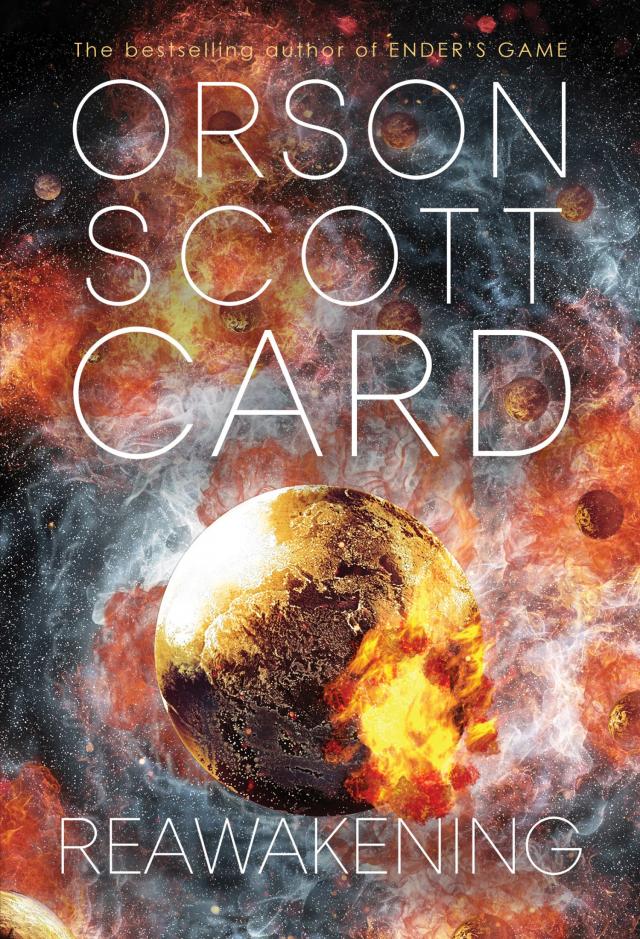
Reawakening, p.39
Reawakening,
p.39


Talk about an invasion of privacy.
And then the first of the Ivy clones went and learned how to side step. So it was possible. Using an identical body to hers, with the same childhood and adolescence, the same experience in handing off timestreams to a Laz (not the Laz), this girl could do what Mother Ivy had imagined doing and tried to do. But she, the original dowser, never seemed to get even the idea of how to side step alone.
That was also the Ivy who had two children. Wretched impossible ungovernable children. Beautiful brilliant powerful children. Children who had been babies, who grew up learning the language and the household customs of a Hayerian family, bearing a combination of the exact genes of Professor Hayerian and Mother Ivy, but not belonging to her. Not her own.
But Mother Ivy had made a good life for herself, recreating and bringing to life plant species that had existed on Earths now lost to human life. These remnants, fragments of once-beautiful biomes, they were her children now, meticulously brought to life using the same kind of equipment invented to allow human cloning, working at a level so nanoscopic that it took two layers of instrumentation to control the processes—the tools that actually did the genetic manipulation, but which were themselves too small to manipulate and sometimes too small to see, and then the tools that controlled those tools, which responded to Mother Ivy’s pressing and pulling, but reduced the scale so that the movements were never sudden or fast.
And then in the garden, her bare hands—gloves? I don’t need no stinkin’ gloves!—plunged into the soil, worked in the peat, the compost, the manure, the root-loving fungi, until all was ready for her altered seeds to germinate and grow into something never before seen on this Earth or the original one.
One of them, the fruiting tree, she learned needed to be grafted onto a native root in order to thrive. But after implanting genes in a seed, the process of grafting was almost child’s play. She found that plum trees from the Old Place were the best root stock, and then, instead of struggling to produce a couple of fruits before dying at the root, the grafted tree bore copious amounts of fruit in the second year—enough fruit for there to be a market for commercially grown orchards to thrive.
Mother Ivy wasn’t interested in actually managing such an orchard. Acres of the same plant, grafted again and again? Bearing the same fruit, season after season? She’d leave that for farmers who were used to such work. She got a royalty from every grafted tree that the nursery sold. And during the season, she was brought seven fruits a week as they ripened, so for four weeks she had a “nanner” every day.
She named it “nannerfruit” partly because it sounded silly and was fun to say, and partly because the flavor was not unlike banana, though the fruit was not so easily bruised and had a longer shelf life than the old Cavendish bananas she had grown up with.
The fruit did not make her famous—she was already far more famous than she ever wanted to be, because of her association with the Professor and her involvement in finding the New Place. No one had blamed her for Shiva still being the nemesis of that timestream. But she didn’t want her work with the nannerfruit to be linked to the dowsing half of the side-stepping team. The one had nothing to do with the other.
Nannerfruit was the only one of her rescue plants that had immediate commercial utility. Because there were still people who rejected fruit that had any genetic manipulation at all—though Ivy had been scrupulous about not altering the genome in the process of inserting it into the seed—Ivy let it be bruited about that nannerfruit was a discovery in one of the timestreams where humanity now lived. She knew it was a rescue from a lost world, and so did a few other people—Ron and whoever he had told—but far more people could enjoy this sweet and nutritious fruit if they did not know how the original seeds were made.
Mother Ivy was in the garden, deadheading her favorite flowering rescue perennial in hopes of a second bloom, when she became aware of someone standing near her.
“Ivy,” he said.
She did not have to turn around to know who it was. “Professor Hayerian,” she said, still not looking.
“I came to thank you,” he said.
“For what?” Mother Ivy asked.
“For saving my life.”
She turned. His hair was white now, and his eyebrows and mustache too. He had become an extraordinarily distinguished-looking old man. She well remembered what he had looked like back when they worked together—exactly like Zero-Laz, as the newest pair had dubbed him. When she saw Zero-Laz it kind of broke her heart.
Now, seeing the real man she had loved, changed by the years they had spent apart, but still the same, and not a copy, it did break her heart, not from sorrow and loneliness—she was an expert at coping with those—but with joy, and relief, and love.
“You’re alive,” she said softly. “And you’re here.”
“I meant to come sooner, but I couldn’t stay in any time long enough to—”
“The newest Laz explained it to me,” said Mother Ivy. “Though I’m not sure he really understood it himself.”
“How could he? I haven’t figured it out either. But he and his Ivy figured out why they didn’t have any trouble coming home and rooting themselves in their own era.”
“Yes,” said Mother Ivy. “They told me.”
“It isn’t that love has even the slightest effect on time,” said the Professor, falling into his lectury voice, his equivalent of baby talk for minds slower than his own. “It’s that love has a strong effect on the time traveler’s mind, so that he can home in on a signal, some kind of signal, from the lover and the beloved. They are so devoted to each other—”
“The traveler’s return is instantaneous,” said Mother Ivy.
“That is how you saved my life,” said the Professor. “Because you still loved me after all these years. They told me you did, and I believed them.”
Again, her privacy had been breached, but no matter. He was home. “Are you now able to stay in one timeframe?” she asked.
“As long as you’re in it,” said the Professor.
“Even though you don’t love me?”
The Professor didn’t answer.
“So my love alone is enough to allow you to home in on the timeframe where I live?” asked Mother Ivy.
“No,” said the Professor. “It has to be reciprocal.”
Ivy was not a slow thinker, but she was a slow believer, so she knelt in the soil and kneaded the peat and the dung together for a while before she dared to voice what she thought his words had meant.
“Does that mean,” she said, “that you also love me?”
“It does,” said the Professor.
“But you never—”
“But I always,” he said. “I didn’t allow myself to think of you, to treat you as an equal, because you were young and beautiful and I knew you could do better than me.” He looked down and spoke softly. “I never thought it mattered that nobody is better for me than you. In all my endless scooting up and down Time, it was your face I dreamed of, your voice I heard in my dreams.”
“You could time travel in your sleep?” asked Mother Ivy.
“I couldn’t stay awake for more than thirty hours at a time, so yes, I often woke up in some timeframe that I couldn’t identify, that I didn’t have time to explore before I was scooting onward. I’ve been everywhere and everywhen but they were also nowhere and never, because you weren’t there.”
Mother Ivy blushed. Like a foolish schoolgirl. And her hands were so covered with soil and muck that she couldn’t even touch her cheeks to try to hide the blush. “That’s very romantic, Professor, but also extravagant.”
“When Laz and Ivy—the youngsters, the whippersnappers—told me how they sustained each other in time travel, how each brought the other home, I was so envious. If only Ivy and I—you and I—could have loved each other.”
“But I did,” said Ivy.
“I suspected it at the time, and they assured me that it still was true. You loved this distant, crusty old professor, faithful for decades.”
“After knowing you, how could I give my heart to somebody else, how could I even want to?”
The Professor stretched out his hand to her.
“I’m absolutely filthy, I can’t possibly—”
“There’s nothing on you that won’t wash off me easily enough, when I feel like it,” said the Professor.
So she took his hand and allowed him to help her rise from the dirt. He was not quite as tall as he used to be. Or… had she ever stood this close to him? And he didn’t let go of her hand.
“The hard thing for me to realize,” he said softly, “was that I loved you all along. You were pretty and young and brilliant and always surprising, so of course I was attracted to you—everyone was. But I was your professor and you were my graduate assistant—”
“I was still an undergraduate then—”
“My assistant, my dowser, my scryer—I like that word, though you and I never used it. You were my partner in the greatest, most important work of my life, I trusted you, I depended on you, and you never failed me. But I could not, would not be That Man, the professor who can’t keep his hands off his students, who believes that somehow the decades of difference in our ages wouldn’t matter—so I desired you, and denied that I desired you, and trained myself not to desire you.”
“Very effectively,” she said. “I could always tell when men wanted me, but I saw you switch that off whenever it occurred. You didn’t want to want me, and so you didn’t.”
“Desire,” said the Professor. “So powerful, so distracting. I schooled myself out of desire, but I never realized that this did nothing to prevent me from falling in love with you. The first person, the first thing I thought of every waking, the woman I had to always know where you were, the one I depended on not just to find me timestreams but to make my life a pleasure, a joy, because I was in your company.”
“Well, you hid that quite well,” said Mother Ivy.
“From myself, I hid it from myself. But it was there. It was there all the time. And as I was keelhauled through time, you were already my anchor, my lifeline, my connection with reality—”
“I love your words, but how can I believe them?” Ivy asked.
“Believe them,” he said. He drew her closer, put his hands on her back in a dancelike embrace.
“Now you’re getting my shirt all dirty,” she said.
“I’ll do the laundry myself.”
“You’re the expert now?” said Ivy. “Since the whole time you were traveling, you were continually getting stains out of clothes?”
The Professor laughed. “You still have the sarcasm.”
“Sarcasm comes naturally to the lonely, bitter heart.”
“Your heart always seemed sweet to me. I felt no malice from your wit.”
“There never was any,” said Mother Ivy. “But Professor Hayerian, we’re old now. I’m afraid our time has passed.”
He pulled her closer, held her body against his. “Too late for us to have children and a family,” said the Professor. “And I’m still twenty years older than you, probably eighty. I’m healthy enough, but I’m not going to live forever. Still… even if we only have three weeks, even if the onrush of happiness is too strong for this old heart to bear, let’s have those weeks, two or three or ten. Will you?”
“I guess you weren’t paying attention,” said Mother Ivy. “I said yes the moment you spoke to me.”
“Not with your voice,” he said.
“It wasn’t my voice that was calling to you. It was my heart, my soul, my essence, call it what you will. That’s what cried out ‘yes’ the moment you spoke. But now that we’re using voices, I’ll say it again. I’ve become a crotchety old spinster waiting for you, but I’m also still a girl in love. Are you proposing marriage, Professor Hayerian?”
“Not if you’re going to call me that,” he said.
“But there are so many other Lazzes in these timestreams. And having thought of you as the Professor for so long, I don’t know if I can change now.”
“And the kids call you Mother Ivy.”
“I like it, though my children are green, growing in the soil all around you.”
“As long as I have you to come home to, I’ll be as rooted here as any of your plants. Let me be the fauna to your flora.”
“How scientifically romantic,” she said. “Did you bring a justice of the peace with you?”
ACKNOWLEDGMENTS
Kristine A. Card and Erin Absher read every chapter fresh from my fingers into digital form, and helped me maintain continuity and clarity. Scott Allen kept the computers, printers, and networks running smoothly, an entire IT department in himself. Emily Janice Rankin did a deep and insightful editing pass that improved the book at every turn. And Cyndie Swindlehurst brought her always excellent and mindful copyediting and proofreading skills. My gratitude to all.
More from this Series
Wakers
Book 1
More from the Author
Visitors
Ruins
Pathfinder
ABOUT THE AUTHOR
Photograph © Terry Manier
Born in Richland, Washington, in 1951, Orson Scott Card grew up in California, Arizona, and Utah. He lived in Brazil for two years as an unpaid missionary for the Mormon Church and received degrees from Brigham Young University and the University of Utah. The author of numerous books in several genres, Card is best known for Ender’s Game, the Tales of Alvin Maker series, and the Pathf inder Trilogy. He lives with his wife in Greensboro, North Carolina.
Visit us at simonandschuster.com/teen
www.SimonandSchuster.com/Authors/Orson-Scott-Card
Margaret K. McElderry Books
Simon & Schuster, New York
ALSO BY ORSON SCOTT CARD
The Side Step Series
Wakers
The Pathfinder Series
Pathfinder
Ruins
Visitors
We hope you enjoyed reading this Simon & Schuster ebook.
Get a FREE ebook when you join our mailing list. Plus, get updates on new releases, deals, recommended reads, and more from Simon & Schuster. Click below to sign up and see terms and conditions.
CLICK HERE TO SIGN UP
Already a subscriber? Provide your email again so we can register this ebook and send you more of what you like to read. You will continue to receive exclusive offers in your inbox.
MARGARET K. McELDERRY BOOKS
An imprint of Simon & Schuster Children’s Publishing Division
1230 Avenue of the Americas, New York, New York 10020
www.SimonandSchuster.com
For more than 100 years, Simon & Schuster has championed authors and the stories they create. By respecting the copyright of an author’s intellectual property, you enable Simon & Schuster and the author to continue publishing exceptional books for years to come. We thank you for supporting the author’s copyright by purchasing an authorized edition of this book.
No amount of this book may be reproduced or stored in any format, nor may it be uploaded to any website, database, language-learning model, or other repository, retrieval, or artificial intelligence system without express permission. All rights reserved. Inquiries may be directed to Simon & Schuster, 1230 Avenue of the Americas, New York, NY 10020 or permissions@simonandschuster.com.
This book is a work of fiction. Any references to historical events, real people, or real places are used fictitiously. Other names, characters, places, and events are products of the author’s imagination, and any resemblance to actual events or places or persons, living or dead, is entirely coincidental.
Text © 2025 by Orson Scott Card
Jacket illustration © 2025 by Sammy Yuen Jr.
Jacket design by Debra Sfetsios-Conover
All rights reserved, including the right of reproduction in whole or in part in any form.
MARGARET K. McELDERRY BOOKS is a trademark of Simon & Schuster, LLC.
For information about special discounts for bulk purchases, please contact Simon & Schuster Special Sales at 1-866-506-1949 or business@simonandschuster.com.
Simon & Schuster strongly believes in freedom of expression and stands against censorship in all its forms. For more information, visit BooksBelong.com.
The Simon & Schuster Speakers Bureau can bring authors to your live event. For more information or to book an event, contact the Simon & Schuster Speakers Bureau at 1-866-248-3049 or visit our website at www.simonspeakers.com.
Interior design by Jacquelynne Hudson
Library of Congress Cataloging-in-Publication Data
Names: Card, Orson Scott author
Title: Reawakening / Orson Scott Card.
Description: First edition. | New York : Margaret K. McElderry Books, 2025. | Series: The side step series ; book 2 | Audience term: Teenagers | Audience: Ages 14 up | Audience: Grades 10–12 | Summary: Seventeen-year-old Laz, a clone born with the power to jump between parallel worlds, must use his powers to stop an interdimensional war.
Identifiers: LCCN 2024041719 (print) | LCCN 2024041720 (ebook) | ISBN 9781481496223 hardcover | ISBN 9781481496247 ebook
Subjects: CYAC: Space and time—Fiction | Cloning—Fiction | Science fiction | LCGFT: Fiction | Science fiction | Novels
Classification: LCC PZ7.C1897 Re 2025 (print) | LCC PZ7.C1897 (ebook) | DDC [Fic]—dc23/eng/20250609
LC record available at https://lccn.loc.gov/2024041719








