The complete works of os.., p.1
The Complete Works of Oscar Wilde,
p.1
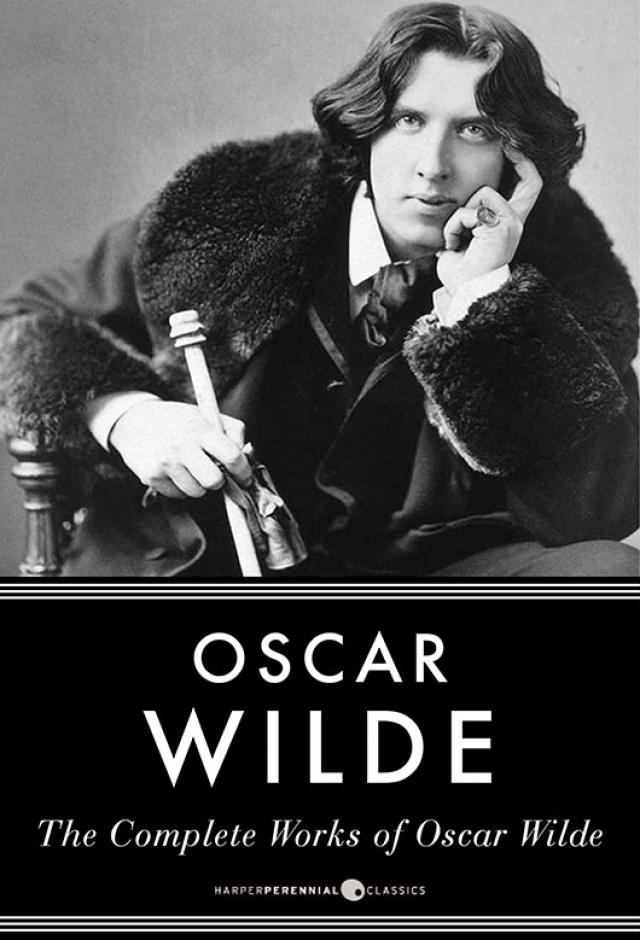


THE COMPLETE WORKS OF OSCAR WILDE
Oscar Wilde
CONTENTS
The Stories
The Picture of Dorian Gray
Lord Arthur Savile’s Crime
The Canterville Ghost
The Sphinx Without a Secret
The Model Millionaire
The Young King
The Birthday of the Infanta
The Fisherman and His Soul
The Star-Child
The Happy Prince
The Nightingale and the Rose
The Selfish Giant
The Devoted Friend
The Remarkable Rocket
The Portrait of Mr. W. H.
The Plays
The Importance of Being Earnest
Lady Windermere’s Fan
A Woman of No Importance
An Ideal Husband
Salomé
The Duchess of Padua
Vera, or the Nihilists
A Florentine Tragedy
La Sainte Courtisane, or the Woman Covered with Jewels
The Poems
Ye Shall Be Gods
Chorus of Cloud Maidens
From Spring Days to Winter
Requiescat
San Miniato
By the Arno
Rome Unvisited
La Bella Donna Della Mia Mente
Chanson
Untitled
Untitled
The Dole of the King’s Daughter
Love Song
Tristitiae
The True Knowledge
Heart’s Yearnings
The Little Ship
Θphnωiδia
Lotus Land
Désespoir
Lotus Leaves
Untitled
A Fragment From the Agamemnon of Aeschylos
A Vision
Sonnet On Approaching Italy
Sonnet
Impression De Voyage
The Theatre At Argos
Urbs Sacra Aeterna
The Grave of Keats
Sonnet
Easter Day
Sonnet
Italia
Vita Nuova
E Tenebris
Quantum Mutata
To Milton
Ave Maria Gratia Plena
Wasted Days
The Grave of Shelley
Santa Decca
Theoretikos
Amor Intellectualis
At Verona
Ravenna
Magdalen Walks
The Burden of Itys
Theocritus
Nocturne
Endymion
Charmides
Ballade De Marguerite
La Belle Gabrielle
Humanitad
Athanasia
The New Helen
Panthea
Phèdre
Queen Henrietta Maria
Louis Napoleon
Madonna Mia
Roses and Rue
Portia
Apologia
Quia Multum Amavi
Silentium Amoris
Her Voice
My Voice
Γλykyπikpoσ Epωσ
The Garden of Eros
Ave Imperatrix
Pan
The Artist’s Dream Or Sen Artysty
Libertatis Sacra Fames
Sonnet to Liberty
Taedium Vitae
Fabien Dei Franchi
Serenade
Camma
Impression Du Matin
In the Gold Room
Impressions
Impression
Hélas!
To V.F.
To M. B. J.
Impressions
Le Jardin Des Tuileries
The Harlot’S House
Fantaisies Décoratives
Under the Balcony
To My Wife
On the Sale By Auction of Keats’ Love Letters
The New Remorse
Canzonet
With a Copy of ‘A House of Pomegranates’
Symphony In Yellow
La Dame Jaune
Remorse
In the Forest
The Sphinx
The Ballad of Reading Gaol
Poems In Prose
The Artist
The Doer of Good
The Disciple
The Master
The House of Judgment
The Teacher of Wisdom
Essays, Selected Journalism, Lectures and Letters
The House Beautiful
The Decorative Arts
Personal Impressions of America
Mrs Langtry As Hester Grazebrook
Woman’s Dress
Mr Whistler’s Ten O’Clock
Dinners and Dishes
Hamlet at the Lyceum
Olivia at the Lyceum
A Handbook to Marriage
Balzac in English
A Ride Through Morocco
The American Invasion
Two Biographies of Keats
Aristotle at Afternoon Tea
Mr Morris On Tapestry
London Models
De Profundis
Two Letters to the Daily Chronicle
The Decay of Lying
Pen, Pencil and Poison
The Critic As Artist
The Truth of Masks
The Soul of Man Under Socialism
The Rise of Historical Criticism
A Few Maxims for the Instruction of the Over-Educated
Phrases and Philosophies for the Use of the Young
About the Author
About the Series
Copyright
About the Publisher
The Stories
THE PICTURE OF DORIAN GRAY
The Preface
The artist is the creator of beautiful things. To reveal art and conceal the artist is art’s aim. The critic is he who can translate into another manner or a new material his impression of beautiful things.
The highest, as the lowest, form of criticism is a mode of autobiography. Those who find ugly meanings in beautiful things are corrupt without being charming. This is a fault.
Those who find beautiful meanings in beautiful things are the cultivated. For these there is hope. They are the elect to whom beautiful things mean only Beauty.
There is no such thing as a moral or an immoral book. Books are well written, or badly written. That is all.
The nineteenth century dislike of Realism is the rage of Caliban seeing his own face in a glass.
The nineteenth century dislike of Romanticism is the rage of Caliban not seeing his own face in a glass. The moral life of man forms part of the subject-matter of the artist, but the morality of art consists in the perfect use of an imperfect medium. No artist desires to prove anything. Even things that are true can be proved. No artist has ethical sympathies. An ethical sympathy in an artist is an unpardonable mannerism of style. No artist is ever morbid. The artist can express everything. Thought and language are to the artist instruments of an art. Vice and virtue are to the artist materials for an art. From the point of view of form, the type of all the arts is the art of the musician. From the point of view of feeling, the actor’s craft is the type. All art is at once surface and symbol. Those who go beneath the surface do so at their peril. Those who read the symbol do so at their peril. It is the spectator, and not life, that art really mirrors. Diversity of opinion about a work of art shows that the work is new, complex, and vital. When critics disagree the artist is in accord with himself. We can forgive a man for making a useful thing as long as he does not admire it. The only excuse for making a useless thing is that one admires it intensely.
All art is quite useless.
1
The studio was filled with the rich odour of roses, and when the light summer wind stirred amidst the trees of the garden, there came through the open door the heavy scent of the lilac, or the more delicate perfume of the pinkflowering thorn.
From the corner of the divan of Persian saddle-bags on which he was lying, smoking, as was his custom, innumerable cigarettes, Lord Henry Wotton could just catch the gleam of the honey-sweet and honey-coloured blossoms of a laburnum, whose tremulous branches seemed hardly able to bear the burden of a beauty so flame-like as theirs; and now and then the fantastic shadows of birds in flight flitted across the long tussore-silk curtains that were stretched in front of the huge window, producing a kind of momentary Japanese effect, and making him think of those pallid jade-faced painters of Tokio who, through the medium of an art that is necessarily immobile, seek to convey the sense of swiftness and motion. The sullen murmur of the bees shouldering their way through the long unmown grass, or circling with monotonous insistence round the dusty gilt horns of the straggling woodbine, seemed to make the stillness more oppressive. The dim roar of London was like the bourdon note of a distant organ.
In the centre of the room, clamped to an upright easel, stood the full-length portrait of a yo
ung man of extraordinary personal beauty, and in front of it, some little distance away, was sitting the artist himself, Basil Hallward, whose sudden disappearance some years ago caused, at the time, such public excitement, and gave rise to so many strange conjectures.
As the painter looked at the gracious and comely form he had so skilfully mirrored in his art, a smile of pleasure passed across his face, and seemed about to linger there. But he suddenly started up, and, closing his eyes, placed his fingers upon the lids, as though he sought to imprison within his brain some curious dream from which he feared he might awake.
‘It is your best work, Basil, the best thing you have ever done,’ said Lord Henry, languidly. ‘You must certainly send it next year to the Grosvenor. The Academy is too large and too vulgar. Whenever I have gone there, there have been either so many people that I have not been able to see the pictures, which was dreadful, or so many pictures that I have not been able to see the people, which was worse. The Grosvenor is really the only place.’
‘I don’t think I shall send it anywhere,’ he answered, tossing his head back in that odd way that used to make his friends laugh at him at Oxford. ‘No: I won’t send it anywhere.’
Lord Henry elevated his eyebrows, and looked at him in amazement through the thin blue wreaths of smoke that curled up in such fanciful whirls from his heavy opium-tainted cigarette. ‘Not send it anywhere? My dear fellow, why? Have you any reason? What odd chaps you painters are! You do anything in the world to gain a reputation. As soon as you have one, you seem to want to throw it away. It is silly of you, for there is only one thing in the world worse than being talked about, and that is not being talked about. A portrait like this would set you far above all the young men in England, and make the old men quite jealous, if old men are ever capable of any emotion.’
‘I know you will laugh at me,’ he replied, ‘but I really can’t exhibit it. I have put too much of myself into it.’
Lord Henry stretched himself out on the divan and laughed.
‘Yes, I knew you would; but it is quite true, all the same.’
‘Too much of yourself in it! Upon my word, Basil, I didn’t know you were so vain; and I really can’t see any resemblance between you, with your rugged strong face and your coal-black hair, and this young Adonis, who looks as if he was made out of ivory and rose-leaves. Why, my dear Basil, he is a Narcissus, and you – well, of course you have an intellectual expression, and all that. But beauty, real beauty, ends where an intellectual expression begins. Intellect is in itself a mode of exaggeration, and destroys the harmony of any face. The moment one sits down to think, one becomes all nose, or all forehead, or something horrid. Look at the successful men in any of the learned professions. How perfectly hideous they are! Except, of course, in the Church. But then in the Church they don’t think. A bishop keeps on saying at the age of eighty what he was told to say when he was a boy of eighteen, and as a natural consequence he always looks absolutely delightful. Your mysterious young friend, whose name you have never told me, but whose picture really fascinates me, never thinks. I feel quite sure of that. He is some brainless, beautiful creature, who should be always here in winter when we have no flowers to look at, and always here in summer when we want something to chill our intelligence. Don’t flatter yourself, Basil: you are not in the least like him.’
‘You don’t understand me, Harry,’ answered the artist. ‘Of course I am not like him. I know that perfectly well. Indeed, I should be sorry to look like him. You shrug your shoulders? I am telling you the truth. There is a fatality about all physical and intellectual distinction, the sort of fatality that seems to dog through history the faltering steps of kings. It is better not to be different from one’s fellows. The ugly and the stupid have the best of it in this world. They can sit at their ease and gape at the play. If they know nothing of victory, they are at least spared the knowledge of defeat. They live as we all should live, undisturbed, indifferent, and without disquiet. They neither bring ruin upon others, nor ever receive it from alien hands. Your rank and wealth, Harry; my brains, such as they are – my art, whatever it may be worth; Dorian Gray’s good looks – we shall all suffer for what the gods have given us, suffer terribly.’
‘Dorian Gray? Is that his name?’ asked Lord Henry, walking across the studio towards Basil Hall ward.
‘Yes, that is his name. I didn’t intend to tell it to you.’
‘But why not?’
‘Oh, I can’t explain. When I like people immensely I never tell their names to any one. It is like surrendering a part of them. I have grown to love secrecy. It seems to be the one thing that can make modern life mysterious or marvellous to us. The commonest thing is delightful if one only hides it. When I leave town now I never tell my people where I am going. If I did, I would lose all my pleasure. It is a silly habit, I dare say, but somehow it seems to bring a great deal of romance into one’s life. I suppose you think me awfully foolish about it?’
‘Not at all,’ answered Lord Henry, ‘not at all, my dear Basil. You seem to forget that I am married, and the one charm of marriage is that it makes a life of deception absolutely necessary for both parties. I never know where my wife is, and my wife never knows what I am doing. When we meet – we do meet occasionally, when we dine out together, or go down to the Duke’s – we tell each other the most absurd stories with the most serious faces. My wife is very good at it – much better, in fact, than I am. She never gets confused over her dates, and I always do. But when she does find me out, she makes no row at all. I sometimes wish she would; but she merely laughs at me.’
‘I hate the way you talk about your married life, Harry,’ said Basil Hallward, strolling towards the door that led into the garden. ‘I believe that you are really a very good husband, but that you are thoroughly ashamed of your own virtues. You are an extraordinary fellow. You never say a moral thing, and you never do a wrong thing. Your cynicism is simply a pose.’
‘Being natural is simply a pose, and the most irritating pose I know,’ cried Lord Henry, laughing; and the two young men went out into the garden together, and ensconced themselves on a long bamboo seat that stood in the shade of a tall laurel bush. The sunlight slipped over the polished leaves. In the grass white daisies were tremulous.
After a pause, Lord Henry pulled out his watch. ‘I am afraid I must be going, Basil,’ he murmured, ‘and before I go, I insist on your answering a question I put to you some time ago.’
‘What is that?’ said the painter, keeping his eyes fixed on the ground.
‘You know quite well.’
‘I do not, Harry.’
‘Well, I will tell you what it is. I want you to explain to me why you won’t exhibit Dorian Gray’s picture. I want the real reason.’
‘I told you the real reason.’
‘No, you did not. You said it was because there was too much of yourself in it. Now, that is childish.’
‘Harry,’ said Basil Hallward, looking him straight in the face, ‘every portrait that is painted with feeling is a portrait of the artist, not of the sitter. The sitter is merely the accident, the occasion. It is not he who is revealed by the painter; it is rather the painter who, on the coloured canvas, reveals himself. The reason I will not exhibit this picture is that I am afraid that I have shown in it the secret of my own soul.’
Lord Henry laughed. ‘And what is that?’ he asked.
‘I will tell you,’ said Hallward; but an expression of perplexity came over his face.
‘I am all expectation, Basil,’ continued his companion, glancing at him.
‘Oh, there is really very little to tell, Harry,’ answered the painter; ‘and I am afraid you will hardly understand it. Perhaps you will hardly believe it.’
Lord Henry smiled, and, leaning down, plucked a pink-petalled daisy from the grass, and examined it. ‘I am quite sure I shall understand it,’ he replied, gazing intently at the little golden white-feathered disk, ‘and as for believing things, I can believe anything, provided that it is quite incredible.’
The wind shook some blossoms from the trees, and the heavy lilacblooms, with their clustering stars, moved to and fro in the languid air. A grasshopper began to chirrup by the wall, and like a blue thread a long thin dragon-fly floated past on its brown gauze wings. Lord Henry felt as if he could hear Basil Hall ward’s heart beating, and wondered what was coming.
‘The story is simply this,’ said the painter after some time. ‘Two months ago I went to a crush at Lady Brandon’s. You know we poor artists have to show ourselves in society from time to time, just to remind the public that we are not savages. With an evening coat and a white tie, as you told me once, anybody, even a stockbroker, can gain a reputation for being civilised. Well, after I had been in the room about ten minutes, talking to huge overdressed dowagers and tedious Academicians, I suddenly became conscious that some one was looking at me. I turned half-way round, and saw Dorian Gray for the first time. When our eyes met, I felt that I was growing pale. A curious sensation of terror came over me. I knew that I had come face to face with some one whose mere personality was so fascinating that, if I allowed it to do so, it would absorb my whole nature, my whole soul, my very art itself. I did not want any external influence in my life. You know yourself, Harry, how independent I am by nature. I have always been my own master; had at least always been so, till I met Dorian Gray. Then – but I don’t know how to explain it to you. Something seemed to tell me that I was on the verge of a terrible crisis in my life. I had a strange feeling that Fate had in store for me exquisite joys and exquisite sorrows. I grew afraid, and turned to quit the room. It was not conscience that made me do so; it was a sort of cowardice. I take no credit to myself for trying to escape.’