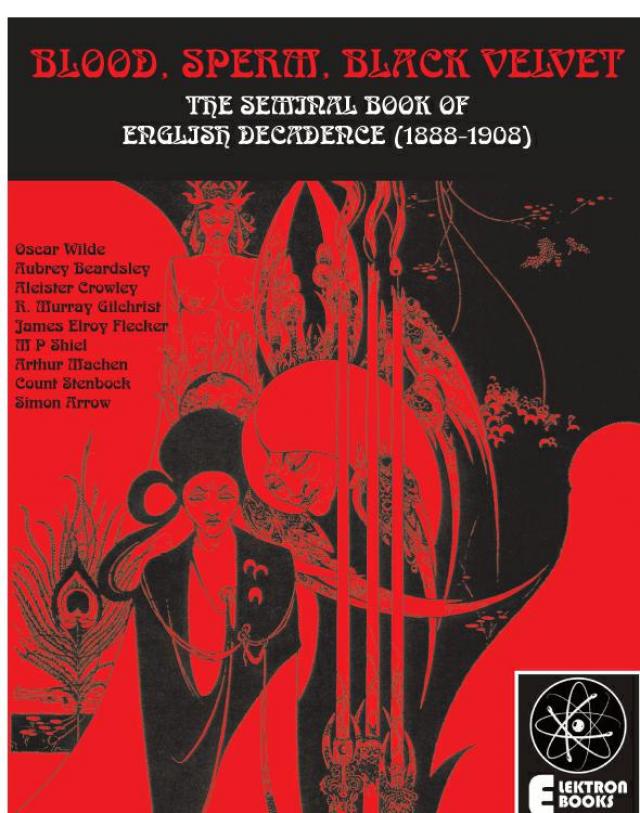
Blood sperm black velvet, p.45
Blood, Sperm, Black Velvet,
p.45


Who comes to to see me daily – I shall die
Happier if I kill him; so shall I
Reap on his body the last tare of lust,
And shivel back into my primal dust
Filled with all worms and horned beasts with wings,
The reptile that sweats acrid juice, and stings
With bloody teeth and tongue! Oh, all the room
Spits fire and dung, and vomits forth a spume
Of tawny sickly death! All blotched and dark,
The putrid air is vital with a spark
Of fiery eyes of yonder filthy hound!
God! I am reeling brain and body! I swound!
The floor heaves up! The worms devour my breast!
Beasts and lewd fish and winged things infest
Each vital part! Screech, rats! more liquor! Come!
Rumble, you rotting whore-skin of a drum!
I care not! Scream, you rats! Snakes, bite and hiss!
Hell’s spawn, I mouth you with this putrid kiss!
Satan! Damnation! This is the abyss!
COUNT FANNY’S NUPTIALS
Simon Arrow (1907)
CHAPTER I
It had been a long vigil, and the three sisters – thinking it may be over much of love – had grown a little languid in waiting for the Royal lover.
Lucy, hidden in the softness of a thousand frills, trembled ever so slightly, with fear or with longing as may be, at the thought of approaching possibilities.
Mrs Birchman, raising the lid from a large ointment jar, commenced to rouge her lips and breasts heavily, smiling approval into a small hand-mirror upon the lavish use of the pigment.
Moll loosened her bodice, and laying aside for a moment the copy of Love And Louisa which she was reading, expressed her impatience in gestures which were frankly sensual. Poor Moll, she had once been a very gallant lady indeed! And even now, when youth’s lilies were faded, she was adorned with the esoteric blossoms of unguentarian art, and Moll still had a certain success among the Mashers and the Beaux.
It was twilight, and the pale acacias, stirred by a fitful breeze, seemed to weep that the day had died so soon, covering the green lawns with the purity of their summer snows and lending to the surroundings an indefinable air of chastity.
Mrs Birchman perceived this and took it as a delicate compliment, puffing out her breasts, and pluming herself, in a manner that was attractive enough, the very moths growing careless of nature and abandoning the flowers to hover in the fragrance of the scented rouge.
A cuckoo that had solved the problem of poverty passed on its way to rest, and already the fire-flies could be seen gleaming in the shadows; a love-bird in a neighbouring coppice was in the midst of one of the most amorous little thrills imaginable, when – Count Fanny was seen to be approaching.
There was a veritable flutter in the dove-cot, and I should blush were I to relate the astonishing stratagems to which Mrs Birchman was put in order to conceal the telltale jar!
Nor would it be easy to describe the ravishing appearance of the adorable Count, for the exquisite Marquis de Parabère himself might have paled with envy at the sight of such preciosity, and surely Monsieur Racinet would have added yet another chapter to his already exhaustive work upon La Costume Historique, had he been so fortunate as to have beheld the delicate indiscretion of Count Fanny’s pantaloons!
He wore canary kid boots – with fourteen buttons and the most fascinating little heels – silk stockings, a false bust, and – Ave Maria! the tiniest little purple moustache in the world, this last the object of many a jeu d’esprit on the part of Monsieur Beau de Monde who, holding nothing sacred, would rally the Count – Pansy or Miss Nancy as he playfully called him – with astounding witticisms.
‘A pretty day to come a wooing,’ murmured Count Fanny, treading delicately upon the flower-strewn lawn which at first terrified him a little with the unnatural softness of its broken blossoms; however he was soon reassured, and recalling a hundred soft phrases and extravagant similes from De Arti Amandi and other books of love, he advanced with a series of the daintiest bows and most elegant gestures, his cheeks flushing prettily with passion.
Cupid himself had come courting!
Penelope might have trembled for her virtue; the Vestals have turned a trifle pale!
He hesitated only for a moment while Erotion advanced with the presents which were of astonishing richness and variety.
There was a cage of silk-worms that wove strange tapestries in two colours.
There were some curious drawings from Les Oeuvres Erotiques of Monsieur Felicien Rops.
There was a Rosary of false jet.
There were books – a copy of Voltaire’s La Pucelle which had belonged to the master himself; Les Fleurs du Mal, flowers ‘beautiful in their sublime decay’; a rare pamphlet attributed to the Marquis de Sade upon the cover of which dwarfs engaged in unthinkable pleasantries; Les Aphrodisiaques – Recueil de Romans Libres, described in the catalogues as curious; the paradoxical Frissons des Vierges, and a dozen others.
There were amber beads upon which cupids played the most indelicate frolics, and beads of pale jade.
There was a pair of frail drawers, woven in one piece, broidered in pink thread with a design of horned satyrs, and said to be possessed of curious properties.
There were some roses that had come from an island where it was always summer and whose infrequent petals, of almost transparent whiteness, glowed with the fragile beauty of anæmic virgins.
Never before, thought Count Fanny, had he beheld such an entrancing creature as the youngest of the three sisters. He fell in love at once, ‘head over ears’, Mrs Birchman declared, and brought a perfect fusillade of amorous sighs and love-ladened glances to bear upon the fortifications of her slumbering virginity, practised a dozen nice deceits of the curious art of love, and even offered her a cachou from his crystal bonbonière in the most accomplished manner possible.
Lucy was of course not so immodest as to love the Count upon so short an acquaintance, but at the same time she felt that she respected him very much.
Ah, how sweet she was! The Madonna-like features had grown a little restless under the Count’s assault and she glowed now with a new beauty – a St Teresa that had wearied of prayer! There were strange enchantments in Count Fanny’s love-making.
It was an exquisite torment to look at her. Her cunningly crimpled hair, which was vaguely reminiscent of the parfumeries had been enticed into the most disquieting curls, and clustered upon the crown, where the comb had been bolder in its ravishment, were the sweetest little puffs.
Puffs that were like poems; curls as feverish as Sapphic song!
Her eyes, vague, expectant, and filled with dreams, nestled under damp, nervous lids which closed from time to time in delicious vandalism. She had little hands that were like prayers, and such restless lips, moist, and scarlet as adultery, they seemed to quiver as though oppressed by the burden of unkissed kisses and were surely a thousand times more potent than all the hateful coctions of Canidia that compelled love.
The cushioned softness of the tiny breasts, things of ivory and coral that would mould themselves exquisitely to the lover’s hand, peeped slyly over the batiste frills which fell away on either side as though shamed with the thought that they should conceal such loveliness, and just for an instant the ruched petticoat graciously permitted a glimpse -fleeting as the virtues – of a single shoe of grey pearl which could only have been fashioned in Arcadia; a shoe that would have caused even Princes to dally and have made common people very unhappy indeed!
It must not be supposed, however, that Count Fanny was so ungallant as to altogether neglect the other sisters.
On the contrary, he complimented Moll upon the courageous chymistry of her hair and the unblenchable suavity of her manner, and whispered some astonishing passage into Mrs Birchman’s ear which sent her into fits of laughter. She made a dignified attempt to blush -even the moon passed for a moment behind a cloud.
‘How sentimental the Count is,’ she chortled, ‘quite the old gentleman,’ and she wiped away the tears that in their passage over her cheeks had graven quaint tortuous ruts through the powder and the rouge.
Presently Count Fanny taking Lucy by the hand led her gently away into the shadow of the wood.
Mrs Birchman played with Erotion, the little page.
The Moon quite unable to conceal her curiosity peeped round the edge of the coppice. It was a pretty sight she saw!
She was pale and swollen and seemed to hover quite near the earth, like some monstrous powder-puff suspended in the sky, or like one of the great arc-lamps that illuminate the Embankment, thought the Count.
‘And hardly less beautiful,’ he mused.
How romantic it all was!
Inside the wood it was quite dark.
Hours later when Count Fanny drove away Mrs Birchman was repairing her raddled features in the moonlight, while Etelin, with noiseless footsteps and immutable features, carried away the sorrowful remnants of an Arcadian repast – the emptied bottles of Liebfraumilch – the crumpled linen – the broken glass.
CHAPTER II
It was late next morning when Count Fanny awoke. His slumbers had been exquisitely troubled, and, in the first delicious moments which followed his awakening, the propitious happenings of the night before mingled themselves with his dreams.
He closed his eyes for a moment, seeking to prolong the illusion, and it was not until he caught sight of the broken flowers, which he had ravished the night before from Lucy’s bosom, that he was reassured.
He picked them up and fondled them, and noting the faint odour of patchouli which they exhaled, found them infinitely sweet. He kissed those places where the little beads of moisture emanating from her skin had stained them or washed away the bloom.
How delicious they were! There was a subtle charm about the slightly artificial fragrance of the blossoms, that appealed to Count Fanny’s temperament and filled him with vague, ungenerous hopes, unformed, transitory emotions such as stir within us at the memory of an early love, or at the thought of an illicit pleasure. He remembered to have read somewhere that Henri Valois was for seven years possessed by a passion which was inspired and nurtured only by the perspiration of a glove, and again that the Curé Gaufridy had intoxicated all women with the fragrance of his breath, and it seemed to him that certain perfumes must be possessed at times of all the properties of aphrodisiacs.
Armande, when he entered to perform the toilet, grew very droll over the Count’s extravagances.
Were I to tell you of the care and ingenuity that were lavished upon his person I feel sure that I should be accused of exaggeration! The Love-birds of the Babylonian marshes will, we are told, in their bridal dances stain their breasts and practise all the cunning arts of prostitution, and though Count Fanny did not go to these extremes, he lingered many hours before his looking glass, time after time changing a scarf, dissatisfied with the choice of rings or the position of a patch, quarrelling with Armande over the crimping of his hair, or at times even musing a little upon his own perfection.
Such are the nice vanities of lovers!
‘C’est vraiment de bon ton,’ exclaimed Armande, when the Count was at length ready to appear upon the Town, handing him at the same time a tiny handkerchief, sewn with lace, and as frail and perishable as lovers’ vows.
He lingered for a moment lovingly before a mirror, then, drawing on his long white kid gloves, he stepped into the coupé.
London was crowded, Mashers, Fops, Rastaquoueres, Dandies, Charlatans, Cocottes, Souteneurs, Countesses, Dwarfs, Gomeurs, Tarts and Beaux jostling each other in the arcades, everybody was there. Monsieur de L’Amorbleu the well-known Parisian gomeur, his hair curling so naturally that people quite thought it was crimped; poor Tombletino, the clown, looking sad because Lord Judas had stolen his columbine away; Prince Piere of the Embassy who had lost a fortune at ‘Bilbocquet’; the Countess Lilee, whose beauty was of that rare type that is embellished by the use of pigment, and, last but not least, Madame Plumsein, an odd old thing, with that air of depraved girlishness and cultivated innocence with which we are told kings have at times been fascinated and even priests and roués. Her appearance was somewhat surprising, the little old face, the voluptuous droop of her lips and abandoned prominence of her breasts giving the lie to the childish innocence suggested by the loose unfashioned hair, the ingenuous brevity of the skirts, the protruding lace of the pantalons.
Everybody was a little unhappy at the Count’s news.
The young men frowned, a trifle jealous perhaps, the veillards sighed regretfully.
The Roués were weeping a little in the Row; the cocottes had painted their faces to conceal their sorrow; only lovers, seated in amorous familiarity, were quite happy.
Mashers had gone in for macquillage, and with their sticks of coral lip-salve had reddened their lips where disappointment had blanched them or envy had turned them pale.
Fops as they congratulated him played nervously with their ruffles.
Exquisites and dilettanti, wearing un bel air de paleu r, had touched their costumes with a note of mauve.
The Marquis de Joliemain had been seen stealing out of Floris’s where he had been buying ‘Antirides for Wrinkles’ that had grown in a night, La Bella Giambetta was confined to her room, and Madame Pomeroy’s was crowded.
Monsieur Beau de Monde alone seemed entirely delighted and he and Count Fanny passed together down the Colonnades, quizzing the passers by. They spent an hour pleasantly enough watching the lapidaries seated in their windows graving gems, or the chemists, who had abandoned all their less important duties and were busy mixing cosmetics. Then the unguentarians had to be consulted about some secret of the toilet and they watched them for a time as they worked at their mysterious labours with shining test-tubes and phials of coloured liquids, iridescent, opalescent and opaque, brewing potions that would inspire passion, crushing cantharides in coloured crucibles, grinding down strange herbs to make love philtres and treating them according to the curious recipes contained in the Grimoire of Pope Honorius, or handling in the most loving manner their pomades, creams, essential oils and essences, poudre-de-riz and psingthium, powder puffs, lip-salves, false busts, pads, coral sticks, patches, plumpers and powder of three colours, blanc, naturelle, and Rachel. There was a rare assortment!
The Count and Monsieur Beau de Monde had a dozen subjects to discuss. Marriage, of course, which Monsieur Beau de Monde declared added ‘such a piquancy to our infidelities’. Mr Tree’s latest astonishing representation, which the critics quaintly enough described as Shakespearean drama. The dancing of Mdlle Genée, who pirouetted with such grace at the Empire that the Roués sighed, and even wept a little, as they recalled their vanished youth and the days when Taglioni and Carlotta Grisi took the town by storm and the clowns languished in the Harlequinade because they dare not tell their love. She was wholly divine and with the double exception perhaps of Yvette Guilbert and Eleanore Duse ranked as the one woman of genius that the nineteenth century had produced. An ephemereal figure that had drifted for a moment from another world! Some strange, exotic flower that had matured in the Arcadian sunshine of the footlights, they declared growing extravagant in their praise!
They talked of the new Turners. ‘Turner,’ said Count Fanny, ‘set nature an impossible task; Sir Napier Hemy has avenged her.’
Of the Manet exhibition.
Of the hats and flowers that made the window of Jay’s one of the most pastoral scenes in the South of England.
Of some gloves of white kid which they saw in the Burlington Arcade, and which were sewn with delicious pink nails and were surely the most unnatural things in the world!
Of Lord Henry who had just published his little volume of erotic distichs – like any other dilettante.
Of the flowers at Goodyear’s: far finer than anything that could be grown in the country, and almost too beautiful to be real!
Of some mysterious creatures with lecherous faces and wanton gestures who had been seen creeping up Bond Street at dusk.
Of Mr Saltus’ latest delightful volume; of the pragmatic philosophy; of themselves; and in fact of everything of importance.
Presently they passed down Regent Street, noted the quality of its lines and grandeur of its conception, which embodied the whole spirit of Greek culture, and made it at once not only the one Street of any architectural importance in London but also one of the finest in the world; looked in at Hatchard’s, spent a pleasant hour turning over the leaves of the books -which afforded them a curious joy – and then to Perruzi’s to see the jewels.
CHAPTER III
Perruzi was a romantic old thing with a flatulent manner. He was always delighted to see Count Fanny and he quickly produced some rare specimens, shoe buckles with the most loving clasps, some heavy gilt earrings carved by dwarfs with images of forbidden pleasures, a pair of gold garters with a long history and the quaintest mottoes, and amorous with gilded loves that must have been possessed of the most curious knowledge, some pearls, and peridots cut in three manners, briolette, rose recoupée, and en cabochon.
But what Count Fanny liked most were the unset stones. How they glittered!
There were corals as pink as his own palms, chrysophrases and chrysoberyls, and agates that had been stained in honey to increase their colour. There were aquamarines in whose green depths were hidden all the secrets of the sea, heliotropes, chalcedony, sard and jade, amethysts – pale, and purple as secret sorrows -and opals as fierce and unquenchable as stifled passions. There were ambers dyed different colours, moonstones that waned with the moon, alexandrites so enamoured of fire that they blushed when they saw the sun, topazes from the Serpent Isles of the Arabian Sea, and turquoises that Perruzi, leering amorously, vowed would only fade when he wearied of loving.