

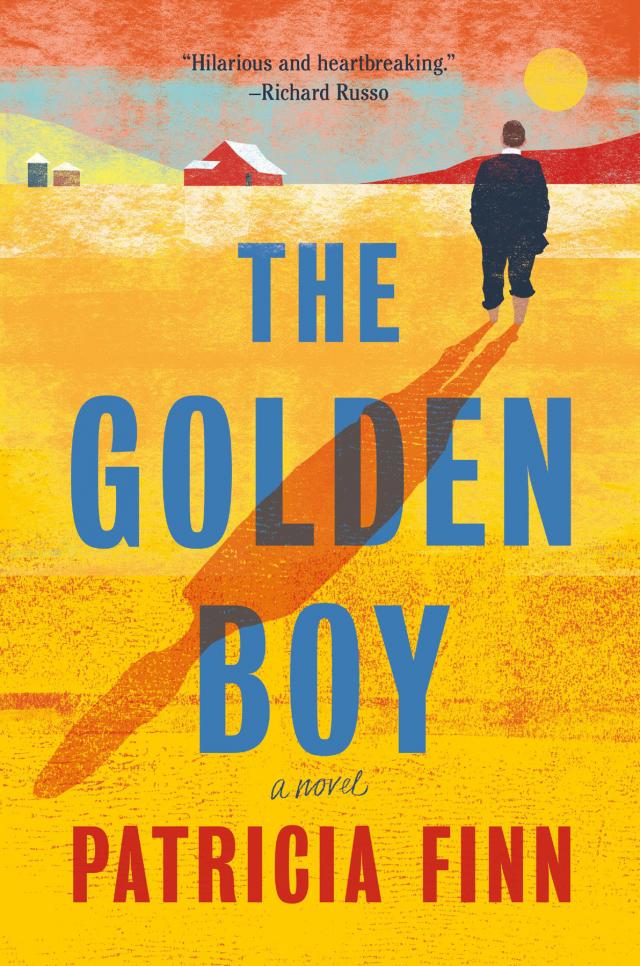
The golden boy, p.14
The Golden Boy,
p.14


“And I mean straight home, Stafford,” his mother would add. “No trips to the main road. And watch out for that nest of bees near the fence.”
Yes, Stafford would answer. He knew about the bees and the road and going straight to the rock and straight back again. But by the time he escaped his mother and the kitchen and then the fenced yard and made his way into the field, he no longer cared who saw him and who didn’t because he knew that he was no longer who they believed him to be. He was not a small boy anymore, too young to have a say in family quarrels or a bath on his own terms. He was an adventurer, an explorer, and the piece of grass in his hand was a bow or a spear and the earth beneath his feet was not a farmer’s field but a distant place that held the promise of uncharted water. And when he came to the rock in the middle of the field, and if his friend was there waiting for him, time would shift like a waking dream.
Bobby and Stafford rarely quarreled over opportunity and possession, believing instead that the gifts of one were the gifts of both. If Bobby found a bigger ant than Stafford, then Bobby’s ant would be the king of the ants and Stafford’s the son of the king and from there the story would unfold until a sudden gust of wind caught their attention and the problems of ant royalty were forgotten. They would climb instead to the top of their rock and watch the grass rippled by the wind that lifted it, and their rock would become a boat and the grass would become water and the waves of a great storm would be upon them. Ants would become sharks and the slow truck lumbering past on the road would become a whale and the tractor in the distance, a pirate ship heading their way. And when the storm had passed and the pirates all killed and captured, and their own boat wrecked upon the shores of a distant island, Bobby and Stafford would stretch out on the ground and lay their faces against the earth, turning over only to watch a sky that changed with each blink of their eyes.
“We should go to Arabia.”
“On a camel.”
“It’s all sand in Arabia.”
“Camels drink sand.”
“Yeah. They don’t drink water.”
“No.”
“They wear pajamas.”
“PJs!”
“Yeah.”
“Why don’t they get dressed?”
“I don’t know.”
“I like camels.”
“Yeah.”
“And elephants.”
“Elephants drink water.”
“All day.”
“Look! An elephant cloud.”
“Two elephants!”
“Three!”
“No. Just two. That one’s a camel. See the hump?”
“Two humps.”
“No, Stafford. Just one.”
“Yeah.”
The wonder of childhood lay easily upon them, and although their parents would never make the move themselves from goodwill to friendship, there was an unspoken understanding between the Hopkinses and the Shepherds that their little boys, their change-of-life babies, needed each other. But Stafford and Bobby knew that it was more than need or loneliness or even the physical proximity of two farms on the same side of a busy road. Somehow, they had recognized from the start that together they were greater than the sum of their parts, greater even than the huge rock that marked the place where another farmer had given up on something bigger than himself, content to leave it alone and unbroken.
“They’re two peas in a pod, aren’t they?” Susan Shepherd would say. “What one thinks, the other says.”
But not everyone agreed with her. A close friendship between two young boys was all well and good in moderation, but it didn’t make one boy the same as another and it never would. An excess of friendship between two young boys was even, some felt, damaging. If the friendship was too intense, for example, and made one boy dependent on another, it could weaken his desire to compete and that would be a problem down the road. Or if the friendship got emotional and boys started acting like girls, all caught up in each other’s problems? Well, that sort of friendship was altogether more serious and would have to be broken up quickly before one boy led another down the wrong path. It was important, therefore, that young boys, all young boys, Bobby and Stafford being a case in point, be made to realize that friendship was not the same as a blood tie. Friends were not as important as relatives. A friend mattered less than a cousin or a brother. But it was generally felt that Stafford and Bobby Shepherd would come to realize this sooner rather than later because there were so many patently obvious differences between the two families that it was inconceivable either boy could remain ignorant for long.
The Hopkinses, for example, had the better farm and a much nicer house than the Shepherds. They also had two sons, while the Shepherds had only one. The Hopkinses were a Catholic family and the Shepherds, barely Protestant. The Hopkinses had many relatives in the area, but the Shepherds were newcomers who rarely had visitors and spoke only vaguely about an uncle “back home” or a sister’s family elsewhere. The Hopkinses kept their front yard tidy, and the Shepherds did not seem to care much about old chairs on front porches although they kept a nice garden. The Hopkinses did not name their chickens. The Shepherds kept cats inside the house. Susan Shepherd was a competent baker, but Mary-Jean Hopkins was famous for pickles and preserves. Michael Hopkins was respected by other farmers while Andrew Shepherd’s opinion on rural matters was generally ignored.
But none of these things would ever really matter to Bobby and Stafford, not even when they were old enough to understand them. What would matter, and far more than anyone anticipated, was not the size of a farm or the neatness of a front yard, but the single and unyielding truth that Stafford Hopkins was a beautiful child and Bobby Shepherd was not.
Bobby may have been a healthy baby, a meat-and-potatoes baby, the nurses had said, but he was genetically destined to become an unattractive boy with the same heavy build as his parents. He had his father’s pale skin and his mother’s sparse red hair, and it could not be said by anyone with a shred of insight that he was likely to grow into a good-looking man, not even with fresh air and the passage of time. No, it could not be said that Bobby Shepherd would ever be handsome.
“A boy that sorry looking,” Stafford’s mother once said, “it’s a wonder he doesn’t care.”
But Bobby had no reason to care, because he didn’t know he was sorry looking, at least not until he was older, and that was because no one told him. Certainly not his best friend, Stafford, or any of the hired men who came and went with the seasonal work of a farm, and certainly not his own mother and father, who didn’t tell him he was sorry looking because they didn’t think he was. Having found their own ideal of beauty in each other, Andrew and Susan Shepherd could hardly be expected to understand that their unattractive child was not a perfect boy, and even Stafford’s mother was reluctant to mention it directly.
Stafford’s mother was a woman of keen practical insight, and while she did not dislike the Shepherds, she was open in her pity for people who looked odd or unattractive. Yes, it was all well and good to say that a homely face was as pleasant as a nice one, but it just wasn’t true, was it? She was therefore justifiably proud of her own two sons, of Emmett and Stafford, who, everyone knew from the start, would grow into handsome men because they were dark-haired, blue-eyed boys with clear skin, fine profiles, and good teeth. In the summer, they would tan easily, their shoulders filling out with the work of a farm, and in the winter, when their skin was pale with the shadows of days made short by a distant sun, their eyes would grow luminous and blue, and even strangers would comment. The Hopkins men were good-looking men, and if they married sensibly, they would produce good-looking children who would do well in the world. Emmett had been, perhaps, the prettier baby, but that was only because Stafford’s weakness in the lungs produced a pallor he would later outgrow.
Bobby Shepherd’s sloping shoulders did not fill out in the summer and his skin did not tan with the glow of rural health. Bobby burned in the summertime. Burned until his skin was mottled and peeling, and when his adolescence arrived, earlier than anticipated, his astonishment in seeing his testicles expand was offset by the onset of cystic acne that swept across his face and upper body like a pestilent invasion. There was no special treatment for acne like Bobby’s in those days, and when it became apparent that his pocked and infected skin was not going to clear up with a little soap and water and the easing of puberty, he learned how to keep his head down and his eyes averted from the direct gaze of strangers who were quick with comments about fat boys who ate too many chocolate bars and didn’t wash their face.
“I knew a priest with skin like Bobby’s,” Stafford’s mother once said. “I went right through school with him. Nobody could look straight at him. Covered in pimples. Just covered. He’s a good priest, though. They like him well enough at Cobourg.”
“Don’t talk about Bobby when he’s not here, Mum.”
“Well, excuse me, Stafford. I was talking about Father Lacey.”
“No, you weren’t.”
“Stafford!”
“Bobby’s going to be a lawyer, you know. Maybe even a judge. Maybe the prime minister of Canada!”
“Stafford, come back here!”
“And that’s better than a priest at Cobourg any day!”
“I’ll be talking to you later, Stafford Hopkins! Where are you going?”
“I’m going to Bobby’s house, that’s where I’m going.”
“What for?”
“Because I like it there, that’s what for. I like it better than here!”
“Stafford!”
But if Bobby’s parents had been unable to provide him with the genetic markers that promised broad shoulders and a fine complexion, they compensated with other things. The Shepherds were different from other people, and while they had the respect of their neighbors for paying their bills on time and behaving themselves in public, there was a sense among the local community that the Shepherds were a little off. It was hard to pinpoint what exactly it was that set them apart from other people, and even Stafford, who spent more time with the family than anyone else, knew only that time spent in the Shepherds’ kitchen was better than time spent anywhere else. The truth was that while Bobby’s parents were old and unattractive—his mother fat and his father ugly—somehow, together, they had discovered the meaning of life and they were happy. Happiness lay over their house like a net and offered a kind of freedom that eluded other people. You could speak more than your mind in the Shepherd kitchen. You could speak your heart. It was impossible, therefore, for them to accept Bobby’s assessment that physical beauty was a necessary component for a successful life.
“Lots of people have bad skin,” his mother told him. “It isn’t the worst thing, and it won’t last forever.”
“Ach! It’s nothing but a few wee spots here and there,” his father said. “Nobody even notices them.”
“Stafford doesn’t have any. Look at him. He’s perfect.”
“I’m not perfect,” Stafford said. “I’m skinny.”
“Stafford’s a fine-looking boy and so are you.”
“Sure,” Bobby said. “That’s what parents are supposed to say.”
“It’s what we know.”
“Handsome is as handsome does, my lad.”
“Dad.”
“It’s what’s on the inside that matters.”
“Nobody sees my insides, Mum.”
“I mean that you’re more than a patch of skin, Bobby, that’s all I’m saying.”
“Tell that to Tammy Bell.”
“Who’s she?”
“Nobody.”
“What do you mean, nobody? A nobody with a first and last name is not a nobody. Stafford, who’s this Tammy person?”
“She’s new,” Stafford said cautiously. “She sits behind me in Miss Arnold’s class.”
“Is she a nice girl?”
“No,” Stafford said. “She’s not. She makes fun of Bobby.”
“Stafford!” Bobby said. “Can it!”
“Well, it’s true, isn’t it?” Stafford said. “She calls you toad-face.”
“Who cares?” Bobby said.
“Toad-face,” his mother said evenly.
“And other things too,” Stafford said. “Worse things.”
“Worse?”
“Oh, you know,” Bobby said, cutting in and he tried to make his voice sound like it was all a big joke to him. “Pus boy. Fish lips. The usual.”
“Now, Cookie,” Bobby’s father said, after a moment. “Don’t get all wound up. Bobby, take the spoon out of your mother’s hand, would you?”
“Toad-face!”
“Cookie, put the spoon down.”
“Tammy—Tammy what?”
“Bell,” Stafford said.
“It’s okay, Mum,” Bobby said. “I don’t care what she says. Anyhow, she’s right, so what does it matter?”
“Bobby,” Stafford said. “She’s not right.”
“Yeah? Well, look at me! Look at my face! I’m a freak. And it’s not just my face.”
“Now, you listen to me, Bobby Shepherd,” his mother said. “You’re a mind and a heart and a conscience and you can’t think less of yourself because some wretched little girl calls you names. I’m going to call her mother and have a few words with her.”
“Mum, no! It doesn’t matter. It’s not important. Dad, do something, please.”
“She’s a tiger when she’s mad.”
“But you’re wrong, Bobby,” his mother said. “Cruelty does matter. Please, Andrew, I’m fine. Give me back the spoon, dear.”
“Ha!”
“It’s the start of everything bad in a life,” she said. “And no nice smooth layer of skin can make up for it. Stafford, dear, don’t look so nervous.”
“I’m okay,” Stafford said. “I’m not nervous.”
“And someday, Bobby,” his mother continued, “you’ll find something that matters more than a few spots on your lovely face.”
“Mum, let go! I can’t breathe. Dad, help!”
“Your mother is a passionate human being, Bobby. She would have made a fine lawyer.”
“Oh, Andrew, don’t be silly.”
“She has a passion for justice. And me, thankfully.”
“Justice? Why justice?” Stafford asked.
“Justice, Stafford Hopkins,” she answered, “is everything.”
Bobby’s skin would remain pocked and infected for the rest of his life, and he would never be handsome. He would not live long enough to see his son born or his best friend rise to the top of the television business in Los Angeles. He would, however, learn to hold his head up around the Tammy Bells of the world and he would come to accept that if it was unfair for one boy to look like a movie star and another a toad, there were, as his mother promised, more important things in life to worry about than a patch of skin.
“He was better than me. He was always better,” Stafford cried on the night that Bobby died.
“Maybe so,” his uncle Christy said. “But you have to keep going.”
CHAPTER 15
Compulsion
Now if he were a solitary, life would be hard for him.
—Aristotle, Nicomachean Ethics
Monday, March 10, 2003
Kingston, Ontario
AT ONE O’CLOCK IN the morning Stafford woke up, the glare from the flashlight held by the young policeman leaving him momentarily blinded and confused.
“I’m sorry, Officer,” he said. “I pulled over to rest. I must have fallen asleep. What time is it?”
“Plenty of motels in town, sir. Why stop here?”
“I’m not staying at a motel.”
“Could I see some identification, please?”
“Some what?”
“Your driver’s license, sir.”
“What for?” Stafford asked, but the young policeman did not reply.
“Here, then,” Stafford said, and he knew he sounded annoyed as he reached into his back pocket for his wallet. “My driver’s license.”
“You live in Hawaii,” the policeman said, studying it, and he flashed the light into Stafford’s eyes a second time.
“Yes.”
“Nice weather in Hawaii.”
“Very nice. Could you move the light?”
“What?”
“The flashlight, Officer. It’s in my eyes.”
“Oh. Sorry. How’s that?”
“That’s better.”
“Good. So, what brings a man from Hawaii to Kingston in the middle of the night?”
“Business,” Stafford replied.
“Business? What kind of business?”
“Personal business.”
“Personal business?”
“Look, I grew up around here and I’m back on some personal business. It was a long flight, a long drive, I got tired, and I pulled over. So, if there are no further questions, Officer, I’ll be on my way.”
“Strange place for a nap.”
“What do you mean by that?”
“You wouldn’t have any personal business at the Collins Bay Penitentiary now, would you?”
Agnes would have laughed, Stafford thought, and then said something that made the situation worse than necessary. “Well, actually, we’re just waiting for somebody to tunnel out, Officer,” she would answer. “It shouldn’t be too much longer.”
But Agnes was not there, and Stafford knew better than to aggravate an Ontario policeman in the middle of a cold March night. In truth, personal business was the only kind of business Stafford had ever had at Collins Bay but there was no value in explaining that now.
“No, sir,” Stafford said. “I have no personal business at Collins Bay.”
“How long are you in Kingston?”
“One night.”
“That’s a big trip for one night. Hawaii to Kingston.”
“It is.”
“You’re lucky it wasn’t colder. You could have frozen out here on a cold night.”
“I was foolish, Officer. And very lucky you came along. Now, if there isn’t anything else, I do have a room booked in town and I’d like to get some sleep before morning.”


