

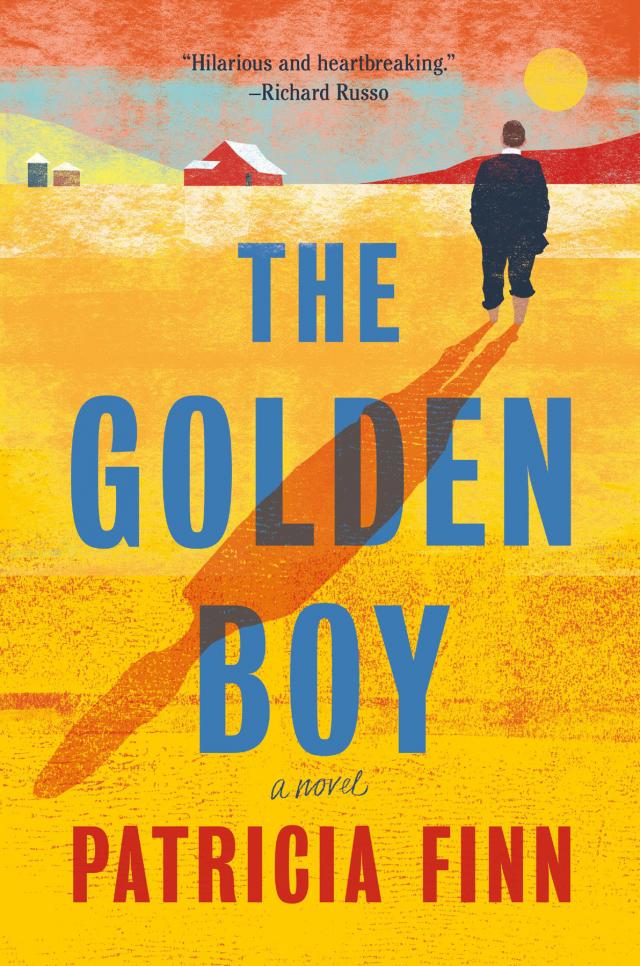
The golden boy, p.5
The Golden Boy,
p.5


He climbed the stairs with more weariness than he cared to admit, already feeling the heavy aftermath of donuts and sugar and jelly eaten too quickly on a hot day. He would work it off later, he reasoned. He would call the personal trainer he met with three times a week and book an extra hour before dinner. That was the problem with these golf-less mornings. They left him with too much time to fill, and unlike his wife, he was not good at pacing out the small days.
His home office consisted of an enormous room separated from an upstairs bathroom and spa by an open breezeway and an enclosed rooftop deck that was too windy for outdoor furniture. The space had been designated as a multipurpose area suitable for a suite of home offices, a personal gym, or perhaps even a palatial guest suite.
“For a gypsy camp maybe,” his wife had said. “It’s too much open space, Stafford. It feels like a dance studio.”
“I like it this way,” he said, although he was unsure why.
“Wouldn’t you rather have a home gym? You still have the downstairs den as an office. What will you do with all this space?”
“I’ll finish my thesis,” he answered.
“Your what?”
“My thesis.”
“Yeah, right.”
“Nicomachean Ethics and Epithumia.”
“Oh please, Stafford, be serious. There’s plenty of room up here for a gym.”
“And Aristotle. Aristotle needs a lot of space.”
“I thought it was Plato.”
“Plato is for pop stars.”
“You’re not serious. Tell me you’re not.”
“Why does it matter if I’m serious? Define your terms and justify your proposition.”
“Stop.”
“Epithumia—the irrational appetite, although there is linguistic argument that ‘orexis’ or ‘desire’ is a more apt definition.”
“Thank you for clearing that up. But wouldn’t you rather just have a home gym?”
“The virtue of a thing, my pet, is relative to its proper work. Book six, chapter two. Material cause, efficient cause, formal cause, and final cause. It’s all coming back to me. Organon, Physica, De Caelo, De Anima, De Poetic, De Partibus Animalium—”
“Oh, all right! Enough. Do whatever you want. Translate the evening news into Latin if you want to. If you want to play academic again, that’s up to you. Just don’t practice your philosophy talk on me. Or on any of our friends.”
“Greek.”
“I beg your pardon?”
“Aristotle wrote in Greek, not Latin.”
He deeply regretted this conversation later, because the commitment entailed in picking up an ancient trail was far more daunting than he anticipated. He had stumbled onto Aristotle in his second year at Queen’s University and angered his mother by immediately switching his major from biology to philosophy. It had been his father’s hope, she had argued, that if the farm went, Stafford would get himself an education in something, and that meant something worthwhile.
“If you take science, you can be a vet,” his mother had said. “A veterinarian, Stafford. Your father thought you’d be good at that. He said to keep a bit of money back for you no matter what happened with me and Emmett. How’s a bunch of Greek and Latin going to help you bring a calf into this world, Stafford? No one’s talking Latin in Napanee.”
And she was right. But a disorganized, overweight classics professor who sweated profusely and struggled with a class of undergraduates who had no doubt been told that his class was a bird course, a simple arts option for science majors, altered the course of Stafford’s life with his comments scribbled on the back of an awkwardly written term paper titled “Spiritual Deception in Aristotle.”
“Mr. Hopkins,” he wrote, “Aristotle was not a parish priest. More questions, fewer answers! Reverse course and look to Athens. Your premise is flawed, but you took a good run at it, and I enjoyed your essay more than most.”
At the end of that semester, Stafford withdrew from science and registered for a bachelor of arts in philosophy. Financial support from his mother, limited as it was, was promptly withdrawn, and he was able to stay on as a full-time student only with the income generated from working six nights out of seven at the campus bar. But his passion for Aristotle remained undiminished by fiscal reality, and he finished his bachelor’s degree in three years and his master’s in one. By the time he began his doctorate he was a married man, and the final break between his boyhood and everything that followed was drawing closer.
It was not generally recommended that serious academic scholars pursue all their degrees from the same university, but an exception was made for Stafford Hopkins based on the brilliance of his work and the increasingly desperate nature of his personal circumstances—which, in his case, referred to the mystery of his marriage. He had met his wife midway through his master’s, and while everyone agreed she had a certain physical appeal for an uneducated American girl with a trashy mouth, nobody understood why he had found it necessary to marry her. It was an improbable relationship from the start.
When the campus bar closed at midnight, it was Stafford’s job to lock up, and he enjoyed this part of the job because it was an opportunity to be alone. Saturdays were always busy nights, but the combination of homecoming weekend and a football win over rivals from a neighboring college prompted a drunken celebration that spilled out of the bar and into the night. Stafford, tired and anxious to leave more quickly than usual, began stacking chairs onto tables even as the last customers were stumbling out, and it was then he saw the girl he would marry nine days later. She was dressed like a teenager at a spring prom, clearly out of place in a campus bar. Too much hair. Too much makeup. Not enough clothing for a Canadian fall. But there she sat, arguing with her companions, who were too drunk to care. As he drew closer, he realized she must have joined the table of revelers uninvited, because they were mocking her with the easy cruelty of passive intellect. And he noticed that she was not a child. She was small, and her head was a bit too big for her body, or was it the hair? And he noticed also that her eyes were blue and her front teeth were not quite straight. Beauty, he decided then, was not order and symmetry. The Greeks were wrong. Beauty was chaos.
When her companions left, they went without her, and she would have gone soon after had he not spoken.
“You’re not familiar.”
“Well, I guess that depends on who the fuck you are,” she said, but she didn’t look at him, because she was trying to collect her things, her cigarettes and her matches, and put them into her purse and get out of there.
“Well, okay, what’s your name?” he asked her.
“Well, okay, I guess it’s none of your fucking business,” she answered, and then, turning to leave, tripped on the leg of the table and fell.
After a few more fuck this and fuck thats, she gave up and began to cry. Stafford took a chair off one of the nearby tables and sat next to her, waiting for her to stop in case she looked up and he could resume the conversation. Cause, Stafford knew from Aristotle, was not merely what happened in the lead-up to an event; it was a goal being suddenly realized as if the outcome, the end, or telos, presented itself ahead of time, pulling reality in its wake. But the reality of this girl, this uneducated American girl from Big Falls, Wisconsin, who fell out of the sky and into his nest like a wounded bird, was not greeted with universal enthusiasm.
“Stafford!”
“I’m coming.”
“It’s ten o’clock. I’m already late.”
“I’m sorry. Have you got the keys?”
“Yes. Did you get hold of them?”
“Who?”
“The security guys, Stafford. Did you call them?”
“No. I mean, yes. I left a message. Has the mail come?”
“Stafford!”
“All right, all right. Don’t get excited. Let’s go.”
He wanted to wait another five minutes for the mail to arrive, but he could see that his wife was already angry with him for interfering with her day. So he left with her and was not at home when the mail was dropped into the secured slot on the wall of the outside courtyard—the usual bills and bank statements, the industry magazines, the junk mail, and the letter from Canada, the letter addressed to him with the word Shepherd scribbled on the back.
CHAPTER 6
Diversions
He leadeth me beside the still waters.
—Psalms 23:2
STAFFORD WOULD LATER REMEMBER what a nice time they had together, on that last day before everything changed. Maui days were usually windy, especially on their side of the island, but there was hardly any wind that day and everyone commented on it, even people who had lived on Maui all their lives and seen many beautiful days.
“What a beautiful day,” everyone said, smiling and repeating themselves and one another over and over again.
“It’s such a beautiful day.”
“Just beautiful.”
And it was a beautiful day, so lovely and calm in fact, that when he suggested they take his car and put the top down, she didn’t argue about the extra time it would take to move her car out of the way. It was only a short drive down the hill to the tennis club, but he drove slowly and turned his head several times to look at his wife, who put her head back and closed her eyes as if, for once, she trusted him to make the turn at fifteen miles per hour without assistance.
“Are you all right?” he asked her, and he rested his hand on top of hers for a moment.
“Smell the air, Stafford. Isn’t it wonderful?”
“There’s no wind.”
“It’s perfect.”
There was something in the stillness of that day that altered more than mood and personality, but it was not, he realized, merely the absence of wind. It was the absence of sound. He had once been on a small, chartered plane whose engines abruptly failed, and in the split second before anyone reacted there was a moment of perfect silence. He thought of that moment now as he drove down the hillside, but not of the many moments of noise and terror that followed before the roar of an engine kicked in. If you could die in a moment of complete silence, he thought, perhaps it wouldn’t be so bad. And then he began to laugh.
“What’s so funny?”
“Nothing.”
“Then why are you laughing?”
“I thought of a joke.”
“A joke?”
“My dad used to tell this joke.”
“Uh-huh.”
“What were Father’s last words?”
“Uh-huh.”
“He didn’t have any. Mother was with him until the end.”
“Don’t try that one on Cheryl and Jim, Stafford.”
“Why? Oh, right.”
She started to laugh then, as if the joke had become funnier all of a sudden, and then they both laughed, and when they arrived at the front door of the tennis club, where a young man waited to park their car for them, they were still laughing.
“Beautiful day,” the young man said.
“Yes,” Stafford replied, “it is.”
He sat outside, watching her lesson, enjoying the way she surprised the young instructor with sudden bursts of competitive fury. He knew she had aged, but she had not yet lost the eternally youthful look of the well-kept middle-aged woman, and he was grateful for that. Women of their economic class took care of themselves and did not deteriorate in the same withering way their mothers and grandmothers had. Stafford’s own mother had settled into old age at the age of fifty-eight, her hands stiff with arthritis, her skin wrinkled and damaged by a lifetime of hard work and cold weather. Her legs were not tanned and slim, but crisscrossed with varicose veins, and he could not have imagined her flying around a tennis court under a tropical sun as his wife did now.
The absence of wind caused the temperature to rise swiftly, and by the time her tennis lesson was over, the full heat of the day was upon them and he could see that she was tired. He stood up and handed her a towel, and she began to wipe her face and the sweat from the back of her neck.
“Why do you push yourself so hard?” he asked.
“Because I want to beat the little fucker,” she whispered.
“Really? I would never have guessed.”
“Are you going to follow me around all day, Stafford?”
“Shhh. Your teacher’s coming. Smile and say goodbye.”
Stafford was accustomed to physical beauty, but the young tennis instructor who bounded toward them now was so beautiful that he had a fleeting desire to reach out and touch the boy on the face.
“You were awesome, Mrs. H. Just awesome! You have a great day!”
“I sure will!” she answered in the same singsong voice, waving as he turned and jogged back across the court to greet his next customer, a woman so laced with Botox she could no longer move the muscles of her face.
“My God,” she said. “Look at her. She looks like a button.”
“What?”
“Never mind. My shoulder is killing me. Let’s go.”
“You have a manicure in ten minutes, Mrs. H.”
“Thank you, Jeeves.”
“Do you need to go home first?”
“I have everything with me. Are you going to follow me around all day, Stafford?” she asked him a second time.
“Yes, I think I will.”
The tennis club was located on the grounds of the Ritz-Carlton, between the hotel and the beach, and it was to the hotel spa she went for her weekly facials, massages, and body treatments, rotating pedicures with manicures, waxings with peelings and exfoliations. There was a paved pathway that wound its way up the steep hillside from the beach to the hotel, passing the tennis courts along the way, and there was a hotel shuttle service available for those too weary to walk.
“Do you want to move the car around now?” she asked, because they had taken the outside road and the car was parked on the far side of the tennis courts.
“Let’s walk up,” he said. “We’ll get the car later.”
“Okay.”
The sun was already high in the sky, and a haze had settled over the landscape like a fine gauze netting. The clarity of the horizon in the distance had loosened its hold on the eye, and the dividing line between ocean and sky was no longer plainly visible. And still there was no wind and no sign of it coming, as it usually did in the afternoons, breaking up the heat of the day and sending sunbathers scurrying for their magazines and towels. Nonetheless, Stafford set up the hill now, a little ahead of his wife, as if to convey a greater sense of purpose and energy. He would lead and she would follow. If there was trouble on the path, he would be the one to deal with it.
“What’s the big hurry?” she asked, struggling to keep up with him.
“What do you mean?”
“I mean,” she said, and she had to stop to catch her breath, “why are we bolting up this hill?”
“We can wait for another shuttle.”
“I don’t want to wait for a shuttle. I just want to slow down.”
“Let’s go back and get the car,” he said. “We’ll drive up.”
It was hot, of course, and her shoulder was beginning to ache, and she was already tired from tennis, but as she stood there watching him change directions, resetting their course without her input, she became angry, and she snapped at him.
“Stafford!”
“What?”
“Will you just stop for a second?”
“You’ll be late for your manicure.”
“I’m not late.”
“It’s after eleven. Your appointment is at eleven fifteen, isn’t it?”
“My schedule is none of your business.”
“You don’t leave yourself enough time.”
“I said it’s none of your damn business.”
“Don’t swear at me.”
“Don’t tell me how to plan my day.”
“Shuttle,” he said.
She stepped off the path as the shuttle, this one coming down the hill with several passengers all loaded with supplies for a day at the beach, pulled up next to her.
“Beautiful day,” said the driver, smiling.
“Gorgeous,” she answered, smiling.
“You folks going up or down?” the young driver asked, still smiling at them.
“Up,” she answered.
“Down,” Stafford said, and this got a big laugh from everyone.
“What can I say?” his wife broke in. “We’re confused.”
“Aren’t we all, honey?” answered an older woman, and this got another big laugh.
Stafford smiled and took his wife by the arm, gently pulling her to his side of the path.
“Don’t let us hold you up,” he said, and the shuttle continued down to the beach, its passengers beaming fondly at Stafford and his wife as if they had become old friends, all of them, even the young driver, who took it upon himself to toot the horn twice in farewell.
The hotel developers had originally intended to position the hotel closer to the beach, thus eliminating the need for a shuttle, but when workers began grading the hillside for construction, their work came to an unexpected and immediate halt.
The people who lived on Maui long before Stafford and his wife arrived to enjoy themselves had also loved this part of the island, so much so, in fact, that more than two thousand of them had wished to remain there, buried over time in unmarked graves hidden beneath the surface of the sloping hillside. But with each deep bite of earth the excavators took from the hillside, the pale bones surfaced, until hundreds of bones and pieces of bones, the splinters and fragments of others, lay blinking and confused by the light of an unfamiliar sun. The men operating the excavators were mostly local men, men whose families went back generations, and they left the site immediately, horrified and ashamed of their part in the story.


