The great revolt, p.13
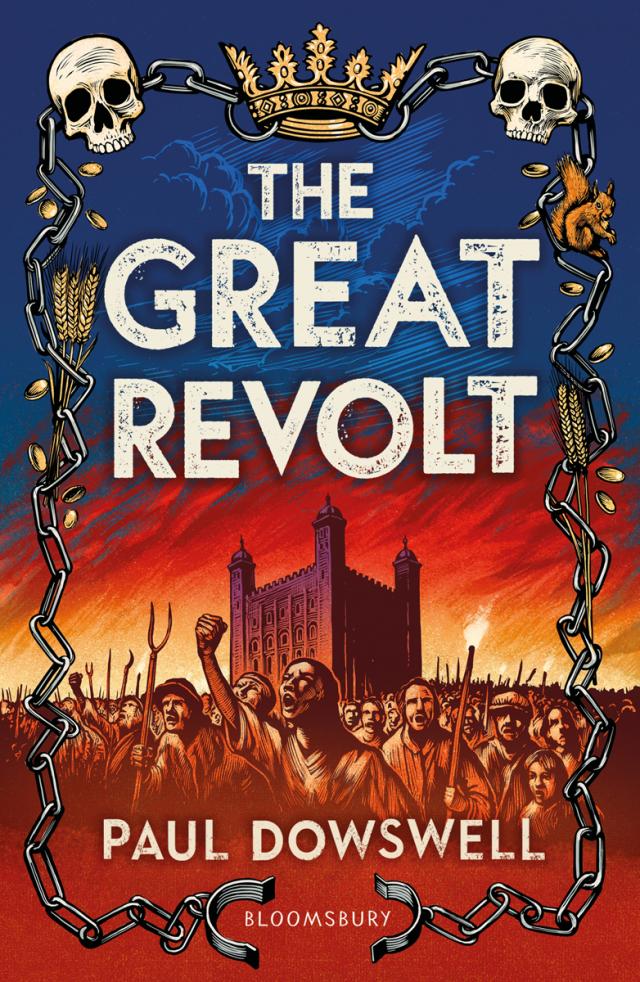
The Great Revolt,
p.13


Tilda looked at the fallen body of Wat Tyler. He was trying to stand up, although even from a distance they could see he was covered in blood. Some of his men had rushed out now and helped him to his feet. They dragged him away, against the flow of the others, no doubt in search of a hospital to try to save his life.
*
Guy de Clare watched all this with astonishment. Who would have thought that Richard could be so brave? If he was like this at fourteen, what would he be like as a grown man? Clearly, he was destined to be one of England’s greatest kings. All at once the king’s closest advisors spurred their horses and hurried to be with Richard at the head of the column. Guy, feeling like he was in a dream, rode alongside them.
The king turned to Sir William Walworth. ‘Find that verminous wretch you stabbed and finish the job.’ Walworth took off in the opposite direction with two soldiers.
*
The streets closed in around them and a strange calm settled after these bizarre events. As they approached Clerkenwell, Guy heard a small group of riders approaching them from a side street. Richard’s soldiers drew their swords but when the riders came into view they saw at once they were loyal soldiers. One carried a head on a spike. They held it high to show the world. It was the man who had presented the demands. The one that Sir William Walworth had stabbed in the neck.
A gasp went up from the column of peasants behind them. Guy wondered if this was another moment when they were all going to be killed? But there was something different in that gasp. It was the sound of fear rather than defiance. He knew at once that the insolent spirit that had prompted this rebellion had finally been crushed.
All around them came more soldiers. They were being mustered from across London. The more soldiers that arrived, the safer Guy began to feel. The rebels were packed into a small square now, their defiance completely gone. Most were on their knees, pleading for mercy. Richard had a look of utter triumph about him. Guy looked at the cringing rustics and realised with a guilty pleasure that he wanted to kick them all in the face. But he checked himself. He felt a fierce elation. They had won, and he was still alive.
CHAPTER TWENTY-THREE
Tilda and her father and uncle watched the rebels marching off with foreboding.
‘How did that happen?’ said John.
‘They could have killed the king and all of his party,’ said Thomas.
Tilda was too astonished to speak.
‘Come on, let’s hasten away before anyone comes to round us up too,’ said John.
They began to walk back to Southwark. No one spoke until they reached the road close to the bridge, when Tilda said, ‘If we’d stayed with the rebels we’d have had to march away with them too. Do you think they’re going to kill them all?’
‘We’ll never know,’ said John. ‘I think we’ve had a lucky escape.’
A soldier rode up to them, a sword in his hand. Tilda feared for her life but he stopped before he got to them. ‘You rustics,’ he commanded. ‘Go with your brothers and sisters to Clerkenwell.’
John spoke boldly. ‘We are Londoners, sir,’ he said confidently. ‘We are not peasants. We’re returning home to Southwark.’
The soldier was not going to argue. ‘Be on your way,’ he commanded. They didn’t need telling twice.
When they reached the Rolfe household in Southwark, Alice was indignant. ‘There you all are,’ she scolded. ‘Thomas and Tilda told me they were going back to Aylsford. But that was three or four hours ago. It’s too late to go now.’
John spoke firmly. ‘It’s too late all round, I think.’
They told Alice what had happened. The indignation slowly left her face. ‘Then of course you must stay here for a while. See what happens. If you go back to your village, they might hang you.’
Tilda was so grateful Alice had said that, and she understood the situation. It would be really difficult staying with the Southwark Rolfes if Alice resented them being there. William, Simon and Joan came into the kitchen.
‘Uncle Thomas and Cousin Tilda are staying with us for a while,’ said Alice. The children’s faces lit up. They liked their visitors.
Tilda felt light-headed with relief for herself, but full of concern for the other rebels. What about the ones who had no London family? Were they going to be killed right then, in Clerkenwell? And if not, what was going to happen to them?
CHAPTER TWENTY-FOUR
Richard returned to Blackfriars with his advisors. Guy could sense a change in him. Had God come to his rescue following the prayers they had said that afternoon at Westminster? The king seemed at least three inches taller.
The rebels had been instructed on pain of death to return home to their villages. Guy was surprised the soldiers did not kill them then and there. But he could see the logic in not doing so. The king’s guard were still outnumbered and there was a small chance that the rebels might rediscover their fighting spirit and a battle would break out on the edge of the city. Freeing the capital of this treasonous infestation was the first priority. Richard’s good sense had not deserted him.
When they were back behind locked and guarded doors, King Richard turned to Guy and declared with conviction, ‘Those who seek equality with lords are not worthy to live… serfs they are and serfs they still are. They will remain in bondage not as before but incomparably harsher. For as long as we live and rule by God’s grace over this kingdom we shall use our sense, our strength and our property to suppress them, so that their slavery shall be an example to posterity.
‘I would like you to record those words,’ he said to Guy. ‘I shall make a declaration about this uprising, and that is what I intend to say.’
Guy reached for a pen and parchment and tried to remember Richard’s speech. He thought about how much he would have liked to kick those peasants, begging for their lives at Clerkenwell, and all at once he felt both shame and pity. What was coming was going to be horrible. He thought of Jack and Sam, the peasant boys he had played with as a child. They would have been on that march if they had lived in Kent or Essex. He was sure of it. But he hid his feelings. The king must never know he had sympathy for these serfs.
When he has finished scribbling Richard added, ‘We shall keep the peace according to the law, or by any other methods, by beheading and the mutilation of limbs.’
Guy scribbled down his words, anxious not to miss a single syllable. Richard waited until he had finished writing and continued, ‘When the rabble have dispersed from London and settled back in their homes, we shall raise an army and hunt down the ringleaders. We shall have them hanged from the trees on their village greens. And the most prominent among them shall be hanged, drawn and quartered. And we shall start with that wretch John Ball – the one they had the effrontery to tell me should be Archbishop of Canterbury. I shall attend his execution myself.’
*
‘What are we to do, Tilda?’ said Thomas. They had left the Rolfes’ house to walk again by the river. ‘Do you believe what the king promised? Because I don’t believe a word of it. Especially after what we’ve just seen.’
Rumours had been flowing thick and fast between Londoners who had come out to support the rebels when they arrived in the city. Everyone had now heard that Wat Tyler’s head had been cut off and placed on a spike. And that the remaining rebels had been driven out of London with their tails between their legs.
Tilda chose her words carefully. This was her opportunity to convince her father to stay.
‘Tyler’s head on a spike tells me all I need to know about what’s happened to the rebellion,’ she said. ‘They lied to us, to get everyone to go home, like you said before.’
‘And what d’you think will happen to us, if we leave?’ said Thomas.
‘I think they will hang us,’ said Tilda. ‘I think Lord Laybourne will be keen to make an example of any of his tenants who abandoned their duties to march to London.’ She fought back tears. ‘Especially after what we did to his manor house. I think this has ended very badly.
‘But I also think we have left behind a life that had no promise for us.’ She grabbed her father’s arm. ‘We must get used to living here. There’s so much we can do to make our lives more interesting, maybe even prosper.’
‘But we will be taking a terrible risk, my dearing,’ said Thomas. ‘I don’t want us to end up like those beggars and starving urchins we saw when we first arrived. And living in the wretched hovels we passed on the edge of the city. I’m sure you’re right about going back to Aylesford but we face destitution here. We can’t stay with John and Alice forever.’
‘Father, I have a surprise for you,’ said Tilda. She delved into the folds of her skirt and unpicked a loose stitch. She held out a handful of Lady Laybourne’s colourful earrings – the ones she had stolen when the Aylesford manor house had been ransacked.
‘Tilda, where on earth did these come from?’
She told him. ‘I kept them secret, Father. I knew we were not supposed to steal from the manor – only destroy it. But I could not see these jewels melting in the flames.’
Thomas was speechless.
‘I kept it to myself, in case you were angry with me,’ she said.
Thomas put an arm around her. ‘Tilda, I think you may have saved us. And I have an idea. We will give a pair to John. He may want to give them to his Alice or sell them. Either way, it will make Alice feel generous towards us. And he will surely know someone we can sell our earrings to. A wealthy merchant who might gladly buy them for his own wife. This will suit John and Alice well. And if we sell wisely then we should be able to find ourselves a nice little house to rent soon enough. Lovely as it is, that house is very crowded with us there too…’
*
That evening, as they sat round the kitchen table eating their supper, Thomas asked John and Alice if he and Tilda could talk with them privately, so the children were dispatched to the yard to beat a rug.
Thomas spoke with a quiet urgency. ‘My brother John, Alice.’ He smiled. ‘You have been very kind to us. And we have taken full advantage of that kindness. But please hear me out because Tilda and I have a plan, which I hope will suit us all.
‘We have realised that a return to Aylesford would be an unhappy and possibly fatal decision. But do not fear, we will not be expecting to stay with you – at least not for much longer.’ Alice’s eyes narrowed. Tilda was anxious to see how she would take this news. ‘But we have a plan, which I am hoping you will help us with.’
John and Alice both looked uncertain. Tilda interrupted. ‘Show them, Father. Show them!’ she said.
‘Hush, child,’ said Thomas. He delved into his pockets and brought out the earrings. ‘My clever daughter picked these up on our way up to London.’
Alice’s eyes widened. ‘They’re worth a fortune,’ she said. ‘We won’t ask where you got them from.’ His brother nodded in agreement.
Thomas continued. ‘We want to give one pair to you – to keep or to sell – for your kindness. And we want to sell the other two. That will give us enough money to find somewhere to rent while we look for work. And we shall no longer need to crowd you out of your own house.’
John hugged them both. ‘I know people who would be pleased to buy these from you,’ he said. ‘Merchants I build for. They’ve got that sort of money. And this kind of jewellery won’t look out of place if their wives choose to wear it. And Alice and I will have to discuss among ourselves whether to keep these you have given us. Thank you.’
Alice hugged them too. She seemed relieved. And Thomas and Tilda began to feel that everything was going to work out well for them.
*
The next morning over breakfast, John had a proposal for Thomas. ‘There’s a lot of work out there for me – especially after the upheaval of the last few days. I’ll need an extra pair of hands and I would be very happy if you would help me. It’s a whole new trade, but I am sure you will be able to learn the skills you’ll need.’ He turned to Tilda. ‘And you will have to find a job too. I’m sure there’s work here for a bright girl like you.’
‘Catherine has promised she will teach me to read,’ said Tilda. She felt really excited about this. ‘And I, in turn, can help her to speak better English.’
They spent the day looking at a couple of houses John knew about, where there were rooms to rent. There were two more to look at tomorrow. That evening Tilda went out alone to stand by the bridge to watch the sun sink in the west.
Across the river, the London skyline looked as bewilderingly busy as ever. She could still not believe how so many people managed to live so close to each other. The evening air carried a hint of the night to come, and a thousand chimneys trailed smoke up to the darkening sky.
Tilda felt gloriously excited and alive. There was nothing at all she missed about Aylesford, apart from her pet squirrel and Brownie. She did love that horse. But here in London she could learn a new trade. She could do something with her hands and her brain rather than the sweat of her brow. And maybe there was a boy out there for her… someone she could love and who would love her too.
CHAPTER TWENTY-FIVE
Autumn 1381
Guy watched the goings-on at court with an increasingly weary cynicism. The revolt had affected Richard in a way that could not be said to be desirable. It was true that the king had acted with courage and cunning. Remarkable, in fact, for a boy of tender years, Guy had heard people say. But Richard was now behaving in a way that would only make people resent him – even turn against him.
And he had been true to his word. Every week, fresh news of reprisals and executions reached the court. There had been rebellious outbreaks far and wide across the kingdom, from Gloucester to York. All had been ruthlessly suppressed. Ignoring something like that and hoping it would fizzle out, as they had done in June, had been a terrible mistake.
The lords of the manor had followed the king’s instructions with great relish. The trees on every village green in Kent and Essex now held the dangling, rotting bodies of the traitor rustics who had dared to rise up against their king. It was easy enough to find them. Soldiers would arrive at a village and tell the filthy villeins they would spare their lives if they pointed out the traitors who had led their rebellion. There had been battles too – small ones, but still outright warfare. They had killed five hundred rustics at Billericay, Guy had heard.
John Ball had been hanged, drawn and quartered, as the king had ordered. Guy had never before witnessed this barbarous method of execution. It had taken every sinew in his body not to spew out his dinner as he watched at the king’s side as Ball was executed at St Albans, two days after his arrest and trial. Guy had felt a shudder of revulsion as Richard, looking on with shiny-eyed glee, relished every moment. The citizens of London could see John Ball’s head every day now. It was displayed very prominently on the gatehouse at London Bridge.
Guy wondered whether this unforgiving cruelty would work its purpose and supposed it would. Fear kept these rustics in their place and only plentiful application of it would save the realm from another rebellion. He could see the logic in that.
But whether the king’s cruel character was right for the court was another matter. Guy had seen how quickly Richard had squandered the admiration he had earned during the revolt with his high-handed arrogance. Now, following a banquet, Richard would require the greatest magnates of the land to stand before him in silence in the throne room. He would survey them all with a jaundiced eye and when his gaze alighted on anyone, lord or lady, duke or earl, then that man or woman would have to kneel and proclaim their loyalty to the young king. Guy knew people well enough to understand such behaviour was bound to end in tragedy.
Historical Note
Although it took place over six hundred years ago, there is much about this story which remains strangely familiar, not least the city of London itself. Although London now has thirty-five bridges, rather than just the one, many of the streets, churches and districts mentioned here will be familiar to anyone who knows the capital.
Although the revolt was put down in June 1381, other revolts flared up that summer, from the north of England to East Anglia and the west country. These were quickly suppressed by soldiers loyal to the king and altogether it is thought that around 1,500 rebels were executed or died in battle. Richard’s pardons and promises, made to the rebels at Mile End and Smithfield, were completely worthless.
However, the poll tax that had done so much to feed the rebels’ anger was dropped and the expensive and unsuccessful war in France, which had prompted the tax, was gradually abandoned.
The serfs returned to their villages, but in the long run the feudal system was doomed. Without an expensive and official police force it became impossible for local lords to maintain a productive labour force with their mutinous, resentful peasants. In the decades to come, many peasants simply ran away from their manors in search of better-paid work. Many others bought their freedom as local lords realised that selling ‘freeman’ status to their villeins was a useful way to raise income. The feudal system familiar to Thomas and Tilda Rolfe had died out by 1500.
Although the uprising was a failure, it has remained an inspiration ever since, not least for those who rose up to fight the English Civil War, the Jacobite Rebellion and the American War of Independence. Further attempts to impose poll taxes – where everyone pays the same regardless of income, by leaders from Charles I in 1641 to Margaret Thatcher in 1990, have met with open rebellion and ended in failure.
Richard II’s leadership during the rebellion remained the high point of his reign. The following year he married fifteen-year-old Anne of Bohemia but there were no children. The marriage was not approved by the court and Richard’s arrogant personality and failure as a military leader added to his unpopularity among the most powerful figures in the land.