Murder she encountered, p.23
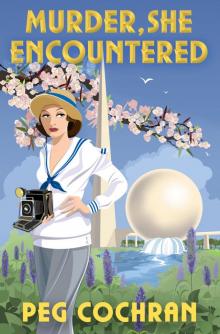
Murder, She Encountered,
p.23



“I’ll run this to the editor right away.”
He began to get up, but the telephone rang just then.
“Kaminsky,” he said tersely. “Yeah? Where?”
Elizabeth leaned back in the chair, sorely tempted to close her eyes.
“Biz,” Kaminsky shouted, jolting Elizabeth upright. “The cops have cornered Vitale down by the docks. Get your camera. We’re going to wrap this whole story up in a bow.”
Elizabeth’s bones ached with weariness. The tension of the ride with Vitale and her escape had exhausted her. All she wanted to do was go home. If she hadn’t stopped at the newsroom, she’d be there now—bathed, refreshed, putting her feet up with a good book or magazine.
But then she realized that the pictures she could get at the scene would certainly be front page material and she sprang to her feet, her energy suddenly restored.
She glanced at Kaminsky. “Well, don’t just stand there. Let’s go.”
* * *
—
The RMS Queen Mary looked majestic sitting in port where she dwarfed the dock with her immense white-and-black bulk. Her paint was pristine and as shiny as lacquer despite the rigors of a transatlantic crossing, with the bright red smokestacks providing a note of gaiety to the otherwise stately design.
The gangplank was down and people were beginning to board as porters wrestled with enormous trunks and stacks of suitcases.
The crowd was elegant with the ladies in silk dresses and strands of pearls and the men in well-tailored bespoke suits. There was a feeling of excitement in the air, which Elizabeth soon realized was centered not on the ocean liner or the prospects of the trip across the sea but on some activity on the dock itself.
As they got closer, she saw a knot of people gathered watching some sort of spectacle playing out. The crowd parted and she recognized Vitale. He was holding several police officers at bay with a gun. Two other officers, with their arms outstretched, were pushing back the crowd. An ambulance was waiting at the entrance to the dock.
Elizabeth began snapping pictures even before she stopped walking. She forgot all about the blister on her heel, her torn skirt, her exhaustion. Kaminsky was right, this was going to be a huge story—first her account of being held hostage by Vitale and now this standoff with the police. No other paper was going to have a story like it.
Vitale began waving his gun around, and the crowd backed up and began to scatter although a few thrill seekers continued to linger.
Elizabeth noticed Marino standing off to one side deep in conversation with another man. From time to time they gestured toward Vitale. She took a couple shots of the men talking.
Things were at a standstill. No one seemed to have any idea what to do, although Elizabeth suspected that that was what Marino and the other fellow were discussing.
The ship’s horn sounded, the loud noise startling everyone and throwing Vitale off guard. One of the policemen who had quietly circled around behind Vitale took advantage of the momentary distraction to throw a rope around Vitale’s arms and chest.
Vitale began to struggle as the policeman drew the rope tight, pinning Vitale’s upper arms to his sides. Vitale dropped his gun and grabbed for the rope with both hands.
The other policemen standing by moved in quickly, and before Vitale could do more than struggle, they had his hands handcuffed behind his back and were leading him toward a patrol car.
Elizabeth finally lowered her camera as they closed the door to the patrol car and began to drive away.
“Did you get all that?” Kaminsky said, his eyes still scanning the scene in case he’d missed something.
“All of it. This story is going to be the talk of the town.”
Kaminsky looked at her. “I think you’ve caught the bug, Biz. There’s no cure for it and there’s no escape. Your heart and soul are now in the newspaper business.”
Elizabeth was about to agree with him when she felt a hand on her shoulder.
“Cara, I was so worried about you,” Marino said.
“Sal!” Elizabeth wanted to melt into his arms. She felt tears pricking the backs of her eyelids.
Marino understood her distress. “It’s normal to have a reaction after everything is over.” He stroked her cheek with his finger. “You were incredibly brave.”
Kaminsky gave a knowing smile. “I’ll go catch us a cab. We’ve got to get back to the newsroom and get those pictures developed.” He gestured toward Elizabeth’s camera. “I’ll give you five minutes, okay?”
Chapter 26
Elizabeth nibbled at the last piece of buttered toast on her plate. Her mother was sectioning her grapefruit half, Rose was stirring brown sugar into her oatmeal, and her father was hidden behind a copy of the New York Herald Tribune. Elizabeth was grateful that her parents didn’t take the Daily Trumpet. They would have been horrified to read about her experiences the day before in the story that she was sure would be on the front page. They would probably try to put their foot down again about her working. If they knew what else she was planning, they would be even more horrified.
She finished her toast, took a last sip of coffee, and carried her dishes into the kitchen. Mrs. Murphy was leaning over the kitchen table where she had a copy of the Daily Trumpet spread out. Jones brought her a copy every morning from the newsstand on the corner.
She looked up as Elizabeth entered, a horrified expression on her face.
“Oh, my sainted aunt!” she exclaimed. “Child, you could have been killed.”
“Everything turned out fine,” Elizabeth said. “And the killer is now in custody.”
“Still! It near gave me a heart attack reading this.” Mrs. Murphy tapped the paper with her finger.
“I think it would be best if you didn’t show that to Mother and Father,” Elizabeth said. “I wouldn’t want them to worry.”
“Of course not,” Mrs. Murphy said, folding up the paper. “I can’t think what your mother would say if she knew about this.” She shook her head. “You never said this job was going to be dangerous.”
Elizabeth smiled. “It’s usually quite run-of-the-mill. Generally we arrive when everything is all over and it’s simply a matter of taking some photographs. I doubt anything like that will ever happen again.”
Mrs. Murphy made the sign of the cross. “Heavens, I hope not.”
Elizabeth felt tingles of excitement as she put on her hat and checked her stocking seams. She had butterflies, too. Today she was making a decision that would change things—possibly forever.
Kaminsky was at his desk when Elizabeth arrived at the newsroom. He was leaning back in his chair, a self-satisfied look on his face and the latest edition of the Daily Trumpet in front of him on his desk.
“Would you look at that, Biz?” He waved the paper in front of her face. “Front page photo and story. The editor is beside himself. We’ve scooped all the other papers—they didn’t cover the story at all, if you can believe it.”
Elizabeth had to admit to a frisson of pride seeing her photograph splashed across the front page.
Kaminsky opened the paper to an inside page. “Look at this spread. We’ve got two whole pages and four more pictures.”
Elizabeth couldn’t recall ever having seen Kaminsky so pleased before.
“Almost makes me want to celebrate with a shot of Old Schenley’s.” Kaminsky linked his hands and stretched his arms out in front of him. His knuckles cracked loudly. “Surely the sun is over the yardarm somewhere in the world.”
Elizabeth gave him a stern look.
“What? Don’t you think we deserve a celebration? You, especially—considering what you went through.”
Elizabeth suppressed a shiver. She didn’t want to think about it. She’d been sure she’d have nightmares last night and had been relieved that instead her sleep had been peaceful and dreamless.
“You go on ahead and get your Schenley’s then. I’ve got an appointment.”
“Oh?”
But despite the obvious curiosity in Kaminsky’s voice, Elizabeth didn’t elaborate. He’d find out soon enough.
* * *
—
The address was on West Seventieth Street. Elizabeth walked down the block scanning the building numbers until she found the one she was looking for. She checked the number against the classified ad she’d torn out of the paper. This was it.
It was a nondescript building—neither elegant nor particularly shabby—but the steps were swept clean and the glass sidelights on either side of the door were free from smudges and fingerprints.
With a certain sense of trepidation, Elizabeth mounted the cement steps and opened the door.
A woman came out of a small office—barely more than a cupboard—near the front door. Her gray hair was swept back into a no-nonsense bun and she wore a plain gray dress and sturdy black tie shoes.
“You’re the gal who called about the apartment,” she said to Elizabeth.
Elizabeth nodded. “Yes. I’d like to see it, if I may.”
“I’ll get the keys.”
The woman disappeared into the cubbyhole that served as an office. Elizabeth spent the time looking around. There wasn’t much to look at. The foyer was small with an elevator at the back, a drooping fern in a pot on a pedestal near the front door, and opposite it, a sand urn for cigarettes.
The woman reappeared with a large metal ring from which numerous keys dangled.
“Fourth floor,” she said tersely.
Elizabeth followed her onto the elevator. It was small, and she could smell the woman’s face powder and the faint scent of Oxydol laundry detergent.
The elevator ascended to the fourth floor with fits and starts and came to a sudden stop that jarred Elizabeth’s teeth.
“Follow me.” The woman got off the elevator and began to walk down the hall.
The carpet was clean if worn and the wallpaper was faded but in decent condition. It was quiet, although they heard Doc Barclay’s Daughters playing on the radio when they passed apartment 4B.
Elizabeth took a deep breath. The hallway was imbued with the odors of food long since cooked and eaten combined with the smell of mothballs and a hint of furniture polish.
The woman stopped in front of the door to apartment 4F. She selected a key from her ring of keys and inserted it into the lock. She had to jiggle it slightly, but eventually it turned and she opened the door with a flourish at odds with the setting.
She marched ahead of Elizabeth into the apartment and stood aside for Elizabeth to enter.
It was small. And dark. Elizabeth had expected that. But she hadn’t been prepared for exactly how small the apartment would be. It was furnished with a chintz-covered sofa and a small armchair in the sitting room along with a scarred wooden table in front of the sofa and a lamp, which leaned crookedly to the left, on another table nestled next to the arm of the sofa.
Elizabeth walked over to the window and looked out. The apartment backed up to an airshaft with a view of a solid brick wall. Elizabeth figured she’d be at work most of the day, only getting home after dark, so who needed a view?
She sighed and turned around. The rental agent motioned toward the bedroom.
The bedroom opened off the sitting room on the left. Elizabeth peeked inside. A twin bed that sagged in the middle was shoved against the wall. An oak dresser was against the opposite wall. One of the legs was missing, and it was propped up by a book.
Elizabeth followed the woman back through the sitting room and to the kitchen, which was off to the right. The appliances were small, but there was a stove and a refrigerator and a sink—everything she would need to make simple dinners for herself. Oddly enough, there was a shower in the corner of the room.
Elizabeth gestured toward it and looked at the rental agent.
She raised her eyebrows and shrugged. “Thirty-five dollars a month due on the first.”
Elizabeth didn’t hesitate. “I’ll take it,” she said with a feeling of trepidation combined with incredible exhilaration.
She couldn’t wait to tell Kaminsky.
BY PEG COCHRAN
Murder, She Reported Series
Murder, She Reported
Murder, She Uncovered
Murder, She Encountered
Gourmet De-Lite Series
Allergic to Death
Steamed to Death
Iced to Death
Cranberry Cove Series
Berried Secrets
Berry the Hatchet
Dead and Berried
Farmer’s Daughter Series
No Farm, No Foul
Sowed to Death
Bought the Farm
The Lucille Mystery Series
Confession Is Murder
Unholy Matrimony
Hit and Nun
A Room with a Pew
Cannoli to Die For
Sweet Nothings Lingerie Series (as Meg London)
Murder Unmentionable
Laced with Poison
A Fatal Slip
PHOTO: ANNIE V PHOTOGRAPHY
PEG COCHRAN is the bestselling author of the Murder, She Reported series; the Farmer’s Daughter Mystery series; the Cranberry Cove Mystery series; the Gourmet De-Lite Mystery series; the Lucille Mystery Series; and the Sweet Nothings Lingerie Mystery series (as Meg London). Originally from New Jersey, she now lives in Grand Rapids, Michigan.
Want more from Peg Cochran?
pegcochran.com
Facebook.com/pegcochran
Every great mystery needs an Alibi
eOriginal mystery and suspense Random House
randomhousebooks.com
What’s next on
your reading list?
Discover your next
great read!
Get personalized book picks and up-to-date news about this author.
Sign up now.
Peg Cochran, Murder, She Encountered