Murder she encountered, p.7
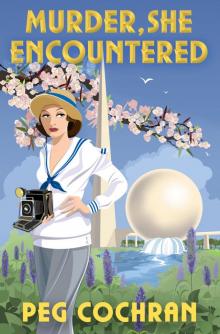
Murder, She Encountered,
p.7


“You know how it is,” Viola said. “She wasn’t his flesh and blood.”
Elizabeth and Kaminsky exchanged a glance.
“It wasn’t like that,” Viola stammered, a shocked look on her face. “I didn’t mean that. Clyde’s been a perfect gentleman.”
“Of course,” Kaminsky said smoothly. He paused. “I assume Clyde was with you the night Flo was killed?”
“Sure,” Viola said a little too quickly, a furrow of doubt creasing her forehead.
The door to the apartment opened and a man walked in. He stopped short when he saw Elizabeth and Kaminsky.
“Clyde!” Viola exclaimed.
“Who are these people?” He glanced accusingly at Viola.
He was wearing a pair of baggy gray pants and a stained white T-shirt. He was short with muscular arms and a belligerent expression. A raised red scar puckered his right cheek. He had a battered fedora on his head and an unlit cigar stuck in the corner of his mouth.
Viola jumped to her feet and smoothed out her housecoat.
“These people are from the Daily Trumpet.”
“Whaddya want to go talking to them for?” Clyde glared at Elizabeth and Kaminsky. “Get ’em out of here.”
Chapter 8
“What a charmer,” Kaminsky said as the door closed behind them.
Elizabeth shuddered. “A nasty character, for sure.”
“This is big, Biz. Real big. Flo had a fight with the boyfriend the night before she died. That gives him a possible motive for murder.” Kaminsky glanced at his watch. “I’d like to talk to that girlfriend of Flo’s—see if she can tell us more about it, but then we won’t make the evening edition. I think I’d better call this in now.”
Kaminsky began walking toward the stairs. He motioned for Elizabeth to follow.
“Come on. Let’s go find a telephone booth.”
They were halfway down the stairs when they encountered an older woman making her way up. She was stooped and had wiry gray hair and was struggling with a shopping cart filled with parcels.
“Let me give you a hand with that,” Kaminsky said.
Just then they heard footsteps thundering down behind them. A young man with dark slicked-back hair appeared.
“Babcia, let me get that for you.”
He squeezed past Elizabeth and Kaminsky and took the handle of the cart from the old woman.
Elizabeth and Kaminsky eased their way past the woman and continued down the stairs.
The staircase was stuffy and they were grateful when they were finally outside. A bird was sitting in the middle of the sidewalk guarding a crust of bread, its beak pecking at it with a rat-a-tat rhythm. Suddenly a rat darted from the well of a basement window and ran toward the bird, its nose twitching. The bird flapped its wings in alarm and flew to the safety of a tree branch, protesting raucously at having lost its treasure.
Elizabeth rushed past the rat, which was now sitting with the piece of bread clutched between its front feet, its head twitching rapidly right and left.
They found a telephone booth at the end of the block, and Kaminsky dove inside, pulling the door shut behind him. He emerged seconds later, cursing loudly.
“Someone’s cut the telephone receiver from the cord.” He shook his head. “Didn’t I tell you?” He glanced at Elizabeth. “There’s a reason this neighborhood is called Hell’s Kitchen.” He pointed down the sidewalk. “Maybe we’ll have better luck farther east.”
Elizabeth noticed that the buildings became more kempt the farther east they walked—sidewalks were swept clean, flowers sprouted in window boxes, and glossy-painted front doors sported fancy brass knockers.
They found another telephone booth almost to the corner of Sixth Avenue. Kaminsky disappeared inside and Elizabeth leaned against the low wall surrounding one of the buildings, her face held to the sun.
She felt herself dozing and came to with a start when Kaminsky burst out of the booth. His hair was standing on end as if he had run his hands through it, and his face was flushed.
“It never rains, but it pours,” he said, pulling out his handkerchief and swiping it over his face. “Someone called the switchboard to say a sailor’s been found dead in an alley behind O’Connor’s Pub down by the docks. Boss wants us to cover the story.”
* * *
—
The door to O’Connor’s Pub was propped open letting in a shaft of sunlight that illuminated the darkened interior as Elizabeth and Kaminsky walked inside. There was only one customer seated at the bar—an older man in dark blue coveralls with something written in white script over the pocket. He had his hands wrapped around his glass nursing a whiskey. Elizabeth noticed Kaminsky looked at it longingly—it was about now that he would normally be heading across the street from the Daily Trumpet for his afternoon shot of Old Schenley and a beer.
Kaminsky flashed his press pass at the bartender, who gave them a world-weary look and jerked a thumb toward the back of the bar.
“News travels fast,” the bartender said as he flung the towel he was holding over his shoulder. “All the action is out back.” He pointed toward the far wall. “Go through that door there.”
Elizabeth and Kaminsky made their way between the tables toward the back door. The floor was sticky with spilled beer, the wooden tables were scarred from use, and the uneven bentwood chairs rattled as they passed.
Kaminsky glanced at Elizabeth. “Not exactly the King Cole Bar, is it?”
They reached the door the bartender had indicated, and Kaminsky pushed it open. It led to a paved alley that ran behind the bar. The bricks were cracked and worn and browning weeds pushed up between them. A stack of empty cartons sagged against the rear wall of the bar.
The air was tainted with the smell of beer, rotting garbage, and the brackish scent of the nearby Hudson River.
A knot of blue uniformed policemen huddled together at the far end of the alley, their broad backs obscuring the view.
“Come on,” Kaminsky said, taking Elizabeth by the elbow.
She undid her camera case as she walked toward the group. All she could see of the body was the sole of one of the man’s shoes. There was a hole near the toe, and the heel was worn down.
One of the men in the group clustered around the body was not in uniform. He had his back to them, but Elizabeth could tell by the set of his shoulders and the way his hair curled in the back that it was Marino.
“Excuse me,” Kaminsky said. “Can we get some pictures?”
“Be my guest,” one of the cops said, making a grand gesture toward the corpse splayed on the ground.
It was the body of a sailor in uniform—not one of theirs, Elizabeth thought. His sailor collar was crumpled under him and the edges were stained with blood. Blood puddled alongside him as well and was collecting in the cracks between the bricks.
His head was turned to the side and his hat—a beret—had slid down over his forehead partially concealing his face.
Marino turned around and looked startled when he saw Elizabeth.
“I’m sorry you had to see that,” he said, touching her arm lightly.
“It sounds appalling, “Elizabeth said, “but I’ve become quite used to it now.”
Was she really becoming that hardened? Elizabeth wondered. Her mother would be horrified. According to Helen, ladies were delicate flowers who needed to be shielded from the harsh realities of life. She could imagine what Helen would say if she could see Elizabeth now. She would no doubt be wailing that Elizabeth would never find a husband unless she learned to faint—or at least pretend to faint—at the sight of something as awful as a dead body.
“Do we know who he is?” Kaminsky said to Marino.
Marino shook his head. “I’m afraid not. No identification on him. He’s wearing a French merchant marine uniform so he must have come off one of their ships.”
Kaminsky grunted. “Was he stabbed?” He pointed at the bricks. “That’s an awful lot of blood.”
“He appears to have been stabbed in the back.”
“Poor bastard probably never even saw it coming,” Kaminsky said, shaking his head. “What a way to go.”
Elizabeth inched closer to the body so she could get a good shot of what was visible of the man’s face.
“Here comes the medical examiner,” Marino said as the back door to the bar slowly opened. “I’m afraid I’m going to have to ask you to leave.” He glanced at his watch. “I’ll be calling a press conference in another hour or so. We need to find out who this man is, and hopefully someone from the public will come forward when they see the story in the papers.”
“Gotcha,” Kaminsky said.
Marino touched Elizabeth’s arm again. “Will you be there?”
“Yes.”
She turned away from Marino reluctantly and followed Kaminsky back into the pub.
Kaminsky stopped at the bar and pulled out a stool indicating that Elizabeth should take a seat.
The bartender stopped swabbing the counter and walked over to them.
“What’ll it be?” he said.
Kaminsky looked at Elizabeth.
“I’ll have a Coca-Cola,” she said.
“Give me a shot of Schenley’s and a Budweiser chaser.” Kaminsky pulled the ashtray toward him and began rummaging in his pocket.
The bartender reached for a glass on the shelf, added ice, a splash of Coca-Cola syrup and a stream of seltzer, then handed it to Elizabeth.
He turned back to the shelves on the wall, grabbed a shot glass, and filled it with Old Schenley. He plunked it down in front of Kaminsky.
Kaminsky waited until the bartender brought his beer, then he downed the shot in one gulp. He shuddered and took a sip of his beer.
“I don’t suppose it’s every day you find a dead body in your back alley,” Kaminsky said, wiping the foam from his mouth with the back of his hand.
“You’ve got that right.” The bartender put down his cloth and walked over to them.
“Did you talk to the guy at all?”
“Nah. He didn’t sit at the bar.”
“So he was alone?”
The bartender nodded. “He came in alone, but then some other fellow came in and joined him.”
“What did the other fellow look like?”
The bartender shrugged. “I only saw the back of his head. Luca took his order.”
“Is Luca here now?” Kaminsky said.
“No. He went home over an hour ago.”
“Did you see the sailor go out the back door?”
The bartender shook his head. “No. We had a bit of a rush. A couple fellows came in—a swanky lot, with gold cuff links and diamond tie clips—and ordered a Ramos gin fizz. They must have mistaken this place for the Twenty-one Club. It’s a cocktail that takes quite awhile to make—he must have slipped out then.”
“So you don’t know if the fellow the sailor was sitting with followed him outside?”
“That’s right.”
“Did you hear anything? From the alley?”
“Like a scuffle, you mean? I would have gone out to investigate if I had.”
The door opened and several men walked in. They looked as if they had just ended their shift somewhere—they were dressed in work clothes and heavy boots.
The bartender smiled at Elizabeth and Kaminsky. “Sorry. I’ve got to go take care of the customers. I’m afraid I can’t tell you anything else.”
“We appreciate your time,” Kaminsky said. He dropped some money on the counter and put on his hat.
“I’d sure like to track down that fellow who was having drinks with the sailor,” Kaminsky said when he and Elizabeth were outside.
“Couldn’t someone else have come along and stabbed the sailor?” Elizabeth glanced behind her to check the seams of her stockings.
“Sure. But it’s far more likely that his drinking companion is the one who killed him.”
* * *
—
The taxi pulled up in front of an Italianate-style building on East Sixty-seventh Street and Elizabeth and Kaminsky got out. They didn’t often take cabs—the boss’s face would turn red whenever he saw charges for a taxi on Kaminsky’s expense reports and would demand a detailed explanation as to why they hadn’t taken a bus or the subway.
They’d barely made it back to the newsroom when Kaminsky had gotten word that Marino was about to hold a press conference relating to the death of the sailor in the alley behind O’Connor’s Pub. If they’d taken the subway, they would have missed it altogether.
As it was, a crowd was already gathered in the small room a patrolman led them to. Elizabeth noticed that Ted Munson from The New York Times and Bobby Markowitz from the New York Herald Tribune had prime spots up front right by the bank of microphones that had been set up by the radio and television networks.
They hadn’t waited more than a minute or two before Marino came out of a side door and stood in front of the microphones. His expression was solemn and he was clutching a sheaf of papers.
Reporters began to shout questions even before Marino started to speak. He held up a hand and waited until silence settled over the room again. Someone toward the back cleared his throat loudly and Marino glanced in that direction.
Finally he began to speak. Elizabeth and Kaminsky already knew many of the details, but some were new even to them.
“The medical examiner believes the killer used a switchblade to murder the victim.”
A murmur went through the crowd, and the sound of pencils scratching across paper filled the room.
“We still do not have any identification of the victim, and no one has come forward to declare him missing.”
“So there was nothing in his pockets?” someone shouted from the back of the room.
Marino consulted his notes. “Nothing that would lead to identifying the victim. The only thing we found was a ticket stub from the World’s Fair.”
“Is there anything new in the case of that girl that was murdered out at the World’s Fair?” Munson from The New York Times yelled out. “The one who was strangled with the pair of nylons.”
“Is that kid still in custody?” another reporter added.
“Joey Dorman? Yes, he’s still in custody.”
“So you think he did it,” someone else said.
Marino held up a hand. “He’s still in custody, but the investigation is ongoing. I’m afraid I have no further information at this time.”
There was a rustling sound as Marino gathered his papers together and then headed out the door.
* * *
—
“Do you think it might be significant that that sailor had a ticket to the World’s Fair in his pocket?” Elizabeth said as she and Kaminsky left the police station. “Maybe there’s a connection between this murder and the murder of Flo Grimm.”
“Come on, Biz. You’re clutching at straws. Thousands of people have already visited the fair. I heard that the king and queen of England will be visiting next week.”
“But coincidences do happen,” Elizabeth insisted. “We’re investigating a murder at the World’s Fair and another victim shows up with a ticket to the fair in his pocket.”
Kaminsky smiled at her. “I guess we’ll see, won’t we?”
“I feel sorry for that poor boy—Joey Dorman. I’m quite convinced that he isn’t the killer.”
“Me, too,” Kaminsky said as he stopped to light a cigarette. “But the evidence is fairly damning—he’d been stalking Flo for days. Obviously he had an unhealthy obsession with her.”
“That doesn’t mean he killed her. And we only have Dotty’s word for it that it bothered Flo.”
“True.” Kaminsky blew out a cloud of smoke. “Maybe we ought to pay a visit to that girlfriend of Flo’s—the one who lives in the same building.”
“Lena Hoffman?”
“Yeah. Maybe Flo confided in her. What do you think?”
“I think it’s a great idea. Let’s go then.”
They were halfway down the block when they heard the footsteps of someone walking very quickly—almost running—behind them. Elizabeth stood aside to let the person pass, since he was obviously in a hurry. She was surprised when she felt a hand on her shoulder.
She spun around to find it had been Marino walking toward her.
“I’m glad I caught you,” he said somewhat breathlessly. His hair was curling in the humidity and a lock had flopped onto his forehead.
Kaminsky raised his eyebrows at Elizabeth before wandering over to a nearby fire hydrant. He put his foot up on it and pretended to tie his shoe. Elizabeth had to hide a smile.
“I wanted to ask if you would have dinner with me tomorrow night,” Marino said.
Elizabeth didn’t think—she didn’t hesitate. “Yes.”
Marino grinned and his shoulders relaxed. “I’ll pick you up at seven o’clock. Will that be all right?”
“I can meet you,” she said, thinking of the reception Marino had received from Helen the last time he’d picked her up at home.
Marino was already shaking his head. “No, I will call for you.” He squeezed Elizabeth’s hand. “I’ll see you tomorrow night, cara.”
Kaminsky wandered over as Marino walked away.
“What was that all about?” he said. “Nothing to do with the case, I assume.”
“No, no.”
As they walked on, Elizabeth wondered whether she had made the right decision. Was it even possible for her relationship with Marino to go anywhere? Was she simply delaying the inevitable—meeting and dating men who would be considered more appropriate by her family?
She didn’t know. All she knew was that she wasn’t ready to make that decision yet.