They thought i was dead, p.1
They Thought I Was Dead,
p.1
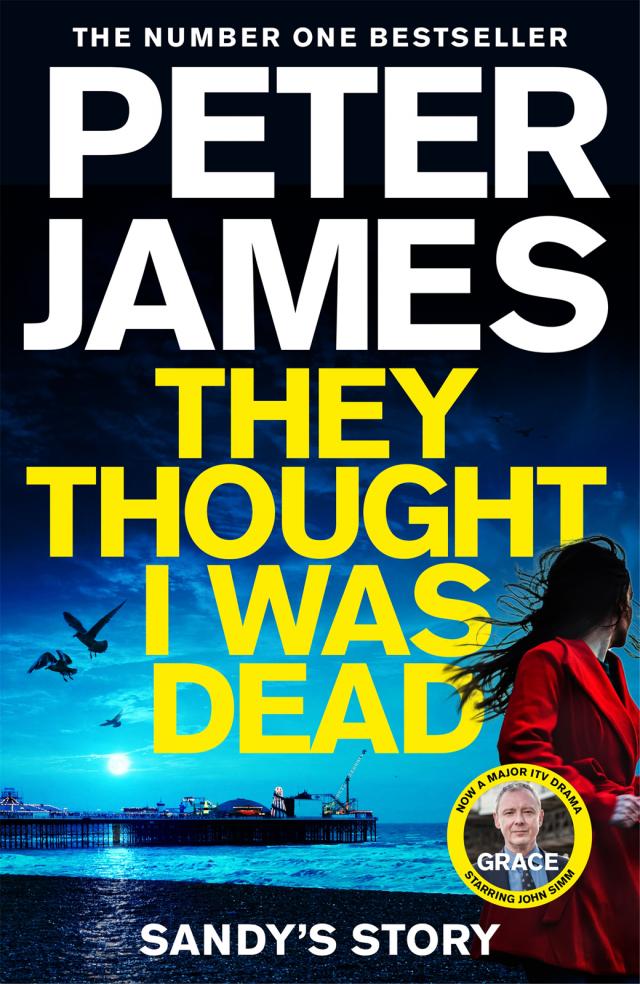


THEY THOUGHT I WAS DEAD:
SANDY’S STORY
PETER JAMES
Contents
PROLOGUE
1
2
3
4
5
6
7
8
9
10
11
12
13
14
15
16
17
18
19
20
21
22
23
24
25
26
27
28
29
30
31
32
33
34
35
36
37
38
39
40
41
42
43
44
45
46
47
48
49
50
51
52
53
54
55
56
57
58
59
60
61
62
63
64
65
66
67
68
69
70
71
72
73
74
75
76
77
78
79
80
81
82
83
84
85
86
87
88
89
90
91
92
93
94
95
96
97
98
99
100
101
102
103
104
105
106
107
108
109
110
111
112
113
ACKNOWLEDGEMENTS
ONE OF US IS DEAD
1
2
ABOUT THE AUTHOR
TO MARGARET DUNCTON – my hawk-eyed vigilante!
PROLOGUE
A lot of us screw up in life, some more than others, and some of us screw up pretty much most of the time. I’m there, right up among the big screw-ups. To paraphrase my favourite comedian, the late Peter Cook: ‘I’ve made loads of mistakes in life and I could repeat them all exactly.’
That’s pretty much how I feel.
I read a poem once that I think was called ‘The Dash’. It talked about that mark, that hyphen you see on gravestones, linking the date of birth and date of death. It’s always struck me as curious that the important thing on those headstones is the two dates. The dash in between is inconsequential. Maybe that’s because human lives are generally inconsequential. Is all that matters that we were born and that we died?
But surely everyone has a story to tell? They may not have invented the wheel, or split the atom, or solved the Riemann hypothesis . . . But surely a lot of people deserve more than that tiny dash, don’t they?
This is my story. I’m just fleshing out the dash a bit on my odd little life.
1
26 July 2007 – The day I leave
My name is Sandy. I’m driving from Brighton towards Gatwick Airport and I’m nervous as all hell. You would be too if you were me, right now, I promise you. I keep looking in my rear-view mirrors for someone following me. Silly, because no one can possibly know – yet – what I’ve done.
I’ve just left my husband, Roy, but he certainly won’t have a clue at this moment – he’s immersed in his work as ever, on a murder case. It’s his thirtieth birthday today and we’re supposed to be going out to dinner tonight – we have a reservation at our favourite restaurant – us and another couple – our closest friends. It’s a big deal your thirtieth, a milestone. I’d even asked the restaurant to make him a cake with a marzipan goldfish just like his pet, Marlon, on top.
Bad timing, I know. If I’d had a choice, I’d have picked any day but this one. But I don’t have that luxury.
I’m not just running from my husband, although that’s part of this story – he’s a decent guy who doesn’t deserve what I’m going to be putting him through. A decent guy but not an ideal husband for me. No, I’m running from a mess I’ve got myself into – a real, proper mess. A death threat from someone the police have in their sights as a highly dangerous Person of Interest. My husband knows the man, he’s talked about him, believes he is behind several killings, but the fact is that the Major Crime Team don’t have enough evidence to arrest him. Yet.
Roy doesn’t know I have an involvement with this man. He has no idea that I’m the next person he is intending to kill. He doesn’t know how terrified I am.
He doesn’t know I am taking someone with me, either, but that’s another story, for later.
And I’ve no idea what Roy will do when he can’t find me or call or text me. I’ve not left a note or anything corny like that. But I have left pretty much all my personal stuff, other than just a couple of small photographs he won’t miss. He’s a smart detective, so I guess he’ll start by using all those great skills he has at tracking down murder suspects, both current and long past.
But he is going to find it hard to track me down, for one very simple reason.
I no longer exist.
2
26 July 2007 – Roel Albazi
Roel Albazi was forty-seven years old, stocky and squat, and dressed in mismatched Versace. He was Albanian and had lived in England for many years. He had a shaven head, tattooed neck and a pencil-thin moustache that ran down either side of his mouth to his chin. Adorned with a gold necklace, big rocks on his fingers and a bling watch, he sat outside the pizza restaurant in Shoreham High Street that was one of his legitimate business fronts, sipping a macchiato and smoking his short cigar, which was nearly down to the stub.
He had the physique of the kind of non-negotiable muscle you’d find outside any nightclub door on the planet. From a distance he looked a thug and not a man with a degree in international law. A hard man, you’d think. Not someone who would be afraid of anyone.
Until you looked closer and saw his frightened eyes.
He was very afraid right now of one person. Her name was Song Wu. She was a lot richer than him, a lot more ruthless and a lot more powerful. And she owned him – pretty much – since making his company, Albazi Debt Recovery International, an offer he should have refused but could not, three years ago. The offer had been a vastly lucrative contract to work for her company exclusively.
It had been an invitation to sup at the Devil’s table, he was well aware of that, but he thought he could handle it. The money on that table just too good to turn down.
And the deal had been too good to last.
And at this moment he was in deep trouble with Song Wu.
There was a rumour that she liked to have people who crossed her – or defaulted on her – cut up alive, and then she watched the videos. But Roel Albazi knew it wasn’t just a rumour.
Before his rise from mere debt collector to Fu Shan Chu in the triad run by Song Wu – effectively, in Mafia terms, her underboss – she’d made him watch the video of his predecessor. It was an hour long and involved kitchen knives, a rotary bandsaw and a chainsaw. The man was still conscious fifty-five minutes into the procedure. His mistake had been trying to broker a deal with another employee to siphon off some money. He didn’t understand about loyalty. This employee was Chinese, and Albazi’s predecessor fatally did not get the way the triad connections worked, and how a Chinese person would always be loyal to another Chinese person over a westerner.
Song Wu was third-generation English, but she was still as pure Chinese as the day her family had left Hong Kong back in 1954. Her father had amassed an empire of thirty-five restaurants and takeaways across the south of England, twenty Chinese grocery stores and a wholesale business supplying Chinese restaurants around the UK.
Privately educated at one of the nation’s poshest girls’ schools, she had reacted to racist bullying with a ferocity that soon made other pupils steer well clear of her, and she found she enjoyed both the power and inflicting pain. Within five years of her father’s death, she had added a dozen more restaurants, a string of launderettes, two fully legal casinos in England and another five around Europe, as well as seven stone of body weight to her existing twelve. She liked an excess of food, but she liked an excess of money even more. She was a glutton for cash. Profits made her eyes light up; losses made her face flame. Nothing melted the ice that was her heart.
She had two brothers who were directly beneath her in the family hierarchy but dealt with other areas of her business. Silent figures in the shadows who executed their sister’s instructions with precision. Albazi wasn’t aware of anyone who admitted to knowing them, or even having seen them, but everyone in the Song Wu organization feared them.
It was from the Casino d’Azur group that she hauled in the biggest gains – but only in part from the actual gaming tables. The highest margins
came from her business model of loaning cash to gamblers who had run out of luck. They were given big loans, always short term, with interest rates of fifty per cent per month. Defaulters were sent a video of someone being tortured, which self-erased after one viewing. Most paid up pretty fast, finding the money somehow. And that was partly because Albazi vetted the people the Casino d’Azur lent to very carefully in advance. He made sure they had assets they could turn to, in desperation. Assets such as the unmortgaged portion of their homes.
But at this moment, Albazi was a worried man. Two people he’d approved big loans to in the past three months had, separately, done a runner, and Song Wu had not been happy. Albazi knew she suspected he was lying to her and had cut some kind of a deal with these people behind her back. Now this third person wasn’t showing up either, and he was feeling physically sick at the thought of having to tell Song Wu. She was going to be even more certain he was double-crossing her.
Every five minutes Albazi methodically checked his watch and each of the three phones lined up on the metal table. Traffic streamed past. Pedestrians streamed past. But there was no sign of her. And no message.
She had given him her word. Assured him. They had an appointment. An assignation. At 12 p.m. today she was going to turn up with the £150K she owed him.
It was now 12.20 p.m. Then it was 12.25 p.m. Then 12.30 p.m.
Yet again he checked the middle phone, the one she had the number for, the one they always spoke or texted on. No message.
Bitch.
He stubbed out the cigar in the ashtray. She might think she was clever, but it wasn’t clever not to pay him. Sure, the interest rates were high, but so they should be as he never took security for the loans. All of them were on trust and he made sure he collected what he was owed. Always. However long it took. His customers paid either with cash or with their homes or with their lives. He preferred the cash but killing a debtor – and very publicly – served as a great warning to others. Call it a marketing cost.
He picked up the phone on the left and dialled. It was answered almost instantly.
‘Sandy Grace,’ Albazi said. ‘Find her. Now.’
3
26 July 2007
I’m on the M23, heading north, and the slip road to Gatwick Airport is coming up a mile ahead. If I take it, I guess that will be the point of no return. How does a relationship get to the point of no return? I have often asked myself if there is a way back to our once blissful marriage. But it is like a broken glass: however brilliantly it gets repaired, there will always be cracks. Roy might call them tiny fractures, but for me they are significant.
Of course, the heat of that first passion can’t last, however much we fantasize it will. We go through stages with any ‘significant other’. First, we fall in lust, then we fall in love, then we hitch our wagons together and steadily rumble and bounce along Reality Road. Whether we have kids or not, some are destined to end up in some form of compromised state of contentment. Acceptance of our lot. And that is fine for many people. But I want more. I’ve always wanted more. I need more. I just feel the compromises I have to make are too many.
That may seem selfish, given my husband is not a bad person, but it’s the only way out I can see. I think it will damage Roy less if I disappear than if I have to tell him what I have become and what I have done. It would ruin his career having a wife who has got into this situation and I can’t help feeling that I would, forever after, be an embarrassment to him. The proverbial albatross around his neck.
All I can say is that it isn’t easy for me. I dislike myself entirely. I hate what I have become. I wish, desperately, it hadn’t got to this.
I like Antoine de Saint-Exupéry’s description of love as not gazing into each other’s eyes, but looking in the same direction together. I think he got that from Dickens, who was always mentioning people sitting in ‘companionable silences’. But wasn’t that because they had nothing else to do in his day? No internet, no computer games, no Amazon to browse, no Sky Sports.
So when does that oh so subtle change in your relationship start? The first night that you share a bed and don’t make love? The first morning you leave home forgetting to say I love you? The first time you don’t notice your significant other’s new hairstyle? The day you forget the anniversary of when you met? The day you realize, for whatever reason, you no longer come first in your significant other’s life?
Tick that last box for me.
The reality of being married to an ambitious Major Crime detective is that you will often come second – sometimes to a corpse.
The more I go over and over this in my head, the more I realize that whatever I now do, even if I somehow sort out this mess, too much has happened for our relationship to continue. I’d always carry the lies and live in fear of Roy finding out about my sordid other life. I have to leave.
Selfishly, it is easier for me if I pass on some blame to him, so I consume myself with thoughts of what he could’ve done to prevent me getting into this mess: maybe he did prioritize his job over me, maybe he didn’t love me enough. That I’m just an appendage, the person who makes the bed, who does the shopping, who cooks, that he doesn’t care for my career or any of my ambitions to use my interior design skills, so long as I turn up to functions on his arm. But deep down, if I let myself go there, I’m just trying to ease my guilt.
He’s actually a bloody good guy. I should find his dedication to his job a positive thing, but I use it against him. I’m a disgrace. He’s better off without me.
Just over a year ago. Our wedding anniversary. He never forgets any significant dates and he’d booked a restaurant as a surprise – our favourite seafood restaurant in the Brighton Lanes – where we had gone on one of our very first dates. He’d sorted a taxi so we could both have a drink, and he’d given me a beautiful present, a white gold eternity ring. I felt bad because I hadn’t given him anything special.
This was the evening when I made a terrible decision.
4
2006 – One year earlier
We are in the back of the taxi. Roy has his arm around me and we are all loved up. All these years of marriage and still in love. I feel hugely grateful despite so long trying, fruitlessly, for a baby, which has been arduous and draining for us both.
We are heading east along Church Road, Hove, one road north of the seafront. A wide, buzzy street, lined with shops, cafes, bars and restaurants. The driver is a young, friendly guy. His plate says Mark Tuckwell. Roy and I are chatting to him, like we always do to taxi drivers, waiters, shop assistants, pretty much anyone, really. We both share an insatiable curiosity about people. I’m sure Roy banks it all, though, somewhere up in that ten-gazillion gigaflop processor inside his skull, whereas I just remember faces. But I know my husband too well. I can see that all the time he’s chatting to this driver he’s looking through the windows, taking in both sides of the street, and suddenly he yells, ‘Stop! Stop! STOPPPP!’
And my heart stops.
I know what’s about to happen because it’s happened before. Roy, with his damned near photographic memory, has spotted a villain he’s been after for a year, or maybe longer, walking along the street.
As the driver pulls hard over to the kerb, Roy already has his door open. ‘Darling, order a bottle of bubbly – I’ll see you at the restaurant as soon as I can.’
Then he’s gone.
The time is 7.30 p.m.
At 8 p.m. I’m sitting in the restaurant, English’s, with a bottle of Champagne, reading the menu over and over. And over. Roy calls with an update. He has chased this suspect down Western Road for over half a mile, finally rugby-tackling and pinning him to the floor at the Clock Tower.
He’s now on his way to the custody centre at Hollingbury. He can’t hand this charmer over to anyone else yet, because of something to do with chain of evidence – after finding Class A drugs on him. But it shouldn’t be a problem, he assures me. It’s early evening, so he will be able to process him through custody quickly, and then join me.
It’s now 10 p.m. I’ve spent much of the past two hours reading the menu until I’ve learned it by heart, and texting my best friend, about my progress on this increasingly boring and increasingly non-romantic date. A combination of the booze and the boredom and I’m really pissed off. It’s escalating in my head, and I can’t stop it even though the evening started so well.
On the plus side I’ve eaten an entire basket of delicious breads with a fish paste and a very yummy butter, and I’ve almost finished the bottle of Veuve Clicquot. And now, Roy has just called with yet another update.