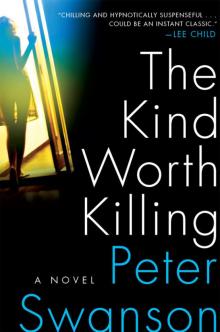
The kind worth saving, p.13
The Kind Worth Saving,
p.13


“That sounds vaguely familiar,” Richard said. “Did she stab him?”
“Yes. He was following a suspect in a murder case, and she became paranoid and stabbed him.”
“I remember that, but I never realized it was Mr. Kimball from our school.”
“I didn’t at first either, but I put it all together, and, the thing is, he’s now a private detective. And he’s going to be our witness.”
“Okay,” Richard said, nodding his head. Joan’s eyes were bright, and she had sucked her upper lip underneath her lower one, something she only ever did when she was very excited.
Lights were going out in the library, one after another. “Can we meet in a week?” Joan said. “Here. Same place, same time.”
“Yes,” Richard said, and Joan got up and left.
Richard stayed in his chair for a minute, in the suddenly dim light of the alcove, then got up and left the library too. Once he was outside, he didn’t want to go directly to his car. It was late September and there was a cool breeze, so he walked for a while down past the church, then past the small cluster of shops, all closed now, that made up the entirety of Fairview’s commercial district. A ragged dog emerged from between a gas station and a house with a mansard roof. It stood on a gravel driveway, and Richard realized it wasn’t a dog, but a coyote, its eyes reflecting yellow in the moonlight. He lifted his arms silently to make himself look bigger, and the coyote turned and trotted away. Richard felt a flush of power, and had a sudden urge to do something animalistic, or crazy, like howl at the moon, or get down on all fours. He stopped himself, knowing that even if no one saw him, it would still be a sign of some form of insanity.
CHAPTER 18
KIMBALL
David Kintner, Lily’s father, had made me a very stiff whiskey and soda, about twice as dark as the one he was holding, and we were sitting across from each other in the living room, a coffee table stacked with books between us.
“Remind me, Henry,” he said. “Last time you were here was right after … soon after Lily returned from … from …”
“From the hospital,” I said, at the same time as he said, “from Winslow.”
I liked David for a number of reasons, but one of them was that he had never questioned my visits to see Lily. It wasn’t entirely clear that he knew the whole story, but he must have known that Lily had attacked me with a knife because she had felt threatened. This was back when I was a police officer, back when I’d become convinced she had a lot more to do with the deaths of Ted and Miranda Severson than she was letting on. After I’d been suspended by the Boston Police Department, and subsequently resigned, one of the department lawyers told me that Lily Kintner had agreed to drop all charges against me and the department. I remembered reminding this particular lawyer—I picture an ill-fitting suit and a goatee—that I was the one who ended up with a knife in my side. He’d said, “About that. This is all contingent on you not pressing any charges against Ms. Kintner, of course.” I’d agreed, happy to let the whole incident slide into the past. But I couldn’t get Lily out of my mind, and on a whim I contacted one of her doctors at the facility she was housed in, and asked if I could visit. Since there was going to be no further legal action, the doctor and Lily both agreed.
I visited her late in the afternoon on a Friday. I didn’t know what to expect but I was brought through two sets of doors into a light-filled sitting room that felt more like the common area of a college dorm than a psychiatric ward. There were vinyl couches and a table with a partly finished jigsaw puzzle, and several patients watching television. Lily entered the room from the other side, and smiled across the room at me as though I were her oldest friend. She was wearing sweatpants and a white sweater and her red hair was tied back at the back of her head.
“Where do you want to talk?” she said, after coming across the room to meet me.
“Where can we talk?”
“Here. Or in my room. I’m not on restrictions right now.”
We ended up finding an alcove and sat across from one another on an uncomfortable couch. “I’m surprised you agreed to see me,” I said.
“I was a little surprised, as well, that you wanted to,” she said. “But I don’t know. Everything in my life is surprising right now.”
“Same for me,” I said.
“You didn’t think you’d ever be stabbed and live to tell the tale?” she said.
“I definitely didn’t think I’d ever be stabbed and then want to go and visit the person who stabbed me. Why do you look so happy?”
“I suppose I’m happy because you’re not dead. Because I didn’t kill you. I know it’s not much, but I’m very pleased you’re not dead.” It was less the words and more the way she was looking at me, but we became friends, I think, in that moment. I told her about my recovery, and she told me about hers. Before leaving the hospital, I said, “You know, now that we’ve agreed to not testify against one another, or press charges, we are kind of free to tell each other the truth. We can’t hurt one another anymore.”
She thought for a moment, and said, “I suppose so. You go first. Tell me something truthful.”
“Okay,” I said. “I was following you partly because I thought you were involved in the deaths of Ted and Miranda Severson, but really, I was following you because I’d fallen for you. The police department was right to fire me.”
She smiled, amused, I think, and I said, “Your turn. Something truthful.”
“Falling for me is a big mistake,” she said. “I’m not a bad person but I’ve done bad things.”
That was the first of three visits I made to Lily in the hospital. On my last visit she told me about a construction project happening next to her childhood home, how it might uncover an old well, a place where bodies were buried, she said, and I realized that for whatever reason she had decided to entirely trust me. She had handed me the means to implicate her in a crime. The fact that I chose not to do that was what truly sealed our bond. Since those trips to the hospital, we have never talked on the phone or sent each other text messages. I don’t even know if she has a phone. After being released from the hospital, Lily quit her job as a librarian at Winslow College and moved back to Shepaug, in Connecticut, to her family home, still occupied by her divorced mother and father. She told me once that navigating between them has become her full-time job. Her mother, Sharon Henderson, is a painter who grew up in Pittsburgh, but has lived in Connecticut her entire adult life, while Lily’s father, David, is a relatively famous English novelist who met Sharon when he was a visiting professor at Shepaug University. He lived in America throughout most of Lily’s childhood, until the divorce sent him back to London and a third marriage. But he was permanently housed in Connecticut now, having fled his homeland after drunkenly crashing his car in the Cotswolds, accidentally killing his wife. He’d agreed to move back to his old house with his estranged wife, who needed his money to hold on to the property.
“Right,” I said to David now. We were still talking about Lily. “Does she still have her house up in Winslow, or is she fully moved in down here?”
“Far as I know she still has the house in Winslow. Rents it out, I think. I suspect, and I also suspect she’d agree with me, that owning a home away from here is of enormous symbolic importance to her. Otherwise she might feel she was stuck here at Monk’s House forever, dealing with her mother and me. It’s not much of a life.”
As though on cue, I heard laughter coming from the adjacent kitchen, where Lily and her mother were preparing dinner. I’d been invited to stay over.
“Are you working on anything?” I said to David Kintner, knowing he wasn’t, but wanting to turn the topic of conversation to his writing.
“Ah,” he said. “No, sadly. The words don’t come anymore, at least not the right words and not in the right order. But did you know that Lily and I, more Lily, really, are going through my manuscripts, doing a little pre-archival work before I die?”
“Are all your papers here?” I said.
“Almost all.” Those words came from Lily, who had entered the living room quietly, carrying a cheese board that she placed on the most stable-looking stack of books on the coffee table.
“Yes, almost all,” David said.
“Dad thinks he has old notebooks at a rental house in France that you used to go to … when was it?”
“Before you, Lil. And then for two summers when you were too little to remember. But I’m not a hundred percent sure, and I’m not even a hundred percent sure that the house is still where I say it is.”
“I’ll go there and find out,” Lily said. “It’ll be a good excuse to go on a trip. I’m going to get a drink. Can I get anyone anything?”
We both declined. David leaned forward and plucked a grape from the bunch that was decorating the cheese board, and said, “I don’t know what I’d do without her. I’m withering on the vine here.” He was staring at the grape in his hand that had just provided the metaphor, and he looked as though a tear might suddenly slide down one of his cheeks. He wore corduroys that were thin at the knees, and a cardigan sweater over a checked shirt. The most robust thing about him was his thick white hair, parted the way it had always been so that it stuck up a little on his left side. He was tall and thin, but his shoulders had rounded a little with age, and there was a noticeable tremor in his right arm.
“You’re lucky to have her,” I said.
His eyes sharpened, and he said, his voice pitched a little lower, “My understanding from Lil is that you might have something to do with that. That’s one of the reasons I like you.”
“What are the others?”
“Well, if I remember correctly, last time you were here you not only matched me drink for drink, but you regularly complimented me on my novels. Those are two traits I revere in a houseguest.”
“I’m happy to compliment your novels if you keep providing me with drinks,” I said.
He grinned, showing off his yellow teeth, then asked me if I’d pick a record. I got up from the sofa and went over to the turntable and the large floor speakers. Elaborate shelving had been built around these items, and one of those shelves contained about three hundred records. I picked a Chico Hamilton album because the cover was interesting and dropped the needle on side one.
“Thank you,” David said when I settled back in across from him. “It’s no picnic having to get up every thirty minutes to play new music but I refuse to have my music choices cataloged and recorded by some Chinese aggregating corporation halfway around the world. What I like to do is sit here and listen to pressed wax and read actual fucking books and be secure in my knowledge that unless the satellites now have x-ray vision no one in the world knows what I’m listening to and reading except for me. It’s actually thrilling. Although I do realize that for a whole generation of human beings the thought of anonymity is worse than death.”
Lily returned to the room with a glass of wine and sat down next to her father and across from me. “Is Dad giving you his speech about anonymity?” she said to me.
“He’s right. Plus, vinyl sounds better,” I said at pretty much the same time as David said, “What precisely do you mean, my speech?”
She turned to her father, didn’t answer his question, and said, instead, “Mom’s making the quinoa salad.”
“Good God,” he said. “What is that? Like the third time this week?”
Lily turned to me. “Sharon has become a fan of quinoa salad with cranberries and goat cheese. She makes it a lot.”
“It’s the only fucking thing she makes around here.”
“Beggars and choosers, right, Dad?”
“I suppose. Let’s talk about something else. Henry was gearing up to praise me, I believe.”
“I want to hear more about what you’re doing with the manuscripts,” I said, looking at Lily, who was still wearing the jeans and the sweater she’d been wearing earlier that afternoon. She took a tiny sip of her wine and put the glass down on the hardwood floor by her feet.
“What I’m doing is mostly just collecting everything there is and trying to get it into chronological order. Dad was a saver, so there’s a lot.”
“Do you know where it will all be going eventually?” I said.
“We have an offer in from a college in Arizona and a potential offer from Emory in Atlanta, although”—she turned and looked at her father—“I think they’re wavering a little.”
“I’ve lived long enough to become a pariah,” David said. “Most of that is my own behavior, and some of that is the changing of the tide. I’m a white man who wrote about white men chasing women.”
“Someone’s got to do it, I suppose,” I said.
“Just not me,” he said. “Not any longer, thank God.”
“Dad does have a complete unpublished manuscript that he wrote between Left Over Right and We Met at the End of the Party.”
“Really?” I said. “Between my favorite David Kintner novel and my second favorite one.”
“Oh, you suck-up,” Lily said.
“Don’t listen to her, Henry. Tell me again about your favorite novels of mine, and be specific about what you liked about them.”
Four hours later the three of us were in the same places in the living room, although in the interim we’d all gotten up to eat quinoa salad and roast lamb in the dining room, then, after dinner, gone to Lily’s office, where she showed the piles of notes from her father’s career, along with newspaper clippings, foreign editions of his books, magazines that contained his stories, and even a stack of videotapes of the lecture series he gave at Shepaug University when he first visited the United States.
Lily was drinking tea, and David had allowed himself a small glass of undiluted single malt. Sharon came into the living room for a while with a large glass of red wine, and stood behind the oldest sofa in the room, its fabric worn thin by time and cocktail parties. She stared at the ceiling and told us all twice about the ants that were now permanently taking up residence in the pantry.
“We’ll worry about that tomorrow, Mom,” Lily said. “Why don’t you sit and we can all talk about something else?”
“Oh, no. If I sit, I might never get up. I’ll just take myself off to bed. Lil, where’s Henry sleeping—not in the maroon room, is he?”
“I set up the room on the third floor, Mom.”
After Sharon left, Lily suggested to David he take his drink with him to his room and finish it there. “Good advice,” he said, and came up surprisingly easily off the sunken sofa. Lily stood too, but he waved her off, saying he’d be fine and left the room, turning at the door and saying, “Good show tonight. Good show.”
“He always says that,” Lily said. “One night, Sharon threw a trivet at him and he bled all over the table and afterward he said it had been a good show.”
“Title of his biography,” I said.
“Ha,” Lily said, then was quiet, her eyes unfocused, her tea mug in her hand. “Are you ready to tell me about what happened? I looked it up on my phone while we were getting dinner ready. It’s being declared a murder-slash-suicide.”
“Whoever did it did a good job,” I said. “I was first on the scene. It looked like Richard Whalen and Pam O’Neil sat across from one another, like we are right now. He shot her twice, then shot himself with the same gun.”
“So why do you think that isn’t what happened?”
I took a breath and said, “The night before the murder I slept with Pam O’Neil. I’d gotten to know her because I was following her. She was very sweet. I should never have slept with her, obviously. Now I can’t stop thinking that because of that she tried to end her relationship with Richard, which led him to shoot her and then himself.”
Lily paused, thinking, then said, “So the reason you think they were murdered by someone else is because if they weren’t then you are to blame.”
“Yes, that’s one reason. I already don’t particularly like myself, and if I caused Pam’s death I’m going to like myself a whole lot less.”
I thought Lily might say something to try and comfort me, and I was glad when she kept silent.
“But,” I said. “I do have a deep suspicion, or maybe just a gut feeling, that Richard didn’t do it. I didn’t know him at all, but I watched him and followed him. He was a cheating suburbanite with a good job, but he doesn’t make sense as a murderer.”
“You can’t really know that,” Lily said.
“I know,” I said. “Here’s the truth. Nothing that I saw over the past week makes me think I was somehow set up. Except for maybe this weird remark that Pam made about being in a threesome, but I’ll get to that. The reason I think I’ve been set up is because of what happened fifteen years ago in my classroom with Joan Grieve. That’s what I keep thinking about.”
“What happened there?”
“You don’t know about it?”
“I know a little. I know that you were an English teacher at Dartford-Middleham High School and that a student in one of your classes shot a girl and then himself.”
“He held us hostage for a while before he did it.”
“Oh, I didn’t know that.”
“And Joan was in my class, as well. The girl who was killed was one of her friends.”
“Joan who hired you Joan?”
“Uh-huh.”
“And what about the boy with the gun? Who was he?”
“Kind of a loner. Like if you were making a movie and wanted your school shooter to be a total cliché you would cast him. Not many friends, crappy home life, into violent video games and comic books.”
“But not friends with Joan Grieve?”
“Joan Grieve was a star gymnast and super popular. She didn’t hang out with kids like James Pursall. But she was there in the room when it happened, and I think she might have had something to do with it. And then, fifteen years later …”
“She comes back to you and the same thing happens again.”
“Exactly. And there’s one other thing, but I’m almost embarrassed to tell you about it.”