The good the bad and the.., p.5
The Good, the Bad, & the Cute,
p.5
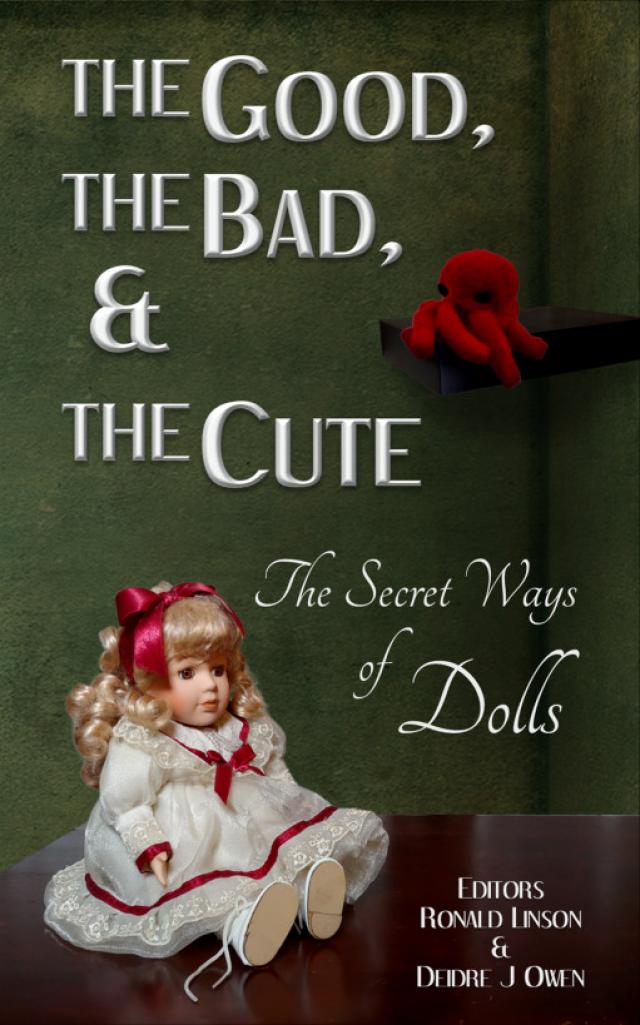


The weeks that followed went by the same; Alan would get up for work, open the closet, glance up at the backside of the doll, grab clothes and leave for the day. All the while the belly of the doll in his closet grew and grew, swelling from something unknown.
Alan awoke to a terrible storm. Thunder shook his apartment while lightning flashed through rain-beaten windows. He began his normal routine and opened up the closet to find the doll on its back, limbs splayed out like a murder victim. A white, full moon belly rose like a mountain.
"What the hell?" Alan asked the room as he grabbed the doll and flipped it upright, so it sat and faced him. Porcelain can't expand like that, can it? As the thought crossed his mind, thunder boomed around him. He felt it shake his bedroom; the closet door inched open further as reverberations wracked the room.
Through the deep thunder Alan's ears perked up to the sound of cracking porcelain. The razor thin crack solidified into a thick, wicked grin. Minuscule fractures spider webbed their way up the face of the doll. Terror gripped Alan while he watched the doll break down in front of him. The bottom half of the horrible visage snapped off and careened down to shatter the mysterious engorged belly. Cloth arms jerked from the motion as porcelain hands came together in an obliterating clap, sending out pale shrapnel that tore through Alan's face.
Alan was unable to move, frozen with fear. Ragged breaths came faster and faster as he saw tiny, unnatural movements through a lens of red, the same movements he glimpsed as a child. He tried to scream but it turned into a grunt as his back met the floor, legs trembling, going out from under him.
The last thing Alan saw before darkness took him was a mass of tiny spider-like figures. Flashes of pale porcelain attached to writhing black legs that skittered towards him. As the mass consumed him the last thing Alan heard was the clink, clink, clink of tiny porcelain feet.
About the Author
Connor Kuntz graduated from the University of Waterloo, and during his time there he realized he enjoyed writing stories more than studying. He lives in Ontario, Canada with his fiancée and their two cats. He loves anything horror and fantasy. In 2020, his story O Sister, Where Art Thou? was published as a Mannison Minibook by Mannison Press. He hopes to become a full-time writer one day.
Smashwords profile here: https://www.smashwords.com/profile/view/crkwriter
8. The Untethered
K. B. Bailey
Ada's black button eyes shone brightly in the false light of the climate-controlled cabin. She wasn't the original, of course, but a copy of my old childhood doll. Someone had gifted the yarn-haired plaything to me for my seventh birthday—an aunt, maybe. And I'd spent the next several years dragging her around.
I'd grown tired of Ada around age ten. I rarely thought of her again until she appeared in the living quarters on the fusion-powered rocket I'd be taking to Mars. The health management team for the solo mission had recreated the doll down to the tiniest detail. They'd dug deep into my past while developing my psychological profile, and they'd resurfaced with Ada, an electric guitar from my teen years, and a uniform from my first job at an ice cream stand.
These anchors, they said, were meant to keep me tethered to the little blue dot during my long journey. Without a tether, you'll drift away and get lost, a serious-faced woman told me. Tethers are important when you're swimming through the universe.
They chose several objects because some connect more than others. Ada connected with me. Her empty eyes spoke to me. Reminded me. Keeping me sane as the time ticked past, every moment bearing me closer to the red planet.
The screen above my desk flashed green. A new message. I crawled out of my bed and situated myself in front of the computer.
I both loved and hated the messages I received. It was unsettling, being jerked back toward Earth when my home planet seemed so odd now. Great portions of it had dissolved in my mind—the nations and cities and peoples—to reveal something very simple: a planet, floating like the rest of them.
When I pushed the receive option, a voice came through the speaker, confident and clear:
"You're approaching the near-miss incident, Natalie. According to our calculations, it will be a close call, but you're safe. If you need our assistance, we're here."
They said that a lot, "We're here," like a customer service agent for some corporation. But their message had taken at least sixteen minutes to reach me, and mine would take the same amount of time to get back to them. That's what space travel came down to. Being alone on day eighty-three of a hundred-day mission. Being in the right place at the right time, during the super alignment between Earth and Mars.
There wouldn't be another super alignment for fifteen years. This was our chance.
As I sat staring at the screen, the lights in the cabin dimmed, and the screen flashed again. This time with a warning:
POTENTIAL COLLISION. CHANGING COURSE.
My heart sped up, as it did with every alarm. They would know my fear on Earth. They measured all my vitals.
I tried to slow my rapid heartbeat with deep breaths. But I couldn't. Instead, I imagined my still, breathless body floating off into space, along with Ada and an electric guitar. Strange relics.
The automated system didn't need my orders, so I just sat and watched it run real-time calculations on the screen in front of me while that warning still flashed:
POTENTIAL COLLISION.
I gnawed on my fingernail, a habit I'd broken years before, as the numbers scrolled restlessly along, charting my path through the heavens.
Then the calculations disappeared. I blinked.
I knew I should do something. But what? What a strange occurrence.
My mind was as blank as the screen in front of me. And without the systems running, everything had gone incredibly quiet.
We had been in the middle of a course change. Maybe the object was closer than they thought. I braced myself in the chair.
Somehow imagining their reaction on Earth made it all worse. A group of dedicated, cheerful scientists and data engineers watching my vitals crash, watching them flatline.
Well, here it was.
I dropped my head, dizzy with something resembling fear. But not quite fear. More like grim acceptance.
Would it be so bad, really?
If it all ended now, the mission would be over. No more danger. No long journey home. Just peace and a human body and a broken rocket littering space, like so many toys.
"Reboot the system," a quiet voice behind me said. "Take a deep breath and reboot."
The chair slid sideways, crashing into the corner of the desk as I jumped out of it.
The voice couldn't be coming from...?
"Ada?"
"Reboot the system." The doll sat still and staring, its button eyes fixed on the blank wall across from it. But the words came from her.
"Reboot the system," I repeated, and I followed the directions without thought, like an automaton. The reboot button—round and red, just as you'd imagine it—was under a plastic case behind a hidden panel in the wall. The failsafe. I should have done it before.
I opened the panel, but just as I went to press the button, my feet began to lift off the ground. The false accelerator, which generated the gravity field within the rocket, had ceased working. I slammed the failsafe, grabbing at the panel for stabilization. A soft humming began as the system restarted, and I lowered gently to the ground.
As the rocket's computer system rebooted, coming slowly back to life, I stumbled toward the middle of the room, wondering how close I was to death. And how crazy I had become to imagine such a thing as a doll talking. I don't know how long I stood there on shaking legs. It must have been a full minute, but time no longer seemed to exist, so it was difficult to say.
I had nearly convinced myself I was already dead when the voice spoke again.
"You're not done. Input these numbers."
The doll rattled off a list of numbers. Coordinates. The manual course change.
I entered them obediently, and when I finished, the screen flashed green:
COURSE CORRECTED. COLLISION AVERTED.
I touched my arm. Goose bumps. Then my leg.
I was alive. Surely.
Going to Ada, I removed her from her small shelf and looked her over. She looked just as she always had. Normal. Not alive.
The mirror near my small dressing area caught my attention. I looked the same as I always had, too. But then, the untethered don't change appearance. The change occurs inside.
How baffling, humanity, with all their flaws. With all their need to break off from the crowd. And then to rejoin it. How baffling and how far away.
I laughed aloud, looking at my own face in the mirror, tracing a newly developed wrinkle with my shaking finger. Then I set Ada on the shelf and returned to the computer.
I needed to send them a message to reassure them that I was all right and that I'd complete this mission and get back to them. Ada would help me with her black-button eyes, in which I could see the end and beginning, the nothingness and the everything.
All I needed to hold on.
About the Author
K.B. Bailey is a copywriter and fiction writer. She lives in Colorado with her husband, a fellow writer and artist, and their two cats. Mannison Press was pleased to publish her story The Carriers (2019) as one of their first Mannison Minibooks. When she's not writing, she loves being outdoors, playing video games, and reading.
Smashwords profile here: https://www.smashwords.com/profile/view/KBBailey
9. The Daily Isabelle
Ronald Linson
I met my maternal grandmother for the first time when I was five. Grandpa had just died and my parents had invited her to stay on the second floor of our house where my father had constructed a nice little apartment for her. Later, it would be mine while I went to college, but that is a different story and probably not half as interesting.
She moved all the way from Chicago to Florida. "No more snow," was her first remark upon darkening our doorstep. Then it was a flurry of activity that overwhelmed me and I had to retreat to my room.
Sometime later, my mother brought me up to make a formal introduction in person, even though I had spoken with her several times over the phone.
"Hello, dear Emily," she said, hugging me.
Rudely, I now realize, although a kindergartener could be forgiven, I asked her, "Do you have any candy?"
Both Mother and Grandma laughed.
"Not right now, honey," Grandma said. "But I will soon. I promise." She touched her fingertip to my nose, making me giggle.
And the next day, when I went to see her, she had a big bowl of hard candies ready and waiting. The lemon drops were, and still are, my favorite.
It was on that day I saw Isabelle for the first time. She sat propped up inside a shiny cabinet made of dark wood with a latched glass door. She had the most beautiful blonde hair styled into pigtails, cornflower blue eyes, and wore a blue gingham dress and black shoes. Her expression was happy, with a great big smile on her little porcelain face.
I tried to open the door, but Grandma rushed over and gently pried my hands away. "No, dear," she told me, "Isabelle is not for playing with. She is very special. You mustn't touch her."
On some level, I understood even then about collectability. My father had a baseball card collection, and my mother collected bird figurines. So, I didn't question her, and only nodded.
The next day, after hugging Grandma and receiving my lemon drop, I went to say hello to Isabelle.
She wasn't Isabelle—or at least not the same Isabelle from the day before. She still had the same face and happy expression, but her dress was now solid pink with white lace trim. Her hair was now loose and fell about her shoulders.
"Grandma, what happened to Isabelle?" I squealed. "Did you do that?" I also understood you weren't supposed to mess with collectibles.
Grandma came to kneel beside me. "No, honey. Remember yesterday, I told you she was very special?"
I nodded.
"Well, Isabelle is magic." She whispered the last word. "She changes every day."
I recall my mouth dropping open. "Magic?"
Grandma grinned. "Yes! Magic. That's why you shouldn't touch her. Magic can act in strange ways, you know."
Of course I knew that. All those books Mom and Dad had read to me about fairies and beanstalks had instilled a healthy respect for magic in me.
"I won't touch her," I promised.
"You're a good girl," Grandma said. "How would you like to go for ice cream? We'll go ask your mother."
For months, I would go up to Grandma's apartment almost every day. She seemed lonely at times, and I tried to cheer her up. I tried other kinds of candy, and made sure to visit with Isabelle.
Each day, the little doll would be different in some way. Sometimes it was a small change: her eyes might be a different color, or her shoes would be Mary Janes instead of pumps. Other times, her entire countenance would be changed.
One day, Isabelle scared me. Her red-and-white dress was scorched and torn, one shoe was missing, her hair was disheveled and filthy, and her expression—what frightened me most—was terrified.
Of course I screamed.
Grandma ran to me, pulled me away, and held me tight for a long time until I stopped crying. "Oh, honey, I should have covered the cabinet today. Sometimes, Isabelle doesn't look very good. I'm sorry."
"Why," I asked, sniffling.
"It's part of the magic," she explained. "Magic isn't always pretty or nice."
I knew that as well, as evidenced by the various nasty things that happened to the bad guys in books. From then on, whenever I came to visit and the cabinet was covered, I knew not to peek at Isabelle.
The next few years were happy ones. I would spend a few hours after school with Grandma, doing my homework, helping her tidy up, and listening to her stories about our family. It was fascinating to see how radically Isabelle could change from one day to the next. I started keeping a diary, describing each one when the cabinet wasn't covered.
March 20: Isabelle has poofy hair! Same dress as yesterday, but barefoot.
March 21: Isabelle is wearing a purple leotard and white legwarmers. Looks excited.
March 22: Covered.
March 23: Isabelle looks like a ballerina. Very pretty.
On my ninth birthday, Grandma sat me down for a talk.
"I think you are old enough now for me to tell you this," she said, putting an arm around me as I sat on her sofa. "I want you to have Isabelle when I'm gone."
I looked up at her. In the mind of a child, grownups are forever, unless they actually have experienced the death of a friend or family member. I couldn't imagine life without her, and I said as much.
She smiled at me gently and said, "Emily, no one lives forever. You do know that, right?"
I hesitated, then nodded. "Yes, Grandma. I think so."
She leaned down and kissed my cheek. Then she said something that confused me utterly.
"But sometimes magic can bring people back, at least for a while."
"Huh?" I was now of an age that I understood magic wasn't real, forgetting in the moment about Isabelle, so much a part of the background of my life was she.
"And, please listen carefully," she continued. "If anything should happen to me, open Isabelle's cabinet and pick her up. But, and this is very important, only pick her up on a day when she looks pretty and happy. Do you understand?"
I didn't. Not at all. But I said yes.
About a month after my tenth birthday, Grandma died.
After the blur of sad, busy days following her death and funeral, my mother brought me Isabelle in her cabinet. She set it on my dresser and told me Grandma had told her years ago I was to have it.
"I don't know why she said not to take the doll out of there. Maybe she was worried about humidity or something? Doesn't make sense; she redecorated it constantly." She shrugged.
When I didn't respond, she gave me a hug and left. I stared at Isabelle for what seemed like hours (but was probably only fifteen minutes). Today, she wore a yellow raincoat and boots. Her hair looked wet and she looked put out. Definitely not pretty and happy.
Remembering what Grandma had told me, but not really believing it, I spent the next week merely existing, missing her so much, I couldn't call it living. Each day, Isabelle transformed in ways big and small, and one morning, she was clad only in underwear, with an embarrassed expression. It made me laugh, and I wondered how often Grandma had covered her up on days like this. I also realized it had been the first time I had laughed since her passing, and that made me sad all over again.
The next day, I woke to find Isabelle looking exactly like Dorothy from the old Wizard of Oz movie, pigtails and ruby slippers and all. She beamed out at me with a gorgeous smile.
Isabelle is magic, I heard my grandmother's voice in my head from so many years ago.
The doll looking this way, it had to be a sign. The Wizard of Oz was the most magical of magical stories, after all.
I went to the cabinet and unlatched it, opening the glass door. The hinges creaked as though they hadn't moved in decades, and they probably hadn't. The air inside smelled fresh, however, fresher than the air in my room.