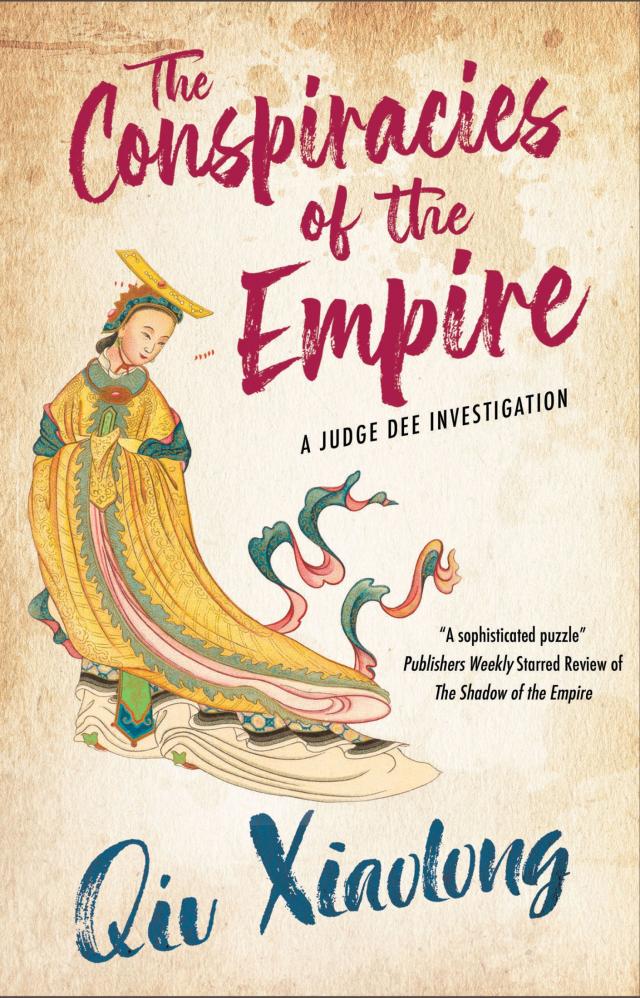
The conspiracies of the.., p.1
The Conspiracies of the Empire,
p.1


Contents
Cover
Also by Qiu Xiaolong
Title Page
Copyright
Praise for the Judge Dee Investigation novels
About the author
Chapter One
Chapter Two
Chapter Three
Chapter Four
Chapter Five
Chapter Six
Chapter Seven
Chapter Eight
Chapter Nine
Chapter Ten
Chapter Eleven
Chapter Twelve
Chapter Thirteen
Chapter Fourteen
EPILOGUE
POSTSCRIPT
APPENDIX
Call to Arms
Ode to a Goose
Ode to a Cicada in Prison
Remembering a Beautiful Girl in Shu
To a Fishing Girl
In the Army
Seeing Off Officer Zheng at the Border
Seeing Off a Friend by Yi River
Climbing the City Wall with the Army
Farewell to a Friend
Borders
Army Song
Lotus Flowers in the Winding Lake
Double Nine Festival on the Mountains
Missing Friends in the Cool Night
In the Mountains
Seeing Off Du to His New Post in Shu
Red Pomegranate Skirt
The Inscription on the Robe Given to Dee Renjie
Farewell to a Goose
By the Wuding River
Bamboo Twig Song
Bamboo Twig Song
Willow Shoots Song
The Song to the Stamp Dance
Also by Qiu Xiaolong
A Judge Dee Investigation
THE SHADOW OF THE EMPIRE *
The Inspector Chen mysteries
DEATH OF A RED HEROINE
A LOYAL CHARACTER DANCER
WHEN RED IS BLACK
A CASE OF TWO CITIES
RED MANDARIN DRESS
THE MAO CASE
YEARS OF RED DUST (short story collection)
DON’T CRY, TAI LAKE
THE ENIGMA OF CHINA
SHANGHAI REDEMPTION
HOLD YOUR BREATH, CHINA *
BECOMING INSPECTOR CHEN *
INSPECTOR CHEN AND THE PRIVATE KITCHEN MURDER *
LOVE AND MURDER IN THE TIME OF COVID *
* available from Severn House
THE CONSPIRACIES OF THE EMPIRE
Qiu Xiaolong
This ebook is copyright material and must not be copied, reproduced, transferred, distributed, leased, licensed or publicly performed or used in any way except as specifically permitted in writing by the publishers, as allowed under the terms and conditions under which it was purchased or as strictly permitted by applicable copyright law. Any unauthorised distribution or use of this text may be a direct infringement of the author’s and publisher’s rights and those responsible may be liable in law accordingly.
First world edition published in Great Britain and the USA in 2024
by Severn House, an imprint of Canongate Books Ltd,
14 High Street, Edinburgh EH1 1TE.
This eBook edition first published in 2024 by Severn House Digital an imprint of Severn House Publishers Limited
severnhouse.com
Copyright © Qiu Xiaolong, 2024
All rights reserved including the right of reproduction in whole or in part in any form. The right of Qiu Xiaolong to be identified as the author of this work has been asserted in accordance with the Copyright, Designs & Patents Act 1988.
British Library Cataloguing-in-Publication Data
A CIP catalogue record for this title is available from the British Library.
ISBN-13: 978-1-4483-1308-2 (cased)
ISBN-13: 978-1-4483-1482-9 (e-book)
This is a work of fiction. Names, characters, places and incidents are either the product of the author’s imagination or are used fictitiously. Except where actual historical events and characters are being described for the storyline of this novel, all situations in this publication are fictitious and any resemblance to actual persons, living or dead, business establishments, events or locales is purely coincidental.
This ebook produced by Palimpsest Book Production Ltd., Falkirk, Stirlingshire, Scotland.
Praise for the Judge Dee Investigation novels
“Qiu combines a sophisticated puzzle with appropriate period detail, avoiding the anachronisms of previous Judge Dee fiction. Fans of those books, by Robert van Gulik and others, will clamor for more”
Publishers Weekly Starred Review
“Qiu writes in a lyrical style … Poems become clues, even evidence, in the far-from-cursory probe he conducts”
Wall Street Journal
“An elaborate and satisfying souffle of mystery, history, and poetry”
Kirkus Reviews
“Qiu’s rendition [of Judge Dee] is just as approachable and good-natured as his contemporary murder mysteries”
The Asian Review of Books
“Judge Dee and Yang are an endearing duo for this delightful series”
The Historical Novels Review
About the author
Anthony Award-winning author Qiu Xiaolong was born in Shanghai and moved to Washington University in St Louis, US, to complete a PhD degree in comparative literature. After the Tiananmen tragedy in 1989 he stayed on in St Louis where he still lives with his wife.
As well as his new mystery series set in Tang dynasty China, featuring the legendary Judge Dee Renjie, Qiu is the author of the renowned Inspector Chen mysteries, which have sold over two million copies worldwide and been published in twenty languages. The Chen novels have all been adapted as BBC Radio 4 dramas. On top of his fiction, he is a prize-winning writer of poetry and a poetry critic.
www.qiuxiaolong.com
One
‘The things you really need are few and easy to come by; but the things you can imagine you need are infinite, and you will never be satisfied.’
– Epicurus
‘The individual has always had to struggle to keep from being overwhelmed by the tribe. If you try it, you will be lonely often, and sometimes frightened. But no price is too high to pay for the privilege of owning yourself.’
– Rudyard Kipling
‘The curfew tolls the knell of parting day;
The lowing herd wind slowly o’er the lea,
The plowman homeward plods his weary way,
And leaves the world to darkness and to me.’
– Thomas Gray
Dee Renjie, commonly known as Judge Dee in the Great Tang Empire, woke with a start from a horrible nightmare.
Rubbing his eyes in disorientation, he found his silk sleeping robe was drenched in cold, clammy sweat. The ominous dream scenes were already fading, like ignorant armies clashing in the confusion of the fast-retreating dark of night.
The candle on the mahogany bedside table had burned itself out, leaving droplets of white wax scattered around, and a faint smell was still hanging in the air. The early-morning light was stumbling in through the bamboo paper window.
A fragment of the dream seemed to be still lingering in his memory, and Judge Dee tried hard to recall it, stroking his white-streaked beard.
In his mind’s eye, he could see a creature with the scarlet head of a fox connected to the white body of a snake. It was moaning, its voluptuous round belly twitching, writhing, as it circled a golden dragon-engraved pillar in the palace, twirling non-stop like a wanton pole dancer. Behind the soaring golden dragon, in the heart of the magnificent court of the great Tang Empire, was a splendid golden throne …
Judge Dee heard a cock crowing in the distance, quickly followed by a knock on his bedroom door.
‘Just a minute. I’m putting on some clothes.’ Judge Dee hurriedly took off his sweat-drenched sleeping robe and changed into a new gray cotton gown.
When he had changed, his servant Yang pushed open the door and entered the room, worry written all over his face.
‘I heard you screaming, Master.’
‘It was nothing but a bad dream.’
‘A bad dream on the day you have to leave the capital to carry out a new investigation? That may not be such an auspicious sign, Master. The investigation is about a missing person, a poet named Luo Binwang, am I right?’
Having grown up in a remote, backward Shandong village, Yang remained full of superstitious, supernatural beliefs, despite the years he’d spent in Dee’s company.
‘Don’t worry, Yang. “Confucius says, you don’t need to talk about anything superstitious or supernatural.”’
‘It’s not your job to search all over the country for a nobody like Luo,’ Yang continued, shaking his head and frowning in spite of himself. ‘I don’t know what Her Majesty’s problem is.’
‘No, Luo Binwang is far from being a nobody. He wrote the unbelievably influential “Call to Arms” during the recent uprising under General Xu against Her Majesty. This well-written poem swelled the rebellion’s armies. Indeed! Such a brilliant masterpiece! It’s said that Her Majesty broke out in a cold sweat halfway thro
ugh reading it. She scolded me for not having recommended Luo, a poet endowed with such talent, to her earlier. And she provided me with some information about the investigation into the mysterious disappearance of Luo Binwang.’
‘That’s hard to believe. Her dramatic reaction, I mean.’
‘She’s eager to have talented people serving under her administration. That’s not unbelievable.’ In fact, Judge Dee himself did not really believe that. It was more than possible that the empress wanted revenge against Luo for the role he had played in the rebellion. So instead of continuing the conversation further in that direction, Judge Dee changed the topic, merely saying, ‘Between you and me, the mission in front of us is by no means simple.’
‘Why not, Master?’
‘It may be just a hunch on my part; I cannot tell exactly at the present moment. Not at this stage of the investigation.’
After Yang left the room, Judge Dee caught himself staring at the bare, crumbling wall again. It revealed no traces of the dream scene – of the horrible monster with its scarlet fox head and white snake body, winding itself around a golden palace pillar. Judge Dee did not believe in the interpretation of dreams. The practice was too weird to have any truth. Nonetheless, the symbolism of that dream scene filled his heart with trepidation.
It could have a lot to do, he contemplated, with the special case Empress Wu had just assigned him the previous day. After the rebellion was quashed, the poet Luo Binwang had vanished, but his body had not been recovered from the battlefield. Was he dead or alive? No one seemed to know for sure.
‘You go and find out what happened to Luo Binwang for me. What a great talent Luo really is!’ the empress had said to him sternly, sitting on the resplendent throne. As an extraordinary favor, in consideration of his age, Judge Dee was allowed to seat himself on a stool beneath her, instead of standing straight like other officials in the court. ‘If Luo’s still alive, bring him back, and if he’s dead, bring back his body. After all, you have to do this job for me because you failed in your duty to recommend Luo to me before he wrote his “Call to Arms”, Judge Dee.’
‘Yes, it is my responsibility, Your Majesty,’ he said, standing up in a fluster. It was no secret that Empress Wu did not like Luo at all, having once thrown him in prison, long before he wrote his ‘Call to Arms’. Judge Dee saw no point, however, in arguing with the empress. ‘I’m old, decrepit and worn out, with so many things on my hands. You know only too well how it is, Your Majesty. I should have stepped down from my position long ago.’
‘Don’t say that to me, my capable Judge Dee. I’m not holding you responsible for Luo’s “Call to Arms”. Let me tell you my experience of reading it for the first time. I was sick with a headache, but halfway through that poem, I broke out in a cold sweat. Believe it or not, it cured my headache miraculously in no time. So you have to ferret him out for me! You’re the only one I can trust for the job. You know you cannot say no to me, Judge Dee.’
She produced a mini scroll and held it out to Judge Dee, without letting him reply. ‘What a masterpiece is this poem “Ode to a Cicada in Prison”! Luo Binwang wrote it, long before he joined the rebellion. You must have read it before.’
The judge took the scroll from her, spread it out and began to read in earnest, frowning:
In the fall, you begin to sing
to a captive overwhelmed by worries.
It is unbearable to hear you scratching
your black wings in a sad song
to a white-haired prisoner like me.
The autumn dew drops falling,
falling too heavy, you cannot fly high.
The cold wind drowns your melody.
Who comes to believe you’re so noble
and pure? Who comes to address
all the grievous wrongs afflicted
on an innocent man like me?
‘I am ashamed to say I have not read it before, Your Majesty. If I had, I might have been able to talk with Luo, about whatever wrongs he was complaining of in the poem.’
‘It was apparent,’ she said, shaking her head under the heavy gold crown of the empress, ‘that he harbored resentment against me. It’s really my oversight.’
‘No, it’s mine, Your Majesty. I’m getting too old, and I’ve been overburdened with work all these years. It would be too difficult for me to carry out the investigation. It’s time for a younger person to take the job.’ Judge Dee went on after a short pause, ‘Besides, I don’t have a detailed file on his disappearance. For instance, where are the likely places he could be hiding? Or who are the people he might contact while running away from the last battlefield?’
‘The last battle has been so recently fought, Judge Dee. The information is still coming, dripping in. I don’t have anything that detailed, but I’ll manage to keep you posted with anything new.’
Luo Binwang’s disappearance was a complicated case with an even more complicated political background, Judge Dee knew. Could that be the reason why the empress chose not to give him any detailed or reliable information? As the old Chinese saying went, the case was full of conspiracies and casualties caused by misplaced Yin and Yang – and solving it involved taking a walk through a dark, deceptive, secret corridor of the Tang Empire’s recent history.
After the death of the late Emperor Gaozhong, Empress Wu had become the supreme ruler. That was unacceptable to some of the orthodox Confucianist scholars-turned-officials, even though, under her rule, the Tang Empire was enjoying a period of unprecedented prosperity. To make things even worse, Wu ruled in a cruel and controversial way. It was rumored that she had deviously framed the previous Empress Wang for the murder of Wu’s own infant daughter, thereby clearing her path to ascend to the supreme empress position, and that she’d also exiled the crown prince using false pretexts, in a devious attempt to further consolidate her own power base …
All that had led to the recent uprising against the empress led by General Xu Jingye, at the beginning of which Luo Binwang had composed his high-spirited ‘Call to Arms’. It had turned out to be an influential and inspiring piece, thanks to which more than ten thousand people were reported to have joined the rebellious army during the first week alone.
As for the empress’s criticism regarding Judge Dee’s failure to recommend Luo earlier to her, it was unexpected, but the judge was not entirely surprised. The empress was, of course, in a strong position to say such a thing, regardless of her real feelings. Whatever problems she might have, she was known for her genuine eagerness to gather talented officials around her. For the welfare of the Great Tang dynasty, she had paid sincere respect to many honest, capable officials in her court, even though some of them were critical of her policies and iron rule. It was a fairly small circle, that included Judge Dee himself.
And Judge Dee had learned this from his own experience. One day, she was alleged to be sleeping with a gigolo in the royal bedchamber, he remembered, but upon hearing that Dee had an urgent report for her concerning the stability of the Tang Empire, she hurried out barefoot, her face flushed, her hair disheveled, to meet with him there and then for a long, serious discussion.
In reality, Judge Dee was a top-ranking minister at court rather than a judge. But, having successfully solved a number of sensitive political cases that had proved to be too difficult to others, he was now simply called Judge Dee by many people. He had been pushed into the position because there was no independent judicial system in the Tang Empire. One had to be an official with executive power in order to carry out a judicial investigation in an effective way.
Dee Renjie himself had no objection to the neutral title. ‘Judge Dee’ sounded somehow distanced from politics. In these days of increasingly fierce, cut-throat power struggles at the Tang imperial court between the Wu and Li families, the title of ‘judge’ was seemingly acceptable to both factions. And it was acceptable to Dee himself too, he reflected, pulling himself out of his memories and back into the present.
The morning light was now streaming in through the white paper window of his bedroom. Judge Dee folded his hands around a cup of Dragon Well tea and took a sip, before adjusting his official cap in an ancient bronze mirror. He was ready to begin preparations for the day’s work concerning Luo Binwang.