

Longings, p.1
Longings,
p.1


isabelle thuy pelaud and viet thanh nguyen
dvan founders
also in the series:
Constellations of Eve
Abbigail Nguyen Rosewood
Drowning Dragon Slips by Burning Plains: Poems
Khải Đơn
Hà Nội at Midnight: Stories
Bảo Ninh; translated and edited by Quan Manh Ha and Cab Tran
Nothing Follows
Lan P. Duong
Watermark: Vietnamese American Poetry & Prose,
25th Anniversary Edition
Edited by Barbara Tran, Monique Truong, and Khoi Luu
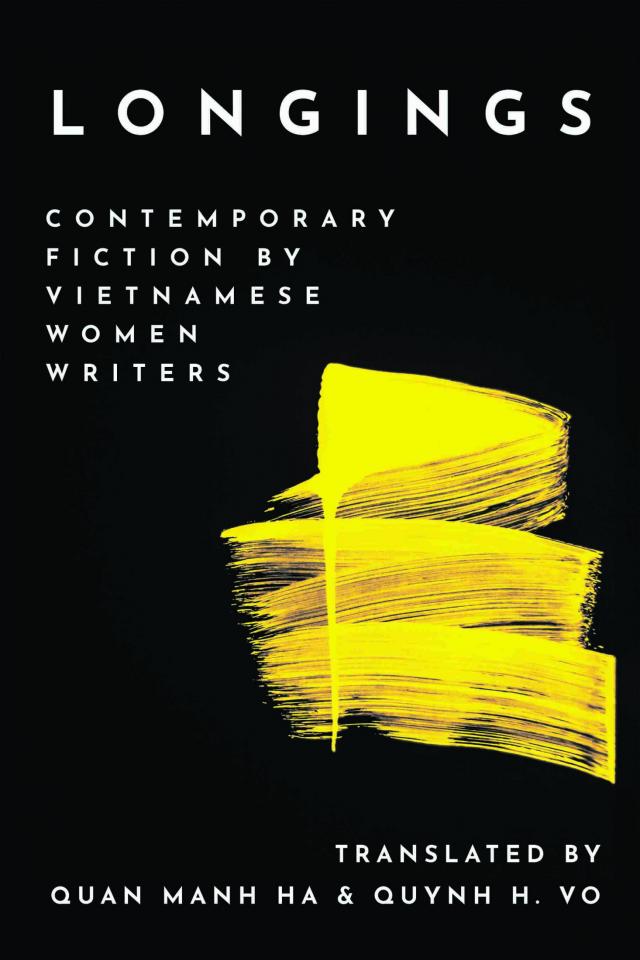
Longings
Contemporary
Fiction by
Vietnamese
Women
Writers
Translated by
Quan Manh Ha and Quynh H. Vo
Texas Tech University Press
Copyright © 2024 by Quan Manh Ha & Quynh H. Vo
All rights reserved. No portion of this book may be reproduced in any form or by any means, including electronic storage and retrieval systems, except by explicit prior written permission of the publisher. Brief passages excerpted for review and critical purposes are excepted.
This book is typeset in EB Garamond. The paper used in this book meets the minimum requirements of ANSI/NISO Z39.48-1992 (R1997). ♾
Designed by Hannah Gaskamp
Cover designed by Hannah Gaskamp
Library of Congress Cataloging-in-Publication Data
Names: Ha, Quan Manh translator. | Vo, Quynh H., translator. Title: Longings: Contemporary Fiction by Vietnamese Women Writers / translated by Quan Manh Ha and Quynh H. Vo.
Description: Lubbock: Texas Tech University Press, 2024. | Series: Diasporic Vietnamese Artists Network (DVAN) | Summary: “Collected fiction by contemporary Vietnamese women writers, showcasing both established and emerging voices”—Provided by publisher.
Identifiers: LCCN 2023048066 (print) | LCCN 2023048067 (ebook) |
ISBN 978-1-68283-206-6 (paperback) | ISBN 978-1-68283-207-3 (ebook)
Subjects: LCSH: Short stories, Vietnamese—Translations into English. | Short stories, Vietnamese—Women authors. | LCGFT: Short stories. Classification: LCC PL4378.82.E5 L66 2024 (print) | LCC PL4378.82.E5 (ebook) | DDC 895.92/230108—dc23/eng/20231213
LC record available at https://lccn.loc.gov/2023048066
LC ebook record available at https://lccn.loc.gov/2023048067
24 25 26 27 28 29 30 31 32 / 9 8 7 6 5 4 3 2 1
Texas Tech University Press
Box 41037
Lubbock, Texas 79409-1037 USA
800.832.4042
ttup@ttu.edu
www.ttupress.org
Contents
Introduction
A Note on the Translation
White Pillows: Dạ Ngân
The Red Cushion: An Thư
Green Plum: Trần THÙY Mai
The Island: Nguyễn Ngọc Tư
Raindrops on His Shoulders: Tống Ngọc Hân
Late Moon: Nguyễn Thị Châu Giang
The Eternal Forest : Trịnh Bích Ngân
Selecting a Husband: Kiều Bích Hậu
The Haunted Garden: Trầm Hương
Desolate Grassy Hill: Trần Thanh Hà
Longing in Vain: Nguyễn Hương Duyên
The Bitter Honey: Niê Thanh Mai
After the Storm: Trần Thị Thắng
Mother and Son: Phạm Thị Phong Điệp
Boozing with a Khmer Rouge: Võ Diệu Thanh
Innermost: Phạm Thị Ngọc Liên
On the Rạng Riverbank: Trịnh Thị Phương Trà
Spring Buds: Nguyễn Phan Quế Mai
The Smoke Cloud: Nguyễn Thị Kim Hòa
At the Border: Võ Thị Xuân Hà
The Sound of Lip Lute Behind the Stone Fence: Đỗ Bích Thúy
Under the Blooming SILK COTTON Tree: Tịnh Bảo
Acknowledgments
Contributors
Permissions
Introduction
Half a century has passed since the American War ended, and Vietnamese women in contemporary society no longer face life-and-death situations due to bombs and bullets, yet they continue to grapple with economic and political upheavals, as well as societal changes and moral degradations. Especially after the normalization of United States–Việt Nam diplomatic relations in 1995, Việt Nam has integrated itself forcefully into the global community, bringing about an influx of new commodities, knowledge, and values. More Vietnamese have been exposed to new ideas and concepts of globalism, Third World feminism, gender politics, and intercultural interactions, thanks to the internet, an increase in the diversity and accessibility of translated literature, and international travel, which has helped them to analyze, question, and even challenge dominant cultural values, norms, mores, and expectations.
This increase in critical examination of Vietnamese society and women’s place in it has had a significant impact on the country’s literature. However, in many of the works written by women, female characters still hold conventional values that perpetuate a heteropatriarchal mentality that is at odds with newly emerging views. For example, women’s fidelity and submission, long considered noble traits of Vietnamese femininity deeply rooted in Confucianism, remain a prominent theme in works of fiction. Nguyễn Ngọc Tư, a highly acclaimed female writer living and writing in Cà Mau, the southernmost province of Việt Nam, lamented this reality while judging submissions for the 2019 Vietnamese literary contest, “The Other Half of the World,” sponsored by the LiBeraturpreis-Frankfurt Award:
. . . the majority of women characters in this collection, The Other Half of the World, is submissive, vulnerable, and acquiescent. . . . They are naïve, altruistic, and gullible in the face of sins, and always sacrifice themselves for others if a tragedy otherwise would strike their family. Compassion and empathy compel female writers to use their pens to celebrate miserable, submissive women while leaving women who dare to confront injustice and who know how to love themselves as much as they love others to remain in the shadows. Writing about sacrifice, resilience, and the endless love of women is a double-edged sword. It can result in locking them behind walls. Even if those walls are made of gold, existing in such a space is not freedom at all. (12; my translation)
In Việt Nam’s heteropatriarchal society, where Confucian doctrines of hierarchy and masculinity are still dominant, feminism is deemed a luxury. A Vietnamese proverb says, A much-trampled earthworm will eventually grow a spine. Feminist sentiments in Vietnamese literature have “grown a spine” since the 1930s. Female authors like Nguyễn Thị Kiêm (aka Manh Manh), Huỳnh Thị Bảo Hòa, Phan Thị Bạch Vân, Đạm Phương nữ sử, and Sương Nguyệt Anh, as well as male authors such as Nhất Linh, Nguyễn An Ninh, Phan Khôi, and Đặng Văn Bảy appeared, blazingly for a time and then ceased to “wiggle.” In the former Republic of South Việt Nam, Trùng Dương, Nhã Ca, Túy Hồng, Nguyễn Thị Hoàng, and Nguyễn Thị Thụy Vũ came into their own during the American occupation. These writers, derisively labeled by their male contemporaries as “female bandits” (nữ tặc), explored existentialism in the context of female agency vis-à-vis the patriarchy. Their prevalent themes—female desire, rebellion against the Confucian tradition, sexual harassment, unwanted pregnancy, adultery, etc.—were considered shocking during their era but have become common subject matter in stories penned by women featured in this collection. It was not until the end of the twentieth century and the beginning of the next that female characters more consistently exhibited self-consciousness and resistance, making women’s literature more enchanting. Some of the female writers that have gained reputation outside Việt Nam are Dương Thu Hương, Phạm Thị Hoài, Đoàn Ánh Thuận, and Nguyễn Phan Quế Mai.
In regard to writing style, narrative techniques, and perspectives, these newer works share many traits. They tend to focus on one specific moment in the quotidian life of a character as opposed to chronicling their entire lives. They also prefer to dwell on the common as opposed to the fantastic so as not to romanticize life, thus expressing the author’s true feelings about the evil or grotesque aspects of traditional humankind and society. Finally, the fiction articulates the author’s aspirations for freedom, social recognition, compassion, and love, while promoting individuality and examining private life via a first-person narrator to reveal multifaceted, complex human psychological states.
Longings: Contemporary Fiction by Vietnamese Women Writers reflects these trends while also presenting examples of stories that break conventions. The anthology brings together twenty-two literary works from both prominent, well-established female authors and younger, emerging voices. Longings introduces English readers to the diverse styles, themes, and subjects that are contributing to a burgeoning body of contemporary Vietnamese short fiction. The authors come from various regions, backgrounds, and ethnic groups. Their narratives reveal the aspirations, struggles, sorrows, and joys of Vietnamese women as they navigate uncharted landscapes in the new millennium.
The majority of these selected stories were written after the year 2000, and many have been published in major Vietnamese literary magazines, newspapers, or short-story collections. Some of them have won national or regional awards. While many of the stories are set in
contemporary times, a few look to the past and instill wartime situations with post-liberation views. For example, among the many famous writers in Longings is Dạ Ngân, a former soldier who fought against the Americans. Her story, “White Pillows,” celebrates the extraordinary traits of a woman whose marital bed becomes a psychological battlefield. The character must endure her husband’s impotence caused by a battle injury. The couple lives together and shares the same bed, but the wife constantly feels empty and must resign herself to seeking solace in the white pillows that represent her suppressed emotions and desires. On the one hand, the story depicts the cruelty of war and its aftermath; on the other hand, it condemns outdated notions of female dignity, as the main character seeks sexual gratification outside of her marriage.
Another story that is related to the war is Trịnh Thị Phương Trà’s “On the Rạng Riverbank,” which depicts a woman named Mịch who remains single for decades after her husband is killed in battle. The couple had been able to spend only a single night together before the husband left, ultimately never to return. For the remainder of her life, Mịch does nothing but long for her husband and reflect upon their brief time together. Such a depiction serves as a reminder of the monstrosity of war that left many Vietnamese women living in solitude, haunted by nostalgia.
The stories involving war in this anthology do not describe the sound of gunfire and explosions or offer gruesome images of bloody battles. Trần Thanh Hà’s “Desolate Grassy Hill,” for example, takes place in a mountainous region in central Việt Nam, where a man’s flute playing conveys the hidden sorrow he experiences after discovering his lover had married someone else, after he himself was believed to have died in combat. He ultimately builds a life with a schoolteacher who had been made an outcast due to her bearing children out of wedlock. The story thus articulates the need to overcome or ignore prejudices and social stigmas. Human efforts to reconcile one’s post-1975 life with the war are found in “Boozing with a Khmer Rouge” by Võ Diệu Thanh. Set in the years directly after the Sino-Vietnamese War (1979), a bloody period generally unknown to many international readers, Võ’s story focuses on a female veteran whose strength is tested when confronted with the need to forgive.
“The Smoke Cloud” by Nguyễn Thị Kim Hòa conjures up a pre-1975 Sài Gòn where people rummaged through airport trash for items to sell and where nearby bars served soldiers’ sexual needs. The love triangle between Diễm Thuý, Bình, and Philip reflects less a political tension than a love-versus-gratitude dilemma. The war’s legacy is presented even more traumatically in “Mother and Son” by Phạm Thị Phong Điệp, in which the female protagonist marries a victim of Agent Orange, and the couple is thus unable to have normal, healthy children. Their adoption of a child abandoned by his real mother demonstrates the unconditional sacrifice and love Vietnamese parents typically have for their children—qualities that are challenged as the boy grows into a wicked adolescent character.
The legacies of war, as well as natural disasters and ineffective political leadership, resulted in poverty, tribulations, and social injustice even as the country enjoyed relative peace in the 1980s and 1990s. The majority of the population was victim to a stagnant economy and food shortages. Although author Trần Thị Thắng crossed the Trường Sơn Mountains and went south with thousands of other North Vietnamese Army soldiers to fight, her story “After the Storm” is not about the war. Rather, it is a realistic depiction of contemporary life. Việt Nam’s long coast is hit by several typhoons annually, and each storm wreaks havoc, ravaging property and taking lives. In major cities, thousands of people, like the story’s female protagonist who has lost everything, must attempt to eke out a living by leaving their hometowns and working as maids, caregivers, and bricklayers.
Fragile and impetuous women often face tragedy in Vietnamese literature. The heroine Thúy Kiều in Nguyễn Du’s national epic The Tale of Kiều (1820) sells herself into marriage with a middle-aged man who turns out to be a pimp; the female peasant Dậu in Ngô Tất Tố’s classic novel Light Out (1937) vehemently resists the arrest of her husband for failing to pay exorbitant taxes. Similar themes are explored in this anthology, including the unjustified suffering of the daughter in Tịnh Bảo’s “Under the Blooming Silk Cotton Tree,” who loses self-control and accidentally murders a thug to defend her mother, which results in her wasting her youth in prison. Võ Thị Xuân Hà’s “At the Border” depicts how many women have become the victims of human trafficking at the Việt Nam–China border. The story ends with an optimistic message of moral redemption, while “Green Plum” by Trần Thùy Mai involves similar themes but concludes on a more pessimistic note. Trần writes about some women’s degradation with compassion, while revealing the all-too-common fate of those young women who must trade their bodies for survival as the free market careens along.
In the introduction to an anthology of Vietnamese short fiction by women writers since 1986, critic Đoàn Ánh Dương observes that Vietnamese women writers do not often attempt to subvert the patriarchy completely, but instead attempt to find equilibrium within the centuries-long reality of Vietnamese culture (11). The domestic sphere poses a challenge to many women, as men are still regarded as the head of the family, and feudal concepts of gender inequality remain rampant in society. External circumstances need to be taken into consideration as well: poverty, the expected role of the male breadwinner, and the pressures of socioeconomic conditions often lead men to take their anger and frustration out on their loved ones or rely on alcohol to cope with their stress. In response, Vietnamese women turn to marriage brokers to find them a Korean or Taiwanese husband in the hopes of assisting their relatives back home financially, while also attempting to escape domestic violence, even if it is just as likely to occur abroad.
The Vietnamese patriarchy dictates how a person should act, think, and live, and often women grapple with how to balance the expected role of a nurturing mother and a caring wife with their aspirations for freedom and gender equality. Such aspirations are becoming more commonplace with each passing decade. Trịnh Bích Ngân’s story “The Eternal Forest” can be read as a Freudian-influenced text that depicts how Vietnamese women indulge or suppress their true emotions and hidden desires.
Both Nguyễn Hương Duyên’s “Longing in Vain” and Phạm Thị Ngọc Liên’s “Innermost” address the issue of adultery. In “Longing in Vain,” the wife commits adultery, while in “Innermost” the husband does. Although the motivations for adultery are different, both stories emphasize karma and seem to show sympathy for the male characters, thus revealing how concepts of patriarchal dominance remain in literature that ostensibly seeks to include more progressive principles.
For centuries, Vietnamese people have shared the belief that one’s failure to produce a male offspring represents bad karma for immoral behavior. The wife in An Thư’s “The Red Cushion” is forced to practice an antiquated custom in order to give birth to a son to continue her husband’s family’s lineage, because her pertinacious husband and superstitious parents-in-law refuse to believe in medical science.
While some of the stories in this anthology are content to poke lightly at social norms, or simply to shine a realistic light on them, others approach the issues more boldly. The aunt in Nguyễn Thị Châu Giang’s “Late Moon” defies every traditional value that her older, conservative sister holds regarding gender expectations. Similarly, when the character Aunt Sửu in Trần Thanh Hà’s “Desolate Grassy Hill” leaves her impotent husband and has a child out of wedlock, she defends her taboo behavior simply by offering: “I don’t give a damn about what people say.” In Trầm Hương’s “The Haunted Garden,” the character Hằng refuses to be affected by toxic rumors when she invites her brother-in-law and his children to live with her after her sister dies in a fire.
Việt Nam’s urbanization in the past decades, and its increased global connectivity, have created a clear chasm between city and rural experiences, which is reflected in many of the stories in Longings. Cosmopolitan views are offered in “Selecting a Husband,” an erotic story by Kiều Bích Hậu. Leaving a traumatizing marriage, the character n ventures away from her agonizing fate, like a water hyacinth drifting to distant shores, following the current’s whims. She resists the traditional mindset that a woman needs a husband, and she pursues physical fulfillment with numerous partners. She even aims to mold a man into an individual who is beholden to her own emotional and sexual needs. Meanwhile, during a trip abroad, the character Lan, in Nguyễn Phan Quế Mai’s “Spring Buds,” must decide between reuniting with a former Australian lover or dutifully returning to her husband and children in Việt Nam.


