

Longings, p.2
Longings,
p.2
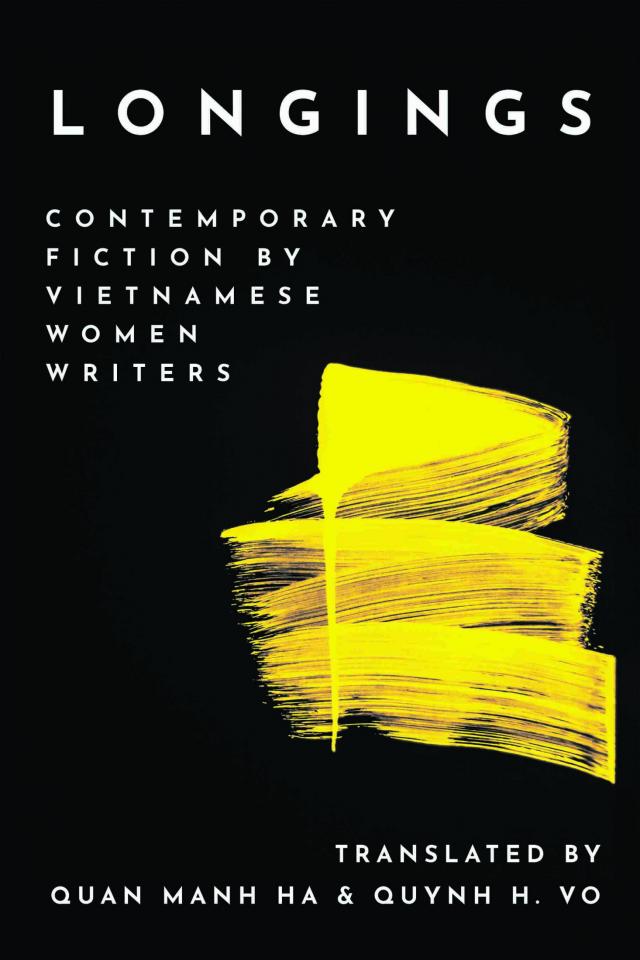


Unbeknownst to many foreigners, the Vietnamese are not a single ethnicity, as the majority Kinh people constitute just one of fifty-four different ethnic groups. Longings thus includes three stories about ethnic Vietnamese women, one of which was written by a member of one of those groups. Đỗ Bích Thúy’s “The Sound of Lip Lute behind the Stone Fence” focuses on a Hmong family in which the husband has decided to take a second wife. The story wrestles with how women in such situations can either resign themselves to a marginalized life or take active steps to secure their own happiness. Meanwhile, limited education and patriarchal assumptions make it difficult for the Hmong women, Mắn and her sister Mẩy, in Tống Ngọc Hân’s “Raindrops on His Shoulders” to take control of their fates. Niê Thanh Mai’s “The Bitter Honey” is a heartbreaking narrative focusing on three women from the Êđê ethnic minority community who reside in the Central Highlands. While a matriarchal social structure allows Êđê women to choose their husbands and live with them in their own houses, the invisible ropes of ethics and commitments bind them to a traditional niche in their culture. The story seems to argue that even outside of the patriarchal system, bitterness and loneliness continue to lurk.
During wartime, women longed painfully for the return of their husbands and sons while managing to carry out all domestic duties. In peace, they continued to wait agonizingly for husbands confined to reeducation camps, and they had to risk perilous journeys when fleeing in rickety boats just for the opportunity to toil in a foreign place far from their beloved homeland. During these times, longing became a virtue of Vietnamese women that persists to this day.
This anthology contains stories that depict past longings as well as ways in which their longing expresses itself in many contemporary women’s outlooks. But rather than connect longing to unwavering concepts of patriarchy, the stories reveal how new ideas and emerging notions of feminism and equality can add a new dimension to the virtues that today’s Vietnamese women aspire to uphold. A woman’s longing can be a source of power, a means by which to expose society’s problems and even rectify them. While Longings aims to present an introduction to the vibrancy of contemporary female writers, it also seeks to instill in readers an appreciation of and hope for Vietnamese women whose stories reveal their inner aspirations.
huỳnh như phương
professor of literature, hồ chí minh city national university of social sciences & humanities
Works Cited
Đoàn, Dương Ánh. “Những khúc quoành của văn học nữ Việt Nam đương đại” [“Twists and Turns in Contemporary Short Fiction by Vietnamese Women Writers”]. Truyện ngắn nữ đặc sắc Việt Nam từ 1986 đến nay [Selected Short Fiction by Vietnamese Women Writers since 1986]. 2nd ed. NXB Phụ Nữ, 2015, 5–12.
Nguyễn, Tư Ngọc. “Dát vàng nước mắt” [“Gilded Tears”]. Một nửa làm đầy thế giới [The Other Half of the World]. NXB Văn Hoá-Văn Nghệ, 2019, 10–13.
A Note on the Translation
Translating Vietnamese literature into English is like walking a tightrope, especially because the two cultures and languages differ vastly from each other. During the process of translation, we served as both translators and editors. While we attempted to remain as faithful as possible to the original Vietnamese, we sometimes had to add a few phrases or even an occasional sentence to a scene to make the meaning or intent more understandable to English-speaking readers. Our translations prioritize the story’s context and content as well as the natural flow of the narrative and the voice(s) in the storytelling. Vietnamese literature does not undergo the same rigorous review process before publication that American literature does; therefore, we occasionally have accepted this role, as well. For the sake of conciseness, we removed redundancies, repetitions, and wordiness; we also rearranged passages when necessary for clarity. When making the changes, we were careful not to distort or alter the meaning that the authors have revealed in their stories.
Việt Nam is a tropical country, and in many of the stories, certain regional trees, flowers, or food might be unfamiliar to Western readers. In some cases, we preferred to use the original Vietnamese word. However, in the opening of Dạ Ngân’s story, “White Pillows,” the author describes many regional trees in the Mekong Delta, and none of the Vietnamese names will be recognizable to Western readers. We thus used their English names so that readers easily can look them up and visualize the story’s setting.
A few stories in this collection are a bit longer than their original Vietnamese versions. We selected many of the stories from Vietnamese newspapers or magazines, which often impose strict word limitations. Free of these constraints, we contacted the authors and asked them if they might prefer to include additions that elaborated on descriptions or plots. Võ Thị Xuân Hà added nearly two pages to the beginning of her story, “At the Border,” for example, which affords the story a socioeconomic angle. Tịnh Bảo also elaborated on the abusive male character in “Under the Blooming Silk Cotton Tree.” We also consulted with the authors when we made some minor changes to make their stories more readable and accessible to English-speaking audiences. For instance, in the original Vietnamese version of Trịnh Bích Ngân’s “The Eternal Forest,” the female protagonist’s roommate does not have a name, and in order to distinguish them, we named the roommate Hạnh, which by no means affects the story’s plot.
Communication between characters was an issue in translation, because English and Vietnamese do not mirror one another in casual speech. For instance, it is typical for a Vietnamese to ask, “Have you eaten yet?” or “Where’re you going?” as a greeting, while an American might typically ask, “Hey! How’s it going?” In some cases, we had the Vietnamese characters speak in a way that would be familiar to English readers so as to preserve intent, if not the literal wording.
Another conundrum of translation involves personal pronouns. The Vietnamese address each other with a variety of pronouns dependent on age and gender, rather than by first names, as is common in the West. A man, for example, can be addressed as em, anh, con, ông, bác, or chú, depending on age and relationship with the speaker. Thus, in Vietnamese literature, a character may be treated with various honorifics or titles based on the speaker or point of view, while their given name remains unknown. In our translations, we avoided confusion by adhering to Western notions of referring to individuals by a single name and adding necessary relationship indicators accordingly.
The significance of regional dialects and ethnic attributes are also impossible to capture from Vietnamese to English. More so than English in America or in other Western countries, Vietnamese differs greatly by region. Accents and terms vary among the North, South and central areas, to say nothing of terms specific to ethnic minority groups. Vietnamese readers will pick up on an author’s background based on the use of language when reading a story in their native language, but it is impossible to engender such differences in English. The translations thus make no attempt to translate local slang literally, for which English has no appropriate analogy.
Another decision we were forced to make involves the use of diacritics (the accent marks above letters that inform how a word is pronounced and thus what it means). These markings give words drastically different meanings in Vietnamese (for example: áo means “shirt,” ao means “pond,” and ảo means “illusive”). We chose to keep the diacritics as they appear in Vietnamese to maintain the beautiful musicality of the Vietnamese language and to help those who are interested in learning the language look up certain Vietnamese words easily.
The most fascinating but also the most grueling task we wrestled with was in remaining true to the narrative point of view. In a typical English story, the point of view is normally clearly indicated, whether it be first-person limited, third-person omniscient, or third-person limited. For a variety of historic and linguistic reasons, this is not the case in Vietnamese fiction. Perspectives often shift, and details are presented from the perspective of varying characters who may not logically be privy to the alternate perspectives. In our translations, we attempted to alter the narrative perspectives to conform to Western conventions of storytelling, which provide the narrator with the necessary omniscient knowledge or perspective. This means that we occasionally had to change the point of view for various sections of the stories.
Translation is an imperfect enterprise; thus, some nuances are inevitably lost. However, these minor flaws do not negate the value of the process. If one is unable to read the stories in their original language, translation is vital for unlocking the pleasure and knowledge they contain. We hope these translations do justice to the original authors’ intents and talents, while also standing alone as powerful stories in English.
quan manh ha and quynh h. vo
Longings
White Pillows:
Dạ Ngân
In this region, kapok trees are planted for residential use, not for public or commercial use as are banyan trees planted near river piers to prevent erosion, pink shower trees with beautiful blossoms to enhance the landscape, tamanu trees for making chopping boards, and sakae trees for constructing monkey bridges. Only those who have sophisticated taste plant a kapok and even then only one in a corner of their garden. During sunny months, kapok pods look like bats’ wings dangling in the wind. They gradually drop off the trees and land on the ground. People dry them in the sun and then keep them in bamboo baskets or sacks. When they are not too busy with farming, they peel the kapok pods, remove the seeds, and put the fibers into a sack again to dry further. The fibers are used to make pillows and mattresses. In this rural region, local beds have not only regular pillows but also bolster pillows.
In fact, this story has nothing to do with kapoks. I briefly mention them so that you can imagine the scene further. Let’s imagine that there is a woman who, as a habit, always refreshes her pillows before Tết. She lives in the city, so there is no land for a garden, and thus no kapok. But that doesn’t stop her habit. She tells the pillow shops in the market to save some sacks of the fresh, cotton-like kapok fibers for her. She doesn’t know how to drive a motorbike, so she carries the puffy sacks home on a bicycle. She washes the pillowcases, opens the pillow protectors, and throws away the old fibers or dries them in the sun to make them soft and fluffy again. She stuffs new fibers inside, which smell fresh and natural. Her pillows are like children who wear new clothing for Tết. The pillows lie all over her bed. She stuffs them with a half-century of emotions and suffering. If Heaven blessed her with beauty and dignity, Heaven also challenged her.
“If I don’t hug a pillow, what will I hug?” This is what she says when I glance at the white pillows that occupy her tidy bed. She doesn’t punch me in the chest or do anything violent, but it feels as if I had been punched in the chest, making it hard to breathe. What if he had just crawled in like everyone else, what if he hadn’t been overly cautious by lying down on his back before sliding into the bomb shelter. What if . . .
My dear friends, she used to be very beautiful, undoubtedly. She was a Phong Điền countryside woman with ivory skin and elegant manners. Her face was slightly angular, not a meek oval face. Her youthful years carried her down the river’s currents, like hyacinths floating on the water with newly blooming purple flowers. And he was waiting for her somewhere; people call it fate. They were compatible. He was a stalwart and caring gentleman. He was also from the countryside, the same district but from a different commune. Back then, I was a clumsy rural Southern adolescent while they were already a perfect golden couple, although back in those days nobody would describe them with such flowery words.
“You know, it would be weird if my hair hadn’t turned gray,” she’s cried out many times. Her hair turned gray remarkably, right after 1975, when she was only thirty. She doesn’t dye it because that would be time-consuming and useless. I feel like someone punched me in the chest again and I can’t breathe. What if he had just crawled in like everyone else, what if he hadn’t been overly cautious by lying down on his back before sliding into the bomb shelter. What if . . .
I had heard about them before I met them in person. They were in the same subcommittee and made a perfect couple, people said. But . . . What if he had just crawled in like everyone else, what if he hadn’t been overly cautious by lying down on his back before sliding into the bomb shelter. What if . . . ?
During the war, she used to go to a farmer’s house located on a river embankment where her twin daughters were being cared for. That day she was with her daughters. Her husband’s injury, caused by bomb shrapnel, was not life-threatening, but it was severe. She was beautiful and he was a wonderful husband. I didn’t witness the injury and by the time I joined the military, she had already sent her children to her family in Phong Điền so that she could devote all her time to taking care of him in the hospital. Then, she returned to her subcommittee, and he was transferred to the subcommittee that I had just joined. It was said that he had requested the transfer because they needed some time away from each other. Everybody was concerned about it although they understood the situation very well: he could no longer fulfill his role as a husband, so there was no need for him to be by her side.
After spending a day with him, I immediately recognized that he was the kind of man that any woman in search of happiness would want. He was mature, the shape of his mouth looked cheerful, his eyes were calm, he talked politely, he was hardworking. No wonder it was said that they were compatible. But his skin started to grow pallid and dull. He looked reserved, and his laughter was no longer jovial. This is unusual for a person possessing such positive traits. A few days later, I saw him whittle a bunch of short bamboo sticks, wrap cotton balls around one end, and tie the sticks in small bundles. I asked, and he replied without hesitation, “I have constipation; I need to eat more fiber, like sweet potatoes or papayas, but I can’t find them here. Whenever I defecate, I need to use these sticks.” I shuddered but couldn’t imagine how the bomb shrapnel must have wounded his intestines. I saw his wife wrestle with her plight and misery every night. What if . . .
It is impossible for a bolster pillow to replace a man who joins the revolution. Women like us rested our heads on diaries and a few notebooks, and held an ammo box, or a memento from the war, tightly in our arms. A strap attached to the ammo box allowed us to carry it across our bodies while marching. We coiled it behind us in the mud before worming our way down a secret trench, keeping all necessary personal items in that ammo box, including an olive mosquito net, a plastic hammock, some clothes, a mirror, a comb, toothpaste, and a toothbrush. You might want to know where we kept our towels or scarves. Well, we carried a large piece of parachute fabric on our backs, also seized in battle, for camouflage, and we wore checkered scarves around our necks, which functioned as towels, or as something to keep us warm, or to drive mosquitoes away. I held the hard, cold ammo box while lying on my side, imagining how she, my pitiful friend, was also holding an ammo box whenever she missed her husband and couldn’t sleep. Nobody separated them; they had confronted their dilemma: they couldn’t leave each other, and they couldn’t be together, either.
He often rowed a boat to visit his wife. He departed in the early evening so that he could go to work in the morning. However, after each trip, he would no longer be the same person as before. He was losing confidence, his skin became more pallid, his face more gloomy. The men in his company were polite and said nothing. They asked no questions, and what could they have asked anyway? Of course they couldn’t ask something like, “Did you and your wife have a good time?”
Behind his back, they talked about his situation hesitantly: “When they meet, they only hold each other and cry.” I couldn’t imagine him crying or holding her tightly against his chest and listening to her sob. If she cried too much, her tears eventually would dry up. Every day I looked at him from different angles and saw that the muscles around his mouth rarely moved, causing a depressing atmosphere to surround him.
She didn’t visit him often, and when she did, she always stayed with him for two or three days. A young man named Liền helped her row a small boat to reach him. She sat at the bow and held a paddle. She made her own broad-brimmed hat and blouses. The dark color of her blouse highlighted her beautiful skin; her long hair flowed down her back, reaching her tiny waist. Her husband would hurry toward her, smile genially, touch the bow of the boat, and anchor it with a rope to a Y-shaped tree branch. Then he would look at me mischievously. He wanted to be a matchmaker for me and Liền, who, according to him, was a tall and robust man, with wavy hair. Liền was around my age—and so compatible. I realized that he was fond of Liền simply because he gave him and his wife something interesting to talk about whenever she visited him. I had no special feelings for Liền, but I admit that I liked his youthfulness and strength. Liền often stayed and hung out for a while with them, and he always asked her before leaving when she wanted to return to her subcommittee so that he could come and fetch her.
On unofficial days off, she turned me into her younger sister. She offered me tips for when I would be married. How to add spices to a pot of sweet and sour soup. How to cut herbs properly and how to throw them into the pot once the fire was turned off so that the herbs’ color remained green. How to make caramel sauce when cooking braised dishes. How to make chili and garlic fish sauce for a fried fish dish. How to properly cook white cowpeas with coconut milk sweet soup. Her voice was clear, her heels soft, her eyes had nice edges, her mouth was charming, and, most importantly, she knew how to manage a family budget efficiently. All men wanted a wife like her. When visiting her husband, wherever she sat, he sat behind her and wrapped his arms around her to help her with whatever she was doing. At night, on the bamboo bed, beneath mosquito nets, I heard them whisper, sniffle, turn their bodies to kill mosquitoes, and then whisper again.


