

Dust child, p.33
Dust Child,
p.33


Just three more months and we’ll see you again! We are counting down each day and can’t wait to visit your home. Linda is very excited to go fishing with Tài and Diễm, taste the delicious vegetables in Phong’s garden, visit Bình’s rice field and hear her sing, and learn how to cook from Quỳnh. We will test our skills with Phong’s musical instruments, of course, but might not be brave enough to take up your offer to ride on a water buffalo!
Tài and Diễm: your English is getting so good; I hope one day I’ll be able to write you letters in Vietnamese the way you are writing to us in English.
Bình: thank you again for sending Linda the áo dài dress. She still wears it to all our parties. Her friends are jealous and want tailor-made clothes, too.
Quỳnh and Phong: it’s truly a miracle that you have found each other. It makes me smile every time I think about it. Your reunion enables me to believe in God again. I hope our family will be further extended when we find Hoa.
See you soon!
With many warm hugs from Seattle,
Dan (and Linda)
It was the second time Quỳnh listened to the letter but she still found herself teary-eyed. She noticed how positive Dan sounded, how enthusiastic.
“Did Mr. Dan really write ‘our family’ in the original letter?” Diễm asked Tài. “Or did you make it up?”
“Make it up?” Tài snorted. “I had to show both the English and Vietnamese versions to my teacher, you dumbhead.”
“Hey, no foul language, remember?” Quỳnh said sternly. “Of course Mr. Dan and Mrs. Linda are our family, for the many things they have done for us, and we for them. But more than that, we share a common history that bonds us together stronger than any blood ties.”
“When you answer the letter,” she told Tài, “could you ask how someone could make a donation to their charity?” None of her family members knew, but over the years, she had donated money to hospitals, pagodas, and orphanages. She’d had good financial fortune, and it was her duty to share her luck with others. And she hoped the psychologists from Dan’s group might talk to Phong, who had told her about his past panic attacks.
“Please, Grandma . . . can I have Mun?” said Diễm as they settled into bed again.
“We’re not supposed to have the dog in bed, but I’m sure Grandma won’t tell,” Tài laughed.
“Ah . . . That could get me into big trouble with your parents, but I suppose it’s worth it.” Quỳnh laughed along. Spoiling her grandchildren was not only her great joy, it was her job. Mun was half-sleeping in her basket when Quỳnh picked her up and brought her to Diễm. The dog smelled like a rose from this afternoon’s bubble bath.
With the warmth of her grandchildren against her, Quỳnh sang one lullaby, then another, and another, until Tài and Diễm relaxed in her arms and their breathing became regular.
Quỳnh slipped from the bed and stepped out to the front yard. The stars were alive above her. They looked like Trang’s eyes. Quỳnh brought her palms together in front of her chest and looked up. In the star’s twinkle, she was reminded that her sister lived on—Trang lived on in the light that had given Quỳnh strength in her darkest moments.
“Thank you for helping me find my son, chị Hai,” she whispered. “You arranged for Phong to meet Dan, then for Dan to find me. You brought us together.” She bowed to the stars’ light. People who died young are said to have supernatural powers, and she believed this now. She believed in the blessings of the dead, and the interconnectedness of life. And she believed that all stories relating to the war were connected, one way or another, by blood.
Looking up to the sky, Quỳnh saw Trang’s face. She was still nineteen, forever young, forever beautiful. Before Trang’s burial, Quỳnh had knelt down next to her sister. She’d wiped all the blood away from Trang’s face, covered her sister’s head with a scarf, took off Trang’s torn clothes, and dressed her sister in fresh shirt and pants. “You are the most special angel,” she’d whispered to Trang, trying not to cry, for she’d heard tears that touched a dead person would prevent him or her from having a peaceful departure from earth.
“Chị Hai, I know you’re watching out for me, so please do more,” Quỳnh told the stars. “Please convince Khôi to accept Phong. Please protect my secret. Please help us find Hoa.”
She had prayed for Hoa often. She wished for Hoa to be at peace. She hoped that Hoa was loved by her adoptive family, who could make up for her parents’ absence. She wished she could find Hoa one day, to tell her how profoundly her mother had loved her.
Quỳnh had loved Trang, too, even though she’d never been able to say it aloud. She’d realized the depth of that love in the abyss of sorrow she experienced after her sister’s death. The sorrow that drove her to drinking, that made her undesirable to the men who frequented the Paradise Bar. After that rainy night when she was kicked out of the bar by her boss, she’d wandered around, wanting to take her own life. Another madam had plucked her out of the street, brought her to her brothel, Minh Anh, and pushed her into the arms of men.
The stars blurred as Quỳnh’s tears started to fall. She cried silently: for herself, for Trang, for the countless young women whose lives had been nothing but firewood in the furnace of wars.
When her tears dried, Quỳnh stood up to go back into the house. She got a whiff of the incense’s fragrance. She’d always loved the smell, for it represented respect, honor, and sacredness, but now she winced, for it reminded her of her lies.
Yes, she had lied to Phong. She had made up her story of romance with Tim so that Phong felt pride in his father and in himself. And now, she could see that the story helped her grandchildren, too.
Phong knew she’d worked at the Hollywood Bar. That part of the story she couldn’t twist because it involved Dan, Linda, and Thiên, but she told him she’d quit after her sister’s passing. Unable to find a decent job afterward, she said, she had sold tea and soft drinks on the street.
The truth was that at the Minh Anh brothel, she’d had to have sex with too many men to remember their faces. None of those men had told her their names. None had shown her any tenderness. She had merely been an object to them.
How could she ever tell her son the truth, that he wasn’t the fruit of a love story but the product of prostitution, and that she didn’t know who his father was? Phong’s father could have been one of the men who had poked at her as if they were poking at dead fish, who had mocked the shape of her eyes, who had called her unspeakable names.
Inside the house, the three red tips of the smoldering incense were still hovering in darkness. Without thinking, Quỳnh stretched her hands and grabbed the incense. The embers sizzled into her palms. She smelled burnt flesh but squeezed them tighter, her heart hammering in the cage of her chest.
In the yard, she dropped the incense. She trampled on it until each stick became dust. With each stamp of her foot, she vowed that the darkness from her past would never touch Phong. She would never let her son know the seeds of his life had come from the depths of her humiliation. She loved him. Out of that love, she had planted the story of Tim and grew it until its fruit tasted sweet in Phong’s mouth. She’d heard Phong telling others about his father with such pride and knew that the sweetness of her fruit of deception was not only real, it was necessary.
Tim was her secret and her fantasy, the name she’d picked out of a book of translated literature. She chose that name because it meant “the heart” in Vietnamese.
She had tried to kill Phong before he was born. She’d beat her fists against her stomach when she found out she was pregnant. She’d swallowed bowl after bowl of bitter herbal medicine.
Now, she was thankful that Phong had refused to let go.
In her decision to continue lying to her son, sometimes regret clouded her mind. Was she denying Phong’s chance of knowing his father, and Tài and Diễm of knowing their grandfather and his family? “No!” She told herself firmly. It was not worth the risk of putting Phong through pain. Whatever Phong and his family needed from his father, she could provide for them. She could take care of them and love them more than any American could. And in a way, Phong had already found his American parents in Dan and Linda, who had become like grandparents to Tài and Diễm.
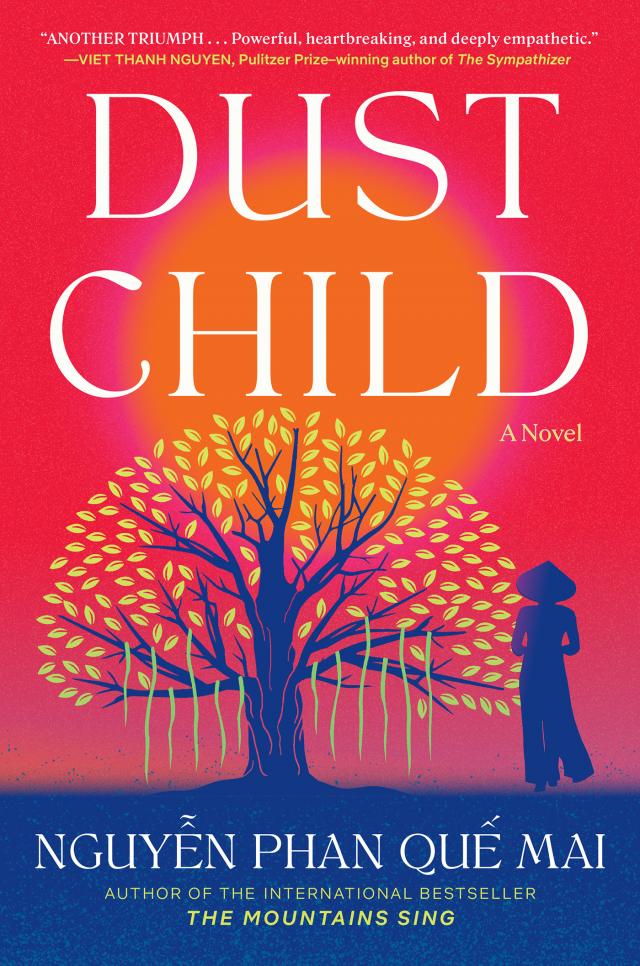
Phong had been looked down on by too many people, who had called him bụi đời—a child of dust. She must keep showing him, in every way she possibly could, that he was the child of love. She respected his decision to look for his father’s relatives. In case he found them or his father, she would deal with the consequences, but for now, she would protect him.
She had tried to live an honest life, but the war had given her no choice. It had forced her to make up a version of herself that was acceptable to others. In a way, making up stories had been the basis of her survival and her success. Her lies had enabled her parents to go on living, and now her lies would protect her sons, their families, her business, and herself.
In her recent visit to her parents’ home, she had unearthed a secret box she’d buried in the garden. The box contained the many letters she and Trang had written home over the years. Those letters hardly contained any truth, but they were beautiful to read. And upon rereading them, she saw how writing them had enabled not just herself but her loved ones to escape horror, and to experience the taste of another life. She was tempted to burn the letters, destroy all the evidence of her past, but decided instead to bring them home. They were safe now, buried deep under the earth, below the banana plants, below the flowers that hung like the red lanterns that once filled the village of her childhood during the Mid-Autumn Festival. The flowers under which she and her sister had waited, full of yearning and hope, for their father to return from the war.
She went into the kitchen, diluted a pinch of salt into a bowl of warm water and disinfected the burns on her palms. She swept the yard with a broom until there was nothing left that would betray her. She checked on her grandchildren and pulled their blankets higher onto their chests. Mun came to Quỳnh, her tail wagging, her wet nose buried into Quỳnh’s arm. Quỳnh picked Mun up, taking solace in the dog’s warmth. She tucked the mosquito net tightly around her grandchildren’s bed. With tears in her eyes, she watched the still shadows of Tài and Diễm. She hoped her grandchildren’s dreams were taking them to a peaceful world where humans were kind to other humans, so that no one needed to live with regret and sorrow.
Out in the yard, with Mun in her arms, she sat waiting for Phong, the stars and the moon bright above her head. There had been days when the starlight had been concealed from her eyes by clouds and storms. But she knew such light was always there. Bright and inextinguishable.
Author’s Note
I grew up in Southern Việt Nam, where during the late seventies and in the eighties I got a glimpse of the discrimination faced by Amerasians born from the wartime unions between American men and Vietnamese women. Over the years, I kept thinking about those Amerasians and hoping that life had treated them more kindly. In April 2014, I read a story that moved me deeply. Jerry Quinn, an American veteran, traveled back to Hồ Chí Minh City with an album of old photos, looking for his girlfriend and their son.1 They had been separated in 1973, forty-one years earlier. Mr. Quinn’s story made me realize the urgency to find their lost children that some American veterans, now in their sixties and seventies, were feeling.
Via an organization that helped unite Amerasians with their parents, I got in touch with American veterans who had been searching for their Amerasian children. I interviewed them and wrote about them for a national newspaper in Việt Nam. I got involved in real-life searches for family members. While I could help several people unite with those they were looking for, after more than forty years, I realized the complexity and the trauma involved. I also learned about the incredible challenges that Amerasians and their family members have had to face.
This novel, Dust Child, took seven years to write and is a result of my PhD research with Lancaster University. It fictionalized my real-life interviews, journalistic experiences, voluntary work with those impacted by wars, reading, and academic research. While characters are fictional, their life stories are inspired by real-life events such as the implementation of the Amerasian Homecoming Act as well as the buying and selling of Amerasians.
Dust Child also aims to demonstrate the effects of wars and armed conflicts beyond the resultant deaths and injuries: approximately 2,700,000 Americans served in Việt Nam during the war alongside and against millions of ARVN and Communist soldiers, most of them were young men, many of whom remain traumatized today. A sex industry, propelled by the American military presence, involved hundreds of thousands of sex workers—mostly young Vietnamese women who suffered their own forms of trauma and social ostracism. There was also a large number of bar girls, not all of whom were sex workers, and who often took their hostess jobs for many reasons, including economic hardship or displacement.
My website (www.nguyenphanquemai.com) has a list of books, films, and resources for those who are interested in finding more about Amerasians and their family members. Some of these books include: Kien Nguyen’s The Unwanted; Sau Le Hudecek’s The Rebirth of Hope: My Journey from Vietnam War Child to American Citizen; Thomas A. Bass’s Vietnamerica: The War Comes Home; Trin Yarborough’s Surviving Twice: Amerasian Children of the Vietnam War; Steven DeBonis’s Children of the Enemy: Oral Histories of Vietnamese Amerasians and Their Mothers; Robert McKelvey’s The Dust of Life: America’s Children Abandoned in Vietnam; Aimee Phan’s We Should Never Meet; Nguyễn Thị Thụy Vũ’s Mèo đêm (Night’s Cats), Ngọn pháo bông (The Tops of Fireworks), and Lao vào lửa (Dashing into the Fire); Le Ly Hayslip’s When Heaven and Earth Changed Places; Nguyễn Ngọc Thuần’s Cơ bản là buồn (It’s Mainly Sadness); Nguyễn Trí’s Ma lực của cội nguồn (The Mysterious Force of Homeland); and Wayne Karlin’s Prisoners and Marble Mountain.
I wrote this book to offer my prayers for a world where there is more compassion, more peace, more forgiveness and healing. May our planet never see another armed conflict.
1 Sue Lloyd Roberts, “A US soldier searches for his Vietnamese son,” BBC News, 26 April, 2014
Acknowledgments
My deepest thanks to Amerasians, mothers and fathers of Amerasians, and all other participants of my PhD research project who shared with me their life experiences and allowed me to fictionalize their stories into this novel. Their names do not appear here, as I would like to protect their privacy and identity, but I bow to them with my deepest gratitude and sincerely hope that their stories will continue to inspire humans to love other humans more so that this world can become a better place.
I am grateful to Lancaster University for giving me a PhD scholarship and, more importantly, a free world to grow my writing dream. I am very lucky to have been mentored there by the award-winning writers Zoe Lambert, Sara Maitland, and Graham Mort. At Lancaster, Jenn Ashworth, George Green, Eoghan Walls, Anne O’Brien, Inés Gregori Labarta, Margot Douaihy, and Tessa McWatt read early versions of this manuscript and gave me much-needed encouragement. Sincere thanks to the writer Wayne Karlin, who helped me sharpen my vision for both my PhD project and this novel.
My journey as a novelist in English would not have been possible without two women who have believed fiercely in me from the very beginning and dedicated countless hours of their lives to this book: my literary agent, Julie Stevenson, and my editor, Betsy Gleick. To Julie, Betsy, and my team—Mae Zhang McCauley, Michael McKenzie, Stephanie Mendoza, Debra Linn, Travis Smith, Kendra Poster, Brunson Hoole, Annie Mazes, Katrina Tiktinsky, Anna Skudlarek, and everyone at Algonquin Books—thank you for lifting my writing up as if it were your own. My most sincere thanks to Christopher Moisan for Dust Child’s beautiful book jacket, Steve Godwin for the unique design inside this book, Chris Stamey for his good eyes in copy editing, and the wonderful people I am fortunate to work with at The Tuesday Agency, Workman Audio, Workman Publishing, Hachette Book Group, and Massie & McQuilkin Literary Agents.
To editors, publishers, and translators who have worked tirelessly to make my work available in many different languages: thank you for giving my writing such rich lives.
To writers, researchers, and filmmakers who have documented the Amerasian experiences as well as the impact of PTSD and trauma: thank you for informing my research with your work.
This book is a result of the very generous support from the Lannan Foundation, who awarded me the Lannan Fellowship in Fiction for my debut novel, The Mountains Sing. Prior to that, my poetry collection, The Secret of Hoa Sen, was published by BOA Editions as part of the Lannan Translations Selection Series. The kind and brilliant people at Lannan rarely advertise the impactful work that they do to support minority writers like me, and I would like to express my sincere thanks to the Lannan family and the entire team at the foundation and its volunteers. Special thanks to Patrick Lannan, Lawrence P. Lannan, Martha Jessup, and Penn Szittya.
Along my writing journey, I have been uplifted by organizations that are making significant impacts in promoting diversity in literature, two of which include The Diasporic Vietnamese Artists Network (DVAN) and the Dayton Literary Peace Prize. My sincere thanks to Viet Thanh Nguyen, Isabelle Thuy Pelaud, Sharon Rab, and Nick Raines.
I am lucky to be surrounded by a wonderful writing community and am indebted to several writers and friends who read earlier versions of this manuscript and offered their insightful comments: Đinh Từ Bích Thúy, Paul Christiansen, Karl Marlantes, Thiếu Khanh, Natalie Jenner, Robert Mason, Sofia Akel, Steven DeBonis, Jimmy Miller, Trần Thị NgH, Elizabeth Griffiths. My heartfelt thanks to writers who read and provided their compassionate blurbs for this novel.


