

Dust child, p.5
Dust Child,
p.5


He gulped down the water, filled the cup again, and helped Sister Nhã sit up. She drank a few sips, shook her head, and lay down again. He was about to go outside when she clutched his hand.
“Phong . . . I hope that you’ll have more than a few minutes for me today. I’m going to tell you a story . . . You have to remember the details, to be able to find your parents.”
His parents? He’d often asked about them but Sister Nhã had always said she didn’t know them. She never talked about her own life, either, as if she harbored some terrible secrets. Why did she decide to tell him now?
He chose the sturdier of their two rickety bamboo stools and sat next to the bed.
Sister Nhã smiled at him. “I’ll tell you the story part by part. Can you then repeat it for me?”
A “no” was forming in his mouth. Was she trying to teach him how to read words? He hated words. Kids who knew how to read and write were monstrous; they hit him and called him all types of names. There had been evenings when Sister Nhã gave him a notebook and a pen. He’d thrown the pen against the wall and the notebook onto the floor. His body ached from the day’s work on the field and all he wanted to do was sleep or play outside. Once, frustrated, Sister Nhã had shouted at him. He screamed back, kicked the notebook. Her slap landed on his cheek so hard his vision filled with fireflies. When he burst out crying, she held him tight, sobbing, apologizing, saying that he needed a proper teacher. She didn’t know that the idea of a school made him shudder; his bullies would be there, waiting for him.
Sister Nhã untangled a dry leaf from his hair. She placed it gently next to her pillow, as if not wanting to break the already brittle leaf.
She held on to his arm. “Darling, without your parents’ names and pictures, your story is all you have. And your story begins with me.”
He nodded. Finally she was going to tell him about herself. He’d always wanted to know why she loved him even though other people despised him.
“I was born a Catholic,” Sister Nhã began. “As a young girl, I wanted to serve God. So instead of getting married, I became a nun and worked at Phú Long Orphanage. In Hóc Môn. On the outskirts of Sài Gòn.” She looked at him. “Now . . . what’s the orphanage’s name and where is it?”
“Phú Long Orphanage. In Hóc Môn,” he said.
“Yes, you clever boy! At the orphanage, together with two other nuns, I took care of Amerasians like you as well as Vietnamese children. Some were orphans. Some still had parents but they were too poor to raise them. Some children had been separated from their parents during bombing raids.”
He nodded. He hoped his parents hadn’t died.
“At the orphanage, there were many things to do but I was happy. My life had a purpose. One spring night after I’d gone to bed and slept for a few hours, I heard a baby crying. The sound was weak, and not from inside the orphanage. I rose from my bed and got my flashlight.
“It was a pitch-black night. There was no moon, no stars, just the wind howling above my head. I shivered in the cool air and shone my light toward the orphanage gate, where the crying came from. Occasionally mothers would leave their babies there.” She looked at him.
He repeated what she had just told him.
She nodded, clutched her stomach. She winced but continued. “As I got closer to the gate, the crying became louder and more desperate. I unlatched the bolt. The metal door creaked as I pulled it open. I stepped outside. I looked around but didn’t see any sign of a baby. I paused and listened more carefully. The sound was coming from somewhere in midair. Oa, oa, oa.”
Hair stood up on his arms and on the back of his neck. “The baby was crying from midair?”
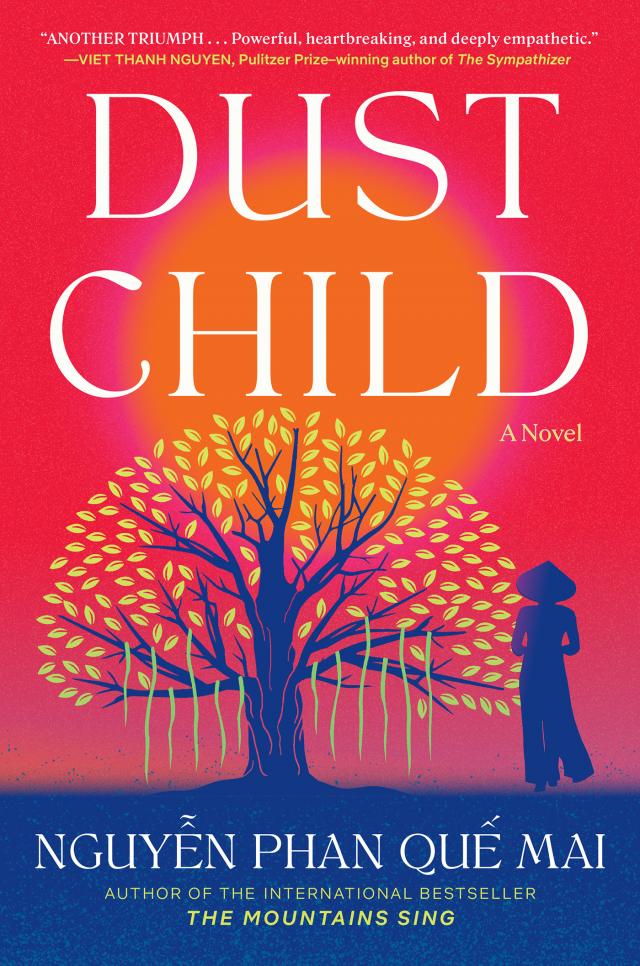
“Yes . . . In front of the orphanage stood an ancient Bodhi tree, with hundreds of hanging roots. This tree is a symbol of Buddhism and even though the founder of our orphanage was Catholic, she insisted that we take care of it to show that people of all religions can live in harmony. That night, I saw a bag dangling from one of the Bodhi’s branches. A sedge bag! The crying was coming from there. I rushed to the bag and lowered it. Reaching inside, I felt a baby. Wrapped in a blue blanket, it was as small as a cat, and trembling.”
Phong trembled, too, as he recounted the details, reminding himself he had to remember them, to be able to find his parents.
“Inside the orphanage, I unwrapped the baby,” Sister Nhã continued. “A beautiful boy! There was a big birthmark on the right side of his chest. The mother had left nothing else in the bag. No clothes, no address, no name, no birth certificate.”
Sister Nhã lifted Phong’s shirt. Twice the size of his palm, his birthmark was dark as burnt firewood. He’d tried to rub it off, but it was getting even darker.
“Remember, my child, your birthmark will help you find your mother. Your mother will remember it. When someone claims that you are her son, you must ask . . . you must ask if there’s any birthmark on your body.”
Phong nodded, his face tingling at the thought of his mother looking for him. When he found his parents, kids in the village would stop taunting him. They’d no longer sing made-up songs about a bastard named Phong born to a prostitute.
Sister Nhã caressed his face. “You arrived at the gate of Phú Long Orphanage in February 1972 as a newborn. Please . . . never forget.” She fumbled inside her pillow and gave him an envelope. “Keep this safe. It has two letters. One with your life story. The other . . . is for your mother. I’ve described what a wonderful person you are, and thanked her for entrusting you to me.”
“Don’t you think she might be dead?” The words escaped his mouth before he could catch them and hold them back.
“I know she’s alive. I can feel it.”
“But why a letter, Dì? Can’t you tell her yourself when we find her?”
“Phong . . .” Sister Nhã wiped beads of sweat from her upper lip with her trembling hand.
“Nothing is going to happen to you, is it?” He stared at her. Half her hair had gone white, her cheekbones protruded. He hoped she wouldn’t be put into a coffin. He’d seen coffins, carried by men and followed by women and children who wore white banners on their heads, wailing.
“Phong . . .” Sister Nhã pushed herself up. “Mr. Thông the healer said that I have a large lump inside my stomach and it’s growing.”
“He means you’ll have a baby?”
“No, it’s not like that.” She chuckled and ruffled his hair. “Oh, I adore your innocence, your everything.”
He beamed at her laughter. “I won’t forget, Dì. . . . Phú Long Orphanage. A sedge bag. Branch of a Bodhi tree. You found me in February 1972 and gave me the name Phong.” He paused. “Dì, did anyone ever come looking for me?”
Sadness flickered across Sister Nhã’s face, then disappeared, almost too quickly for Phong to catch it. “I’m sorry, Son. But wherever your parents are, they must be thinking about you.”
“They don’t want me. They threw me away, Dì!”
“Please . . . don’t think like that. The fact that you were put inside a bag and hung on the tree branch showed that the person who’d brought you to me cared about you very much. And the war . . . it was terrible.”
“My father . . . you think he’s American? People called me Mỹ đen all the time. I hate it.”
“Your father must be a beautiful man. You have his skin, his hair.” She untangled his curls. “When I sold postcards in Sài Gòn . . . to raise money for our orphanage, quite a few Black soldiers bought from me. Some told me to keep the change. Your father could have been one of them, Phong.”
“They were that nice? What did they look like?”
“Most of them were very young. Some had the same skin color as you, some were much darker. Some were friendly toward me, but others suspected that I was a Communist in disguise and that I could be hiding a hand grenade under my clothing. They pointed their guns at me or told me to go away. They were just boys, you know . . . Boys who were scared of the war as much as I was.”
He tried to imagine his father, but any image that came to his mind was blurry, as if concealed by layers of mist. He’d been hoping that his father was a nice man but he wasn’t sure now.
Sister Nhã opened another envelope and gave him two pictures. One showed a large Bodhi tree and the gate of Phú Long Orphanage. In the second photo, three women and a group of children stood, beaming at him. “That’s you,” she said, pointing at a tiny boy. Phong studied the picture. How happy he’d looked. Sister Nhã, too. Dressed in her headscarf and long robe, she appeared so young and full of life. He wished they would all come back to the orphanage and be a family again.
He spotted Miềng in the photo and wondered whether she would ever come back. Sister Nhã had brought Miềng along from the orphanage too. When she was fifteen, Miềng ran away with a married man, taking all of the savings Sister Nhã had buried under the bed.
“Do you know where they are now?” He pointed at the people in the picture, squinting as he tried to recall a face or a name, but nothing. He’d just been a three-year-old baby when he was ripped away from the safe cocoon of the orphanage.
“Some of the children should be with their relatives,” Sister Nhã said. “Before Sài Gòn collapsed, we didn’t have any money left so I wrote to mothers who had left their children with us. We also put up notices for adoptions.”
As young as Phong was, he understood that Sister Nhã had no way of contacting his relatives, and Vietnamese families didn’t want to adopt Black children anyway. He and Miềng were two Black kids from the orphanage.
“The other nuns went back to their families, but I came here so the three of us could stay together.” Sister Nhã’s eyes were distant. “I hadn’t done any farming before in my life, so I had a lot to learn.”
“I am sorry you are stuck with me, Dì.”
“Don’t ever say that.” Sister Nhã’s voice was stern. “You’re the best thing that ever happened to me. You’re God’s gift.”
Phong wiped a tear from his eye. God must be real for someone as kind as Sister Nhã to exist.
He filled the cup again and insisted that Sister Nhã finish it. He told himself he had to take care of her better.
“Dì . . .” he cleared his throat. “There’s something I don’t understand . . . I get it that everyone around us here is having a hard time, but why do so many people hate us?”
“Oh, they don’t hate us, Son.” Sister Nhã looked at the pictures again, her eyes lit up with nostalgia. Then she carefully returned the pictures to the envelope. “The authorities associate us with the enemy, so people who are not Christian stay away from us to avoid trouble. If our neighbors get upset at us, it’s because they need to take their anger out on someone. Some of them used to have privileged lives, living in villas, owning cars. All of a sudden everything they had was taken away, they were branded capitalists, and had to leave their homes.” She explained that the war had ended nine years earlier, but the fighting hadn’t stopped: the government had been sending people to reeducation camps and New Economic Zones, to turn remnants of the old regime into good citizens. The terrible embargo imposed by the U.S. made life extra-difficult and people resentful.
Phong didn’t understand everything his guardian was saying but he recalled how loud their closest neighbors—a mother and her two daughters—had screeched when they found leeches clinging to their calves after returning from the field. He would never forget those women’s sullen faces later that night as they squatted on the ground in the common hall alongside Sister Nhã and everyone else to sing songs praising the new government. During such meetings, while he was being bitten by mosquitoes, government officials passionately preached about everyone’s responsibility to rebuild the country through their labor, how they had to fight Việt Nam’s food shortage by farming empty lands, how evil the American imperialists were. Such speeches, together with daily radio broadcasts about the American transgressions, instilled in Phong a sense of guilt, a constant reminder that he was born out of a wrongful act. He was sure that such speeches and broadcasts made his neighbors avoid him more.
Sister Nhã sighed. “You see, we should always look past people’s actions and try to understand their reasons. Your parents . . . they must have had reasons to be apart from you. I hope their circumstances have changed, and they can now take care of you.”
“But how will I find them, Dì?”
“God will show you the way.” The nun lifted her rosary off her head and placed it around his neck. “Put yourself in God’s love.”
He touched the shiny wooden beads, his guardian’s most precious belonging. He could lose the chain or break it when climbing trees. “I can’t, Dì . . .”
“From now on, you wear it. God will protect you. Don’t forget to pray every day, my son.”
Phong had always thought that Sister Nhã loved him too much to leave him alone in the world, so when she died he hung on to her so tight his neighbors had to disentangle them and pull him away. “Dì,” he screamed as the nun’s body—wrapped in a straw mat—was being lowered into a freshly dug rectangular hole. He launched himself toward her as the neighbors held him back. He did not want to let the ground swallow his Dì and take her away from him. She would be too cold under the dark earth; they hadn’t been able to afford a coffin.
It rained hard and long after Sister Nhã’s burial. As Phong howled, thunder rumbled in the distance. As he beat his fists against the bed that he and his guardian once shared, lightning flashed, tearing the dark sky into a million pieces.
Once Phong’s tears had dried and everything became quiet, he learned the weight and depth of sorrow. He understood the true meaning of loneliness; it ate at his core the way termites ground away their meager furniture.
He set up an altar for Sister Nhã, lit a small candle, prayed to God to bring her soul to heaven, and to keep him safe on earth. He asked if he should try to escape; he had nothing left, his only hope was to find his parents. His neighbors had given him some food but he knew they would soon return to their own struggles. Several days later, Sister Nhã appeared in his dream. “Go back to the orphanage,” she told him. “Perhaps your mother has returned to look for you.”
He thought he wouldn’t be able to leave, but he managed. Perhaps the guards took pity on him and ignored it when they saw him slip away. He saw no pity, though, on the faces of the people at a bustling market he ventured into after a day of walking. Some ruffled his curly hair and pulled his ear. Some laughed at him, chanting, “Mỹ lai, Mỹ lai, mười hai lỗ đít,” calling him an Amerasian with twelve assholes. One man kicked him for no reason and told him, “Hey you, Black American. You lost the war, why don’t you fucking go home?”
People had said these things to him before, but Sister Nhã had always been there to shield him from their venomous words. Without her, those insults felt like knives that slashed him open. A deep anger within him grew, like a flame that burned strong, its heat making him fearless. He started stealing: some peanuts, an apple, an orange, an egg—which he ate raw. That night, as he sank his tired body into a pile of dry rice straw a seller had left behind, he recalled how Sister Nhã had made animals out of straw for him to play, how she’d woven a straw hat for him, and the many meals she’d cooked with straws. His tears mingled with the faint scent of the rice harvest, and he promised Sister Nhã he would survive, for both himself, and for her. He brought her rosary chain and letters to his face, inhaled her love, and repeated in his head the story she’d told him.
The next day, he succeeded at pickpocketing. He held the money tight in his palm and ran from the market, his victim—the man who’d kicked him—chasing. Phong’s sandals had been broken and he was barefoot. As pebbles dug into his skin, the pain made him more determined. He ran faster.
After a long while, he slowed down. No soul was in sight. Only trees and birds that sang for him their comforting words. He let their songs lead him forward. He found a highway where a truck driver gave him a lift to Hóc Môn. As he stood in front of the Phú Long Orphanage, he gazed at the Bodhi tree, at its many branches and hanging roots. He imagined his mother reaching up, tying a sedge bag onto a branch. He heard his own cries as his mother walked away, not looking back.
The orphanage had been taken over by the army and the sight of soldiers made him shrink back like a snail withdrawing into its shell. But he gathered his courage and lingered outside, hoping he might run into his mother. It took him nearly a week to realize how ridiculous he was: he didn’t even know what his mother looked like.
He wandered to Sài Gòn and became a bụi đời, the dust of life. He hated the term, for it referred to all homeless people, as if to erase them of their own identities. Many bụi đời he knew were Amerasians. Like them, Phong slept on the street, fought for food, and stole. He joined a gang. After years of living wild like this, he broke into a house and took a bicycle. He was caught and sent to a reeducation camp high up in the mountains of Lâm Đồng.
On his first day at the camp, he was told that he was cặn bã xã hội—dreg of society that had to be reeducated by hard labor. Several Amerasians were in the camp with him, and others were criminals or former soldiers who had fought against the Communists. There were harsh rules they all had to follow. Anyone who tried to escape would be shot.
By now, at fifteen, he no longer looked like a child. His skin had been roasted even darker by the sun, his arms were muscled, his hair thick and curly. He was expected to work as much as an adult. Together with the others, he cut down trees, hoed, and dug, turning dry and rocky areas into cultivable fields able to grow manioc and sweet potatoes. His stomach constantly moaned for food, too greedy for the single bowl of rice and the few strings of vegetables that he received at each meal. Around him, people collapsed, dying from the different illnesses that swept through the camp. He caught malaria a few times and was lucky to survive.
Working on the land made him miss Sister Nhã even more. He felt he’d failed her by living life the way he had. He no longer prayed and had lost her rosary chain, her letters, as well as the pictures she’d given him. Gone were the beacons that would lead him to his parents. He swore that if he was given another chance, he would lead a good life, a life worthy of his guardian’s love and faith in him; he would try harder to blend into the Vietnamese society; he would stay away from gangs and troublemakers.


