

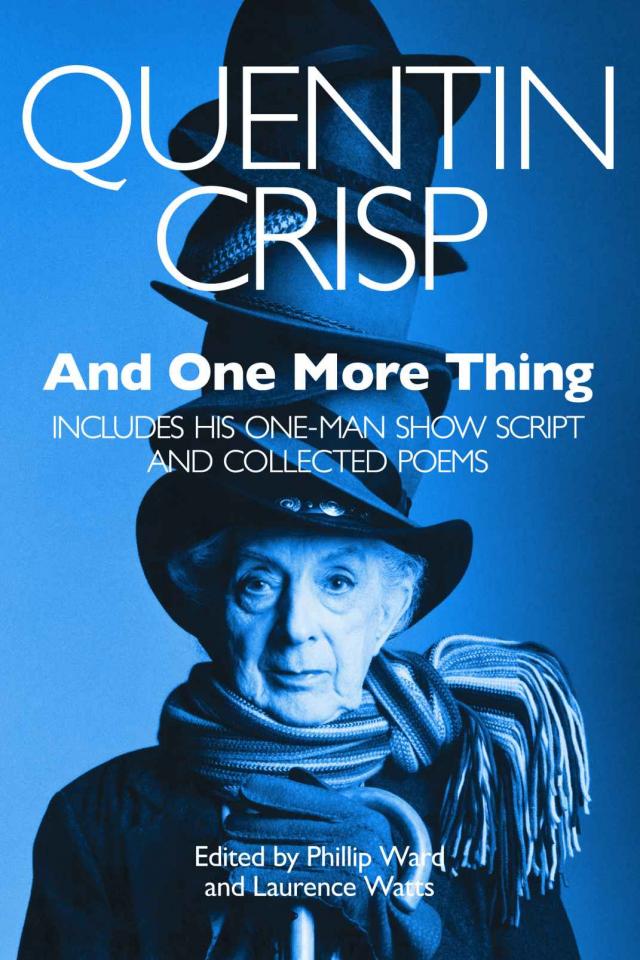
And one more thing, p.14
And One More Thing,
p.14


And it follows logically. If there is to be no doodling and no hobbies, there ought to be no evening classes. Do you have evening classes here? Well, it is alright if you’re going to learn to sing and dance, because these are activities the results of which you take out into the world and wear like a crown. People who’ve learned to sing will always have richer, rounder voices. People who’ve learned to dance will always have bigger, bolder movements. But as for pottery and basket-weaving, what good are they? The moment the doors of the evening institute clang shut behind you, you’re back where you started. On the way home, you might get into an argument with a stranger at a bus stop and be left saying, “Well, I can’t express myself. You’ll have to come and see one of my baskets.”
And once you’ve rid yourself of the unnecessary actions, you’ll next need to focus on the superfluous people in your life. I’ve been forbidden to say that each of you must live alone. I’ve been told my attitude toward cohabitation is glib. So I will lean toward true love and say that if you are actually stuck with somebody, you had better stagger on with them. It’s the very best I can do.
Until recently, I had no opinions about cohabitation. But in the last two years, I’ve become a kind of mail-order guru. People write to me, and then they come and see me. Most of the people who do this are very young and I know why they visit me. It’s in order to get the edge on their parents.
Recently a girl of fifteen turned up and she got me to write my name on a piece of paper, and the moment I stopped, she said, “I can’t make up my mind whether to show this to my mother or not.” She was going to save it for her darkest hour. When her mother says, “You dress yourself like a harlot. You do nothing that your father wishes. You use this house as a hotel.” She’s going to say, “You don’t know the half of it, mother. I’ve met Quentin Crisp!”
And the other people who come to see me are women in middle life. Over and over again, they ask me the same burning question: “Is there life after marriage?” The answer is, “No.” The constant proximity of another person will cramp your style, fatally in the end, unless that person is somebody you love and then the burden will become unbearable at once.
How can anybody begin each dawn with a fresh assault upon his style, if the moment he opens his eyes, he hears a voice beside him say, “And another thing. . .?”
And if going around in pairs is bad, it’s even worse going around in a heap. Never be seen tagging along at the tail end of a demonstration. Never be found hopping up and down on the fringe of a pop group. And above all, never, never strike. Do you have strikes here? When I talk to men about strike action, they always say, “It’s alright for you. You don’t have a wife and kids.” I can tell from the sound of their voices that men regard a family as suffering incurred in a moment of weakness. Even so, you must never strike. There is danger in numbers. They may nudge you into performing an action which is beyond the limits of your chosen style, and in public.
The striker makes demands on the dreary grounds that he is one of many, all of whom are alike. But the stylist asks for what he wants in the name of the fact that he is unique. And everything in the world, except diamonds, is subject to the law of scarcity value. When the time for serious bargaining comes, you will win.
But, of course, it is not enough merely to get the foundations of your home life squared up. You also have to decide what you are going to do in the outer world. Some of you may be so old-fashioned that you still have jobs. If this is so, try not to get stuck in work where you deal only with things. And I include the highest possible level of things: sculpture, books and paintings. They are only objects, just like washing machines, but not as useful.
It would be difficult for me to translate the dilemma that lies before the visual artist into American terms. But in England, if I could show you a huge great piece of concrete with a hole in it, everyone would say, “It’s a Henry Moore.” But if I could drag on Henry Moore himself, nobody would know who he was. So all that chipping, all that chiseling, it’s been in vain. You must have a job where you deal with people, because then every waking working hour you will be secretly polishing up your techniques of self-projection.
There are plenty of such jobs available. There’s preaching. All the great evangelists in the world have been American, so this shouldn’t be difficult for you. Before any of you were born, I saw Amy Semple MacPherson. Magnificent, dressed in white from head to foot, with scarlet hair up to here, and she said, “The Lord has sent out his angels on speed bikes of mercy.” You can try something like that.
If you don’t want to be a preacher, you can be a teacher. Teaching is also very stylish, because the material with which you are working is nearly always children and teenagers, and they have built-in publicity value. It doesn’t matter if you encourage them or repress them, you’re in!
The great teaching stylist was a man called Mr. Braithwaite[72]. He wrote a book called To Sir, With Love. It caused a great sensation when it was first published, but in that book there is not one sentence about education, about whether history is easier to teach than geography. It is full of what the children, their parents, and the other members of the staff thought about the writer. So, now we know that whatever anyone says he was teaching, his subject was always himself. Teaching is for teachers, and not for students. And this principal pervades throughout the professions. The stage is for actors, not for audiences. Religion is for priests, not for congregations. Politics are for politicians, not for voters.
If you can’t be a teacher, if there’s nothing that you know and they don’t, then you can try politics. The great political stylist was Mrs. Peron[73]. I don’t know whether any of you realize in what a personal and, at the same time, pervasive way she ruled her kingdom.
In England, spelling primers begin with the words “the cat sat on the mat.” No wonder literacy is at a low ebb, when the first glimpse of it is this banal and even distasteful piece of information. But in Argentina, spelling books began, “I love Evita.” And the crowning moment of her entire career was when she stood on the balcony of the Casa Rosada, in Buenos Aires, to make a speech. She lifted her hands to the crowd. And as she did so, with a sound like railway trucks in a siding, the diamond bracelets slid from her wrists. When the expensive clatter had died away, her speech began “Guerra: Nosotros, los descamisados…” We are the shirtless ones!
Now, I don’t really believe in Mrs. Peron, but the Argentineans did and still do. So much so, that when she died, they petitioned the pope to make her a saint. His holiness declined. But if he had consented, what a triumph for style that would have been! A double-fox stole, ankle strap shoes and eternal life. Nobody’s ever had that.
But if you feel preaching or teaching are insufficiently physical to embody your idea of yourself, then there’s sport. Did you know that Mohammed Ali said, “The boxing was only to bring me to the people.” Think of that. All that diet, all that abstinence, all that downright suffering. They were only to raise him to a level from which he could still further extend his image. And if you think he hasn’t done so, remember this: the fight before ‘the final triumph’ was never once referred to as the contest that that unknown gentleman won. It was always regarded as the fight that Muhammad Ali lost. So, now we realize that having a lifestyle doesn’t even depend on winning or doing things right.
But if you feel that you’ll never get up early enough in the morning even to be an indifferent sportsman, all is still not lost. Because the career that will give you the most direct route to self-fulfillment is the stage. And nowadays, you don’t even have to go on the stage, because all professions whatsoever are also the career of acting. This is because television has become inextricably woven into our lives. No politician can hope to win votes unless he looks good on television. We have Sunday programs that make you feel that no bishop is ever going to bless any part of the congregation which doesn’t happen to be kneeling under the arc lights. And we have medical programs that make you feel that no surgeon is going to bother to cut out of your middle anything that he doesn’t think worth showing to the television cameras.
It stands to reason that if you want to propagate your image, you’ll have to go into television. And you’ll have to stay there. As Mr. Coward[74] said, “Television is not for watching, it’s for being on.” And it’s easier to do than you imagine, because only one law prevails on television: the survival of the glibbest.
If, for instance, a televisionary asks you, “What is the secret of the universe?” It is no good stammering and saying, “A..a…a good question.” You’re finished. What you do when the televisionary asks you “What is the secret of the universe?” You say, “I am happy to tell you all that there is no secret.” The remark is inane, but you’re smiling and your lips are moving. You’ll be back.
A television interview is like a geography exam. You can’t study the whole world. So, the night before the exam, you take your atlas from its shelf and you open it. It says, “China.” So, you study China. And the next day, in the exam, you discover the main question in your paper is, “France.” So your answer begins, “France is not like China, which. . . .”
I’ll translate that, if I can, into television terms. If you arrive at the studio with a wonderful antidote about your mother, and some clot says, “How’s your father?” You’ve got a few seconds in which to say, “Thank you, my father’s worn out coping with my mother, who. . . .” In other words, you say what you’ve come to say no matter what the question.
You must also remember, when you think about the stage, that the journey made by an actress from anonymity to stardom is the path that all of you must tread in one context or another. At the beginning of her career, an actress plays a great number of very different parts, anything she can get actually. And at that stage, she says that what she enjoys is the variety. Later on, it’s noticeable that she plays fewer, more closely related parts. In the second half of her career, an actress says that what she likes is the opportunity to study character in depth. She means her own, because finally, with luck, she finds the one part which fits in every detail her dream of herself.
I’m so old that I knew Bette Davis when she was a nice girl. But after many long dark years, she was finally given the part of Regina in The Little Foxes and this gave her the chance to say, “Very well then, die!” And what do we learn from the glaring eyes and the mouth worn upside down? These features tell us that those were the words she’d been waiting to say since 1936.
Now, once an actress has found her ideal part, from that moment onward she never looks forward. She has given up the profession of acting and has entered the profession of being. And this, as I see it, is where all of you in the end belong.
Are you still with me? Do you understand this idea? Good, because there is a very special glow which surrounds people who have succeeded in synthesizing their professional and their personal lives.
Joan Crawford appeared in any number of movies in which she rose from rags to a position of worldly power. And in real life she finally married Mr. Pepsi-Cola. And she had all the luck in the world, because he died. This meant that she herself could enter the boardroom of that vast empire, where presumably she said, “Who told you to read the minutes?” Just like she did in all of her movies.
I saw Joan Crawford at the National Film Theatre. A car as long as the Thames drew up, and from it stepped those two now-famous children. They stood in the lobby looking bewildered. And no wonder, for after about three minutes, Ms. Crawford came out of the same car and kissed the children as though she hadn’t seen them for months.
I had gone up a few steps in order to have a really good view, and for a second she saw me with those great alligator eyes. It felt as though my silhouette were being burned onto the wall behind me. She was radioactive with belief in herself. And not only will having a lifestyle bestow upon you this massive self-confidence, but it will improve the texture of the entire world through which you move.
I am told that we live in a sex-ridden society. Personally I would say that we live in a world corroded with envy. This I have no difficulty in substantiating. When I turn on my television, what does it show me? Someone stomping through streets, screeching for equal pay, equal opportunity. Equal is a dead word. Never take as your goal in life the desire to be anybody’s equal. Once you have entered the profession of being, you have become a professor of a subject on which you are the only living authority. What other people do with their life, with their style, will not matter. In fact, every morning you should say to yourself, and preferably aloud, “Other people are a mistake.”
No. I withdraw that remark. It might be thought sweeping. Say instead to yourself, “Concern with other people is a mistake.” Now I know that this is not what most people teach you, but I am trying to spare you that traditional scramble for mutual self-sacrifice. Altruism is a debilitating, fragmenting process. But the constant watch over and the perfection of your idea of yourself, and the presentation of it gift-wrapped to others, that is a unifying and invigorating way of life, both for you and those you meet. And it carries with it a built-in invitation to the party at the end of the world, that glittering function at which everybody will be speaking and nobody will be listening.
And if you are armed with your style, you will be able to run toward that happy hubbub without the faintest fear that you may be out of your depth. Without the faintest doubt but that you will shine. And more important than either of these, the burdens of your sorrowful and angry freedom will fall away from you. You will know who you are, you will know where you are going.
Andy Warhol is said to be famous chiefly for being famous, and that suggests that he would have something to say about lifestyle and he did. He promised to each of us a quarter of an hour of fame before we die. All I am trying to do here, this evening, is to place into the hands of anybody who wishes to receive it the philosophy and the techniques by means of which he will be able to augment that mere moment of glory, so that it becomes a whole long wonderful lifetime.
Now, I see that I have rattled on too long. What we usually do now is have a pause and a good cry. In your programs you will see bits of paper on which you can write questions. This is for those who do not wish to be identified. If you don’t fear identification, you will speak to me from where you sit. I only want to be sure that I say the words you wish to hear.
Thank you.
21. A Conversation with You-know-WHO
Taken from a personal letter written to Ian Ayres.
[Tap Tap]
YKW: Come in.
[Silence]
YKW: Well?
Me: I’ve arrived.
YKW: So what?
Me: I thought I had to announce my arrival.
YKW: Whatever for?
Me: I don’t know. I’m sorry. Shall I go?
YKW: By all means.
Me: Where shall I start?
YKW: Anywhere. You’re not going to like it here, you know.
Me: I thought I was in Heaven.
YKW: It’s a Hell of a place. You’ll have to learn to play the harp, for one thing.
Me: Oh, g—. I mean, dear me!
YKW: I never liked you.
Me: Nor I you, Sir.
YKW: Good. Now we’ve got that straight.
Me: Goodbye, Sir.
YKW: Goodbye. I don’t expect we’ll see each other again.
[Silence]
QUENTIN CRISP
A bibliography
In Chronological Order
1. Lettering for Brush and Pen (1936), Quentin Crisp and A.F. Stuart, Frederick Warne Ltd. Manual on typefaces for advertising.
2. Colour In Display (1938), Quentin Crisp, also illustrated by Quentin Crisp. The Blandford Press. Manual on the use of color in window displays.
3. All This and Bevin Too (1943), Quentin Crisp, illustrated by Mervyn Peake, Mervyn Peake Society. Parable, in verse, about an unemployed kangaroo.
4. The Naked Civil Servant (1968), Quentin Crisp, Jonathan Cape. Crisp's account of the first half of his life.
5. How to Have a Life Style (1975), Quentin Crisp, Cecil Woolf. Essays on charisma and personality.
6. Love Made Easy (1977), Quentin Crisp, Duckworth. Fantastical, semi-autobiographical novel.
7. Chog: A Gothic Fable (1979), Quentin Crisp, Methuen. Illustrated by Jo Lynch, Magnum (1981).
8. How to Become a Virgin (1981), Quentin Crisp, Duckworth. Second instalment of autobiography, describing his experience of the fame that The Naked Civil Servant and its dramatization brought.
9. Doing It With Style (1981), Quentin Crisp, with Donald Carroll, illustrated by Jonathan Hills, Methuen. A guide to thoughtful and stylish living.
10. The Wit and Wisdom of Quentin Crisp (1984), Quentin Crisp, edited by Guy Kettelhack, Harper & Row. Compilation of Crisp’s essays and quotations.
11. Manners from Heaven: a divine guide to good behaviour (1984), Quentin Crisp, with John Hofsess, Hutchinson. Instructions for compassionate living.
12. How to Go to the Movies (1988), Quentin Crisp, St. Martin’s Press. Movie reviews and essays on film.
13. Quentin Crisp’s Book of Quotations, also published as The Gay and Lesbian Quotation Book: a literary companion (1989), edited by Quentin Crisp, Hale. Anthology of gay-related quotes.


