

And one more thing, p.4
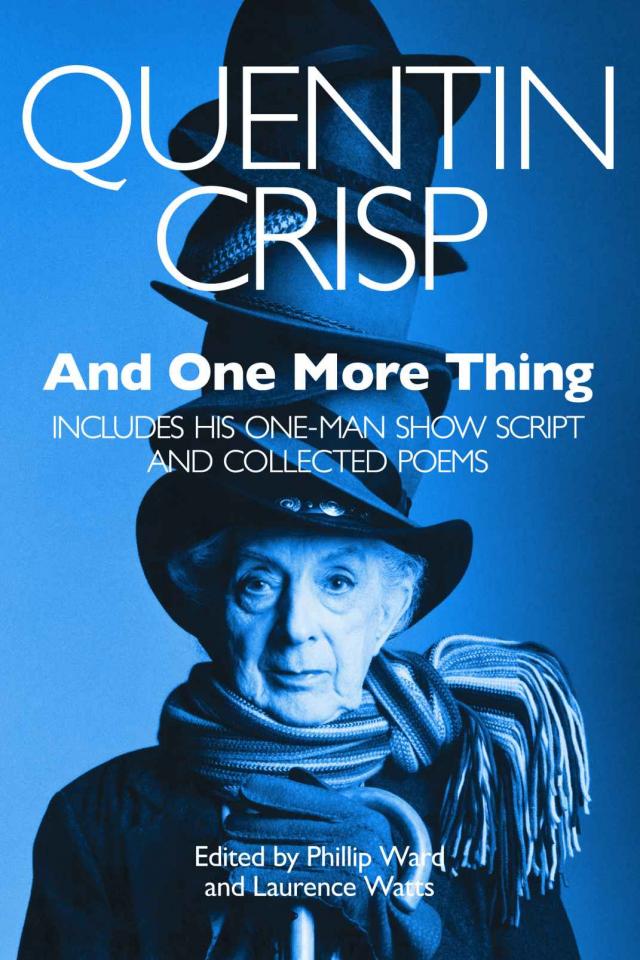
And One More Thing,
p.4


Of course, I have met unkind people throughout the world, and from time to time people have been unkind to me. When I was in San Francisco, I missed a meeting for the simple reason that I wasn’t aware I was meant to attend. My agent hadn’t told me. The papers said terrible things about me.
A woman, who I knew and thought was my friend, not only told me but cut out of the paper the clipping that said I was a terrible person and didn’t keep my appointment. She gave it to me. I know if I had said to her, “Why have you done this?” She would have said, “I am your friend. Other people wouldn’t tell you this, dear.” But I think it was an unfriendly thing to do. I think she did it to have a hold over me. Sort of: “I am your friend, other people don’t like you. Other people speak badly of you. I speak well of you. So now you belong to me.”
Let me return to my aging telephone, if I may. When I tell people of my impending telephonic catastrophe, they tell me not to worry and claim that soon I will be using the Internet to communicate instead. This I am not looking forward to. I was told that the Internet would put me in touch with more than two million people. Well, as I can’t cope with the people I am already in touch with, it doesn’t seem much use.
Though I’ve been placed on the Internet, I can’t tell what is happening to my world image, although at least I now realize that I have a world image. People tell me that they’ve seen or heard what I’ve said or done on the Internet.
I once said that I wanted to meet everybody in the world before I died. And nowadays everybody is thinking the same thing, because now they all own computers and each of these machines is connected to the Internet. I suppose that’s nice. If we can all get in touch with more people, if we all know more people, we are less likely to be afraid of them and then we are less likely to attack them.
A word of warning however: if each of us can be in touch with the whole world now, we will all have to cling to our individuality more firmly than ever or else we risk getting lost in a sea of people.
In recent years I have been receiving email letters! I never know when I’ve received email letters, but when I ring up a man called Mr. Ward[7], who has a computer, he will tell me when I have email. His demon machine is what keeps me connected to the Internet.
The Internet seems to have made it easier for people to write to me. I tell him, “I can’t write back to them all!” Instead, I think I will write my ‘letter to the world’, like Emily Dickinson[8]. Except that Ms. Dickinson’s work begins, “This is my letter to the world, which never wrote to me.” My letter will instead begin, “This is my letter to the world, which never stopped writing to me.”
This is, as Ms. Dickinson would have said, my letter to the world, which never stopped writing to me. I was put on the Internet against my will, but I am very glad of the result of being put there. I like my friends, but I am mad about strangers. The only trouble is that I cannot reply to each of you separately. I can only thank you generally for the interest you have shown in me, in my work, and in my happiness.
Thank you.
Quentin Crisp
I was once asked if I thought the Internet was too abstract. I don’t really. I don’t think you can be too abstract because that is what gives things their poetry. Prose has to be matter of fact. Poetry doesn’t. A woman I once knew wrote a poem which begins ‘Once I was princess of this palace’, and it goes on to describe ‘a castle with cobwebs across its corridors’ and stairs. In the poem she is wandering through it when there is a door, which is locked. She wrote and said to me, “I don't know what to say is behind the door.” And I said, “Don’t say anything.” The last line of her poem is ‘Time now to turn to that locked door’. That’s what you have to do with poetry, leave it open-ended.
Of course, the modern trend is to look for sex on the Internet. I think that’s a dubious proposition. I think sex is better if it springs from a contact. I can’t describe how I think affairs should begin, but they should begin pretty soon after you meet someone. Because you can easily get to know someone so well that you can’t possibly have an affair with them. There comes a time when you know them well enough to have an affair with them, but not too well. But seeking a sexual partner on the Internet, I think, is very unwise. So, the whole Internet may just be a mistake. It’s bound to all just be about sex in the end.
5. people who work
Work is a terrible thing. I presume somebody has to do it. And once you do it, you’re stuck with it. I can’t imagine. I think you should avoid work, if you can. But if you can’t, you have to find a job where you can add what you are to what you do. That is the essence. But if you can avoid it, avoid it.
The secret of looking young is, of course, never, never work, and this I really believe in. I was asked this secret by Mr. Rose, and I said, “Never, never work.” He laughed nervously, so I think it was not the answer he was looking for. But, of course, it’s work that makes you look old because you have to get up at half past seven every morning and leave the house by half past eight, and get to the office by half past nine. Also, it’s the look of resentment that settles on to your face when you begin to think, “Why do I have to work for them?” And that makes you look even older.
If you hate your job, I think you should leave it. But I don’t think you should leave it suddenly and I don’t think you should leave it and say you hated it. That gives the impression that the job was badly presented to you or that you worked with people you didn’t like. And I don’t think you should ever portray not liking anyone. So, when you get a better job, you say that you have to go and that you are very sorry and that you had a wonderful time, but now you have a job nearer home or one that pays more or something of that nature. That’s if you’re even asked why you’re leaving. You may not be asked. You may go to your boss and say, “I’m leaving.” And he may say, “Well, thank God for that.”
When I left one firm of printers, the foreman said, “Oh, thank God. I was wondering what we were going to do with you.” I worked in the art department and it was a thankless job because the price of the artwork was always reduced and then reduced further until the firm finally got the order for the printing. But, as an artist, you still had to try and make your wages. And, of course, you couldn’t do that because you were charging less and less. Somehow I survived. I was there for four years in the end.
I’ve never worked in America at all. In America, you see - and I didn’t know this until I got here - you can just do fame. It’s what I call the ‘profession of being’ and that is how I have earned a living. Chiefly, I have relied on the kindness of strangers. If you don’t yet know that you can do this, you should blame your mother. Mothers spend their lives saying, “Well, you’d better learn because you’ll be alone and people won’t help you.” This is a lie. People will help you. But in order to best receive their help, it’s advantageous to look as helpless as you can.
I remember standing at a bus stop once and a taxi drove up and said, “Get in and I’ll take you as far as we go.” Sensing that he didn’t mean to charge me, I got in. And we drove a great long distance and, to his word, he didn’t charge me a penny. A woman I once told this story to said, “They’ve never done that for me.” To which I inquired, “Do you try and look helpless?” And she said, “No! Of course, I don’t.” Well, if you don’t look helpless how are you ever going to get help?
In my case I don’t even need to look helpless. I am helpless. I am neither proud nor ashamed of this fact. For other people it is problematic. They neither want to appear nor be helpless. They prefer to be in control and independent from the world. I avoid both of these things. I do try and resist being cute, however. I worry when I’m told I am cute. I don't like the word. I think being cute is an endeavor to make use of being undersized. Anyway, I try to resist it because I know that in the end it’s not cute, it’s annoying.
I do not consider writing to be work. Mr. Bolden once said that he had met only two people who said they liked writing and he didn’t believe either of them. I once met the literary critic of the Financial Times at a bus stop, and he said, “Do you like writing?” I said, “No. Good heavens.” He continued, “I love it, but then I’m a born lighthouse-keeper.”
If you are a born lighthouse-keeper, of course you love writing. You’d be happy to sit alone in a lighthouse ignoring the world. Personally, I dread the day when I will have to say, “I can’t come out to play, I haven’t done my homework.” I hope that day will never come.
I think I’ve lived my life ‘in excess in moderation’. ‘Excess in moderation’ is a lovely state because you have what is an excess to other people, but is in moderation to yourself. Almost everything you do is excessive to other people. They will always say, “Why do you do this? What makes you do that?” And usually they are referring to things that are second nature to me. I find that I can’t reply. I’ve never thought about why I do certain things, but I should. A person should know why they do everything. As the saying goes, the unexamined life is not worth living.
But I have never gone so far in any one direction as to destroy other people or even to worry them very much. I expect my mother was worried about what would happen to me, but I reassured her that I would be alright; and during her life, I was. I don’t think anyone else has cared enough about me to think, “Oh, I don’t think he should do that. He’ll go too far. He’ll get put in prison. He’ll make himself ill.” Or indeed say anything.
Although I think I have lived my life in moderation, I have indulged myself in the matter of time. I live without most things, but with lots and lots of time. Most people don’t have enough time and they complain about it, especially women, who now have several jobs to do at once. To be a mother, to be a housekeeper, to be a cook, and to go to the office and type. I mean, it’s a life they’ve chosen, mostly. Or else it is a life their husband has chosen for them because he took a job that made it necessary for both of them to work in order to maintain their standard of living.
Everyone is mad about their standard of living these days. It’s very difficult for a man to say, “Let’s live more cheaply. Let’s go live in a poorer part of town and not worry about the neighbors and not have a car.” All so that he needn’t work so hard. I can’t imagine a man saying that, but if he did it would be wonderful because women are the people who suffer for this craze about the standard of living. Men always say when challenged, “I’ve done it all for you and the children.” But, of course, they haven’t. They’ve done it for themselves.
Now, when it comes to my standard of living, I wanted to get as low as possible. To have nothing. That way, nothing could be taken from me. So, I lived my life wanting nothing and wanting to have nothing. And now I want nothing and I have nothing, so I suppose I have succeeded in this quest. I don’t put material value on anything. Actually, that’s not quite true, because I care about almost everything in this room, and I would be very worried to lose any of it. But this room is tiny, so I hope I cannot be faulted for that. So, I do care about material things, but not on a very large scale. I’m a very bad example of materialism and consumerism. I don’t want to have a car, because I can’t drive. I don’t want a large house, because I couldn’t look after it. In a perfect world, I would like to have endless money and no possessions, because if you have endless money you have endless power. And if you have no possessions, you have no worries. So, power without any feelings of guilt. That seems to me to be an ideal state.
In spite of my lack of observable wealth, I don’t think there has ever been a time in my life when I’ve gone without eating or without comfort. I don’t think I’ve ever realized that until now.
Back to my previous statement, about power without guilt, I should make it clear that, personally, I reject any personal attainment of power. I never take a superior position in any relationship with people. Instead, I consider myself the slave and as a result I am not to blame for anything. If you assume command, then you are to blame.
It was of course writing that led me to the profession of being. I hesitate here to use the word ‘famous’, since I am nothing and I am no one. But it was Mr. Greene[9], I believe, who said he couldn’t expect more than 250 usable words to be written each time he sat down to write. So, he probably wrote a great many and then felt that a small portion of what he wrote could be used. He put them together and that constituted his work for the day. Now that’s very little. I would have expected a productive day to consist of about twice that, or to have at least two pages of presentable type. That at least is my experience. I mean, you wouldn’t get far with a narrative in only 250 words. To write a book, in my experience, you should write about 1000 words a day. That way, by the end of the year you’ll have finished your book.
Mr. Styron[10] said it took him six years to write Sophie’s Choice. Now I don’t think he meant he sat down in a hut at the end of the garden every day for six years until it was complete. He wrote it and then he forgot about it. Then he wrote other things. Then he went on holiday. And then finally he went back to it. What he meant was it took six years from writing the first sentence to completing the last. Doubtless he probably scrapped what he had written more than once or twice and began writing again.
I could never take that long. Not because I write faster or better, but because my patience is limited. If it took that long I would get tired of it and think, “Oh, this is no good. I should give this up!” When I sat down to write Love Made Easy, I was determined to get it done in about six months. And that’s quite different from six years.
To my mind, the best way to write is to write about yourself. You pick a beginning someplace or sometime that interests you and you go from there. When you want to describe how you hated your parents, you describe them and it will go somewhere in the book. I don’t think most people can begin at the beginning and end at the end. I think they have to write about what interests them and then join it all together. Because you are writing your autobiography, that gives you the shape of the book. Time is the skeleton onto which you add the flesh. So, you know that, when you’ve written about your childhood, you then write about your adolescence. Then you write about being a young man and so on.
If you’re writing a novel, you don’t use that same skeleton. So, you are more or less at sea. And I don’t know how people write novels. I have written one novel, Chog, a satirical novel about the welfare state. The whole thing was planned before I started, and then I truly did begin at the beginning. I don’t think there’s any secret about writing a novel, but then I’ve never written an important book.
The fact that I love words helped me write. I don’t know why I love words so much. I think that you have to first of all govern yourself with the use of them. You cannot go on the stage and seize at the first word and make it a sort of theme. You have to decide what adjectives to use. You’re not allowed to have your favorite adjective. And that’s very important. You must think, “Do I mean fabulous? Do I mean part of a fable? Marvelous? Do I mean that which causes me to marvel, to wonder about the origin of this phenomenon?”
You see, people use all the words which intensify their adjective. And that is very bad. You can’t say, “Terribly good.” For a thing to be terrible, it should frighten you. You have to think about what you’re saying. Most people use clichés like ‘crystal clear’. Clear is quite enough without prefixing it with crystal. You can’t say “very” over and over again, because that really intensifies the adjective that it comes before. You have to express what you’re saying in other words.
The word I use the most is the word ‘kinky’. This is because it describes anything which is a variant on the expected, the normal, the conventional and the average. I use it a great deal because it saves me the trouble of saying ‘perverse’. Well, perhaps not ‘perverse’ but certainly ‘eccentric’. I once caught myself saying ‘kinky’ at least six times in one afternoon. I am sure other people describe me as kinky. I don’t think I have a least favorite word. I like all words.
Of course, I had two brothers who were educated not at the same school, but at similar schools, and who had the same upbringing and the same parents that I did. They didn’t cling to words in the same way as I did. I remember when I was young saying of condensed milk “It’s a glutinous substance.” And my nanny said, “Oh, where did you learn that word?” I dismissively and snobbishly thought, “You fool.” So, from a very early age, I clung to words, not because they made me seem educated or grown up, but simply because I liked that they described a situation or a thing so precisely or perfectly. The power of words was what I liked. I had liked words even before I could spell them.
From all of that it’s now obvious to me why I went into the profession of writing and speaking. Words are my friends. And if you can surround yourself with friends and indeed do something that you love, you will, as the saying goes, never do a day’s work in your life.
6. FLAPPER GIRLS And walt Disney
I don’t think there was a decade I recognize that had as long a lasting individuality like the 1920s. The Twenties came immediately after the First World War, which was the first time in a long time that the English realized that everything in the world was not plain sailing. It was the first time in living memory that the British thought they might not be destined to rule the world.
Noel Coward spoke of this in his play - later an award-winning film - Cavalcade. One of his characters sits at the piano, waving an ostrich feather, singing, “Who’s escaped those weary twentieth century blues?” It was a descriptive song about the decadence of the world. As far as I’m concerned, the 1920s was the most noticeable decade, the most stylish in which I have lived.
After the war, which ended in 1918, everything changed. It was known that right would not always win out over wrong. Not without cost, anyway. It was known that war was a terrible thing. It was known that heartbreak was everywhere and there was a change in the human psyche. It was that change that gave the next decade its desperation. Everybody went mad and sex reared its ugly head in public after decades of being swept under the carpet.


