

The homestead, p.22
The Homestead,
p.22
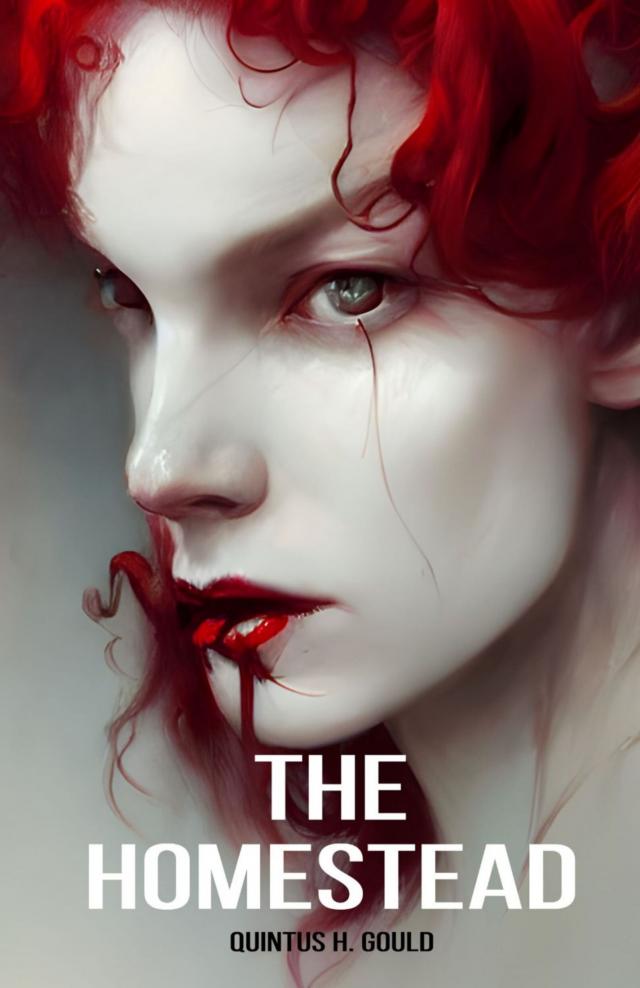


Robert’s father laughed and banged his fist on the table. ‘You simply cannot eat a newborn every other day,’ he barked, bits of meat showing as he opened his mouth. ‘Have you,’ the old man jabbed his fork in the direction of the woman, who raised her hand to her bosom in a show of shock, ‘ever considered that Rupert’s just full of shit?’
Giddy, inebriated laughter erupted. In their seats, Alexander and Mary grinned, the former having to put his fork down so as to avoid choking on the infectious gaiety that was sweeping across the table. Alexander had never met Rupert — or at least wasn’t old enough to remember meeting him if he had — and the stories he had heard about the man made him seem too maniacal to be real. Audaciously egotistical and, according to some of the stories, a philanderer of shameful proportions, Rupert was also said to be competent and well-connected — two sets of qualities which Robert had raised Alexander to believe were incompatible with one another. That the man was younger than Robert made him even more of a sore point for Alexander’s father.
‘Come now, Father,’ Robert said, chastising the old man, but still smiling. ‘It is rude to speak of absent friends in such a way.’ It was then that Robert turned in his seat in the direction of the red silk woman, Zéphyrine. She hadn’t contributed anything to the conversation and sat silent, back straight in her chair, cutting a piece of meat with her knife and fork. His tone affable, Robert addressed her by name. ‘Since we are on the subject, you must tell us,’ he said, ‘how is Rupert keeping these days?’
The table quietened. Several people looked up from their plates. Zéphyrine continued cutting her food, forcing Robert to wait for a response. When she was done, she placed her cutlery on her plate and, coolly, said, ‘I don’t know why you would suppose I know anything about the man.’ Her eyelashes were long and black. They held each other’s gaze until Robert smiled and let her return to her food.
‘What was that all about?’ Alexander asked Mary after people had returned to their microcosms of conversation about the table.
She drew closer to him and, keeping her voice low, said, ‘She’s one of Rupert’s spies. One of his mistresses. His favourite, quite possibly.’
Alexander smiled in disbelief. ‘A spy?’
Mary nodded, nibbling on the end of a green bean. ‘It’s a game he plays with your father. And, I suspect, he with him. I’ve heard him mention it before, once or twice.’
Alexander laughed. ‘So, right now, my father has a spy of his own at Rupert’s New Year’s party?
‘I wouldn’t know,’ Mary shrugged, ‘but quite possibly.’
Alexander laughed again and imagined his father instructing a legion of spectacle wearing, moustachioed informants. ‘Ridiculous,’ he grinned, shaking his head and moving his fork over his plate.
Thirty-Two
By the time the second course was served, the conversation had turned to Robert’s speech and genetics. Seated in what should have been Alexander’s chair, Gerald Foye was describing what he referred to as the hypothesis of the upward anomaly. ‘After all,’ he said, moving his head to look at others who were seated around the table, ‘were we not all born of apes?’
Someone further down the table chortled and, helping themselves to a second heaping of roast potatoes, asked the man where he got such ideas.
Gerald sat back in his chair. ‘You would be surprised,’ he began, ‘by the great number of remarkable things that you observe when out in the field. I am left with no doubt that Robert,’ he inclined his head towards the host, who, brown eyes soft, acknowledged his deference and nodded in return, ‘is correct in his proposition of their being a genetic element. What interests me, is if one can defy bad genetics. Is it possible for the offspring of the sub-homo to be born without their parents’ genetic defect?’
‘What are you saying, Gerald?’ a woman with long, sparkling earrings asked. ‘That genetic heritage can be changed?’
The man moved in his seat. ‘If so, it would be a rarity,’ he explained. ‘Just as certain disorders are caused by the mutation of a single gene, could it not also be so that a beneficial mutation may occur? An upward anomaly.’
Two seats down from Mary, Ern put down his glass and joined the conversation. ‘I concede, in the past I myself have witnessed some quite extraordinary behaviour from students who came from sub-homo families.’ A couple of others nodded and murmured in agreement.
‘Anomalies,’ Gerald said, looking at Ern, ‘that could be identified using Robert’s genetic method.’
Opposite him, a man wearing a large-faced gold watch, put down his napkin. ‘I am sorry, I must interject,’ he said, his watch hitting the table as he lowered his hand. ‘We have not observed any evidence of this. Alligators haven’t changed their genetics for aeons. What is to say these creatures will ever change theirs?’
Shoe man was chewing and turned his head when his neighbour cleared his throat to speak. ‘You are far too liberal in your thinking, Gerald.’ It was the young man who hadn’t stopped to speak to Alexander at the front door. Dark haired and tight-lipped, he was pompous and sounded like his lungs were full of helium. Alexander, having just emptied his plate for a second time that course, took a sip of wine and grinned. ‘I do not believe such a thing is possible,’ the young man continued, looking at Gerald with contempt.
Alexander set his glass on the table and laughed. Eyes now on him, he looked about the table and, after a pause, said, ‘If we put stock in the reluctance of a few narrow-minded individuals, science would never progress.’ At the head of the table, Robert looked at his son, a curious smile on his lips. ‘Say Gerald is wrong—’ Under pressure to continue, Alexander nodded at the man with the thin grey hair, trying to keep his eyes away from the young man, who was, by now, seething. ‘Nothing is lost. But, if he is right and all we do is ridicule him, then our understanding does not evolve.’
Gerald smiled and nodded at the younger man. ‘Such is my point,’ he said, ‘we must ask questions or risk stagnation.’
Alexander matched his smile before reaching for his glass, eager to retreat from the conversation he had inadvertently entered. It was too late. Another at the table, a woman wearing a bold, oriental-style green and gold velvet jacket, was desirous to hear more from Robert’s heir. She asked him if he, in the course of his studies at university, had, like Ern, come across anyone who challenged his expectations of the sub-homo. As he considered his response, he hoped that his father might hijack the conversation and relieve him. He didn’t and so Alexander floundered, not knowing how to reply. He recast his sentence twice before settling on, ‘I don’t think so.’ The woman looked disappointed. ‘I just think we always have more to learn.’
Next to him, Alexander noticed an impish smile forming on Mary’s lips. She picked up her napkin and, covering her mouth, pretended to cough.
Back on the other side of the table, Gerald raised a query about the emotional capacity of the sub-homo. Several guests had something to say about that and spoke over each other trying to express their opinion. Gold watch man seemed to snarl when Gerald dared to suggest they had any form of emotional intelligence. The woman in the bold jacket interrupted him and spoke of the grief displayed by a fresher after her infant had died.
‘Jiang,’ Robert said, addressing the man with the gold watch, ‘you cannot seriously believe they have no capacity for emotion whatsoever?’
The other man didn’t say anything and pushed a forkful of food, a slither of meat dripping in a red wine jus, into his mouth.
‘Gerald here is not suggesting they feel the same complexity of emotion as you or I,’ Robert smiled, ‘merely that, in their own simple-minded way, they experience some sort of primitive feeling.’
Gold watch man, Jiang, swallowed and looked at Robert. ‘It’s this sort of thinking that will get you in trouble,’ he said, his tone serious. ‘You are projecting — confusing their emotions with your own.’
Without thinking, Alexander was speaking again. ‘I have seen it,’ he said. ‘Emotions in these creatures.’ Once again, heads turned in his direction.
Alexander was thinking of Pandora. How could he not? For the past eleven days she and her newborn had been at the centre of his existence. Constant alarms on my phone, milk bottles every three hours, IV bags, blue pills and unceasing tears. How could he deny that she — the young mother who still cried for her child each time he tended to her — felt emotion? It would take more than the stubborn posturing of a few old men to make him think otherwise.
‘I’ve been attending a heifer,’ Alexander continued, trying to keep his voice steady as more people at the table turned to listen. ‘She has recently given birth, preterm, and has had to be separated from her infant.’ Under the table, he was bouncing his left leg up and down, nervous. ‘She cries,’ he said, his voice firm. ‘All the time she cries.’ The way he said it made the whole table fall silent. He dropped his eyes to his plate and said, ‘I don’t think that’s a projection.’
Alexander felt a soft pressure on his knee. Mary offered him a small smile, and he let her expression wash over him before breaking eye contact and taking a drink.
Dessert couldn’t come soon enough. For those who still had space in their stomachs, a pyramid of profiteroles, dripping in chocolate sauce and dusted with icing sugar. Mary half nibbled one and then offered her bowl to Alexander, who happily ate two servings, and would have finished a third if one had been offered to him. Most of the guests stayed at the table for coffee, but Alexander excused himself, he and Mary leaving the room to get some fresh air, outside at the back of the house.
They sat down together at the top of the steps that led away from the back door. The night air was cool and a breeze rustled the branches of the winter trees. Alexander gave Mary his jacket and she rested her feet against his.
Her voice was quiet when she spoke. ‘What you mentioned in there—’ she broke off and, after a pause, said, ‘You can speak to me, you know?’
Alexander looked at the lawn. Only a few months earlier they had celebrated Mary’s twenty-first birthday on that lawn. In many ways, life had been less confusing then, and, in many other ways, moreso.
‘You wouldn’t want to hear it,’ he muttered. ‘And, to be honest,’ Alexander continued, ‘neither do I.’
Mary breathed heavily and swayed, nudging his shoulder with the side of her face. They sat together in silence for a moment, until Mary bent over and reached for her shoes.
‘What are you doing?’ Alexander asked, amused.
Her hair tumbled over her face as she fiddled with them. ‘My feet are in agony,’ she complained, loosening the clasp on the right shoe. One at a time, she took them off. ‘Be thankful you were born a man and are not expected to wear heeled shoes,’ she laughed, placing the shoes on the step next to her.
Alexander grinned and pointed to her, now bare, feet. ‘You’ll freeze.’
‘Not for a while,’ she said and patted her stomach. ‘I am stuffed. The heat my body is generating to digest it all is tremendous.’
‘Well, if that’s the case, can I have my jacket back?’
She laughed as he tried to take it back, his hands tickling her skin as he slipped them under his jacket and across her back and shoulders and arms.
‘My,’ he teased as she squirmed in his arms, ‘you are warm!’
‘Alex, please,’ she said in between giggles, ‘I am very full.’
‘Okay, okay.’ He laughed and pulled the jacket back over her shoulder, his eyes lingering on her lips. ‘But, you might have to share your warmth with me.’
A suggestive glint and she elbowed him. ‘Because you ate nothing?’
He laughed and shrugged. With her permission, both now grinning and suspicious of the other’s touch, Alexander slipped his hand back under the jacket to reach into the inner pocket. She didn’t say anything when he pulled out the pipe and started loading pinches of cannabis into the bowl. The match crackled in the winter air and sent smoke up into the sky. A skunky fog of pine and lemongrass.
‘My toes look so very far away,’ Mary whispered, eyes focused on her feet as she passed the pipe back to Alexander. He laughed and inhaled. Millions of miles away, a star burnt itself out.
‘Do you think they’re wondering where we are?’
Slowly, Mary shook her head and wafted her hand. ‘They’re all drunk.’
Alexander rolled his head back and laughed. ‘Outrageous,’ he said to the sky. Mary followed his gaze, shaking her head so that her curls loosened and fell down her back. They both jumped when a bang came from the front of the house and a light flashed in the sky. Sparks of ruby red and blazing orange erupted against midnight blue, and fizzes of silver and purple and a magical shade of teal sprinkled across the night.
Turning his eyes from the fireworks, Alexander put his lips to Mary’s ear. ‘Happy New Year,’ he said, close enough for her to hear over the noise. She turned and smiled, bringing her face in line with his so that they were eye to eye.
He kissed her, at first soft, and then with a hunger, ardent and zealous, parting her lips with his own, his hand on the back of her head. Placing his other hand on the base of her spine, he drew her even closer to him, she half standing, half shuffling along the step, until she was close enough that he could feel her heart pounding inside her chest. He tried to lie her down, his fingers ragging at the silken fabric of her dress. She pulled her lips away, eager for air, and so he moved to her cheeks and her chin and her neck and her chest, decorating her skin with his kisses. In soft, breathless words, she asked for more, more, as much as he could give, and then, suddenly, to stop, stop, to stop right now, ‘Alex, stop—’ she pushed him away and, before he had a chance to be bewildered, giggled and hushed, ‘Quick, someone’s coming!’
Taking his hand, she pulled him away from the steps and hurried, barefoot, onto the grass. There, she dropped to her knees and, still leading him, crawled underneath a large, evergreen bush. Leaves tickled the sides of their faces as they held each other, watching the back of the house, trying to suppress their laughter.
Two figures emerged. The first, Alexander immediately recognised as his father. The second, tall and sensual, could have only been the red silk woman Zéphyrine. A firework flashed overhead and revealed their faces in its transitory light.
‘—it always has been,’ they heard Robert say from the bush. It was but a fragment of a longer sentence, the booming of exploding pyrotechnics muffling the rest.
Zéphyrine took a step closer. Her hands were out in front of her, gesticulating as she replied. When Robert spoke again, his hands were also raised. Even from a distance, his posture could be seen to stiffen as a tension set in his shoulders. Alexander strained forward in the bush, trying to hear what was being said. Anger was an emotion that he had rarely, if ever, seen his father display. But now, under the cover of darkness, at the back of the house and in heated conversation with one of his guests, Robert looked angry.
‘It risks us all,’ he said, loud enough to be heard over the fireworks. Zéphyrine was quick to respond, her words causing Robert to turn, sharply, on his heel. He took two paces away from her before returning, running his fingers through his hair and softening his stance.
Mary looked at Alexander and mouthed, ‘What?’ He shook his head and turned his eyes back to his father and Zéphyrine.
An abatement in the fireworks. ‘Give him my best,’ they heard Robert say in his normal voice. The woman said nothing. She walked along and around the back of the house, as if to join the rest of the party at the front. Robert stayed where he was, hands at his side and then up again to arrange his hair.
In the bush, Alexander and Mary had returned to laughter. Alexander’s drugs still fresh in their systems, the scene they had just witnessed was transformed from enigmatic and conspiratorial to something comical and absurd. Their eyes were back on each other by the time Robert moved. Walking to the back door, he noticed a pair of shoes at the top of the steps. He leant down and picked them up, confused by their desertion, before opening the door and stepping inside, bringing the shoes with him.
ACT III
Pioneering a New Order: The Patrimony of the Homo Sapien
In a previous treatise I proposed the existence and inherent characteristics of a hitherto unclassified species of the homo genus. In this, my second treatise on the sub-homo, it is not only my intention to affirm and expand upon my previous discourse, but to propose a solution to the threat posed by this species, to both civilised society and to the health of our planet, so that we may find ourselves restored to Eden.
In Genesis, this species is referred to as a ‘creeping thing’: a creature that bears the image but not the likeness of the Creator. We, on the other hand, possess both these divine qualities, and have as such been given the classification homo sapien, meaning wise man. Mirroring this logic, I propose that the sub-homo also be given a classification reflective of its disposition: homo subrependus, meaning creeping man, in recognition of its serpentine nature, a creature who seeks to imitate its superior and, through moral deformity, barbarism, and wastefulness, steal their natural position as custodians of this planet.
The prominent economist and author of over two-hundred and fifty papers and books, Professor Francis James Stansfield, has spoken of an imminent crisis: rapid population growth in combination with insatiable consumption of seemingly abundant resources will send this country, and others around the world, into a dark era of starvation and destitution. The resources of this planet, although they are treated as such by the homo subrependus, are not limitless, making it the responsibility of the homo sapien, the superior of the two species, to ensure that our planet is not entirely squandered, and is safeguarded for future generations. Efforts have been made to try to manage the barbarism of the homo subrependus, through soft means, such as programmes of education, and through harder methods, including gaols, houses of correction, asylums, and workhouses. As has been made apparent through the warnings of scholars like Professor Stansfield, these methods have failed in their intention: the homo subrependus is still very much a threat to the stability of this planet.


