

The homestead, p.31
The Homestead,
p.31
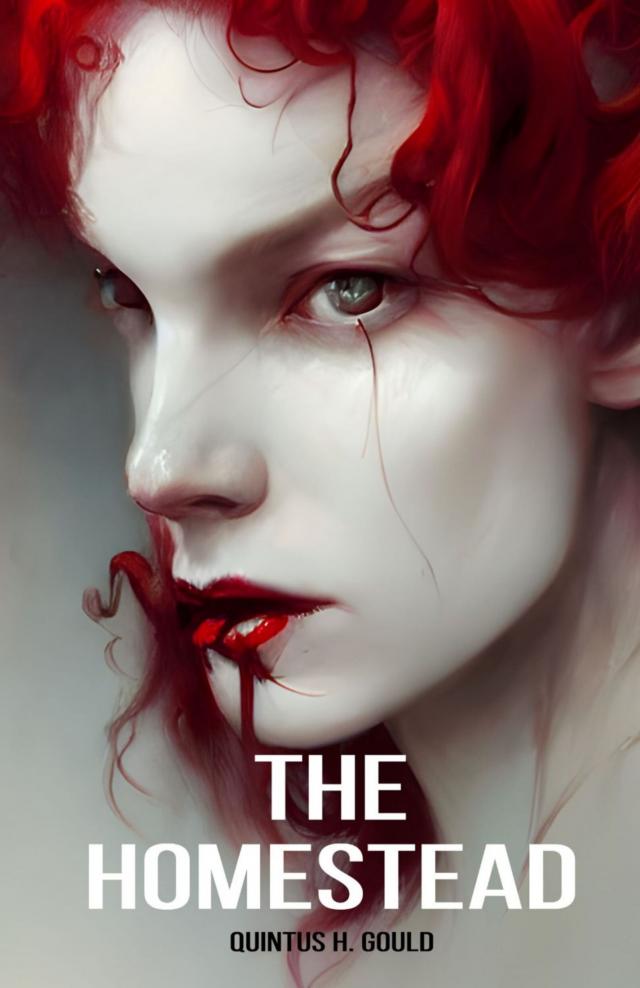


Sophie’s eyes flickered between her face and her stomach. Softly, she took up Samantha’s hand — the one bound by the chain — and squeezed her fingers. ‘Come now, dear,’ she hushed. ‘Try not to upset baby.’
Samantha wanted to say something but couldn’t. She wanted the woman to hold her and tell her everything would be okay — it being all too easy to forget that she, the soft-spoken woman who smelled of flowers and biscuits, played a part in her suffering.
Sophie continued to soothe her as she cried. Eventually the tears started to soften, the exhaustion of sorrow simply too much to sustain. Samantha hiccuped and Sophie chuckled.
‘That’s better,’ she said and patted Samantha’s hand. ‘Try not to cry. We’ll move you inside soon.’
She turned and looked over her shoulder. Most of the others who had escaped after Samantha opened the locks were back inside. In the distance, a group of young boys were loitering close to the red sandstone building. There were about a dozen of them and they spoke quietly, appearing strangely subdued for their age. The woman watched as Robert approached them and ushered them to move.
‘Once you’re in,’ Sophie continued, turning back to face Samantha, ‘I’ll bring you something nice to eat, okay?’
Samantha nodded. A final squeeze of her hand and Sophie stood up and walked away, heading in the direction of her husband. Robert smiled when he saw her, his lips moving fast as he told her something which made them both laugh. They led the boys away and disappeared out of view.
‘Please, let’s go to the house now.’
Samantha turned her head. The door to the Seat had opened. Robert’s son stepped through it and waited. In one hand he was holding a blanket, his other he held out for his companion to take. Samantha’s skull hurt when Mary stepped outside. Watching, she saw her take Alexander’s hand and move towards him. It was obvious from the way she moved that she was having trouble walking. She had her right arm wrapped around her torso and there was still blood on her forehead.
Mary leant close to Alexander’s ear and whispered something. Samantha narrowed her eyes to see what she was saying but his hair concealed her lips.
He laughed and turned to look at her. ‘Okay,’ he said and put his arm around her.
The path passed by Samantha and she cast her eyes to the ground as they approached. She heard a voice call before they got too close. A man with wrinkled skin emerged from the red sandstone building and waved his hand.
‘Alex,’ the man repeated. ‘Ern’s on the phone.’
Samantha turned and looked up. The pair had stopped and he said something before releasing her and stepping away. ‘I’ll be quick,’ he called back to her as he sprinted towards the other man. Mary’s eyes followed him all the way to the door. As soon as he went inside, her posture slackened and her grip on her torso increased, as if she had been concealing the full extent of her pain. Samantha saw Mary’s mouth quiver as she reached for the lamp post to steady herself.
Until that point, it didn’t seem as though Mary had noticed Samantha sitting on the ground. If she had, she hadn’t shown it. But now, Mary looked down at her. She adjusted her stance. Red hair loose and tangled, it shrouded her face as she dipped her head and caught her breath. When she straightened herself, her face was no longer pained. Still holding onto the lamp post for support, her expression plain, Mary lowered herself to the ground.
Samantha’s eyes hurt from all of the crying, salt having formed a crust on her skin, but she tried not to blink as the other woman looked at her. Mary didn’t say anything at first. Her eyes crept over Samantha’s face and then down to her torso and abdomen.
Mary pulled herself forward. Her lips were close to Samantha’s face, so much so that she could feel her breath on her skin.
When she spoke, her voice was quiet and hoarse. ‘I’m sorry,’ Mary said. Samantha didn’t move. She heard Mary swallow as she searched for more saliva to lubricate her damaged vocal cords. Lightly, she cleared her throat and continued, ‘I hope I didn’t hurt your baby.’
Mary wobbled forward but caught herself. Samantha’s breathing was shallow.
‘You understand,’ Mary paused and swallowed, ‘that I had to do it. Knock you out.’
Although she couldn’t see her, their faces being too close together, Samantha nodded, her heart loud in her chest.
‘You see,’ Mary continued, whispering, ‘you can’t escape what’s coming to you.’ Samantha winced to hear her own words thrown back at her. ‘And neither can your baby.’
Mary pulled away now and Samantha was horrified by the impassive expression on her face. A moment to catch her breath and then Mary said, perfectly calm, ‘I’m going to eat your baby.’
The two women stared at each. The silence was broken by the sound of approaching footsteps. Samantha, numbed and aghast, looked up to see Alexander standing over them. His eyes were awash with concern, and he reached down to help Mary up.
‘Are you okay?’ he asked, searching her face. She nodded, smiled and squeezed his arm. ‘No more distractions,’ he said, ‘I’m taking you to the house.’
Unresisting, Mary nodded again and let him support her. Without looking down, they moved around Samantha and along the path.
‘I spoke to your father,’ Samantha heard Alexander say as they walked away, ‘he’ll be here as soon as the causeway’s clear.’
Causeway.
Just as it had taken a moment of crisis for Alexander to embrace his place in the world, crisis had engendered a similar epiphany for Samantha also. Cold and wet in the mud, her arms draped around her unborn child, Samantha realised there never had been any hope; she had been doomed from the start.
The first breath she had taken on the Wheatleigh family’s tidal island homestead had been fatal. Indeed, it could be argued that the very first breath she had ever taken, some twenty-three years earlier, had amounted to the same thing: the first in a series of breaths that would ultimately bring her to where she was now. A tiny cog in a machine of death and suffering.
Mary didn’t hate her — not really. Watching her walk away now, Samantha knew that the red-headed woman had already pushed what she had said to her to the back of her mind, her thoughts racing onwards to other things. Samantha — and by extension her baby — was just a thing that she could take. Mary, the same as Robert and Sophie and Alexander and everyone else who perpetuated this cycle of horror, did it because they could. That was just the way it was — the way the world was meant to be arranged — with little thought ever being given to the suffering on the other side. That was the prerogative of the blessed.
APPENDIX
Closer to Eden: A Homestead for the New Millenium
Mapping the human genome is one of the greatest feats of exploration that mankind has ever attempted. Initiated on 1st October 1990, the aim of the Human Genome Project (HGP) is demystification of the occult: namely, nature’s complete genetic blueprint for the human being. In determining the exact order of the base pairs that comprise human deoxyribonucleic acid (DNA), it is hoped scientific research and clinical care can progress to new frontiers. In this, however, there is a fatal flaw: the assumption that there is but a single genetic blueprint for the human being. There are, in fact, two: a genetic blueprint for the homo sapien, and another for its imposter, the homo subrependus.
In certain circles, it has long been acknowledged that there currently exist not one, but two, species of human being. Until recently, the identification of the lesser of these two species, the homo subrependus, had been fraught with difficulties. Whilst the recognition of certain abhorrent and barbarous characteristics has allowed for some measure of illumination, the true biological nature of the homo subrependus has been hidden from us. In this way, the results of the HGP, and the future research it will facilitate, present us with a novel opportunity: to obtain a cellular understanding of the homo subrependus and the species-specific genetic differences that separate us from them.
Although the HGP is currently unfinished, it has been estimated that the human genome contains some 30,000 individual genes. Already there have been attempts at genetic association studies which aim to pinpoint the specific genetic component associated with the homo subrependus (Wheatleigh et al., 1994; Helton et al., 1995; Fisher and Reid, 1997). The importance of this work cannot be understated. Once the genetic blueprint of the homo subrependus is determined, it will only be a matter of time before mass identification is possible. For the first time in our history, we approach a resolution whereby the ‘secret repulsion of the blood’, so described by Dr. Richard Alexander Wheatleigh as early as 1879, will be secret no longer. The homo subrependus shall be unmasked.
The implications of such an unmasking will be profound. With the biological basis of the homo subrependus in hand, efforts can be made to expand, and indeed perfect, our current system of managing the species. It is not a fantasy to imagine how the simple testing of biological samples, such as saliva and blood, will revolutionise our movement in the near future, exposing hitherto hidden homo subrependi within a matter of hours, or even minutes, after testing.
Encouraged by the findings of early genotype-phenotype studies, it has been hypothesised that the genetic element will be found in the genes responsible for prion protein production (Wheatleigh, 1996). As it has been observed that the homo subrependus suffers from cognitive disorders and neurodegenerative diseases caused by misfolded forms of these prion proteins at a statistically significant higher rate than the homo sapien (Wheatleigh and Helton, 1997), it is thought that a variant may exist within these genes that causes the expression of these malformed proteins to occur throughout the nervous system and many other tissues, including the brain, of the homo subrependus. Such an exclusive genetic variant responsible for abnormal, pathogenic agents, particularly in regards to inherited cognitive processes, could offer an explanation as to the differences between the homo subrependus and the homo sapien in regards to degeneration and primitive behaviours. If this is found to be accurate, preliminary statistical modelling has suggested that anywhere between 84.6 and 98.3 percent of the population may possess the genetic element of the homo subrependus (Stansfield, 1998).
Although it has long been suspected that the homo sapien is vastly outnumbered by its imposter species, such a dramatic imbalance between the two populations would necessitate the development of a new model of management. Methods which we currently perceive to be modern would quickly transform into something quaint and out-moded when considered with regard to the wider populace. The new millenium will therefore be defined by this struggle: the struggle to develop a new form of homestead, one which can accommodate the needs of both the abundant numbers of homo subrependi who pollute this planet, and us, their superior, the homo sapien, the true successor to Adam, as we continue towards our creation of a New Eden.
Robert Adam Wheatleigh MBBS, MSc, DRCOG, PhD
& Ernest Philip Stansfield BS, MSc, PhD, 1999
Quintus H Gould, The Homestead


