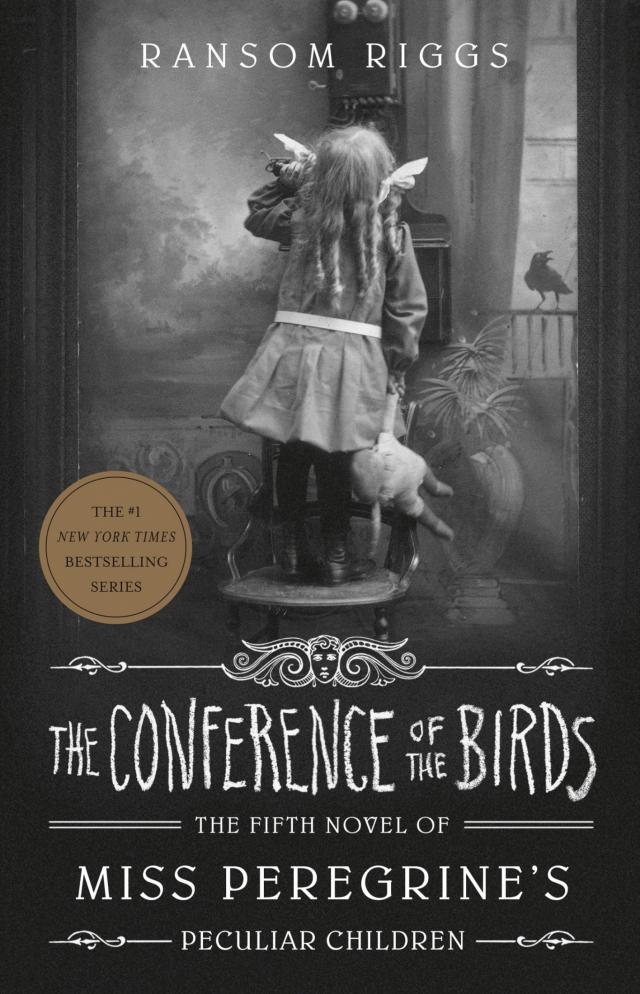
The conference of the bi.., p.24
The Conference of the Birds,
p.24


It seemed like we had beaten the prophecy, circumvented the worst outcome, and something like a future was now possible. For her. And for us.
“Maybe I could go to that program with you,” I said. “If everything settles down, I’d like to get my degree, too.”
“Have a foot in the peculiar world and the normal one,” she said.
“Exactly.”
All my other peculiar friends had given up on having anything to do with the normal world a long time ago. I had nearly given up on it, too. Until now, I hadn’t realized how much I had been mourning the loss of it.
Maybe together, Noor and I could figure out what it meant to be both normal and peculiar, and to be just seventeen among century-old friends, and to be someone whose birth was prophesied and someone who was the grandson of a legend and—as awkward as it made me feel sometimes—someone who was becoming a bit of a legend himself. It was unmapped territory for us both.
We got off at Noor’s station, climbed the stairs into daylight, and walked ten blocks along leafy streets holding hands. For a few minutes it felt like nothing in the world was wrong and never had been. Eventually we stopped and Noor said, “This is it.”
There was no nostalgia or homesickness in her voice.
She let herself in with a code. We went up three flights of stairs to her foster parents’ place. They weren’t home, but her foster sister Amber was—watching TV in a darkened room.
Amber barely looked up when Noor came in.
“Thought you ran away,” she said. “Who’s that?”
“I’m Jacob,” I said.
Amber looked me over with one eyebrow raised.
Noor had gone down the hall. “Where’s my stuff?” she called from one of the rooms.
“The closet,” Amber shouted. “I took over your part of the room after you didn’t come back. Dad says I can keep it.”
We found Noor’s clothes, shoes, some books, and her backpack piled in a wrinkly mess in the closet. She began to pull them out. Then she stood up quickly, looking at something in her hand.
A postcard.
“Where’d this come from?” she shouted down the hall. “The postcard.”
“Uh, the mail?”
Noor turned the card over, then over again. Her hand was shaking.
“What is it?” I said.
She handed it to me. On the front was a picture of a tornado. Below it was a town name: WAYNOKA, PENNSYLVANIA.
On the back were Noor’s name and address, and below that, in neat cursive: “Miss you, honey. Sorry it’s been so long. I heard the news—and I’m so proud of you. This was the last address I had for you . . . I hope this note reaches you, and that you’ll come visit.”
It was signed, “Love, Mama V.”
And there was an address.
“My God,” Noor whispered.
I looked at her, awestruck. “She heard about what you did. She knows you know about her!”
“So you think it’s real? You think it’s really her?”
I blinked at Noor. That the postcard might not be real hadn’t even occurred to me. But then, we’d been through a lot these last few weeks. I understood how Noor was feeling; it’d become hard to trust anything.
But I hated that instinct. I was tired of it. I wanted to remember how to be excited about things again. I wanted to remember what it was like to feel hopeful.
So I sighed. “Yeah, I think it’s real. I mean, I think she’s telling you, in so many words, that it’s safe for her to see you now. That things weren’t safe before, but now, because of what we’ve done, it’s possible to reconnect.”
“Yeah,” Noor said softly.
“You okay?” I asked.
I heard her sniff. She wouldn’t look at me.
She tried to smile. “I think maybe I’ve just gotten really good at doubting the good things in my life.”
“I understand,” I said quietly. And then I pulled her close. She rested her head against my chest.
Finally, she pulled back. Her eyes were red, but dry. “So—Waynoka, Pennsylvania, huh?”
We typed the address into my phone. It was only a few hours away.
Noor gazed at me with wonder and barely restrained joy. “Want to go visit my mom?”
* * *
◆ ◆ ◆
Waynoka, Pennsylvania was two and a half hours away, to be exact, and to get there Noor took (without exactly asking) her foster sister’s car. She had taken Noor’s space without asking, so the scales seemed balanced; and anyway, we’d bring it back. Probably.
We might’ve gone back to Devil’s Acre first and told our friends. In another situation, I would have brought a few of them along. We probably should have, but it would have cost us an hour of travel there and another back, and my friends had other concerns now—Fiona, primarily, who had only just come back to us—and, in a way, this journey felt like ours. Mine and Noor’s. The quest to find V had started with just her and me, and it felt right that it should end that way.
There wasn’t much to Waynoka. We drove down a flat, straight country road past fields and farms and lonely houses at the ends of long lanes. We passed some hunters in camouflage pulled over to the side of the road, strapping a dead deer to the hood of a truck. The stump of a giant tree split long ago by lightning. The place seemed a little bit lost. A little bit damned.
Noor had been staring into the rear-view mirror for nearly a minute. “I’m getting the weirdest feeling of déjà vu,” she said.
“Like you’ve been here before?”
She looked uneasy. “Yeah, but—I don’t think I have.”
We came into a low-density commercial zone. A dollar store, a payday loan place. It was a regular, if rusted-out version, of small-town America. We left the main road and made a few turns, and then finally we came to the address: an old brick warehouse. A sign out front read BIG MO’S U-STORE-IT. It stood against the banks of a muddy river, which made me think it had once been a mill. Now it was just a parking place for people’s extra crap.
I scanned the building’s exterior as we pulled into its almost-empty parking lot, making a quick mental map: one main entrance, a big roll door for loading and unloading trucks, old leaded factory windows in rows rising up five floors, and a roof I couldn’t see onto, with no fire escape or obvious quick way down.
“If you were a loop entrance in an old storage warehouse,” I said, “where would you be?”
“The roof?” Noor said, her eyes locked on it.
I parked and killed the engine. I started to get out, then noticed Noor wasn’t moving. She was playing with the light between her knees.
I turned in my seat to face her.
“You okay?”
“For eleven years this woman’s lived with me as a memory. A painful, good memory. But the minute we walk in there, she becomes real.” She let the light slip through her hands and looked at me. “What if she turns out to be horrible? Or crazy? Or nothing like I remember?”
“Then we’ll leave. And forget about her. But if you’d rather not go, there’s no reason we have to. Maybe just knowing she’s there is enough.”
Noor stared up at the building for a few seconds. “No,” she said, and grabbed the door and pushed it open. “I have to see her. I want her to tell me what happened that night.”
The night she pretended to die.
I got out, too. “You know what happened,” I said gently, across the car’s roof.
“I want to hear it from her.”
* * *
◆ ◆ ◆
In a small, fluorescent-lit room, a bearded hipster in a lumberjack shirt sat at a computer.
“Help you?” He looked high.
I said, “What’s the quickest way to the roof?”
“The roof’s off-limits.”
“Okay,” Noor said. “But how do we get up there?”
“Uhh, you don’t. It’s off-limits.” He leaned back in his chair, squared his shoulders. “Have you got a unit here?”
“Four-oh-four,” I said, making up a random number, and I nudged Noor toward the inner door.
The hipster called after us, but we didn’t stop and he didn’t bother chasing.
We entered the Stor-It part of Big Mo’s U-Stor-It, a once-vast mill converted into a claustrophobic warren of wire cages. Long rows of them receded away into gloom, broken at intervals by squares of pale window light. There was chill in the air and a thin, sour smell.
“It’s like a tomb in here,” Noor whispered, and I thought I heard her teeth chatter.
Her voice, even at a low register, echoed like a penny dropped into a well.
Coming here, I’d imagined something more welcoming waiting for us—perhaps a nice shade-dappled glen in a forest. Just once, something like the portals in kids’ books. But this place felt oppressive and unfriendly. As I still had to remind myself now and then, this was usually the point of loop entrances: to keep people away.
Our eyes having adjusted slightly, we began looking for some stairs or an elevator. The instant we took a step, a bank of fluorescent lights above us flickered to life.
“What the—” Noor said, and we both jumped.
I looked up at the buzzing lights, then down the alley of storage units. There were hundreds more lights, all dark.
“Motion-control sensor,” I said.
I took another few steps forward. Another bank of lights popped on above me.
It felt weirdly like someone was watching us.
We hurried along the rows of storage units, the lights popping on above us as we ran, until we came to a stairwell and started climbing. The stairs topped out at the fourth floor. The roof was on five. There had to be another staircase somewhere on the fourth floor, so we went to find it.
This floor looked just like the first, long alleys of cages bursting with junk: cardboard file boxes stacked in towers, furniture covered in sheets, heaps of stuff in garbage bags, old sports equipment. Noor held up her arm to slow me, then put a finger to her lips and cocked her head. We stopped and listened.
For a moment, there was only silence, but then a loud bang came from somewhere up ahead and got my heart going, followed by the sound of metal scraping against concrete. Then we heard someone grunting and swearing. We walked on until we came to the right aisle, and paused to look. In a pool of blue light surrounded by dark, an old man was trying to push a hulking beast of an oven into one of the cages, and he was struggling, wheezing for breath.
One of his arms was wrapped in a cast.
Noor shook her head. “I know we shouldn’t stop, but . . .”
The old man bent to give it another try. He planted his good shoulder and two hands against the oven and pushed, but his feet slid out from under him and he fell, catching himself with both his good arm and his hurt one.
He rolled onto one side and started to moan.
His back was to us. He hadn’t looked at us once.
Noor sighed. “We have a minute. I can’t just watch.”
We started down the aisle toward him. The lights clicked on overhead as we went, drawing an arrow toward the old man.
He sat up, and hearing us, swiveled quickly around. “Oh!” he said, startled.
“You look like you could use a hand,” Noor said.
“I could, God bless you.”
He spoke in a Southern twang, and wore a few weeks’ worth of gray beard. His eyes were filmy and bloodshot. The cast on his arm was dirty, and his brown Carhartt work jacket and pants were stained with oil or grease.
I gave him my hand and helped him up, and while he muttered a litany of thank-yous, we started shoving his old oven the rest of the way into the storage cage, which was jam-packed with a random assortment of heavy appliances, camping gear, and open cartons of dried food. In one of the only open spaces left, I saw a rolled-up sleeping bag, and I realized he was probably living here.
“I’m in salvage, see,” he said, rambling as the oven scraped along, “and when deadbeats . . . we got a lot of deadbeats in this town what don’t pay their debts . . . when they don’t pay and they lose their units, the manager . . . he and me got an understanding . . . manager lets me cherry-pick some of the good stuff, ’cause I know where I can sell it to get the highest price, and it ain’t Craigslist.” With his good arm, he directed us toward an open space at the back of the surprisingly large unit, which we were now completely inside. “Right there in the corner, that’s it . . .”
We’d just about gotten the oven wedged into the tight corner when I saw a different kind of space farther back—an unnatural blackness in the shape of a door.
I stopped shoving and gaped at him.
He was staring back now with a new acuity, and something in his face had sharpened. “You can go in if you want,” he said. “But it ain’t a very good idea.”
“What are you talking about?” Noor said sharply.
The man nodded toward the darkness. His voice lowered. “That loop door there.”
Our jaws dropped.
“What do you know about it?” Noor said.
“I keep watch out here for Miss V.”
“You know V?” I said, astounded.
“Sure. Haven’t seen her in years, though. She don’t come out no more. Tell you the truth, I think she could use a little company.”
“We’re going in,” said Noor.
“It’s a free country. But I should warn you—it’s a tad dangerous.”
“Why?” I said.
“Weather can be rough,” he said blandly. “You seem like smart kids, though. I’m sure you’ll be just fine.”
We certainly weren’t turning back now. So we started toward it.
“Are you coming?” Noor said to him over her shoulder.
He grinned at us crookedly. “Hell no.”
I was falling, falling, weightless, enveloped in a velvet void. I tried to count the seconds but kept losing them
One, two
three
four
five
four
I dreamed I was standing in a thicket of Florida woods at night in a summer downpour.
I dreamed I saw my grandfather in his bathrobe holding a flashlight, and I tried to shout at him to stop, go back home, you’re in danger. But my words came out in hollowspeak, and when he heard me he looked frightened, then angry, and he lunged at me with a letter opener held like a knife.
I ran, shouting “Stop, it’s Jacob, it’s your grandson”—
I dreamed he said, “STOP, YOU MUST STOP.”
And plunged the letter opener into my shoulder.
Pain exploded through me, and then I was being shot into the air in a wide, lazy arc. Bright sky and brown earth traded places as I spun, then landed in a splattering, cushioning puddle of mud. I tried to sit up, but was too dizzy to get it right on the first attempt and fell back into the puddle.
Something heavy landed beside me with a great wet splat, and a wave of mud splashed over me.
It was Noor. We were disoriented and covered in filth, but seemed to be miraculously unhurt.
How far had we fallen? And where from?
I’d never seen a loop entrance like this.
I scanned our surroundings: shed, barn, grain silo, fields. The sky was an ominous sallow gray. Somewhere in the distance, I heard the long whistle of a train.
“How do we get out again?” Noor said, looking around.
“Hopefully V can tell us.”
If we find her, I thought. If the rest of this loop was as strange as its front door, it might not be so easy.
We helped each other up and began to scrape the mud off. Neither of us wanted to meet Noor’s sort-of mom like this. Then Noor stopped, suddenly, and tilted her head to one side. “What’s that?”
It was the same train I’d heard before, but it had grown louder now, with an added layer of sound that reminded me of a ship’s sails ripping in a gale.
My gaze wandered upward.
High above us and directly overhead was a small, dark object. It was growing steadily larger.
“What is that?” Noor said.
“It kind of looks like a house,” I replied.
The sight was so surreal that it took a moment to process that it was, in fact, a house.
And then I was shouting it—“HOUSE, HOUSE, HOUUUUUUUSE”—while we both tried to escape the deep, sticky mud. I grabbed Noor and yanked her forward. We stumbled, and Noor pulled me up—a two-link human chain grasping for traction. And then she shoved me and my feet touched dry ground and we were both running, the sound of the train and the ripping sails deafening.
The earth itself seemed to crack, and a sea of mud crashed over us from behind. At that same instant, something punched me hard in the back and I was thrown forward.
On the ground behind me lay a dented doorknob.
I scrambled to my feet again, then over to where Noor was standing. “Are you all right?!”
She was, and I was. And then she was staring at the house, unblinking, with a haunted look on her face.
“I think I used to live there,” she said. “In that house. When I was really little.”
It was a half-collapsed ruin, of course, despite somehow having landed right-side up.
I didn’t know what to say. She closed her eyes and started humming the song she used to calm her nerves, and I hugged her.
I think we were both in shock.
After a moment, another sound broke us out of it. It was like God clearing his throat—a long, deep rumble coming from the heavy cloudbank above.
Behind us, reaching slowly down from the heavens like the trunk of some giant elephant, was the funnel of a tornado.