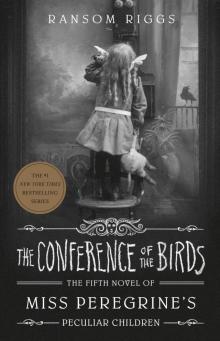
The conference of the bi.., p.26
The Conference of the Birds,
p.26


It made a soft pop. I felt a sharp pain in my side, and as I tumbled to the floor I heard a second one—
He had shot Noor.
I couldn’t get up.
I grabbed my side. Something was sticking out.
A dart.
I felt searing pain as darkness clouded my sight.
Then, in a moment, or a minute—I don’t know how long it was—I felt rain on my face.
We had been dragged outside.
I forced my eyes open. Willed my vision to focus. I was handcuffed to the porch railing, and next to me, Murnau was cuffing Noor. She was limp, her eyes half closed.
V lay facedown in the yard, out in the grass. The sky churned.
I managed to slur out a few words. “You’re not . . . going to kill us?”
“Unfortunately, I won’t have the pleasure. Orders from the boss.” He finished cuffing Noor, then glanced over his shoulder at V. “He wants you to watch. And then feel what it’s like to have a loop collapse on you.”
“It’s not . . . going to work,” I said slowly. “You don’t even . . . have the right in . . . gre . . . dients.”
He looked like he’d just remembered something. “Oh, that’s right. You children still think—”
He laughed—then I heard a thwip! and he winced and bent over. The shaft of an arrow was sticking out of his thigh.
He growled and whipped around to face V.
She was propped up on one elbow, covered in blood, holding a compact crossbow that she had somehow concealed.
She fired again. This arrow went into Murnau’s shoulder.
He grunted. Raised his gun and shot her again.
She dropped the crossbow and collapsed.
Noor moaned.
Murnau turned back to look at us. “As I was saying”—he grimaced but seemed barely distracted by the pain—“Bentham thought he could fool us with a bad translation. But we saw right through his ruse. The Apocryphon’s original text doesn’t mention a mother of birds. There isn’t any such thing. What it calls for is the still-beating heart of the mother of storms.” He tossed away his revolver. Unslung the leather bag from his shoulder and drew out a long knife.
“Speaking of which, I’d better get to work.”
He hobbled off toward where V lay in the grass.
The sky was a chaos of funneling clouds.
I tried to shout, to call Noor’s name—to turn my head and look at her—but I could not.
My vision tunneled. The world spun.
When the blackness briefly peeled away, I saw Murnau hunched over V’s prone form. His arm was pistoning up and down.
Then darkness again, until I felt something slapping my face. Leaves, grit. And I heard what sounded like a freight train. With great effort, I lifted my eyelids.
The tornado was devouring a giant tree across the street, and its branches whipped as if possessed by some devil. Its roots were coming up out of the ground like arms—and Murnau was walking straight toward it. He had the bag slung over his shoulder and something small and dark gripped in his hand, which was raised in triumph.
Just before he was swept away, he stopped and turned back to look at us, and I swear I saw him grinning.
And then he was lifted up by the wind, and he was gone.
I may have blacked out again. What I remember next was a bank of vibrant yellow clouds coalescing toward the funnel of the tornado, gathering into a conical spike that pointed up into the sky. The tree had been ripped whole from the ground, and it hovered there, spinning gently, a hundred feet from the ground, in the center of the funnel.
There was a low moaning that grew louder and louder until it threatened to break my head. It sounded almost like human speech slowed down, a voice inside the wind speaking unintelligible vowels that rose and fell in long waves. The yellow spike of cloud thickened and merged with the levitating tree, and then the clouds around it took a shape, holographically vivid.
It was a face.
A face I knew.
And then its mouth opened, and in a slow, rolling thunderclap, the sky uttered my name.
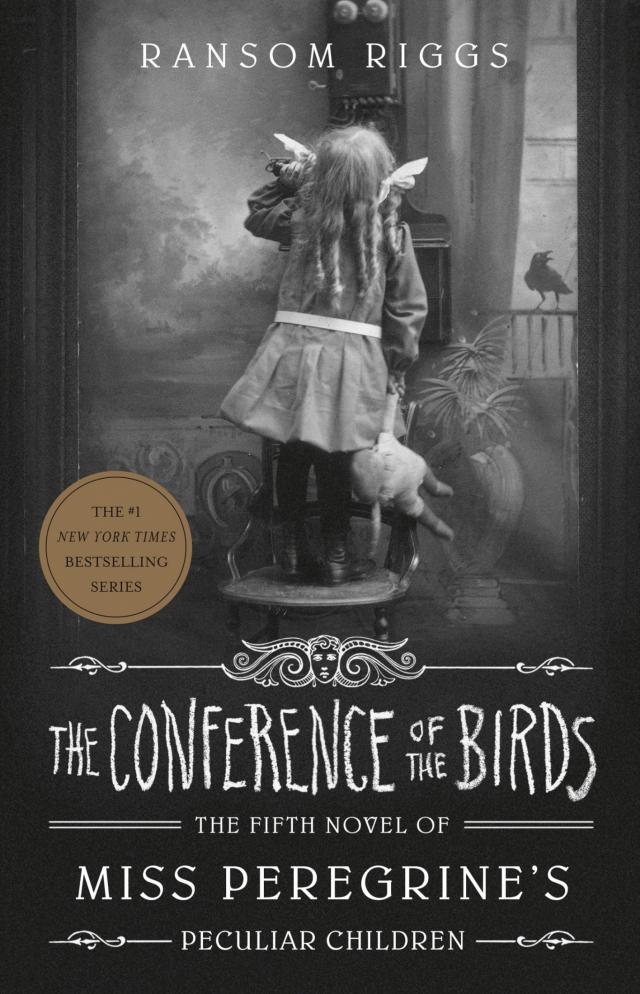
The little girl had been deeply asleep when Pensevus began whispering to her. She did not know how long it had been, but by the time her eyes blinked open, her head was full of nightmares.
She knew just what she had to do.
The little girl rose to her feet and crossed the room.
Pensevus kept whispering. (He almost never stopped whispering.) She carried him dangling from one hand. (She carried him everywhere.)
She had only used the telephone once before, but Pensevus told her just what to do.
He always told her what to do.
She pulled a chair out from the corner and placed it below the telephone, then climbed it so she could reach the receiver.
She made six calls, one after the other. Her task was not even complete when the first ymbryne alighted on the sill of her open window.
When each call was answered, she said only one thing.
“He’s back.”
ABOUT THE PHOTOGRAPHY
The images that appear in this book are authentic, vintage, found photographs, and with the exception of a handful that have undergone a bit of digital processing, they are unaltered. They were painstakingly collected over the course of several years: discovered at flea markets, vintage paper shows, and in the archives of photo collectors more accomplished than I, who were kind enough to part with some of their most peculiar treasures to help create this book.
The following photos were graciously lent for use by their owners:
LOCATION
TITLE
FROM THE COLLECTION OF
1
Hattie
Jack Mord / The Thanatos Archive
2
Breedlove
John Van Noate
3
Horse-drawn hearse
John Van Noate
4
LaMothe
Jack Mord / The Thanatos Archive
5
Ellery
John Van Noate
6
Elsie
Billy Parrott
7
Josep
Billy Parrott
8
Cyclone
Jack Mord / The Thanatos Archive
9
Girl on phone
Billy Parrott
About the Author
Ransom Riggs is the #1 New York Times bestselling author of the Miss Peregrine’s Peculiar Children novels. Riggs was born on a farm in Maryland and grew up in southern Florida. He studied literature at Kenyon College and film at the University of Southern California. He lives in Los Angeles with his wife, bestselling author Tahereh Mafi, and their family.
What’s next on
your reading list?
Discover your next
great read!
Get personalized book picks and up-to-date news about this author.
Sign up now.
Ransom Riggs, The Conference of the Birds